
Sensor Tap India: Touchless & Automatic Faucets for Homes (2026 Guide)
How infrared sensor taps actually work, battery vs mains power, the hygiene and water-saving payoff, and why hard water is the real test — plus temperature limits, where a touchless faucet belongs, install, maintenance and honest rupee ranges.
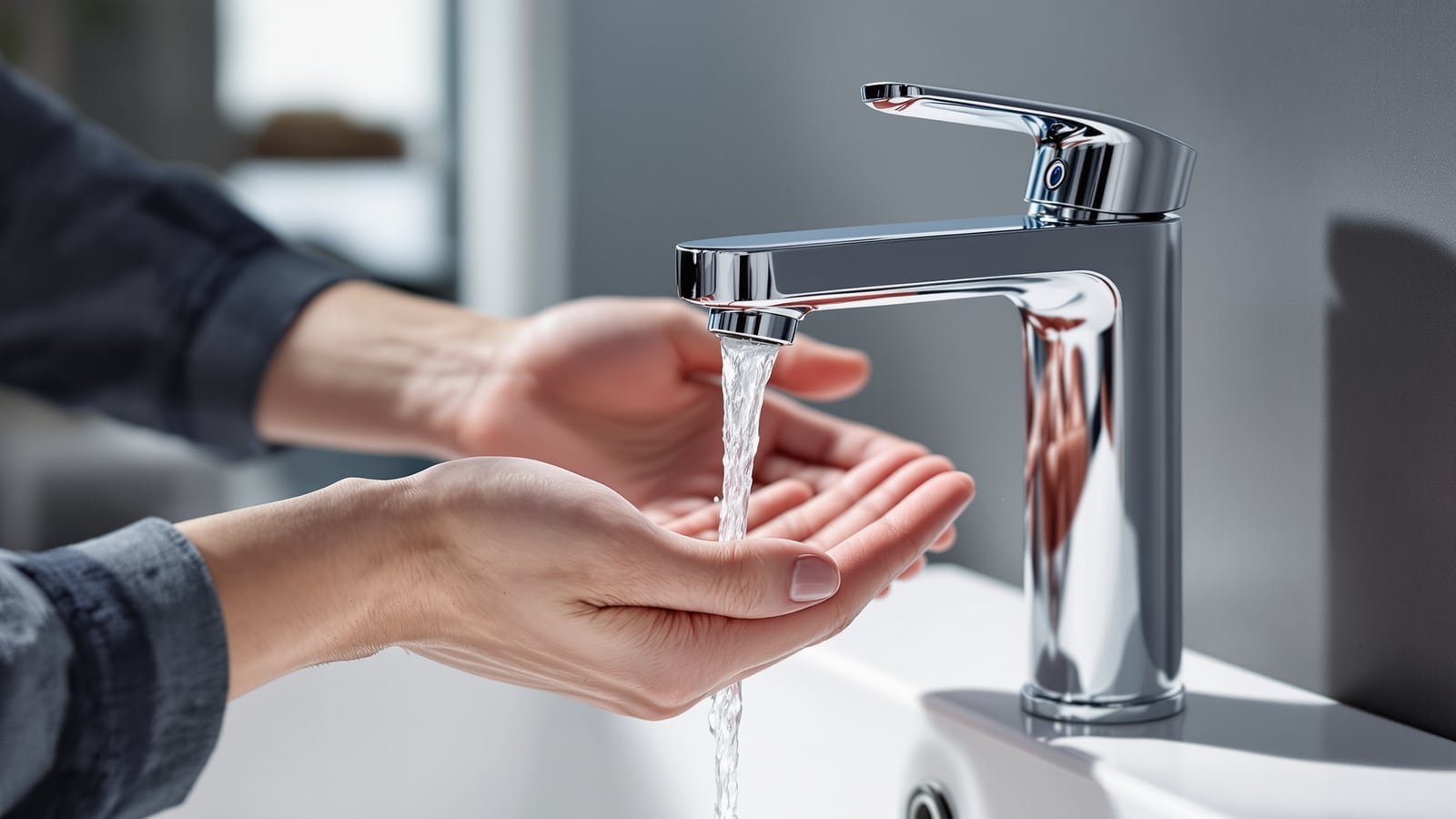
Wave a hand under the spout and water flows; take it away and the water stops. A sensor tap — also sold as a touchless, automatic, hands-free or infrared faucet — removes the one thing every ordinary tap forces on you: touching a handle with dirty, soapy or wet hands, then touching it again to turn off. In a country where the same washbasin is shared by a whole family and a guest bathroom sees a dozen strangers a week, that single change has a real hygiene and water-saving payoff. But sensor taps also fail in ways a plain pillar cock never will, and in Indian water they fail faster than the glossy showroom demo suggests.
This guide is India-first: how the sensing actually works, the battery-versus-mains decision that trips up most buyers, honest rupee ranges, and — most important — why hard water and load-shedding decide whether a touchless faucet is a delight or a fortnightly annoyance. Read it alongside the bathroom faucets guide for India for the full tap landscape, the water-saving faucet guide for flow-rate strategy, and the smart bathroom guide if the sensor tap is one piece of a larger automated bathroom.
A sensor tap is a small electronic appliance plumbed into your wall. Judge it like an appliance — power source, water quality, spare parts and service — not like a piece of brassware you buy once and forget.
How an infrared sensor tap works
Almost every domestic sensor tap uses active infrared reflection, not motion or heat. A small infrared LED just below the spout throws an invisible beam; a photodiode next to it watches for the reflection. When your hands enter the zone, the beam bounces back, a tiny controller (solenoid valve) opens, and water flows. Pull your hands out, the reflection disappears, and after a short delay the valve shuts.
- Sensing range is factory-set, usually 5–20 cm, some models adjustable. Too long and it triggers on the basin itself or a passing sleeve; too short and you have to hunt for the sweet spot.
- The solenoid valve is the heart of the tap — an electrically operated valve that does the actual opening and closing. It is also the part most sensitive to grit and scale.
- A control board manages the delay, an auto-off safety cut (typically 30–60 seconds of continuous flow) and, on better units, a self-adjusting range that ignores a fixed reflective background.
- Flow is set by an inline aerator or flow regulator, commonly 2–6 litres per minute (LPM) — the same restrictor logic covered in the water-saving faucet guide.
Because the sensor only sees reflection, a matt-black basin, a very dark or mirror-glass surface, or bright sunlight falling directly into the sensor can all confuse cheaper units. It is worth testing the actual tap over your actual basin colour before committing to six of them.
Battery vs mains: the decision that trips up most buyers
Every sensor tap needs power. There are two ways to feed it, and picking wrong is the single most common regret.
- Battery-powered taps run on 4 x AA or a 6V lithium pack hidden in the base or under the counter. No electrician, no wiring, no dependence on the grid. Batteries typically last 1–2 years at domestic use, less in a busy guest loo. When they die the tap simply stops — so a low-battery LED matters.
- Mains-powered taps run off a low-voltage transformer (usually 6V or 9V DC) plugged into a 230V point, stepped down so no mains voltage ever reaches the spout. No batteries to change, but you need a switched socket near the basin and, honestly, most Indian bathrooms were never wired for one.
The Indian twist is load-shedding. A mains-only tap goes dead every time the power does — precisely when you most want to wash your hands without fumbling. The safest domestic choice is often a battery tap, or a mains tap with battery backup. If you go mains, the socket must be on a residual current device (RCD/ELCB) and comply with the electrical safety intent of IS 732, sited outside the wet zone.
| Factor | Battery-powered | Mains + transformer |
|---|---|---|
| Wiring needed | None — DIY-friendly | Switched 230V point + RCD near basin |
| Works in load-shedding | Yes | No (unless battery backup) |
| Ongoing task | Change batteries every 1–2 yrs | None |
| Best for | Retrofit, guest bath, most homes | New build, high-traffic, commercial |
| Failure mode | Tap stops when battery dies | Tap dead during power cut |
| Typical extra cost | Batteries ~₹300–600/change | Wiring + socket ₹1,500–4,000 |
Hygiene and water saving — the real payoff
The case for a touchless faucet rests on two genuine benefits.
- Hygiene. You never touch the tap with contaminated hands, so the handle — normally one of the germiest points in a bathroom — is eliminated. In a shared family basin or a guest washroom this meaningfully cuts cross-contamination, which is why hospitals and airports standardised on them.
- Water saving. Water flows only while hands are present and stops the instant they leave, killing the litres wasted while you soap up, brush or shave with a conventional tap running. Combined with a low-flow aerator, a sensor tap can cut basin water use by 30–50%. That efficiency contributes to the fittings credits under IGBC Green Homes and GRIHA, and pairs naturally with the wider approach in the water-saving faucet guide.
The water saving is real but conditional: it comes from the auto-off, not the sensor itself. A sensor tap left with a slow-responding valve, or one people keep waving at, can waste as much as a handle tap. The aerator and a crisp shut-off delay do the actual saving.
The hard-water problem — India's real test
This is where showroom promises meet Indian reality. Most of India runs on hard, high-TDS water, and the sensor tap's two weak points are exactly the ones hard water attacks:
- The solenoid valve has a fine internal orifice and a moving diaphragm. Scale builds up, the diaphragm sticks, and the tap starts dribbling after shut-off, responding slowly, or refusing to open at all.
- The aerator and inline filter clog with scale and grit, throttling flow until the stream is a sad trickle.
Practical defences: fit an inline strainer/filter on the supply (many taps ship with one — never remove it), choose a model with a serviceable solenoid rather than a sealed throwaway unit, and if your area is very hard, treat a water softener or at least the aerator as a maintenance consumable. Clean the aerator every 1–3 months. Assume a sensor tap in hard water needs more attention than any handle tap, and buy from a brand whose spares (solenoid, aerator, sensor module) you can actually get locally — this is where brand-neutral names like Jaquar, Hindware, Cera or Kohler matter only insofar as their service network reaches your town.
Temperature control limits
Be clear-eyed about hot water. Most affordable sensor taps are single-temperature — they deliver whatever the connected supply gives, with no mixing. Options, in rising cost:
- Cold-only or single-supply — the common, cheapest case; fine for a guest or powder-room basin.
- Manual mixing valve behind/beside the tap — you preset a blend once; the sensor still only starts/stops flow.
- Thermostatic sensor mixer — a true mixed, temperature-limited touchless tap; premium, and the safest around children and the elderly because it caps scald risk.
If you want warm water at a touchless basin, budget for a mixing or thermostatic model — do not expect a ₹3,000 sensor tap to blend it.
Where a touchless faucet actually suits
Sensor taps are not an everywhere upgrade. They earn their premium in specific spots.
- Guest and powder rooms — strangers, no handles to touch, and cold-only is perfectly acceptable.
- Children's basins — no handle to leave running, and a thermostatic model removes scald risk; see the children's bathroom guide.
- Elderly and accessible bathrooms — no grip or twist needed, a boon for arthritic hands, as covered in the elderly-friendly and accessible bathroom design guides.
- Commercial and shared washrooms — offices, clinics, restaurants: hygiene and vandal-resistance justify mains units with battery backup.
They suit less in a busy master bathroom where you fill buckets, hand-wash clothes or need sustained hot flow — the auto-off and single temperature become a nuisance. A conventional or single-lever mixer is often the better master-basin choice.
Install, cost and maintenance
Installation is close to a normal pillar or wall-mounted tap plus the electrics. Key points:
- Fit the standard G 1/2" connections and the supplied inline filter; flush the line before connecting so construction grit does not reach the solenoid.
- Keep the control box and battery pack accessible under the counter — not sealed behind tile — because you will service them.
- For mains units, the transformer and socket go in a dry, ventilated spot with RCD protection, never inside the shower/wet zone.
- Set the sensing range to suit the basin, then test for false triggers off the basin surface.
| Item | Typical India range (₹) |
|---|---|
| Entry battery sensor basin tap | 2,500 – 5,000 |
| Mid-range serviceable battery/mains tap | 5,000 – 12,000 |
| Premium / thermostatic sensor mixer | 12,000 – 35,000+ |
| Mains wiring + RCD socket (if new) | 1,500 – 4,000 |
| Battery replacement (each change) | 300 – 600 |
| Aerator / solenoid service part | 200 – 1,500 |
Maintenance is the honest catch: budget an aerator clean every 1–3 months, a battery change every year or two, and a solenoid or sensor-module swap somewhere in a 3–6 year life. Do that and a sensor tap stays a pleasure. Ignore it, and hard water turns it into the tap nobody wants to use.
References
- National Building Code of India (NBC) 2016, Part 9 (Plumbing Services) — water supply and sanitary fittings.
- IS 8934 — sanitary fittings / pillar taps and cocks (dimensional and performance requirements).
- IS 1172 — code of basic requirements for water supply, drainage and sanitation.
- IS 732 — code of practice for electrical wiring installations (low-voltage supply and RCD/ELCB protection for the transformer/socket).
- IGBC Green Homes and GRIHA — water-efficiency credits for low-flow and auto-shutoff fittings.
- CPHEEO Manual on Water Supply and Treatment, Ministry of Housing & Urban Affairs — water quality and demand norms.
Export this guide
Related Guides — Deep-dive reading
Bathroom Faucets India: The Complete Guide to Taps, Cartridges, Finishes & Flow (2026)
Every faucet type explained for Indian bathrooms — pillar taps, basin mixers, single-lever vs two-handle, wall vs deck vs concealed, sensor and thermostatic — plus the ceramic-disc cartridge that survives hard water, CP-fitting quality to IS standards, finishes, aerators and honest rupee ranges.
BathroomsSmart Water Monitoring India: Track Bathroom Usage, Catch a Running Toilet, Cut the Bill (2026)
A clamp-on or inline flow sensor turns your water line into a dashboard — litres per shower, a toilet that never stops filling, a hidden drip you would never hear. This is the honest India-first guide to smart water monitoring: how sensors meter each fixture, the apps and alerts, tie-ins with auto shut-off valves, and the real rupee cost against the bill it saves.
BathroomsDigital Shower India: Smart App-Controlled Showers, Presets, Costs & Whether It's Worth It (2026)
A digital or smart shower sets an exact temperature and flow from a control panel or phone app, with the mixing brain hidden in the ceiling or wall. How they work, presets per user, remote start and warm-up-pause water saving, the electrical and plumbing you need, and the hard-water and voltage caveats that decide whether it survives an Indian bathroom.
BathroomsRelated Tools — Try Free
Electrical Safety & Load Audit
Home electrical audit — 10 categories, 65+ checkpoints across earthing, RCCB, MCB, wiring, switchboards, appliance circuits, DG/inverter backup.
Safety AuditWater Softener Size Calculator
Size a water softener from your hardness, daily water use and days between regeneration, with the grain capacity needed.
Plumbing CalculatorBefore vs After — Cost Reality Check
Compare what you expected to pay vs what you actually paid, category by category.
Reality Check