
Water Saving Faucet India: Aerators, Flow Restrictors & Efficient Taps
How water-efficient faucets and retrofit aerators cut basin flow from 12-15 down to 4-6 litres per minute with no felt loss of pressure — foam vs spray aerators, pressure-compensating flow, IGBC and GRIHA credits, and the real payback on water and geyser energy.
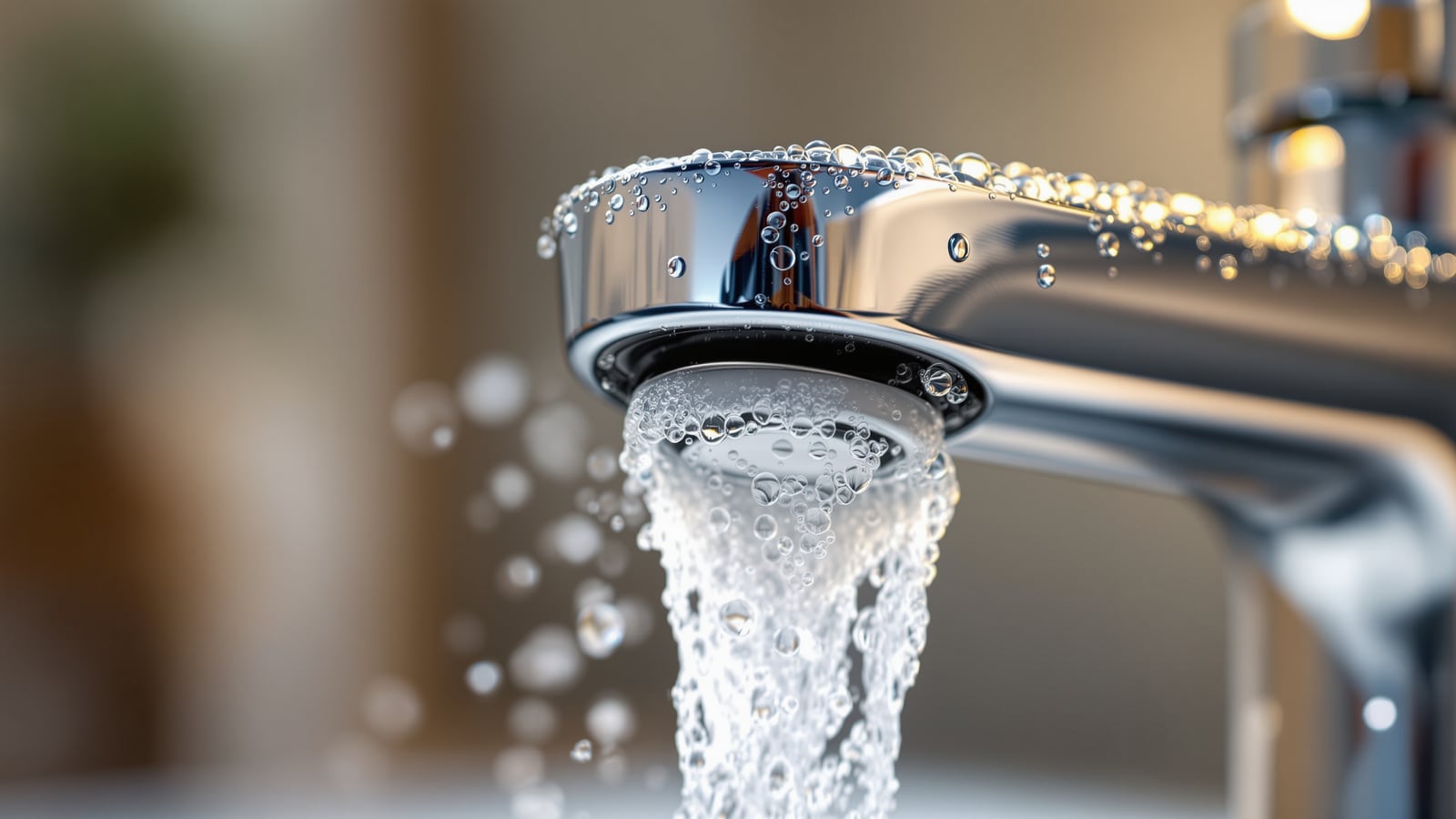
Open a typical old pillar tap in an Indian home and it will pour out 12 to 15 litres a minute — far more than any hand can actually use to wash. Most of that water simply falls past you, straight down the drain, and if it is coming off a geyser you are paying to heat it as well. The single cheapest, fastest fix in the whole bathroom is not a new tap at all: it is the small mesh nozzle screwed into the spout, the aerator. Swap or upgrade it and the same tap delivers a full, satisfying wash at 4 to 6 litres a minute, with no felt loss of pressure.
This is the water-saving faucet guide of the Studio Matrx bathroom hub. Read it alongside the complete bathroom faucets guide for India for tap types, cartridges and finishes, and the eco-friendly bathroom guide for how faucets fit into a whole-house water strategy. If you want taps that turn themselves off, see the companion piece on sensor faucets for India.
The aerator is the highest return-on-rupee upgrade in any bathroom: a ₹150-500 part that halves the water and hot-water bill of every tap it touches, installed in two minutes with no plumber.
How an aerator actually saves water
An aerator does two things at once. It restricts the opening the water passes through, and it draws in air to mix with the stream. The air is the clever part: instead of a thin, hard jet that feels weak, you get a soft, fatter, white column that covers your hands and feels like more water than a bare restrictor would. That is why a well-chosen 6 LPM aerated tap feels as good as a wasteful 12 LPM open bore — your skin cannot tell the difference, but the water meter can.
A flow restrictor is the simpler cousin: a small washer or disc with a calibrated hole that caps flow without adding air. Restrictors are cheaper and thinner, but the stream feels harder and more jet-like. In practice most modern water-saving faucets combine both — a restrictor to set the ceiling and an aerator to make the reduced flow feel generous.
The numbers below show why the fitting, not your restraint, does the heavy lifting.
| Fitting on a basin tap | Typical flow (LPM) | Feel | Water used per 30-sec wash |
|---|---|---|---|
| Old open pillar tap, no aerator | 12-15 | Gushing, wasteful | ~6-7.5 litres |
| Standard aerator (as sold) | 8-10 | Full, strong | ~4-5 litres |
| Water-saving aerator | 5-6 | Full, aerated | ~2.5-3 litres |
| High-efficiency / eco aerator | 3-4 | Softer, adequate | ~1.5-2 litres |
| Spray / laminar aerator | 1.5-4 | Fan of fine jets | ~1-2 litres |
For a basin you use for hand-washing, brushing and shaving, a 4-6 LPM aerator is the sweet spot: barely noticeable in daily use, roughly half the water. Drop to 2-4 LPM only where the tap is used lightly, such as a guest cloakroom or powder room.
Foam, spray and laminar: the three stream types
Not all aerators produce the same stream, and matching the type to the tap matters more than the headline flow number.
- Foam (aerated) aerator. The classic bubbly white stream. Air is whipped in so the water feels soft and splash-free. Best all-rounder for basin mixers and pillar taps. Splashes least in a shallow washbasin.
- Spray aerator. Breaks the flow into a fan of many fine jets, like a tiny shower rose. Feels light and covers a wide area, so it rinses hands and soap fast at very low flow (down to 1.5 LPM). Can feel cool in winter because the fine droplets lose heat, and it splashes more in a small basin.
- Laminar-flow aerator. Produces a clear, non-aerated, crystal-like column with no bubbles. It splashes very little, stays warmer, and — because it does not mix in room air — is preferred in hospitals and clinics where aerated streams can harbour bacteria. Slightly higher flow than a foam type for the same feel.
For a normal home basin, choose a foam aerator first. Use spray where you want the lowest possible flow and the basin is deep enough to catch it. Reserve laminar for healthcare or where water quality is a concern.
Retrofit: the cheapest water saving there is
You almost never need to replace a whole faucet to save water. Nearly every tap sold in India has a threaded aerator housing at the spout tip — male (M22, ~22 mm) or female (M24, ~24 mm) thread. Unscrew the old aerator with your fingers or a cloth-wrapped plier, take it to the shop to match the thread, and screw in a water-saving replacement. Two minutes, no plumber, no wall-breaking.
- Cost of a retrofit aerator: ₹120-500 each for a good brass-bodied unit; cheap plastic ones from ₹40 but they clog and crack faster.
- Adjustable / vandal-proof types cost ₹400-900 and let you dial the flow or lock it.
- Compare that to ₹2,500-9,000 for a new water-efficient mixer. The aerator captures 80% of the saving for 5% of the cost.
Because retrofit is so cheap and reversible, do it to every tap in the house on a single Sunday. That is the fastest water-and-energy win available to any Indian household, renter or owner.
Pressure-compensating aerators for apartments
In a multi-storey apartment, mains pressure varies wildly — the ground floor may see 3-4 bar while the top floor gets a trickle. An ordinary aerator's flow rises and falls with that pressure, so the lower floors gush and waste. A pressure-compensating aerator contains a flexible O-ring that squeezes the opening tighter as pressure rises, holding a near-constant flow (say 6 LPM) across roughly 1-8 bar. Fit these where supply pressure is high or inconsistent — they cost a little more (₹350-800) but guarantee the saving no matter which floor you are on.
| Aerator type | Flow behaviour | Best for | Approx cost |
|---|---|---|---|
| Standard foam | Rises with pressure | Steady municipal / OHT supply | ₹120-350 |
| Adjustable | You set the flow | Mixed-use taps | ₹400-900 |
| Pressure-compensating | Constant across pressure | High-rise, variable pressure | ₹350-800 |
| Spray / low-flow eco | Very low, fan spray | Guest / light-use basins | ₹200-600 |
The payback: water and geyser energy
The saving is not only water. Roughly a third of what a basin tap dispenses in the cooler months is hot water off a geyser, so every litre you do not pour is also energy you do not spend heating. That is the hidden second dividend of a water-saving faucet.
A rough four-person household calculation:
- Cutting one basin tap from ~12 LPM to ~6 LPM saves on the order of 15,000-25,000 litres a year.
- Across three or four taps in a home, that is comfortably 50,000-90,000 litres a year — a meaningful dent in a metered or tanker-fed water bill.
- The share of that which was heated water represents perhaps 100-250 units of electricity saved annually on the geyser, depending on usage and season.
- Payback on a ₹300 aerator is measured in weeks, not years — arguably the best-returning fitting in the entire home.
For the whole-house picture — dual-flush WCs, efficient showers and greywater — see the eco-friendly bathroom guide.
Green ratings: IGBC and GRIHA credit
Water-efficient fixtures are not just a bill saving — they earn points under India's green-building systems. IGBC (Green Homes and Green New Buildings) awards water-efficiency credits for fittings that beat a baseline flow, typically rewarding basin taps at or below ~5.7 LPM and showers at reduced flow. GRIHA similarly scores reduced water demand. Under the water-conservation intent of NBC 2016, low-flow fittings are the simplest compliance lever. If you are chasing a rating, specify the aerator flow rate in the fixture schedule and keep the datasheets — the certified LPM at a stated test pressure (usually 3 bar) is what auditors want to see.
Living with a low-flow faucet: hard water and upkeep
India's hard water is the aerator's main enemy. Calcium scale builds on the fine mesh and slowly chokes the flow until the stream sputters and splits.
- Clean the mesh every 1-3 months. Unscrew the aerator, soak it overnight in warm white vinegar or a mild descaler, brush off the scale, rinse and refit. This restores flow and is far easier than people expect.
- Prefer brass-bodied aerators over plastic in hard-water areas — they thread more reliably and last longer.
- Do not judge low flow as a fault. A common mistake is to "fix" a sputtering aerator by removing it entirely, undoing the whole saving. Descale it instead.
- Match thread and gender when buying: M22 male and M24 female are the two common Indian sizes; take the old one to the shop.
- Whole-house softening helps if scale is severe, protecting geyser, taps and showers together.
Do and don't
| Do | Don't |
|---|---|
| Retrofit aerators to every tap first | Assume you must buy new faucets to save water |
| Choose foam aerators for basins | Use a hard spray jet in a shallow basin (splashes) |
| Fit pressure-compensating types in high-rises | Ignore floor-to-floor pressure swings |
| Descale the mesh every 1-3 months | Remove the aerator to "improve" a sputtering flow |
| Keep the LPM datasheet for green ratings | Guess the flow rate for IGBC/GRIHA claims |
A water-saving faucet is the rare upgrade with no downside: it costs little, installs in minutes, needs no wall-breaking, feels the same in the hand, saves water and geyser power at once, and helps a green rating along the way. Start with a Sunday of aerator swaps, then specify low-flow fittings from the outset in any new bathroom or renovation.
References
- NBC 2016 (National Building Code of India), Part 9 Plumbing Services — water supply and water conservation provisions.
- IS 8931 — Copper alloy single-taps, pillar taps, angle stop cocks and stop valves for water services.
- IS 1172 — Code of basic requirements for water supply, drainage and sanitation.
- IGBC Green Homes / Green New Buildings rating — water efficiency credits for low-flow fixtures (Indian Green Building Council).
- GRIHA (Green Rating for Integrated Habitat Assessment) — reduced water demand criteria.
- CPHEEO Manual on Water Supply and Treatment — demand and conservation benchmarks.
Export this guide
Related Guides — Deep-dive reading
Bathroom Faucets India: The Complete Guide to Taps, Cartridges, Finishes & Flow (2026)
Every faucet type explained for Indian bathrooms — pillar taps, basin mixers, single-lever vs two-handle, wall vs deck vs concealed, sensor and thermostatic — plus the ceramic-disc cartridge that survives hard water, CP-fitting quality to IS standards, finishes, aerators and honest rupee ranges.
BathroomsLow Flow Shower Head India: Aerating vs Laminar vs Pulse, Feel & Payback
How a water-saving low-flow shower head cuts flow from 12-15 down to 6-8 litres per minute while keeping a full, warm feel through air infusion — aerating vs laminar vs pulse types, the geyser-energy saving, the gravity-fed pressure caveat, retrofit vs new, IGBC and GRIHA credits, and the real payback.
BathroomsPlumbing Systems: The Ultimate Guide for Indian Homes & Buildings
The wide-angle pillar for the Studio Matrx Plumbing Knowledge Hub — what plumbing is, the two halves of every system (water supply and drainage/DWV), the whole-house water journey from source to fixture to drain, the main system types, and where conservation, building services and maintenance fit — with links down to every deeper guide.
PlumbingRelated Tools — Try Free
Green Building Water Score Calculator
Score a building's water efficiency 0–100 from treated-water reuse, rainwater harvesting, low-flow fixtures and metering, with an IGBC/GRIHA-style rating and your biggest improvement lever.
SustainabilityRenovation vs New Build Calculator
Compare renovating vs building new interiors city-wise across 13 work scopes with GST and per-sqft rates.
Cost ComparisonShower Water Flow Calculator
Shower water use per shower, day and month by head type, plus a pressure-adequacy check for your tank height or pump and low-flow savings.
Bathroom Calculator