
Security Cost Per Apartment in India (2026): The Per-Flat Budgeting Metric
How a housing society, RWA, builder or apartment buyer works out the security cost per apartment — dividing shared perimeter, gate, guard, CCTV and access infrastructure across the number of flats, adding each flat's own door security, and separating one-time capex from the recurring guarding and AMC opex that maintenance charges actually fund.
Ask a builder, a resident welfare association (RWA) or a prospective buyer what security costs, and you will get answers that range from a lock-shop quote for one door to a lakhs-large tender for a whole tower. Both are right, and both are useless on their own, because they are answering different questions. The metric that a housing society, an RWA committee, a developer or an apartment buyer actually needs is security cost per apartment — the per-flat share of a complex's security, expressed as a number you can put in a budget, compare across projects, and explain to residents whose money it is.
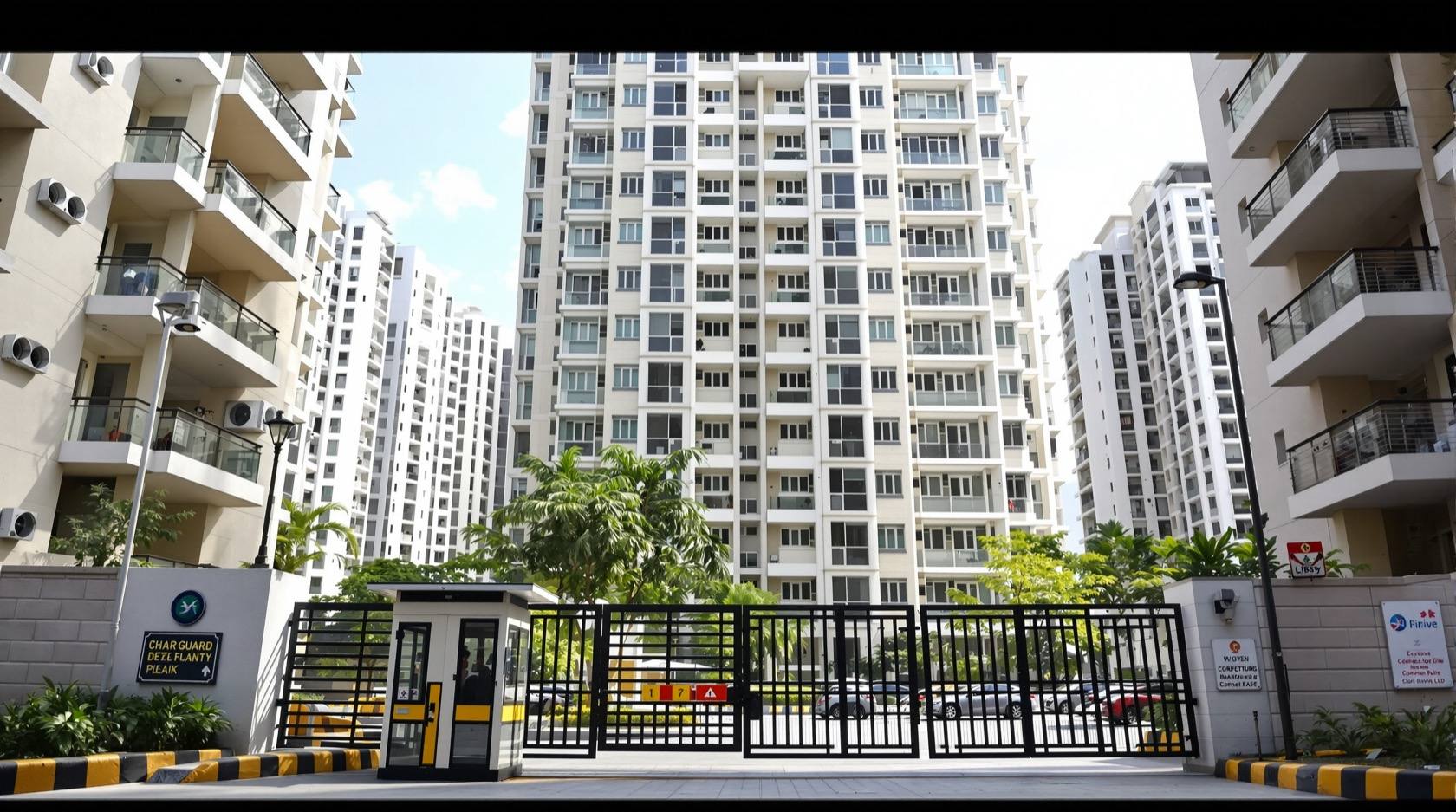
The reason a per-apartment figure is meaningful, and not just an accounting trick, is the nature of residential security itself. A tower's protection is overwhelmingly shared infrastructure: one perimeter wall, one or two gates, a boom barrier, a guardhouse, a team of guards, common-area CCTV, a visitor and access-control system, intercoms, and the fire and life-safety systems the building code demands. That total cost is borne by the whole society and then, in effect, divided across every flat — through a one-time contribution or the sinking fund for capex, and through monthly maintenance charges for the running cost. On top of that shared share sits each flat's own private spend: the front-door lock and the video door phone inside the apartment.
This guide is about doing that division honestly. It separates one-time capex from recurring opex (the running cost is the one buyers forget, and in a residential society it is the larger number over any real horizon), it shows why the per-apartment figure falls sharply as the number of flats rises, and it gives wide indicative bands that you must always treat as a starting point for quotes — never as a price.
Scope & how to read the numbers. This is a planning and budgeting guide for RWA committees, society managers, developers, architects and buyers — not an installation manual and not a quotation. Every rupee band here is a wide, indicative ballpark to verify locally; get at least three written, itemised quotes before you commit, and read them against the cost drivers named alongside each band. Prices move with time, city, spec, brand and site. GST is extra on both equipment and services. Keep capex (one-time hardware and installation) firmly separate from opex (guards, AMC, monitoring, storage, electricity) — in a society, opex is the number that recurs every month for the life of the building. Common-area CCTV and access logs hold personal data under the DPDP Act 2023 (the RWA is the data fiduciary); guards must come through a PSARA 2005-licensed agency on lawful wages; and fire and life-safety and egress are non-negotiable and code-governed under NBC (SP 7:2026) — never cut them to make a per-flat number look smaller.
What "per apartment" actually means
The per-apartment number is a division. To read it correctly you have to see the three things that go into it, because they behave completely differently.
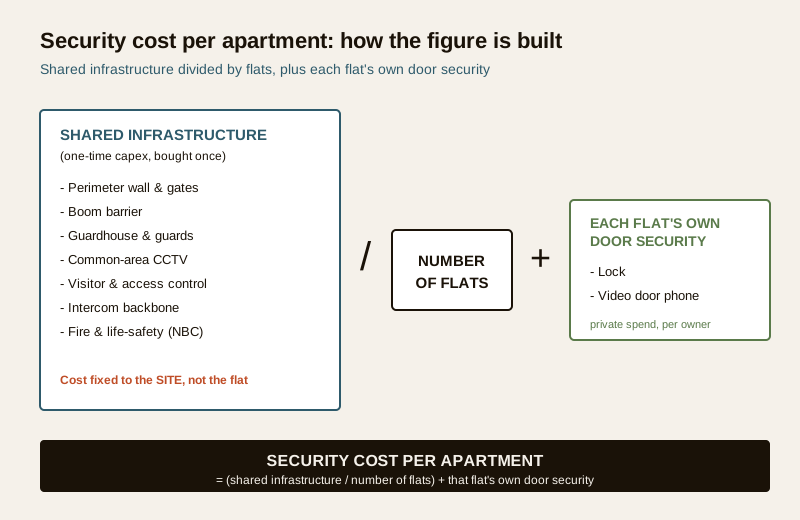
- Shared capex (one-time). The physical infrastructure the whole society buys once: the perimeter wall and gates, the boom barrier, the guardhouse structure, the common-area camera network and its recorder and storage, the visitor and access-control system at the gate and lobbies, and the intercom backbone. Divided across the flats, this is the per-apartment one-time share.
- Shared opex (recurring — the big one). The cost that never stops: the guards' wages (usually the single largest line by far), the AMC on cameras, gates, intercom, access control and fire systems, any central-monitoring or CCTV-cloud subscription, plus the electricity and consumables to keep it all running. This is funded from monthly maintenance charges and, divided across the flats, is the per-apartment monthly share.
- Per-flat private spend. What each owner spends inside their own front door — the lock (mechanical, digital or smart) and the video door phone indoor unit. This is not shared; it is the individual apartment's own security budget, and it varies with the owner's taste and risk appetite, not the society's headcount.
So the honest formula is: per-apartment cost = (shared infrastructure ÷ number of flats) + that flat's own door security. The first term is a society decision funded collectively; the second is a private one. Confusing the two is the most common budgeting error in a residents' meeting — someone quotes a lakh-level camera tender against a single flat, or budgets a smart lock as if the society should pay for it.
Why the per-apartment figure falls as flats rise
The most important idea in per-flat budgeting is economies of scale. Because the biggest costs are shared and largely fixed to the site, not the flat, spreading them over more apartments makes each apartment's share smaller. A perimeter wall costs roughly what it costs whether it rings 20 flats or 200; a guard's monthly wage is the same regardless of how many families he protects; one gate, one boom barrier, one guardhouse serve the whole tower.
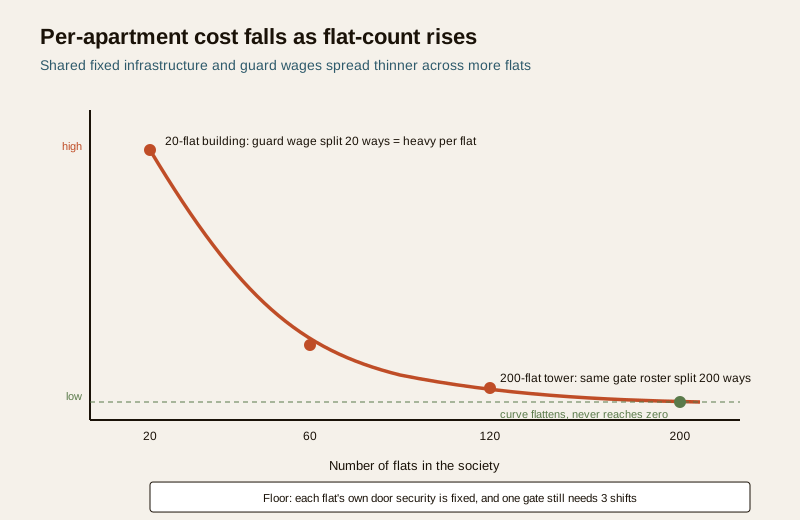
Consider the guarding line, which dominates opex. A three-shift, round-the-clock guard post needs roughly four to five guards to cover shifts, reliefs and weekly-offs lawfully. In a 20-flat building, that wage bill divided by 20 is a heavy monthly load on each flat. In a 200-flat tower, the same roster (a single gate still needs the same three shifts) is divided by 200 — a tenth of the per-flat burden. This is why small buildings often cannot afford round-the-clock guarding and share a guard, run a day-only post, or lean harder on gate automation and CCTV, while large complexes can fund multiple posts, patrols and a proper control room and still charge each flat less per month.
The curve flattens at the right, though, and it is honest to say why. Two things do not scale away: each flat's own door security is a fixed per-flat cost no matter how big the society is; and there is a floor to the guard roster — a single controlled gate needs its three shifts even in a mid-size building, so below a certain size you cannot divide the human cost any thinner without dropping the post. So very large societies enjoy a low per-flat share, but it never reaches zero.
The practical lesson for a committee: do not benchmark your per-flat cost against a differently sized society. A 40-flat building will and should have a higher per-apartment security cost than a 300-flat township, and that is economics, not mismanagement. For a complementary way to normalise across differently shaped projects, the security cost per square foot guide divides by built-up area instead of by flat, which developers often prefer at the design stage.
The one-time (capex) per-apartment share
Here is the shared capex a residential complex typically buys once, with the drivers that move each line, and a very wide indicative band for the total one-time spend expressed per flat after division. Treat these as ballparks to test against three quotes, not as prices.
| Shared capex item | What drives it up or down | Notes |
|---|---|---|
| Perimeter wall, gate(s), boom barrier | Boundary length, wall vs fence, number of gates, ANPR or plain barrier | Largely fixed to the site, not the flat count |
| Guardhouse / gatehouse structure | Size, toilet and water, whether it doubles as a control room | See the guardhouse cost guide |
| Common-area CCTV (cameras, recorder, storage, cabling) | Number of cameras, IP vs analog, resolution, retention days, backbone runs | The retention period quietly drives storage cost |
| Visitor and access control (gate readers, boom integration, app) | Boom-linked ANPR, RFID or app-based visitor management, lobby readers | See the access control system cost guide |
| Intercom / video-door backbone | Wired vs IP, number of lobby panels, integration with app | Society backbone only; the in-flat unit is private |
| Fire and life-safety systems | Building height and NBC occupancy requirements — code-governed, non-negotiable | Statutory; never a place to economise |
Indicative per-flat one-time (capex) share: for a typical Indian residential complex, the shared security capex divided across the flats commonly lands somewhere in a wide roughly ₹15,000 to ₹60,000 per flat band — pushed toward the low end by a large flat-count, a simple boom-and-analog-CCTV specification and a compact boundary, and toward the high end (or beyond) by a small society, a long perimeter, IP CCTV with long retention, ANPR, app-based access control and a proper control room. A premium, low-density gated community with elaborate infrastructure can sit well above this band; a large no-frills society well below it. The drivers, not the headline, tell you where you sit. On top of this shared share, each flat's own door security — a good lock plus a video door phone — is typically another wide roughly ₹8,000 to ₹40,000 per flat, depending entirely on whether the owner buys a basic deadbolt and an audio phone or a fingerprint smart lock and a large-screen video door phone. For the private-side detail, see the pillar, the home security system cost guide.
Get three itemised quotes — and read what a cheap one hides. A suspiciously low tender usually economises where residents cannot see it: fewer cameras than the coverage plan needs, short retention that loses last week's footage, no proper cabling or conduit, unbranded gear without warranty or AMC, or a guard headcount that cannot lawfully cover three shifts. Ask every bidder to itemise hardware, installation, cabling, taxes and the AMC separately, and compare like for like. The cheapest capex often carries the most expensive opex.
The recurring (opex) per-apartment share — where the monthly money goes
For a residential society, the running cost is the number that matters, because it is charged to every flat every month, forever, out of maintenance dues. And within it, one line dominates.
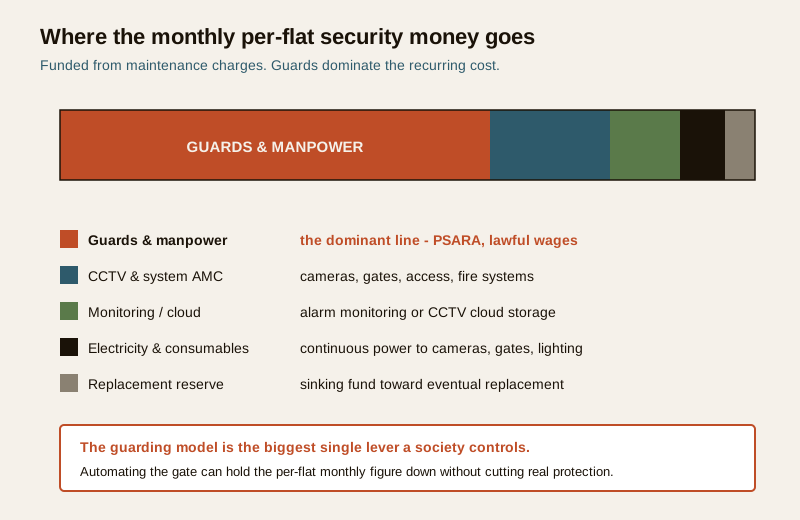
- Guards and manpower — the dominant line. In almost every Indian residential society, guarding is the largest recurring security cost by a wide margin, often the majority of the monthly security spend. It is set by the guarding model: how many posts, how many shifts, day-only versus round-the-clock, and the agency's rate — which under PSARA 2005 and minimum-wage law must reflect lawful wages, ESI/PF and statutory dues. A quote that undercuts on manpower is often quietly proposing to underpay guards, which is both unlawful and a false economy (high churn, no accountability).
- AMC on the systems. Annual maintenance contracts on the CCTV, gates and boom, access control, intercom and — critically — the fire and life-safety systems. A common budgeting figure is that annual AMC runs at a modest single-digit percentage of the equipment's capital cost; the fire-system AMC is not optional.
- Monitoring / cloud subscription. If the society uses central alarm monitoring or cloud CCTV storage, that recurring fee sits here.
- Electricity and consumables. Cameras, recorders, gates, lighting and the control room draw power continuously.
- A replacement reserve. Prudent societies set aside a little each month toward the eventual replacement of cameras, batteries and gates — a sinking fund so a failed NVR is not a sudden special levy. Thinking this way is lifecycle cost, covered in the security lifecycle cost guide.
Indicative per-flat monthly (opex) share: across the whole society, the recurring security cost divided per flat commonly falls in a wide roughly ₹300 to ₹1,500 per flat per month band — again driven mostly by the guarding model and the flat-count. A large tower running a single gate post spreads guarding thin and can sit at the low end; a small or low-density society insisting on round-the-clock multi-post guarding and patrols sits at the high end. The single biggest lever a society controls is the guarding model — the number of posts and shifts. Automating the gate (boom plus ANPR plus app-based visitor management) so fewer guards can safely cover more is often the most effective way to hold the per-flat monthly figure down without cutting real protection, because it replaces recurring wage cost with one-time capex.
Right-sizing to the society's real risk
The temptation in a residents' meeting is to swing between two poles: a fear-driven demand for everything, or a cost-driven demand for the cheapest bid. Neither serves the residents whose money it is. Right-sizing means matching the spend to the actual risk profile of this complex — its location, its history, its density, who passes the gate, and what residents genuinely value.
- Concentrate spend where risk concentrates. For a residential complex that is almost always the gate (who and what enters) and the perimeter (no easy way in around it). A controlled single gate with a boom, a maintained visitor log and good boundary integrity buys more real safety per rupee than scattering cameras. The apartment security guide works through the layered composition a society actually needs.
- The guarding model is the master lever. Because manpower dominates opex, the biggest budget decision is not which camera brand — it is how many guards, on how many shifts, doing what. Decide that against the risk, not against a neighbour's spec.
- Do not gold-plate the private side into the society budget. Smart locks and premium video door phones are wonderful, but they are each flat's own choice and each flat's own money. Keep them out of the shared tender.
- Never trade away life-safety. Fire detection, alarms, egress, extinguishing provision and the ability of a fire tender to reach the building are governed by NBC (SP 7:2026) and are non-negotiable regardless of budget. A society that skimps here is not saving money; it is deferring a catastrophe. For how to sequence and stage the whole spend sensibly, the security cost planning guide is the companion piece.
Transparency: it is the residents' money, collectively
A residential security budget has a feature no other security budget has: it is spent collectively, from many families' pooled dues, and those families are entitled to know how their money is used. That makes transparency not a nicety but a duty of the committee.
- Itemise the tender to residents. Show the community the capex breakdown and the monthly opex lines — guards, AMC, monitoring, electricity, reserve — so the maintenance charge is legible, not a mystery.
- The RWA is the data fiduciary. Common-area CCTV, ANPR plates, visitor logs and access records are personal data under the DPDP Act 2023. The society — as the entity that decides why and how the footage is captured — is the data fiduciary, responsible for who may view footage, how long it is retained, signage that cameras are in use, and not pointing cameras into private windows or homes. Budget for lawful, minimal, well-governed data handling, not maximal surveillance.
- Guards on lawful terms. Engaging guards only through a PSARA 2005-licensed agency paying statutory wages is both a legal duty and a value decision: lawfully-paid, properly-trained guards are the ones who actually stay and do the job.
Putting a per-apartment number together
To build your own figure, the sequence is simple and honest:
1. Get an itemised shared-infrastructure quote (three of them) for the capex the society needs, right-sized to real risk — perimeter, gate, guardhouse, common CCTV, access control, intercom, and the statutory fire and life-safety systems.
2. Divide the shared capex by the number of flats for the one-time per-apartment share. Expect it to be higher for a small society and lower for a large one.
3. Build the monthly opex — dominated by the guarding model, then AMC, monitoring, electricity and a replacement reserve — and divide by the flats for the per-apartment monthly share funded from maintenance charges.
4. Add each flat's own door security (lock and video door phone) as a separate private line — not part of the society tender.
5. Add GST on equipment and services, and read every band against its drivers, never in isolation.
Done this way, the per-apartment figure becomes what it should be: a transparent, comparable, defensible number that lets a committee budget fairly, a buyer ask the right questions, and every resident see that their share of the society's security is spent honestly and well.
Key takeaways
- Security cost per apartment = shared infrastructure ÷ number of flats, plus that flat's own door security. The first term is a collective society decision; the second is a private one — keep them separate.
- Separate capex from opex. In a society the recurring opex, funded monthly from maintenance charges, is the number that matters most over time — and guards dominate it.
- The per-flat figure falls sharply as flat-count rises because perimeter, gate and guard costs are largely fixed to the site — so never benchmark a small society against a large one.
- Indicative bands only: roughly ₹15,000–₹60,000 per flat one-time shared capex and roughly ₹300–₹1,500 per flat per month opex are wide ballparks — read them against their drivers and get three itemised quotes.
- The guarding model is the master lever; automating the gate can hold the monthly figure down without cutting real protection.
- Right-size to real risk, and never cut life-safety — fire, egress and fire-tender access under NBC (SP 7:2026) are non-negotiable.
- It is the residents' collective money — itemise it to them; the RWA is the DPDP data fiduciary for common-area CCTV, and guards must come through a PSARA-licensed agency on lawful wages. GST is extra.
Where to go next
- The pillar, the home security system cost guide, for the private-side and whole-picture cost view.
- The security cost per square foot guide — the same shared cost normalised by built-up area, which developers often prefer at design stage.
- The security cost planning guide and the security lifecycle cost guide — how to sequence spend and think in total cost of ownership.
- The guardhouse cost guide and the access control system cost guide — two of the biggest shared line items.
- The apartment security guide — the layered composition a residential society actually needs.
- The cost sub-hub at security costs and the main security hub.
References
- National Building Code of India (SP 7), Bureau of Indian Standards — occupancy classification, means of egress, exit width and travel distance, fire-tender access, and fire and life-safety provisions for residential buildings; these govern the non-negotiable life-safety element of any society security budget. Verify the current edition (SP 7:2026) via the BIS catalogue: https://www.services.bis.gov.in/
- Digital Personal Data Protection Act, 2023 — common-area CCTV footage, ANPR plate reads, visitor logs and access records are personal data; the RWA or society, deciding the purpose and means of that processing, is the data fiduciary, responsible for lawful, minimal, well-governed handling, retention limits and resident notice.
- Private Security Agencies (Regulation) Act, 2005 (PSARA) — guards deployed at the gate, guardhouse or on patrol must be supplied through a PSARA-licensed agency on lawful, statutory wages; verify licensing before contracting, and budget for lawful pay rather than the lowest headline manpower rate.
- Goods and Services Tax (GST) — applies to security equipment and to installation, monitoring and manpower services; treat every indicative band in this guide as exclusive of GST, and confirm the applicable rate on each quote.
This is an educational, right-sizing budgeting overview for RWA committees, society managers, developers, architects and apartment buyers — not legal, financial or engineering advice, and not a quotation. Every rupee band is a wide, indicative ballpark to verify locally with at least three written, itemised quotes; prices move with time, city, specification and site. Life-safety, egress and fire provisions under NBC (SP 7:2026) take priority over any cost consideration; engage guards only through PSARA-licensed agencies, treat common-area CCTV data under the DPDP Act 2023, and verify any standard's current status via the BIS catalogue before relying on it.
Export this guide
Related Guides — Deep-dive reading
Home Security System Cost in India (2026): The Honest Budgeting Guide
There is no single price for a home security system — it is a stack of choices. This pillar gives you the mental model to budget the whole home: the cost drivers, the split between one-time capex and ongoing opex, wide indicative tier bands, a five-year total-cost lens, and how to read and compare quotes.
SecurityWireless CCTV Cost in India (2026): Cheap to Buy, Read the Running Costs First
What Wi-Fi and wire-free CCTV really costs an Indian home — a low, DIY-friendly install price that hides a subscription, battery and reliability bill. An honest, capex-versus-opex look at where the money actually goes over three to five years, with indicative bands and the drivers that move them.
SecurityData Storage Cost for CCTV in India (2026): Local Disks vs Cloud, and How to Size It
The running cost people forget when they buy cameras. Where the footage actually lives — a one-time surveillance hard disk in the recorder, or a recurring per-camera cloud plan — and how camera count, resolution, frame rate, recording mode and retention days decide how many terabytes, and how much money, you really need.
SecurityRelated Tools — Try Free
CCTV Camera Coverage & Count Calculator
Estimate how many CCTV cameras you need, the NVR channels, storage in TB for your retention period, and an indicative all-in cost with GST.
CCTV CalculatorApartment Video Door System Planner
Enter flats, entrances, floors and guard desk for a first-pass building intercom plan — door stations, indoor monitors, guard station, the right architecture and an indicative cost band.
Building PlannerCCTV Cloud vs Local Cost Calculator
Compare cloud CCTV subscription against a local NVR + HDD — upfront, 5-year total, monthly fee and break-even.
Cloud vs Local