
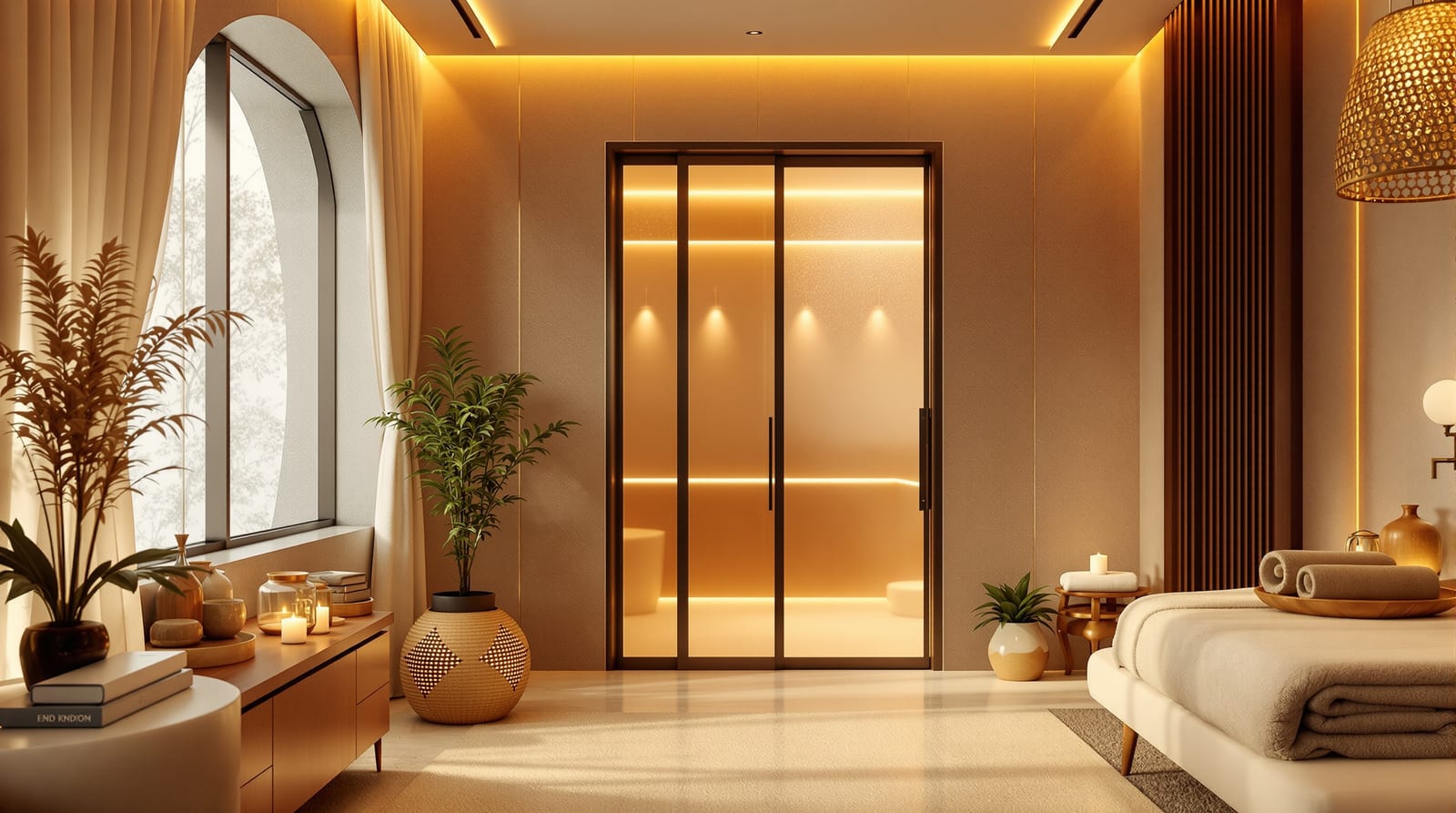
Salon and Spa Door in India: Frosted Privacy, Acoustic and Moisture-Resistant Doors by Zone (2026)
A zone-by-zone guide to specifying doors for a salon or spa in India - a chic frosted-glass entrance, frosted privacy doors for treatment and massage rooms, acoustic doors for relaxation rooms, and moisture-resistant WPC or PVC doors for wet, steam and sauna areas - with the door demand and indicative per-door cost for each.
A salon or spa sells one thing above all: how it makes a person feel the moment they cross the threshold. The doors are a quiet, constant part of that feeling. A guest who can be seen undressing through a gap, who can hear a hairdryer screaming next door during a massage, or who notices a swollen, peeling door in the steam room is a guest who will not rebook. In an Indian salon or spa the doors are working harder than they look - they carry privacy, calm, hygiene, moisture resistance and a chic, expensive-looking aesthetic, often inside compact cabins where every square foot is paid rent.
This guide takes a spa zone by zone - entrance, treatment and massage rooms, relaxation room, wet and steam areas, and the back-of-house - and recommends the right door for each, with the reason and an indicative per-door cost. It complements the door-type and material guides rather than repeating them: where a door type matters, follow the link. For the whole-building view of which door suits which space, see the doors-by-space guide.
What a salon and spa door has to deliver
Strip away the mood lighting and a spa door is judged on six drivers. They pull in different directions, so the right door changes from zone to zone.
- Privacy (the non-negotiable). Treatment, massage and changing rooms involve people partly or fully undressed. The door must give complete visual privacy with no gaps, a reliable lock and, ideally, an occupied/vacant indicator. This is why clear glass is wrong for these rooms and frosted or opaque is right.
- Calm and acoustics. A spa is selling silence. Reception chatter, hairdryers, the reception phone and traffic noise must not bleed into a relaxation or massage room. Doors with mass and perimeter seals keep the quiet in.
- Moisture resistance. Steam rooms, sauna lobbies, wet treatment areas, hydrotherapy and pedicure stations are humid and splashed daily. A timber or MDF door here swells, delaminates and grows mould within months. Wet zones need WPC, PVC, uPVC, FRP or aluminium leaves that shrug off water.
- Hygiene and easy cleaning. Salons and spas are regulated for cleanliness and inspected. Smooth, non-porous, wipe-clean surfaces - laminate, PVC, glass, powder-coated aluminium - beat textured timber that traps oil, wax and product.
- Chic, premium aesthetic. The door is part of the brand. A frameless frosted-glass entrance, a clean veneer or a soft-backlit panel signals a premium spa; a tired flush door undercuts a thousand-rupee facial.
- Space-saving in compact cabins. Indian salon cabins are small. A standard swing door eats a metre of floor that could hold a trolley or a chair. Sliding and pocket doors recover that space.
Zone-by-zone: the right door for each space
Entrance - chic, welcoming, framed glass
The street-facing entrance has to look expensive and feel inviting while giving daytime visibility into a calm, well-lit interior. The default for a premium Indian spa is a frameless or slim-framed toughened-glass door, often with a frosted band or a printed logo for a hint of privacy and brand. In a footfall location an automatic sliding glass door adds a hands-free, hospitality feel. See the glass doors guide for the entrance leaf and the frosted glass doors guide for the frosting and manifestation. The door must use safety glass with visible manifestation so nobody walks into it.
Treatment and massage rooms - frosted privacy, space-saving
This is the heart of the spa and the door that matters most. The brief is total visual privacy, a calm closure, a lock with an occupied indicator, and as little floor footprint as possible. Two strong answers:
- Frosted or opaque sliding / pocket door. A sliding leaf on a top track, or a pocket door that vanishes into the wall, recovers the floor a swing would waste in a small cabin - ideal where a trolley and a treatment bed already fill the room. Use an acid-etched or frosted-film glass leaf, or a solid opaque WPC/laminate leaf, never clear glass.
- Solid flush leaf with frosted vision-free finish. Where acoustics and warmth matter more than saving floor, a solid-core flush door in wipe-clean laminate gives better sound privacy than a single glass leaf and a soft, residential calm.
Whichever you pick, add a perimeter seal and a privacy lock. For the space-planning logic of swing versus slide in tight rooms, see the interior doors by room guide and the doors-by-space guide.
Relaxation / quiet room - acoustic
The relaxation lounge, meditation room or post-treatment quiet area is where the spa delivers its promise of silence. This is the one zone where you should buy a genuine acoustic door: a solid-core leaf with perimeter gaskets and an automatic drop seal at the threshold, targeting STC 30-40 so reception and corridor noise stay out. A single hollow flush leaf or a frosted glass door will not do it. Read the soundproof doors guide before specifying - frosting blocks sight, mass and seals block sound, and they are different problems.
Wet, steam and sauna areas - moisture-resistant
Steam rooms, sauna lobbies, wet treatment and hydrotherapy areas are the zones that kill ordinary doors. Specify only moisture-immune materials:
- WPC or PVC for changing-cubicle and wet-treatment doors - waterproof, termite-proof, wipe-clean and inexpensive. See the WPC doors guide.
- Aluminium (powder-coated) or uPVC framed leaves for steam-area and pool-side doors that take constant humidity.
- A dedicated steam-room / sauna door - typically a toughened-glass leaf in an aluminium frame with a heat-and-moisture-tolerant gasket - for the steam cabin itself. (A timber sauna door is purpose-built and acceptable inside a dry sauna; the lobby door is the wet one.)
Never use ordinary timber, MDF or unsealed engineered-wood in these zones - they swell, delaminate and grow mould fast in Indian humidity.
Changing rooms and toilets - private, wipe-clean
Changing cubicles and washrooms need a lockable, moisture-tolerant, easy-clean door with an occupied indicator. A PVC or WPC leaf (see the PVC doors guide approach) is the standard low-cost choice; a frosted-glass cubicle door reads more premium. A pocket or sliding leaf again saves floor in a narrow cubicle.
Back-of-house - durable, fire-safe
Stores, the dispensary/product room, staff areas and any laundry need durable, hygienic doors. The premises must also meet fire and exit rules: a salon or spa is a commercial occupancy, so any required escape route needs a fire-exit door with panic hardware that opens in the direction of escape, and fire-rated leaves where the NBC and local fire NOC demand them.
Recommendation and cost table by zone
The table maps each spa zone to its recommended door, the driver that decides it, and an indicative per-door cost. Costs are for a standard 3x7 ft door in 2026, plus 18% GST; vary by size, finish and city.
| Spa zone | Recommended door | Why (top driver) | Indicative cost per door |
|---|---|---|---|
| Entrance | Frameless/slim-frame frosted toughened glass (or automatic sliding) | Chic, welcoming, daytime visibility | 18,000-55,000 (auto: higher) |
| Treatment / massage room | Frosted sliding or pocket door, or solid flush in laminate | Total privacy + space-saving | 6,000-22,000 |
| Relaxation / quiet room | Acoustic solid-core door + seals + drop seal | Calm (STC 30-40) | 12,000-30,000 |
| Wet / hydrotherapy area | WPC or PVC leaf | Moisture + hygiene | 1,800-12,000 |
| Steam room / sauna lobby | Glass-in-aluminium steam door, or uPVC | Moisture + heat tolerance | 8,000-25,000 |
| Changing room / toilet | PVC or WPC, lockable, occupied indicator | Privacy + wipe-clean | 1,800-9,000 |
| Back-of-house / fire exit | Flush/laminate; fire-rated where required | Durability + fire code | 3,000-9,000 (fire: 12,000-45,000+) |
For a quick build-up of doors and shutters across the whole premises, the commercial door cost calculator gives a per-zone estimate.
Privacy and moisture - the two diagrams that decide a spa door
The single most common mistake is treating privacy and moisture as the same problem. They are not: a frosted glass treatment-room door gives privacy but is the wrong leaf for a steam lobby, while a WPC wet-area door resists moisture but is plain. The diagram contrasts the two.
Hardware the spa zones need
- Privacy lock with occupied/vacant indicator on every treatment, changing and toilet door - the small turn-button-with-coin-release type, or a thumbturn with a red/green indicator. This is the single most reassuring detail for a guest.
- Soft-close closer or floor spring so doors close quietly - a slamming door destroys the calm. For glass entrance and steam doors a floor spring; for flush leaves a soft-close overhead closer. See the door closers approach in the hardware guide.
- Lever handles, not knobs - the accessible, comfortable and easy-to-clean choice; specify a finish that resists product, oil and water (stainless or PVD).
- Acoustic seals - perimeter gaskets plus an automatic drop seal turn an ordinary solid leaf into a genuinely quiet relaxation-room door.
- Hands-free / pull-free options at wet stations where staff have oily or wet hands.
Standards, clearances and the fire NOC
A salon or spa is a commercial premises, so it must meet the NBC 2016 and the local fire NOC, not just look good. Practical points:
- Clear widths. Give main and treatment-room doors a clear opening of at least 900 mm so they are accessible (RPwD 2021), with a lever handle and a threshold of 12 mm or less - important for guests in robes and slippers.
- Glass safety. All glass doors must be toughened (safety) glass with visible manifestation - the frosted band or a logo - so no one walks into a clear leaf.
- Fire and egress. Escape doors must open in the direction of escape and carry panic hardware where the occupant load requires it; coordinate fire-rated leaves with your fire consultant and the emergency exit door standards.
- Moisture-area material rules. Specify only WPC/PVC/uPVC/aluminium/FRP in wet zones - this is a durability and hygiene requirement, not just a preference.
For where the spa sits among other commercial spaces and how its doors compare, see the doors-by-space guide.
Do and don't
- Do use frosted or opaque doors, never clear glass, for treatment, massage, changing and toilet rooms - privacy is the whole point.
- Do put a privacy lock with an occupied indicator on every private-treatment door.
- Do buy one genuine acoustic door for the relaxation room - mass and seals, not just frosting.
- Do specify WPC, PVC, uPVC or aluminium for every wet, steam and pedicure zone.
- Don't install timber or MDF doors in wet or steam areas; they swell, delaminate and grow mould.
- Don't assume frosted glass is soundproof - it blocks sight, not sound.
- Don't waste a small cabin's floor on a swing door where a sliding or pocket door fits.
Frequently asked questions
What is the best door for a spa treatment or massage room in India?
A frosted or opaque door with a privacy lock and an occupied/vacant indicator - never clear glass. In a small cabin a frosted sliding or pocket door saves the floor a swing would waste; where acoustics and warmth matter more, a solid-core flush door in wipe-clean laminate gives better sound privacy. Add a perimeter seal and a soft-close closer so the door shuts quietly.
Which doors survive a spa's wet and steam areas?
Only moisture-immune materials: WPC and PVC for changing cubicles and wet treatment rooms, uPVC or powder-coated aluminium for steam-area and pool-side doors, and a purpose-made glass-in-aluminium leaf for the steam cabin itself. Ordinary timber, MDF and unsealed engineered-wood swell, delaminate and grow mould within months in Indian humidity, so keep them out of every wet zone.
Is a frosted glass door soundproof enough for a spa relaxation room?
No. Frosting only blocks sightlines for privacy; it does nothing for sound. A relaxation or quiet room needs a real acoustic door - a solid-core leaf with perimeter gaskets and an automatic drop seal, targeting STC 30-40 - so reception chatter, hairdryers and traffic stay out. Treat privacy and acoustics as two separate problems with two different solutions. See the soundproof doors guide.
How much do salon and spa doors cost in India?
Indicatively, per 3x7 ft door in 2026 plus 18 percent GST: a frosted frameless-glass entrance 18,000-55,000; a frosted treatment-room sliding or flush door 6,000-22,000; an acoustic relaxation-room door 12,000-30,000; WPC or PVC wet-area and changing doors 1,800-12,000; a steam-room door 8,000-25,000; and back-of-house flush doors 3,000-9,000, with fire-rated leaves 12,000-45,000 and up. Use the commercial door cost calculator for a full premises build-up.
Should spa cabin doors slide or swing?
In most Indian spa cabins, slide. A swing door needs roughly a metre of clear floor to open, which a small treatment room cannot spare once a bed and trolley are in. A frosted sliding or pocket door recovers that space and still gives full privacy. Reserve swing (or solid flush) doors for rooms where acoustic performance and a warmer, residential feel outweigh the lost floor.
Export this guide
Related Guides — Deep-dive reading
Soundproof Doors in India: How Doors Leak Sound, STC Ratings, Seals & Real Costs
A door is the weakest acoustic link in any wall - and it usually leaks through the gaps, not the panel - so here is how to actually quieten a bedroom, home theatre or street-facing room, from a 1,500-rupee seal kit to a proper acoustic door.
Home Doors & EntrancesDoors by Space in India: The Complete Which-Door-Where Decision Guide (2026)
Pick the right door for every room and building type in India - residential, office, hotel, hospital, retail and industrial - with the driver that should decide it and indicative costs.
Home Doors & EntrancesGuest Room Door in India: Privacy, Quiet and Smart Picks Without Overspending (2026)
How to choose a guest bedroom door for an Indian home - privacy and acoustics so visitors feel comfortable, but budget-sensible for a room used only now and then: solid-core flush for quiet, panel or laminate for looks, the right privacy lock, simple soundproofing, and a finish that matches the rest of your doors - with picks ranked and indicative rupee costs.
Home Doors & EntrancesRelated Tools — Try Free
Acoustic Privacy (STC) Visualizer
Indian healthcare acoustic visualizer — compare wall assemblies and noise sources, see received SPL after STC attenuation, and check FGI 2018 / IS 1950 / NABH speech-privacy compliance with live dual-canvas waveform.
Acoustic ToolDoor Cost Calculator
Estimate the all-in cost of a door — leaf, frame, hardware, fitting and GST — by type, material and size.
Door CalculatorAccessible Door Checker
Check a door against wheelchair-accessibility guidance — clear width, threshold, handle and closer force per RPwD 2021.
Compliance Tool