

Electrical Renovation & Rewiring Guide for Indian Homes
When an older home needs its electrics upgraded — how to recognise wiring that has reached the end of its life, what a full rewire versus a partial upgrade involves, how to add smart controls, RCCB protection and capacity to an existing home, and how to estimate the cost.
An older home's electrical system is often its most dangerous and least visible weakness. Wiring installed decades ago was sized for a home with a few lights, a fan and a radio — not for today's air-conditioners, geysers, induction hobs and EV chargers. Insulation grows brittle, the old fuse box has no earth-leakage protection, aluminium conductors loosen at every joint, and the whole installation quietly slips out of step with both modern demand and modern safety. This guide is about recognising when a home's electrics have reached the end of their life, understanding what a rewire or upgrade involves, and doing it safely and cost-effectively.
It is the renovation counterpart to the new-home design guide, and builds on the residential electrical systems pillar and the planning guide.
The safety line — sharper here than anywhere. Old wiring is genuinely hazardous, and diagnosing or replacing it is entirely a licensed electrician's job. This guide helps you recognise the warning signs, understand your options and budget honestly — so you can commission the right work and judge it. Do not open old boards, probe suspect wiring, or attempt repairs yourself. If you see the danger signs below, the correct action is to stop using the affected points and call a competent electrician.
When does a home need rewiring?
Not every old home needs a full rewire, but many need more than they have. The warning signs that an installation has reached — or passed — the end of its safe life:
- Age: wiring more than 25–30 years old, or of unknown age in a home you have just bought, should be professionally inspected regardless of symptoms.
- No RCCB / earth-leakage protection: an old fuse box or a board with only fuses and MCBs has no protection against fatal shock. This alone justifies an upgrade.
- Aluminium wiring: older homes were often wired in aluminium, which is more prone to loosening, oxidising and overheating at joints than copper.
- Frequent tripping or blown fuses, warm switch plates, a persistent burning smell, flickering lights, sparking sockets, or a tingle from appliance bodies — any of these means stop and call an electrician now.
- Too few points and constant extension leads — a sign the home is being asked to carry loads it was never wired for.
- Brittle, cracked or discoloured insulation visible at any exposed point.
- No proper earthing, or earthing you cannot confirm exists.
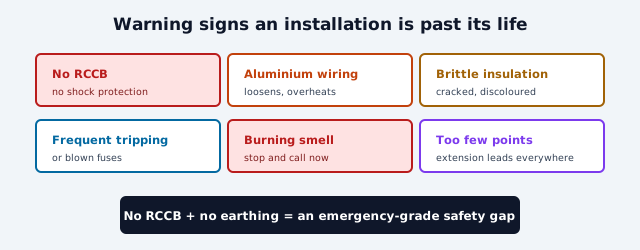
If a home has no RCCB and no confirmed earthing, treat that as an emergency-grade safety gap, not a nice-to-have upgrade. It is the difference between a fault that trips and a fault that kills.
Full rewire versus partial upgrade
Once an electrician has inspected, the options fall on a spectrum:
- Full rewire — replacing all the wiring, the distribution board, and the accessories throughout. This is the right answer when the wiring is old, aluminium, brittle, or dangerously under-provisioned. It is disruptive (walls are chased, rooms are emptied) but it resets the home to a safe, modern, adequately-sized installation for another generation.
- Partial rewire — replacing the worst circuits (often the kitchen and heavy-appliance points) while retaining sound ones. Reasonable when only part of the installation is at end of life and the rest is genuinely good.
- Board and protection upgrade — replacing an old fuse box with a modern distribution board including an RCCB and properly rated MCBs, and adding or improving earthing. Sometimes the highest-value single upgrade a home can have, even short of a rewire — but only if the existing wiring itself is sound enough to keep.
- Capacity upgrade — enhancing the sanctioned load with the DISCOM and upgrading the main cable and board to carry modern demand (a new AC, a geyser, an EV charger).
A good electrician will recommend the least intervention that makes the home safe and adequate — not automatically the biggest job. Your role is to understand the trade-off: a partial fix is cheaper today but may leave known-old wiring in the walls; a full rewire costs more but ends the uncertainty.
| Scope | What it addresses | Typical when |
|---|---|---|
| Board + RCCB + earthing upgrade | Shock and fire protection | Wiring sound, but no RCCB / poor earthing |
| Partial rewire | Worst circuits (kitchen, heavy loads) | Localised end-of-life wiring |
| Full rewire | The whole installation | Old / aluminium / brittle wiring, under-capacity |
| Capacity enhancement | More power (AC, EV, geyser) | Adding heavy modern loads |
Adding modern capabilities to an existing home
Renovation is also the moment to bring an old home up to modern expectations:
- RCCB and modern protection — the most important upgrade, discussed above.
- More capacity and dedicated circuits — a dedicated kitchen circuit, AC points, a geyser circuit, and headroom for an EV charger.
- Smart-home retrofit — the honest catch: smart switches usually need a neutral at the switch box, which many old homes lack. Where a rewire is happening anyway, insist on neutrals at every switch to make automation trivial. Where it is not, battery or no-neutral smart devices exist but are more limited — so a rewire is the ideal window for smart-readiness.
- Efficiency — replacing old fittings with LED lighting and BEE-rated appliances cuts both the bill and the load, sometimes deferring the need for a capacity upgrade.
- Solar and EV readiness — as with a new home, adding conduit routes and spare DB ways during a renovation is far cheaper than later.
Estimating the cost
Rewiring cost in India depends on the home's size, the scope (full versus partial), the quality of materials (copper wire, branded MCBs/RCCBs, modular accessories), the amount of chasing and making-good, and the city. As very rough, indicative planning figures — to be replaced by an electrician's itemised quote against your actual home:
- Costs are usually driven by area and number of points, plus the board and protection, the civil work (chasing walls and making good), and finishing (accessories, painting).
- A board + RCCB + earthing upgrade is a relatively contained cost and often the best safety-per-rupee spend.
- A full rewire is a significant project, comparable to a substantial room renovation, because of the civil work involved — but it is a once-in-a-generation cost.
Get itemised quotes (points, board, wiring, civil work, accessories, earthing) from licensed electricians so you can compare like with like, and never let the lowest quote win on wire gauge or protection — those are exactly where a cheap job cuts corners you cannot see. A dedicated cost guide and calculator will help you sanity-check a quote; for now, budget honestly and prioritise safety items first.
Doing it safely and with least disruption
- Inspect first. Commission a licensed electrician to assess the installation and recommend scope before committing to a rewire.
- Sequence with other renovation. If you are re-plastering or re-flooring anyway, that is the cheapest possible time to rewire — the civil work is shared.
- Prioritise safety items. If budget is tight, do earthing and an RCCB and the worst circuits first; they buy the most safety.
- Keep a record. Get the finished circuit list and DB chart, and keep them — the next owner and the next electrician will thank you.
The one-line answer
An older Indian home often carries wiring that is under-sized for modern loads and unprotected against fatal shock; recognise the end-of-life signs — no RCCB, aluminium or brittle wiring, frequent tripping, burning smells — and commission a licensed electrician to inspect and recommend the least intervention that makes the home genuinely safe and adequate, from a board-and-RCCB upgrade to a full rewire, prioritising earthing and shock protection above all, and using the renovation window to add capacity, smart-readiness and efficiency. Diagnosis and work are the electrician's; recognising the need and budgeting honestly are yours.
Where to go next
- How the system works: Residential Electrical Systems.
- Plan the upgrade: Home Electrical Planning.
- New construction: Electrical Design for New Homes.
- Estimate demand for the upgrade: Electrical Load Calculator.
References
- IS 732 : 2019, Code of Practice for Electrical Wiring Installations (Fourth Revision), Bureau of Indian Standards.
- IS 3043 : 2018, Code of Practice for Earthing (Second Revision), BIS.
- National Electrical Code of India, SP 30 : 2023, BIS: https://www.bis.gov.in/
- Central Electricity Authority (Measures relating to Safety and Electric Supply) Regulations, CEA: https://cea.nic.in/
- Bureau of Energy Efficiency — appliance star ratings: https://beeindia.gov.in/
Warning signs and cost ranges are indicative and for homeowner literacy only. Inspection, diagnosis and all rewiring must be carried out by a licensed electrician to the current code. If you notice any danger sign described here, stop using the affected points and call a professional. Verify any standard's status via the BIS catalogue before relying on it.
Export this guide
Related Guides — Deep-dive reading
Residential Electrical Systems: The Complete Guide for Indian Homes
How the electricity in an Indian home actually works — from the utility supply and meter through the distribution board, circuits, wiring, earthing and protection, to lighting, safety, energy efficiency, smart controls, solar and backup — written so a homeowner can understand, plan and judge it, and know exactly where a licensed electrician must take over.
Electrical & WiringFuture-Proof Wiring Systems for Indian Homes
Build electrical headroom now so tomorrow's loads are plug-and-play, not demolition.
Future-Ready HomesKitchen Electrical: Wiring, Circuits & Points for an Indian Kitchen
The highest-load, highest-risk room in the home — how to plan a kitchen's electrics: enough 16A socket points at counter height, dedicated circuits for heavy appliances, RCCB protection near water, and the layout that makes a modular kitchen work, all specified before the tiles go up.
Electrical & WiringRelated Tools — Try Free
Electrical Safety & Load Audit
Home electrical audit — 10 categories, 65+ checkpoints across earthing, RCCB, MCB, wiring, switchboards, appliance circuits, DG/inverter backup.
Safety AuditElectrical Load Calculator
Estimate a home's connected load and realistic maximum demand from its appliances, whether it needs single or three-phase supply, and a suggested main switch rating.
ElectricalHome Building & Interior Cost Calculator — 20 Cities
Construction + interior costs for 20 Indian cities across kitchen, wardrobes, flooring, painting, ceiling.
Cost Calculator