
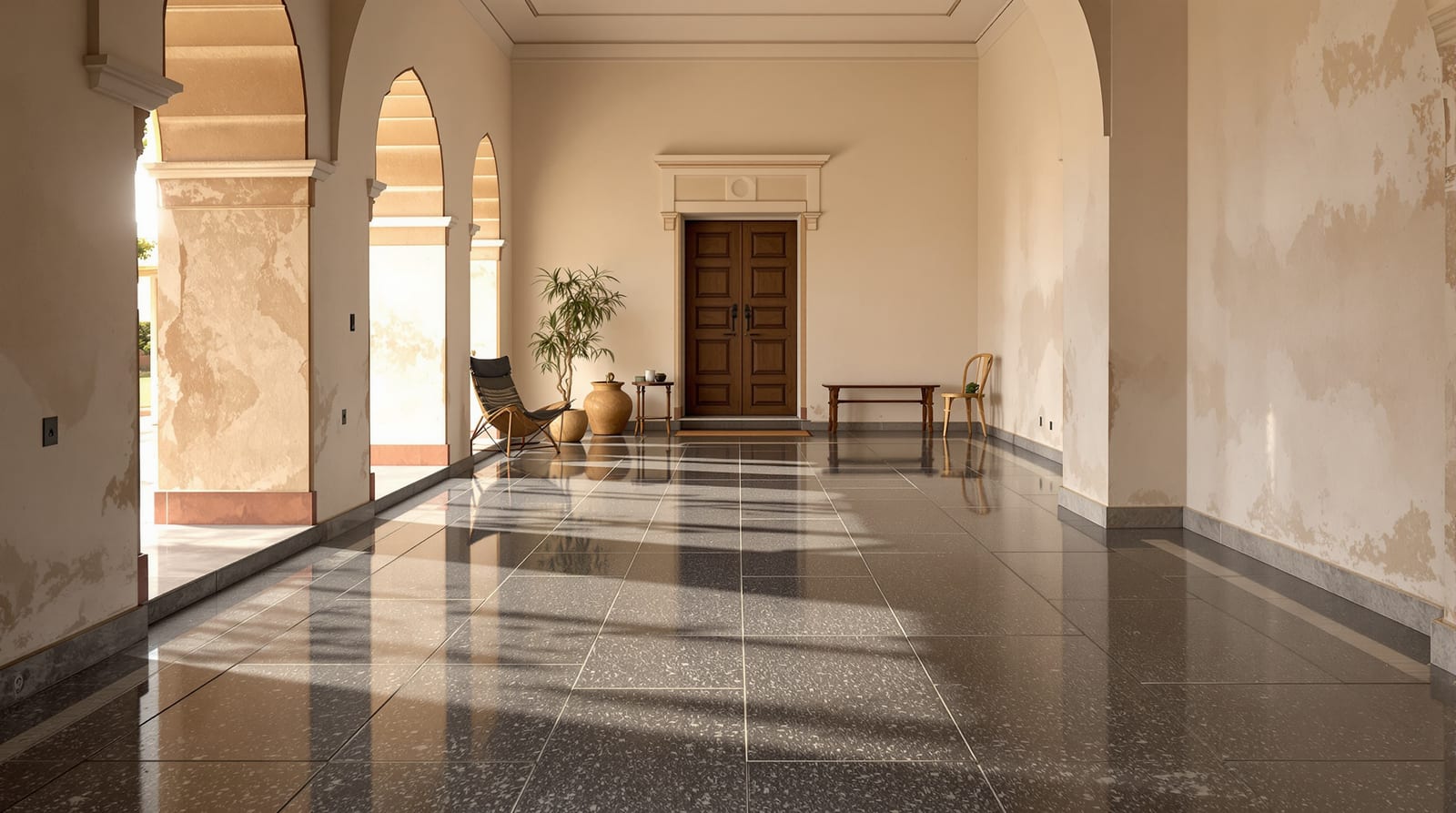
Flooring Embodied Carbon in India: The Lifecycle Footprint of Every Floor, Explained
Embodied carbon is the total CO2 locked into a floor across extraction, manufacture, transport, installation, maintenance and disposal - and durability plus local sourcing matter far more than the label 'eco'. Compare bamboo, cork, linoleum, local stone, ceramic, vitrified, imported marble, vinyl and laminate on a true cradle-to-grave basis for Indian homes.
When people ask which floor is "green," they usually point at a single label - bamboo, cork, the word "eco" on a brochure. But the real carbon story of a floor is not in the label. It is spread across its entire life: digging up or growing the raw material, the heat used to make it, the diesel burnt hauling it to your site, the adhesives and energy of laying it, decades of cleaning and re-polishing, and what happens when it is finally torn out. That whole accounting is called embodied carbon, and once you understand it, two unglamorous truths take over: a floor that lasts a century quietly beats a "renewable" floor you replace three times, and a heavy local stone often beats a light imported one. This guide shows you how to think about flooring embodied carbon honestly, for an Indian home.
What embodied carbon actually means
Embodied carbon is the total greenhouse gas, measured in kilograms of CO2-equivalent, released to put a material into your home and keep it there - everything except the energy you use living in the room. For a floor it is the sum of six life stages:
- Extraction (or growing). Quarrying stone, mining clay and feldspar for tiles, drilling crude oil for vinyl, or growing and harvesting bamboo, cork and timber. Plant-based materials get a head start here because the plant absorbed CO2 while growing.
- Manufacture. This is usually the biggest single chunk. Firing a ceramic or vitrified tile to 1100-1200 degrees Celsius, or pressing and curing vinyl and laminate, takes enormous heat and electricity. A raw stone slab, by contrast, is mostly cut and polished - far less heat.
- Transport. Diesel burnt moving heavy material from source to site. This is where "imported" becomes expensive in carbon: Italian marble travels thousands of kilometres by ship and truck, while Kota stone may travel 200 km.
- Installation. Cement-sand mortar beds, tile adhesives, screeds, underlays, primers and sealers all carry their own carbon - cement is itself a high-carbon material.
- Maintenance. Decades of cleaning, re-sealing, re-polishing, re-coating. A floor that needs diamond-grinding every few years keeps adding carbon long after it is laid.
- End-of-life. Demolition, transport to landfill, and whether the material can be reused, recycled, or simply buried. A floor that can be salvaged or crushed into aggregate has a lower end-of-life burden than one that is landfill-only.
The phrase you will see in green-building documents is "cradle to grave," meaning all six stages, versus "cradle to gate," meaning only up to the factory door. Most marketing numbers quietly stop at the gate, which flatters materials that are heavy to transport or short-lived. For a homeowner the only honest comparison is cradle to grave, and crucially, per year of service.
Why durability and local sourcing beat the "eco" label
Two ideas decide most of a floor's real footprint, and neither is printed on the packaging.
The first is lifespan, which lets you amortise carbon. Imagine a stone floor with a high upfront manufacturing-plus-installation carbon cost that lasts 100 years, versus a "renewable" floor with a much smaller upfront cost that you replace every 15 years. Over a century you fit the renewable floor six or seven times - new material, new adhesive, new labour, new demolition - each time stacking carbon. The durable floor amortises its one-time carbon across 100 years and frequently wins. This is why granite, good vitrified tile, terrazzo and well-laid Kota stone, all of which routinely outlive the building, are quietly some of the lowest carbon-per-year floors available in India even though their day-one number looks high. Durability is the single most powerful lever you control.
The second is transport, which rewards local sourcing. Flooring is heavy. Moving a tonne of stone across an ocean burns far more diesel than moving it across a state. An Italian marble or a Spanish porcelain has a large transport burden baked in before it reaches Mumbai port; an Indian granite from Karnataka, Kota stone from Rajasthan, or Morbi vitrified tile travels a fraction of the distance. Green-building systems reward "regional materials" sourced within roughly 400 to 800 km for exactly this reason - see green-building-flooring-credits-india. Choosing local is one of the easiest carbon wins, and it usually costs less too.
A floor is "low carbon" in practice when it is durable, locally sourced, low-maintenance, and ideally recyclable at the end - not simply because it carries a green-sounding name.
How the main flooring materials compare
The table below is a relative, directional comparison for Indian conditions - manufacturing intensity, typical transport distance for the Indian market, realistic lifespan, and the resulting cradle-to-grave verdict. Treat the carbon bands as relative (low, low-moderate, moderate, high), not lab-precise numbers; actual figures vary with the specific product, plant fuel mix and source distance.
| Material | Manufacturing carbon | Typical transport (India) | Realistic lifespan | Cradle-to-grave verdict |
|---|---|---|---|---|
| Bamboo (strand-woven) | Low - rapidly renewable, absorbs CO2 growing | Moderate - much is imported from China | 20-30 yrs | Low if local-ish and kept dry; humidity can shorten life |
| Cork | Low - bark regrows, tree survives | High - largely imported from Portugal/Spain | 20-30 yrs | Low manufacturing but high transport; renewable feedstock |
| Linoleum (true) | Low - linseed oil, cork, jute, wood flour | High - mostly imported | 25-40 yrs | Low and biodegradable; transport is the main penalty |
| Local natural stone (granite, Kota) | Low-moderate - mostly cut and polish | Low - quarried within India | 50-100+ yrs | Excellent per-year carbon thanks to durability + local source |
| Imported marble (Italian) | Low-moderate - cut and polish | Very high - shipped thousands of km | 50-100+ yrs | Durable, but transport burden drags it well above local stone |
| Ceramic tile | Moderate-high - fired ~1100C | Low-moderate - Morbi/local | 15-30 yrs | Mid; high firing energy offset by local supply |
| Vitrified / porcelain tile | Moderate-high - fired ~1200C, very dense | Low - Morbi dominates Indian market | 30-50+ yrs | Mid, improving - durability + local + recycled-content options |
| Vinyl / LVT / SPC | Moderate-high - fossil (PVC) feedstock | Moderate - much imported | 15-25 yrs | Fossil-based and largely landfill-bound; weakest end-of-life |
| Laminate | Moderate - HDF core + resins, glues | Moderate - much imported | 10-20 yrs | Short life + non-recyclable layered build = poor per-year |
| Reclaimed timber / recycled-chip terrazzo | Very low - reuses existing material | Low if local salvage | 30-100 yrs | Lowest available - avoids new extraction and firing |
A few patterns jump out. Plant-based floors (bamboo, cork, linoleum) win on raw feedstock but can lose ground on transport because so much is imported. Fired tiles carry real manufacturing carbon, but their local supply chain and (for vitrified) long life claw a lot of it back. Stone's heavy day-one number is rescued by extraordinary lifespan - provided it is sourced locally. And the genuinely lowest-carbon option is almost always reused or recycled material, because it skips new extraction and manufacture entirely - see reclaimed-and-recycled-flooring-india.
Carbon per year of service: the diagram that changes the decision
The single most useful way to compare floors is to divide their whole-life carbon by the number of years they actually serve. A high upfront floor that lasts 80 years can beat a low upfront floor replaced five times. The chart below illustrates this idea: same notional 60-year window, very different totals once you count replacements.
The stone is one solid block of carbon. The laminate is four shorter blocks - new material, new underlay, new adhesive, new demolition each time - that stack up taller. This is the whole argument for durability in one picture, and it is why "buy once, buy well" is also a climate strategy.
The hidden stages: installation, maintenance and end-of-life
Most carbon conversations stop at the material, but three site-side stages quietly move the needle.
Installation carbon. Cement is one of the highest-carbon building materials in the world, so a thick 25-50 mm cement-sand mortar bed carries more embodied carbon than a thin 3-5 mm tile-adhesive bed. Where the substrate allows, a thin-set adhesive layer (and avoiding an unnecessarily thick screed) trims installation carbon - see how-to-lay-floor-tiles-india and tile-laying-methods-india. Underlays, primers and solvent-heavy glues add to it; choosing water-based, low-VOC adhesives and sealers helps both carbon and indoor air - see low-voc-flooring-india.
Maintenance carbon. A floor that demands frequent diamond-grinding, re-polishing or re-coating keeps spending carbon for decades. Marble needs periodic crystallisation and re-polishing; solid wood needs sanding and re-coating every several years; laminate cannot be refinished at all and is simply replaced. Low-maintenance vitrified and well-sealed granite spend very little after day one. Factor lifetime upkeep, not just the showroom price - see floor-resealing-guide-india and marble-polishing-and-care-india.
End-of-life carbon and recyclability. What happens when the floor comes out matters. Natural stone can be re-cut, re-used or crushed into aggregate. Ceramic and vitrified rubble can be crushed for sub-base fill, and Indian vitrified makers increasingly use recycled content. Reclaimed timber can be salvaged and relaid. But layered, glued-together laminate and PVC-based vinyl are extremely hard to separate and recycle, so they overwhelmingly go to landfill - their weakest stage. If end-of-life recyclability matters to you, lean towards stone, fired ceramics with recycled content, and reusable timber, and away from fused multi-layer synthetics.
Putting it together: a low-carbon flooring strategy for an Indian home
You do not need a spreadsheet to make a low-carbon choice. Apply these priorities, roughly in order:
- Choose durable first. A floor that outlives the building is the cheapest carbon you will ever buy. Granite, good vitrified tile, terrazzo and properly laid Kota or local stone are workhorses - see natural-stone-sustainability-india.
- Source local. Prefer Indian stone, Morbi tile and regionally made products over imports. The transport saving is large and free.
- Reuse where you can. Reclaimed teak, recycled-chip terrazzo and recycled-content vitrified beat new extraction outright - see reclaimed-and-recycled-flooring-india.
- Pick renewables for the right rooms. Bamboo, cork and true linoleum are excellent in dry, gentle-traffic spaces if you accept their shorter life and (often) import distance - see bamboo-flooring-india and sustainable-flooring-materials-india.
- Keep installation and upkeep light. Thin-set over thick cement beds where possible, low-VOC adhesives, and low-maintenance finishes.
- Avoid the worst end-of-life. Treat short-life, landfill-only laminate and PVC vinyl as last resorts where budget forces them.
For the broader picture of which "green" materials suit which use, read eco-friendly-flooring-india. To turn these priorities into a shortlist for your own rooms, the Studio Matrx eco-flooring selector at /utilities/eco-flooring-selector and the flooring material comparison at /utilities/flooring-material-comparison let you weigh durability, source and maintenance side by side.
Frequently asked questions
Is bamboo or cork always lower carbon than tile or stone?
Not always. On raw feedstock, yes - they grow back and absorb CO2. But most bamboo and cork sold in India is imported, which adds transport carbon, and they last 20 to 30 years versus 50 to 100-plus for good stone or vitrified. Over a long horizon, a durable local stone can match or beat a renewable floor you replace twice. Think cradle-to-grave per year, not just the feedstock.
Why is imported Italian marble worse for carbon than Indian granite if both are natural stone?
Because the dominant difference is transport, not manufacturing. Both are mostly cut and polished, so factory carbon is similar. But Italian marble is shipped thousands of kilometres to reach an Indian site, while Indian granite or Kota travels a few hundred. That shipping diesel is real embodied carbon, which is why green-building systems reward regionally sourced stone.
Does a vitrified tile's high firing temperature make it a bad choice?
Firing to around 1200 degrees Celsius gives vitrified tile a genuinely high manufacturing carbon. But it is made locally in Morbi (short transport), lasts 30 to 50-plus years, needs almost no maintenance carbon, and its rubble can be crushed for fill - and recycled-content options exist. Per year of low-maintenance service it is mid-pack and improving, not a villain.
What is the single most effective way to lower my floor's carbon?
Choose a durable, locally sourced floor and keep it for as long as possible. Lifespan amortises the upfront carbon, and local sourcing cuts transport. Buying well once beats replacing a "greener" but shorter-life floor several times. After that, reuse or recycled content, low-VOC water-based adhesives, and a thin installation bed give further savings.
Can any flooring be genuinely recycled at the end of its life in India?
Some. Natural stone can be re-cut, re-laid or crushed into aggregate; ceramic and vitrified rubble is routinely used as sub-base fill; reclaimed timber is salvaged and re-sold. Layered laminate and PVC vinyl are very hard to separate and mostly go to landfill. If end-of-life matters to you, favour stone, recycled-content fired tiles and reusable timber.
Export this guide
Related Guides — Deep-dive reading
Eco Friendly Flooring in India: The Homeowner's Guide to Greener Floors, Low-VOC Choices and Lower Embodied Carbon
What actually makes a floor green — embodied carbon, recycled content, VOC emissions, renewability, recyclability, lifespan and local sourcing — and which Indian flooring choices are genuinely sustainable, from bamboo, cork and linoleum to local stone, fly-ash tiles and recycled-chip terrazzo.
Flooring & SurfacesSustainable Flooring Materials in India: A Material-by-Material Eco Catalogue
A deep catalogue of the genuinely sustainable floors you can actually buy in India — bamboo, cork, natural linoleum, reclaimed and FSC-certified wood, local granite, Kota and sandstone, recycled-chip terrazzo, fly-ash and recycled-content vitrified, and rubber from old tyres — with their real eco credentials, durability, cost, look and best use.
Flooring & SurfacesGreen Building Materials Guide (India): Low-Carbon, Healthy & Sustainable Choices (2026)
What actually makes a building material green - low embodied carbon and energy, recycled and renewable content, local sourcing, durability, recyclability, low VOC and water efficiency - mapped honestly across the whole Indian building, with the lifecycle nuance no label can give you.
Building MaterialsRelated Tools — Try Free
Cross-Ventilation Analyzer
Estimate airflow and air changes per hour (ACH) from room size, window areas, layout, and local wind — with NBC 2016 Part 8 compliance check.
Ventilation CalculatorMaterial Decision Framework (M-Score)
Score 30+ Indian construction materials across cost, durability, climate fit, maintenance, and sustainability.
MaterialsFlooring Cost Calculator
Estimate the all-in cost of a floor — material, laying, wastage, skirting and GST — by area and material.
Flooring Calculator