
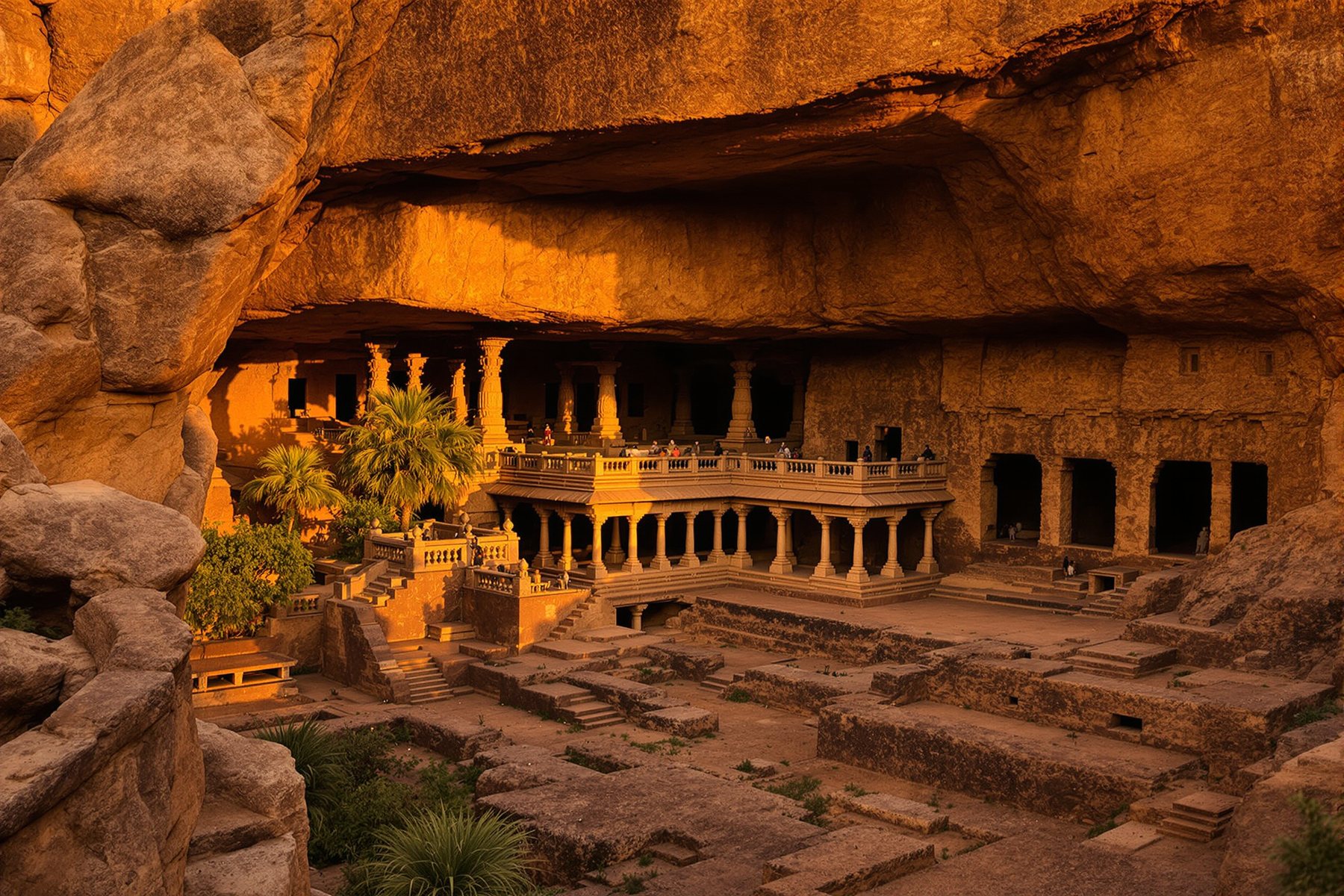
Badami: The Cradle of the South Indian Temple
How 6th-century Chalukya carvers, still working into a red sandstone cliff like the cave-makers before them, designed the porch, hall and sanctum that every later South Indian temple would copy — and shared one cliff between Shiva, Vishnu and the Jain Tirthankaras. The rock-cut laboratory where Dravidian architecture was born.
In the last article we stood inside Ajanta, where Buddhist monks hollowed whole painted halls out of a basalt cliff. Travel south and forward a few centuries, into the red sandstone country of northern Karnataka, and you find the rock-cutters still at work — but doing something new with the technique. At Badami, in the 6th century, the Early Chalukya dynasty cut four caves into a cliff above a green lake, and in them you can watch one of the most important things in all of Indian architecture actually happening: the South Indian temple being invented.
These are not the grandest caves in India, nor the most famous. But they may be the most _consequential_. Almost everything in the later wonders of this series — the porch and hall and sanctum of Brihadeeswara, the temple-cities of Hampi, the whole Dravidian tradition — has a parent here, in this rust-red rock.
This is the sixth article in our Architectural Wonders series. It is the hinge of the Indian story: the place where carving _into_ rock began to turn into building _out of_ it.
1. Four caves above a lake
Badami was once Vatapi, the capital of the Early Chalukyas, who from the 6th century ruled much of the Deccan. Above the town, over a beautiful green tank called Agastya Lake, rises a horseshoe of red sandstone cliffs — softer and warmer than Ajanta's hard black basalt, and a delight to carve. Into the southern cliff the Chalukyas cut four cave temples, climbing one above the other and linked by a rock-cut stair.
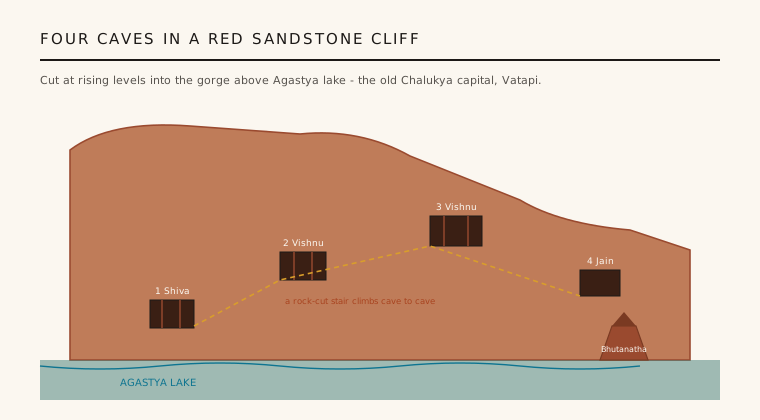
The lowest and earliest is dedicated to Shiva; the next two to Vishnu; and the highest is a Jain shrine. They span roughly the 6th to the early 8th centuries — and one of them, as we will see, carries a date that makes it a fixed star in the history of Indian art.
2. The plan that became every temple
Here is the heart of Badami's importance, and it is worth slowing down for. Walk into any one of these caves and you pass through the same sequence: a flight of steps, then an open pillared verandah (the _mukha mandapa_), then a larger columned hall (the _maha mandapa_), and finally, cut deepest into the rock at the end of the axis, a small square sanctum (the _garbhagriha_) holding the deity.
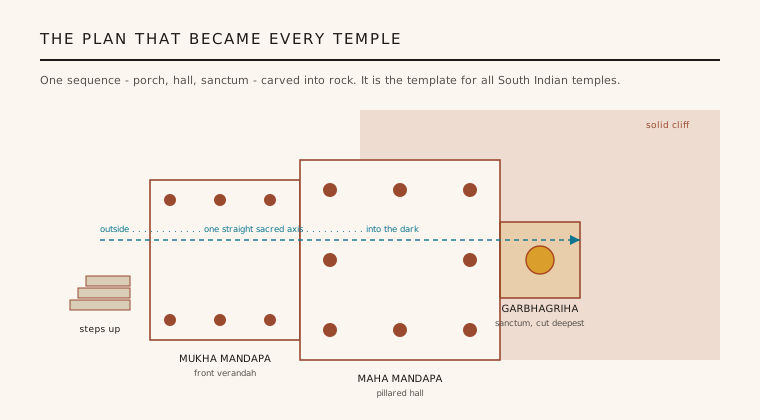
That sequence — porch, hall, sanctum, on one sacred axis running from daylight into darkness — is the fundamental grammar of the South Indian temple. Every later Dravidian temple, however vast, is a development of it. Brihadeeswara is this plan grown to colossal scale and crowned with a 216-foot tower; Hampi's temples are this plan multiplied across a city. And it is being worked out _here_, in the controlled, forgiving medium of solid rock, where you can carve a complete temple without first solving how to make it stand up.
That is why Badami is best understood as a laboratory. A rock-cut cave is a temple with the structural problem removed — the mountain holds the roof, so the architect is free to concentrate purely on the _form_: the proportions of the hall, the rhythm of the pillars, the placement of the sanctum, the relationship of the carving to the space. Badami is where those decisions got made, before anyone had to make them stand in the open air.
3. One cliff, three faiths' work
There is something quietly remarkable about the four caves taken together. Cut by the same dynasty, with the same chisels, to the same basic plan, they serve three different religions.
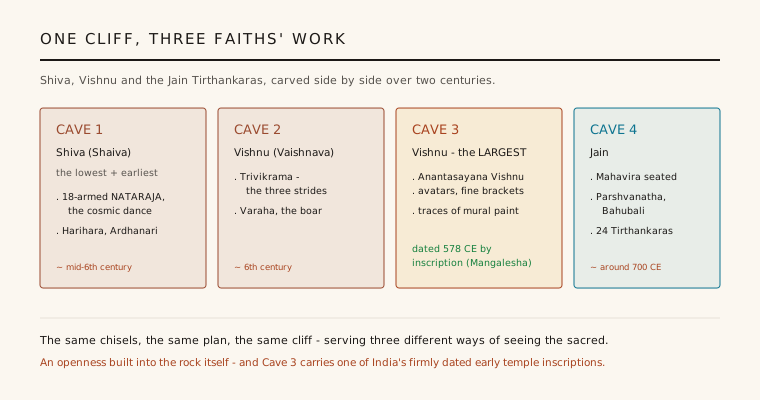
Cave 1 is Shaiva, dedicated to Shiva. Caves 2 and 3 are Vaishnava, dedicated to Vishnu. Cave 4 is Jain, holding Mahavira and the twenty-four Tirthankaras. Hindu and Jain worship, side by side in one cliff, carved across two centuries — an openness built into the rock itself.
And Cave 3, the largest and finest, gives historians something precious: an inscription dating its dedication to Saka 500, that is 578–579 CE, in the reign of the Chalukya king Mangalesha. Firmly dated early temples are rare; Cave 3 is one of the anchor points from which the whole chronology of early South Indian architecture is measured. It is also the richest — deep pillared halls, finely carved bracket figures, and on its ceilings the faded traces of painting, a direct cousin of the murals at Ajanta.
4. Stone set dancing
If the plans make Badami important, the sculpture makes it unforgettable. The Chalukya carvers handled the soft red sandstone with extraordinary freedom, cutting reliefs so deep the figures seem to stride out of the wall.
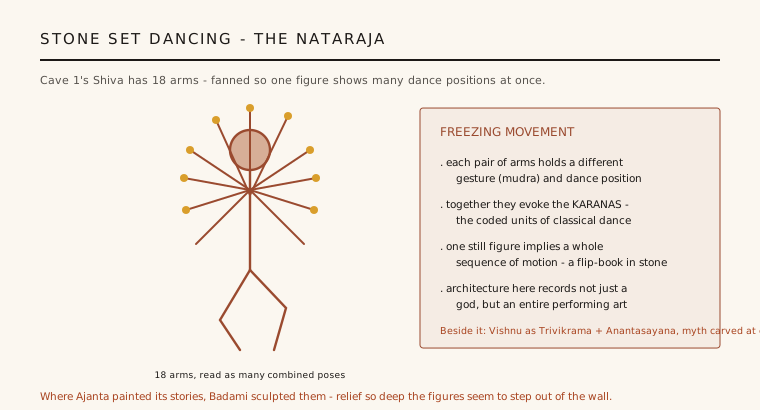
The masterpiece is in Cave 1: a great Nataraja — Shiva as lord of the dance — carved with eighteen arms, fanned out so that the single figure simultaneously displays many different hand-gestures and dance positions. It is traditionally read as encoding dozens of the karanas, the coded units of movement that underlie classical Indian dance: one still image that implies a whole sequence of motion, a flip-book frozen in stone. Where Ajanta _painted_ its stories, Badami sculpted them — and here it sculpted not just a god but an entire performing art.
The Vishnu caves answer in the same language at the same pitch: a colossal Trivikrama (Vishnu striding across the universe in three steps), a great Varaha (the boar avatar), and a serene Vishnu reclining on the cosmic serpent Ananta. These are among the founding images of South Indian sculpture, and the standard against which everything carved after them in the Deccan would be judged.
5. The cradle, and what outlived the city
Step back, and Badami's place in the story becomes clear. It is the cradle — and it sits at one corner of a remarkable triangle. Within a short distance are Aihole and Pattadakal, where the same Chalukyas, having rehearsed the temple in the rock at Badami, went on to build it in the open air, freestanding, experimenting boldly with both northern (Nagara) and southern (Dravida) tower forms. Together, Aihole–Badami–Pattadakal is often called the very birthplace of temple architecture in India, and Pattadakal is already a UNESCO World Heritage Site.
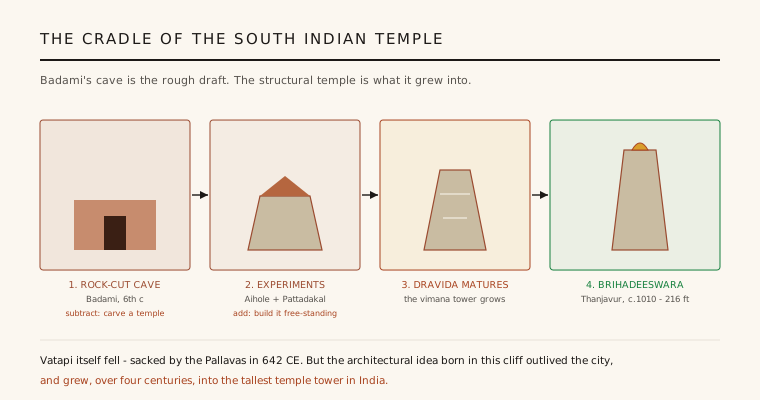
The arc runs straight from this cliff to the greatest stone towers of the south. Cut the temple into rock here at Badami; build it freestanding next door at Pattadakal; let the tower grow over the centuries; and you arrive, around the year 1010 and five hundred kilometres away, at the 216-foot vimana of Brihadeeswara.
There is a poignant coda. The Chalukya capital itself did not last. In 642 CE Vatapi was stormed and sacked by the Pallava king Narasimhavarman I, who took the proud title _Vatapikonda_, "conqueror of Vatapi." The city's golden age ended — and yet the architectural idea born in its cliff long outlived the empire that made it, travelling across South India and down the centuries. Like Konark, Hampi and Ajanta, Badami knows loss. But its truest legacy was never the city. It was the template.
6. What a modern architect can learn from Badami
- Prototype where mistakes are cheap. Badami's genius is that it worked out the temple in the one medium that let the architect ignore structure entirely and concentrate purely on form. Every good practice still needs a place to test ideas with the hard problems temporarily switched off — a sketch, a model, a rock-cut rehearsal. (It is the spirit our design education writing keeps coming back to.)
- Get the plan-sequence right and everything follows. The porch–hall–sanctum axis invented here governed a thousand years of temples at every scale. A clear, repeatable spatial sequence is worth more than any single beautiful detail.
- A strong framework welcomes difference. One plan, one cliff, one set of carvers served Shiva, Vishnu and the Jain Tirthankaras without strain. A robust architecture is general enough to host more than one way of living.
- Carve for movement, not just for stillness. The eighteen-armed Nataraja shows a static art reaching for time and motion. The most alive design implies what happens next, not only what is.
- Ideas outlast their patrons. Vatapi fell; the template it produced conquered the south. Build the idea well enough and it will travel far beyond the building, and the lifetime, that first held it.
References & further reading
1. UNESCO World Heritage Centre — Group of Monuments at Pattadakal (the Chalukya context). https://whc.unesco.org/en/list/239/
2. Encyclopaedia Britannica — Badami and Chalukya architecture. https://www.britannica.com/place/Badami
3. Archaeological Survey of India — Cave Temples, Badami. https://asi.nic.in/
4. Incredible India (Ministry of Tourism) — Cave Temples of Badami. https://www.incredibleindia.gov.in/en/karnataka/badami/cave-temples
Last verified 2026-06-30. Dates, dedications and cave attributions follow standard archaeological and ASI reference sources; the 578 CE date of Cave 3 follows its own inscription, and the 642 CE Pallava sack of Vatapi follows the established historical record. The reading of the Nataraja's arms as dance poses follows widely held art-historical tradition.
Export this guide
Related Guides — Deep-dive reading
Hampi: The Stone City of Vijayanagara
How a medieval South Indian empire built an entire capital out of the boulder field it stood on — granite that sings, a chariot carved in rock, two architectural worlds fused into one — and how the whole of it fell in a single year.
Architectural WondersAjanta: The Architecture Carved from Within
How ancient Buddhist monks hollowed thirty halls, monasteries and shrines out of a solid basalt cliff — from the top down, with no scaffolding — and painted, by lamplight, some of the greatest pictures of the ancient world. The rock-cut method, the murals, and the lesson.
Architectural WondersPattadakal: Where India's Two Temple Grammars Meet
How the 8th-century Chalukyas built the temple at last in the open air — and set the curved spires of the North beside the stepped towers of the South, on one riverbank, as if in a single open-air showroom of styles. The site that crowned kings, named its architects, and gave Ellora its model.
Architectural WondersRelated Tools — Try Free
Main Door Design Selector
Answer a few questions and get a main-door style — traditional, contemporary, luxury or budget-smart — plus material.
Design SelectorBefore & After Studio
Generate AI before-and-after renders to preview how your redesign could look.
DesignAIWindow Orientation Planner
Pick the best window type, glass and shading by wall direction — north, east, south and west.
Window Tool