
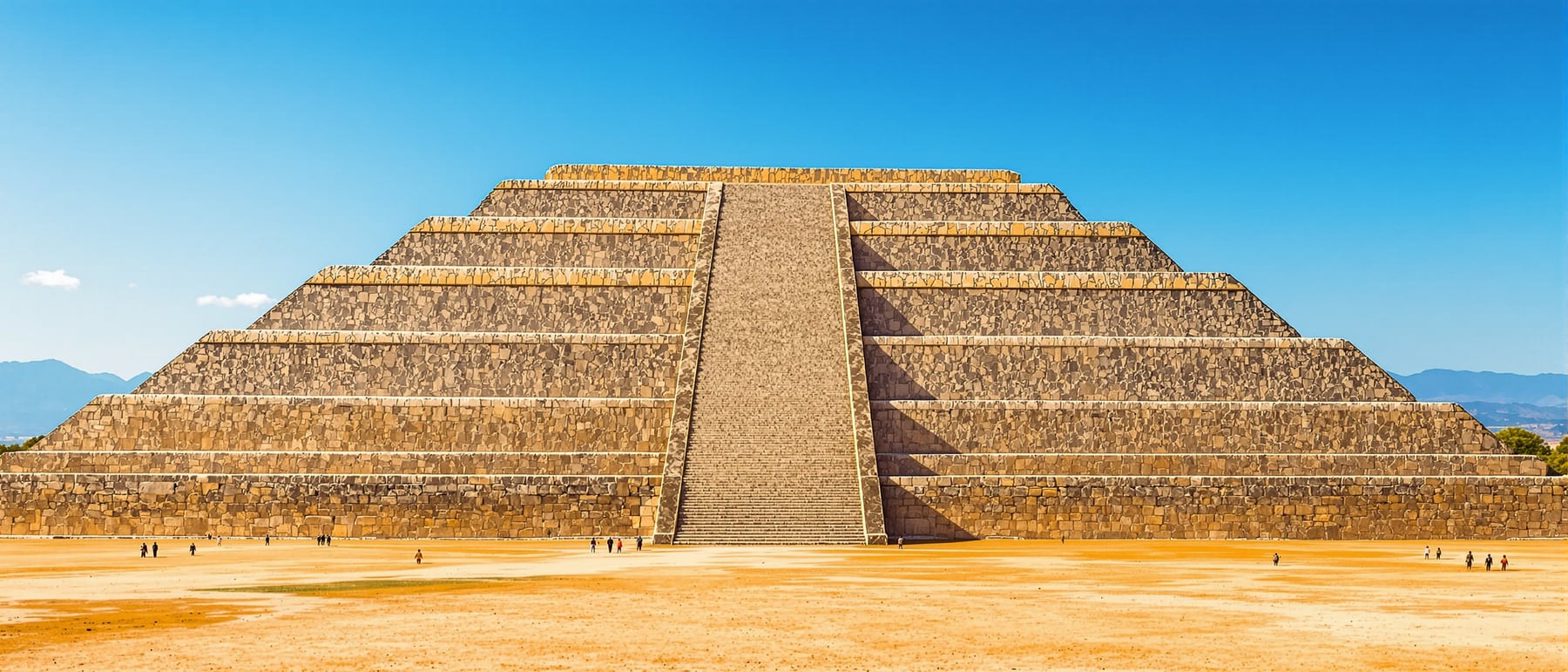
The Pyramid of the Sun: A Mountain Raised Over a Cave by a People With No Name
In the Valley of Mexico, a civilisation we cannot name built one of the largest pyramids on Earth — a man-made mountain of a million cubic metres — and set it precisely over a sacred cave they believed was the womb of the world. They left no writing we can read; even the words 'Pyramid of the Sun' were given, a thousand years later, by the Aztecs, who found the city in ruins and called it the birthplace of the gods.
From the Parthenon — a temple of modest size but infinite refinement, built by a people whose language, gods and history we know in intimate detail — we cross to the opposite of almost all of that. In the high Valley of Mexico stands the Pyramid of the Sun, one of the largest pyramids ever raised anywhere on Earth: not a jewel of subtle proportion but a colossal man-made mountain. And it was built by a civilisation about whom we know astonishingly little — so little that we cannot even tell you what they called themselves, their city, or this pyramid. Every name we use for it was given by someone else, a thousand years too late.
This is the fifty-fifth article in our Architectural Wonders series, and the eighth in our chapter on the great temples and sacred places of the world.
That is the strange power of this place. The Greeks left us their poets and philosophers; the builders of the Pyramid of the Sun left us no writing we can read, and then vanished. What they left instead was sheer, overwhelming scale, and a single, extraordinary secret buried beneath the pyramid's heart — a secret that tells us why this mountain of earth and stone was raised on this exact spot.
1. The city whose name we lost
To understand the pyramid, you have to stand in the dead city around it — and confront how little we know.
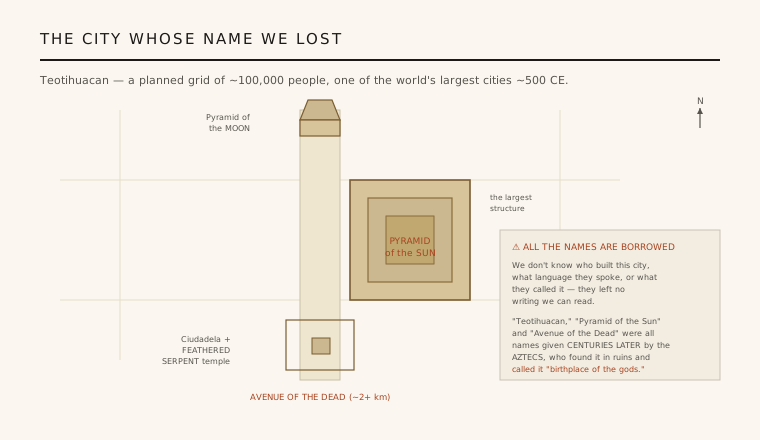
The pyramid stands in Teotihuacan, which around 500 CE was one of the largest cities in the entire world — a planned metropolis of perhaps 100,000 people, laid out on a strict grid, with multi-family apartment compounds, workshops, and painted murals. Its spine is a great avenue running north–south, and along it stand three colossal monuments: the Pyramid of the Moon at the north end, the Pyramid of the Sun rising on the east side, and, to the south, a walled compound called the Ciudadela holding the Temple of the Feathered Serpent (beneath which archaeologists have found the remains of some 200 sacrificed people — though that grim discovery belongs to that temple, not the Sun pyramid). Here is the humbling part: we do not know who built any of it. The people of Teotihuacan left no readable writing, and their city was already an ancient ruin when the Aztecs came upon it, centuries later. It was the Aztecs, awestruck, who named the place Teotihuacan — "the place where the gods were created" — and who gave us "Pyramid of the Sun," "Pyramid of the Moon," and "Avenue of the Dead." Not one of these is the builders' own word. We are looking at one of humanity's greatest cities through a borrowed name.
2. The mountain of the sun
The pyramid itself is, before anything else, an act of almost unimaginable labour and scale.
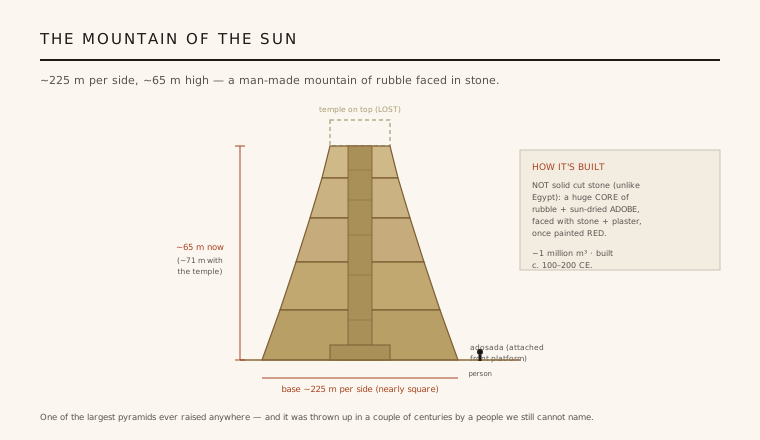
It is a stepped pyramid of about five sloping tiers, roughly 225 metres on each side at the base — nearly as wide as the Great Pyramid of Giza — and about 65 metres high today, one of the largest pyramids ever built, holding around a million cubic metres of material. But it is built quite differently from an Egyptian pyramid. It is not a solid mass of precisely cut stone; it is a huge core of rubble and sun-dried adobe brick, faced on the outside with a skin of stone and plaster, and once painted a deep red. A broad staircase climbs its western front, and a lower attached platform, the adosada, was added at its foot. On the very summit — bare today — there once stood a temple, so the whole thing originally rose higher, perhaps 71 metres. Most of it was raised in a burst of building around 100 to 200 CE. Think about what that means: a people with no metal tools, no wheels for transport, and no draft animals piled up a million cubic metres of earth and stone into a mountain — and did it, essentially, in a couple of generations. The scale is not decoration. As we are about to see, the pyramid is a mountain on purpose.
3. The cave beneath
In 1971, archaeologists discovered the secret that explains everything — why the pyramid is here, and why it takes the form of a mountain.
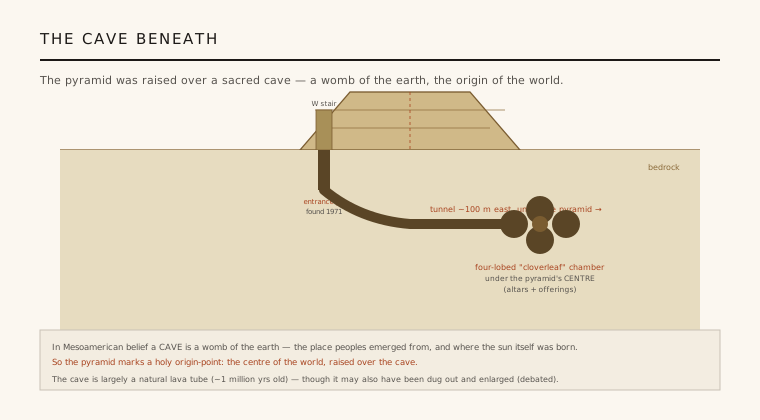
Beneath the pyramid's western staircase, an archaeologist found the entrance to a cave — a tunnel running about 100 metres east, directly under the pyramid, and ending in a strange four-lobed, "cloverleaf" chamber right below the pyramid's centre. The chamber had been deliberately shaped and used, with altars and offerings. The cave is largely a natural lava tube (formed roughly a million years ago), though there is debate over how much of it was later dug out and enlarged by human hands. And this is the key that unlocks the whole monument. In Mesoamerican belief, a cave was sacred — a womb of the earth, the dark place from which peoples first emerged into the world, and, in some traditions, the very place the sun and moon were born. To build over such a cave was to claim the origin-point of creation itself. So the Pyramid of the Sun was almost certainly raised on this exact spot because of the cave beneath it — a man-made mountain marking the centre of the world, a stairway between the underworld womb below and the sky above. The scale suddenly makes sense: they were not building a big temple. They were building a mountain over the door to creation.
4. Aligned to mountain and sun
And the placement goes further still: the pyramid, and the entire city around it, are locked onto the sky.
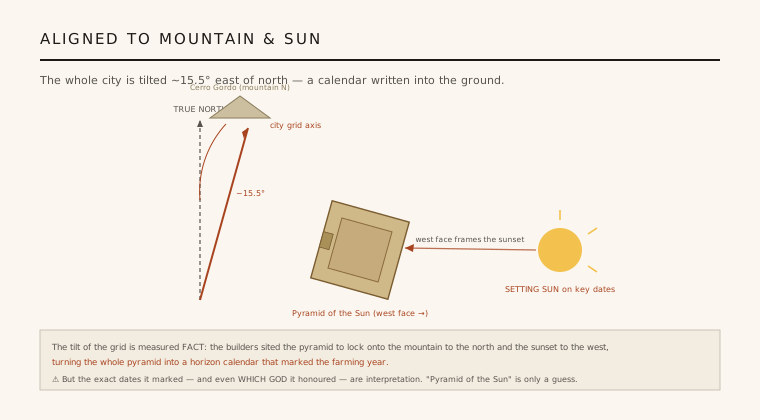
The whole grid of Teotihuacan is deliberately tilted about 15.5 degrees east of true north — and the Pyramid of the Sun shares that tilt exactly. This was no accident of terrain. The builders sited the pyramid so that it lines up northward with a prominent mountain, Cerro Gordo, and so that its broad western face frames the setting sun on certain key days of the year — turning the pyramid into a giant calendar marker against the horizon, tracking the farming year and the great festivals. It is the same instinct we saw in Stonehenge and Abu Simbel: architecture used as an astronomical instrument, welding the building to the movement of the heavens. Two honest cautions belong here. The tilt itself is measured fact, and the mountain-and-sunset siting is well established. But the exact dates the alignment marked, and their precise meaning, are matters of interpretation and debate — and, remember, even the very name "Pyramid of the Sun" is only a guess. We do not actually know which god, or which power of the sky, this mountain was raised to honour.
5. The burning, and the Aztec pilgrims
Teotihuacan's story has a violent end — and, centuries later, a second life that gave the ruins their meaning and their names.
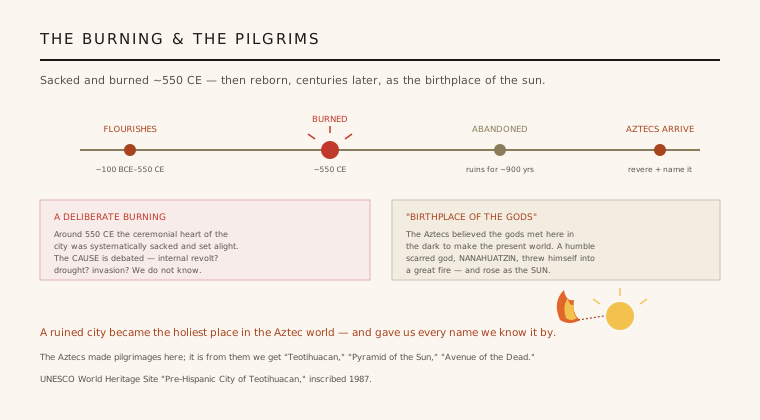
For centuries Teotihuacan was the dominant power in Mesoamerica, its influence reaching as far as the distant Maya cities. Then, around 550 CE, catastrophe: the great monuments along the avenue were deliberately sacked and set on fire — the ceremonial heart of the city burned in what looks like a violent, targeted destruction. Over the next century or two the city was largely abandoned. Why? We genuinely do not know: the leading theories include an internal revolt against the ruling elite, a prolonged drought, or invasion — perhaps some combination. The people who raised the greatest city in the Americas slipped out of history, leaving their mountain to the grass. And then, roughly nine hundred years later, the Aztecs arrived in the valley, found the vast silent ruins, and were overwhelmed. They decided this could only be where the gods themselves had gathered, in the darkness before the present age, to create the world and its sun. In their myth, the gods met at Teotihuacan and asked who would sacrifice themselves to become the sun; a humble, scarred little god named Nanahuatzin threw himself into a great fire and rose, reborn, as the blazing sun. That is why the Aztecs called the place the birthplace of the gods, made pilgrimages to it, and gave its monuments the names — "Pyramid of the Sun," "Avenue of the Dead" — that we still use today. A dead city became the holiest ground of a new empire. It was inscribed as the UNESCO World Heritage Site "Pre-Hispanic City of Teotihuacan" in 1987.
6. What a modern architect can learn from the Pyramid of the Sun
- Sometimes the site chooses the building. The pyramid is where it is, and shaped as it is, because of the cave beneath it. The most powerful architecture often begins by reading what is already sacred, or special, in a place — and building to reveal it, not to override it.
- Form can be an argument. By raising a literal mountain over the door to creation, the builders made a claim — that this was the centre of the world — in a language everyone could read without words. Other traditions would make the same cosmic claim with the opposite gesture — not a solid mountain but a hollow dome of light, like the Roman Pantheon. A building's shape and scale can state an idea more forcefully than any inscription.
- Monuments outlive the meanings we give them. The same pyramid was a Teotihuacano axis-mundi, then an Aztec birthplace-of-the-sun, and is now an archaeological wonder. Build something great enough and later ages will pour their own meanings into it — you cannot control, only enable, that afterlife.
- You can move mountains without machines. No metal, no wheels, no draft animals — and yet a million cubic metres of mountain. It is a reminder that the deepest resource in building has always been organised human will, not technology.
- Be honest about the limits of knowledge. Almost everything here — the builders' name, the pyramid's god, the reason for the fire — is unknown, and the responsible thing is to say so plainly. Confident certainty about the distant past is usually a story we are telling ourselves.
- What we cannot name, we can still honour. We may never know who built this, but we can stand before their mountain in awe and respect. A work can outlive even the memory of its makers — and still speak.
References & further reading
1. UNESCO World Heritage Centre — Pre-Hispanic City of Teotihuacan (inscribed 1987). https://whc.unesco.org/en/list/414/
2. World History Encyclopedia — Teotihuacan and Pyramid of the Sun. https://www.worldhistory.org/Teotihuacan/
3. Smarthistory — Teotihuacan. https://smarthistory.org/teotihuacan-2/
4. The Metropolitan Museum of Art — Teotihuacan: Pyramids of the Sun and the Moon. https://www.metmuseum.org/essays/teotihuacan-pyramids-of-the-sun-and-the-moon
5. Encyclopaedia Britannica — Pyramid of the Sun and Teotihuacan. https://www.britannica.com/place/Pyramid-of-the-Sun
6. Sugiyama, Saburo, et al. — Arizona State University Teotihuacan research (tunnels, offerings, chronology). https://teo.asu.edu/
*Last verified 2026-07-04. Figures follow UNESCO, the World History Encyclopedia, Smarthistory, the Metropolitan Museum of Art and Britannica, and are given as widely cited approximations that vary by source. The Pyramid of the Sun is the largest structure at Teotihuacan, a ruined city in the Valley of Mexico (~40 km NE of Mexico City). Teotihuacan flourished c. 100 BCE–550 CE, peaking around 1–500 CE as one of the largest cities in the world (est. ~100,000+ people). The pyramid's base is ~220–225 m per side; height ~63–66 m today (~71–75 m originally, with a lost summit temple); volume ~1 million m³; a rubble/sun-dried-adobe core faced with stone and plaster, once painted red; built chiefly c. 100–200 CE (an adosada platform added later). The BUILDERS are unknown: no deciphered writing, ethnicity/language debated; the names "Teotihuacan" ("birthplace of the gods"), "Pyramid of the Sun," "Pyramid of the Moon" and "Avenue of the Dead" were all given later by the Aztecs, who found the city in ruins. Which deity the pyramid honoured is unknown ("Pyramid of the Sun" is a later guess). CAVE: in 1971 a cave was found under the west staircase — a ~100 m tunnel (largely a natural lava tube, possibly partly artificially enlarged/dug) ending in a four-lobed "cloverleaf" chamber under the pyramid's centre, ritually modified; in Mesoamerican belief caves were sacred origin/emergence places (wombs of the earth), and the pyramid was likely sited to sit over it (axis mundi). ALIGNMENT: the pyramid and the whole city grid are tilted ~15.5° east of north, sited to align to Cerro Gordo (north) and to sunrises/sunsets on key dates (a horizon calendar) — the orientation is measured fact, but the specific dates/meanings are interpretive. The mass sacrificial burials (~200 individuals) are at the Temple of the Feathered Serpent, NOT the Pyramid of the Sun. COLLAPSE: the ceremonial core was deliberately sacked and burned c. 550 CE; causes debated (internal revolt, drought, invasion); largely abandoned over the following century or two. The Aztecs arrived ~900 years later, revered it as the birthplace of the gods / the Fifth Sun (Nanahuatzin's fire-sacrifice myth) and named it. UNESCO World Heritage Site "Pre-Hispanic City of Teotihuacan," inscribed 1987.
Export this guide
Related Guides — Deep-dive reading
Cahokia and Monks Mound: The Great City America Forgot
A thousand years ago, across the river from where St Louis now stands, Native Americans built a city of perhaps twenty thousand people — larger than London at the time — with a hundred and twenty earthen mounds, a plaza the size of dozens of football fields, and a solar calendar of cedar posts. At its heart rose Monks Mound, the largest earthwork in the Americas, with a footprint to rival the Great Pyramid. Then, before Europeans ever arrived, it vanished — and almost no one remembers it.
Architectural WondersĠgantija: The Oldest Temple Standing, Built by 'Giants'
How a Neolithic island people on Malta — with no metal and no wheel — raised the oldest free-standing stone temples on Earth a thousand years before Stonehenge or the pyramids, moving fifty-tonne blocks on stone balls into clover-leaf sanctuaries for a faith we can trace but cannot read, then vanished, leaving stones so vast that later islanders swore only giants could have built them.
Architectural WondersThe Moche Pyramids: Mountains of Mud, Gods of Blood
How a writing-less people on Peru's desert coast raised the largest mud-brick structure in the Americas from 130 million hand-made bricks, buried temple within painted temple beneath the face of a fanged god who demanded human blood, hid a king in gold no looter found for 1,700 years — and were undone at last by the very floods they had killed to appease.
Architectural WondersRelated Tools — Try Free
Window Orientation Planner
Pick the best window type, glass and shading by wall direction — north, east, south and west.
Window ToolAI BOQ Generator
AI generates detailed Bill of Quantities with city-specific rates and labour breakdown.
ArchitectAIBefore & After Studio
Generate AI before-and-after renders to preview how your redesign could look.
DesignAI