
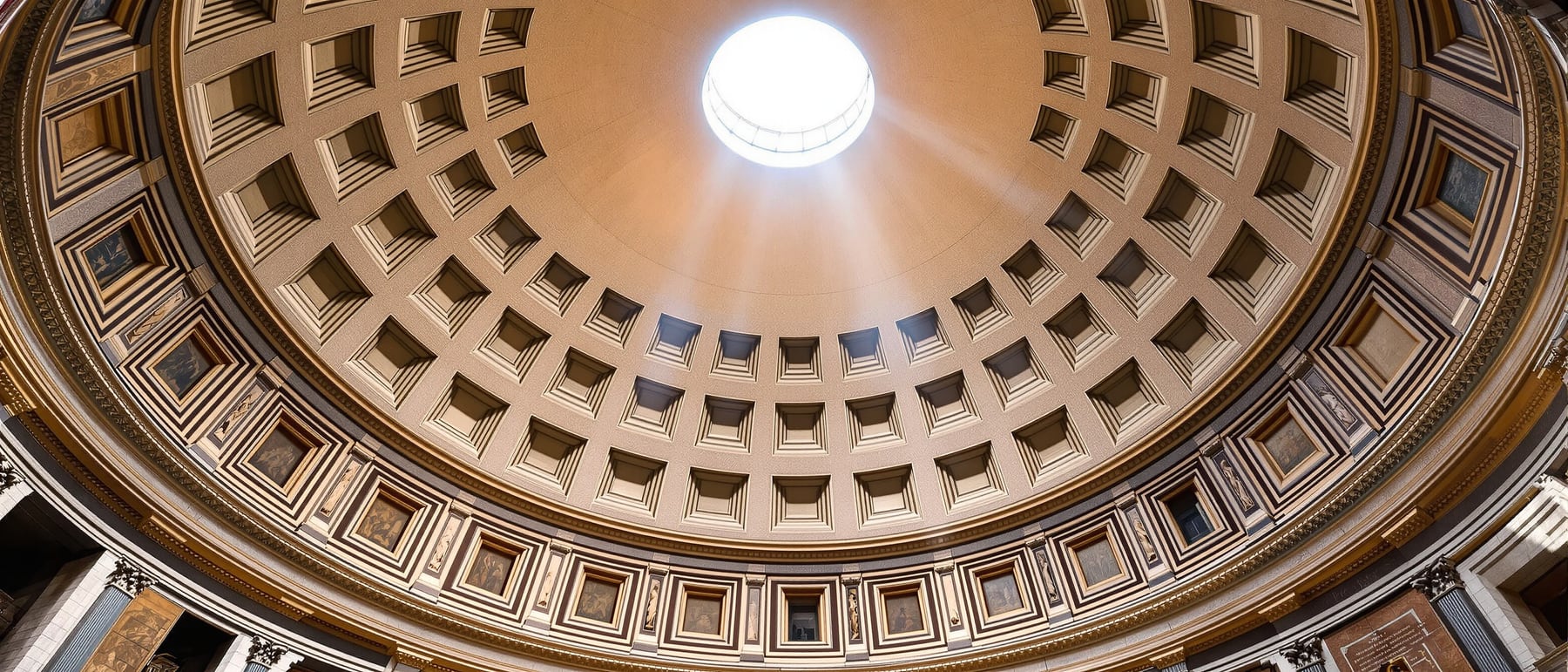
The Pantheon: The Dome That Has Never Been Beaten
Nearly nineteen centuries ago the Romans poured a hemisphere of concrete 43 metres across, left a single round hole open to the sky at its summit, and walked away — and it is still, today, the largest unreinforced concrete dome on Earth. A temple to all the gods that became a church, the best-preserved building of ancient Rome, and the ancestor of every great dome from Florence to the United States Capitol.
From the Pyramid of the Sun — a solid mountain of a monument, all mass, that you cannot enter and that was raised by a people we cannot name — we come to almost its exact inverse. The Pantheon in Rome is a masterpiece not of mass but of void: its whole genius is the immense, hollow, light-filled space inside it. And where the builders of Teotihuacan vanished namelessly, we know the Pantheon's story in detail — the emperor who built it, the inscription on its front, even the joke Romans told about the pope who looted it. It is one of the very few buildings in this series you can still walk into today and see, essentially, as the ancients did.
This is the fifty-seventh article in our Architectural Wonders series, and the tenth in our chapter on the great temples and sacred places of the world.
The single most astonishing fact about it is this: nearly nineteen centuries after it was finished, the Pantheon's dome is still the largest unreinforced concrete dome in the world. No one — through the entire Middle Ages, the Renaissance, the Industrial Revolution, right up to the age of steel — built a bigger one out of plain concrete. It had already eclipsed the greatest dome of the older world, the corbelled stone beehive of the Treasury of Atreus, which had held the record for well over a thousand years. The Romans got there first, and, in this one respect, no one has ever surpassed them.
1. The temple to all the gods
Its name tells you its ambition, and its front tells you a small, delicious lie.
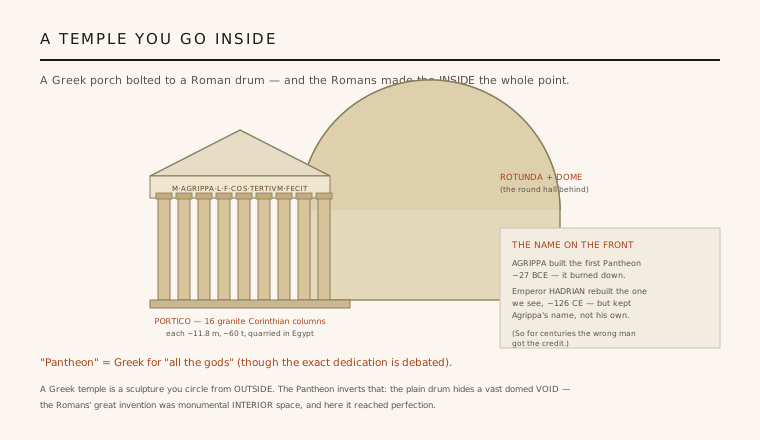
The word "Pantheon" comes from the Greek for "all the gods" — though what exactly it was dedicated to, and how it was used, is still debated. The building has two parts that do not quite belong together: a Greek-style portico (a deep porch of sixteen towering Corinthian columns of grey and pink Egyptian granite, each about 11.8 metres tall and weighing some 60 tonnes) bolted to the front of a giant Roman rotunda — a cylindrical drum capped by the great dome. And across that portico runs a famous inscription: "M·AGRIPPA·L·F·COS·TERTIVM·FECIT" — "Marcus Agrippa, son of Lucius, three-times consul, made this." For centuries, people believed it. But Agrippa's Pantheon, built around 27 BCE, had burned down. The building we actually see was rebuilt from scratch by the emperor Hadrian, around 126 CE — the same restless emperor-architect who would build himself the great pleasure-villa at Tivoli — and Hadrian, in a striking act of modesty (or shrewd political theatre), put the old name back on the front and left his own off entirely. Only much later did brick-stamps give away the true builder. (The dating is genuinely uncertain because of that re-inscription, and some scholars think construction may even have begun under Hadrian's predecessor, Trajan.) Above all, notice the thing that makes the Pantheon Roman: a Greek temple like the Parthenon is a sculpture to be admired from outside; the Pantheon's plain brick drum hides its glory within. The Romans' great gift to architecture was the mastery of interior space — and here it reached perfection.
2. A perfect sphere of space
Step inside, and the whole design resolves into one breathtaking idea: pure geometry.
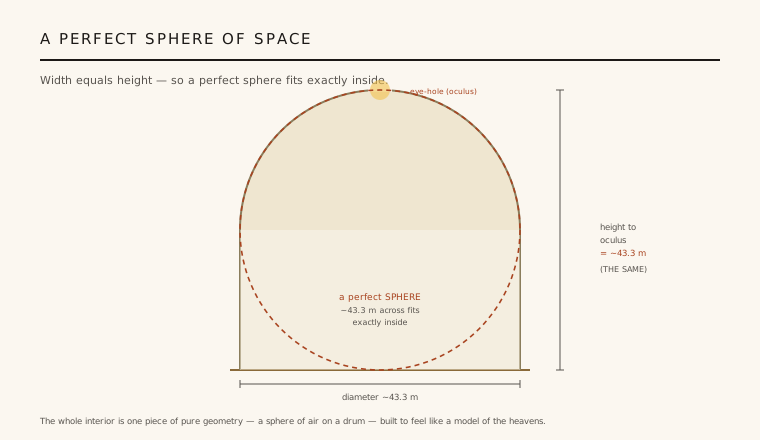
The interior is a cylinder crowned by a perfect hemisphere. And here is the magic: the diameter of the floor (about 43.3 metres) is exactly equal to the height from the floor to the top of the dome. That means you could drop a perfect sphere, 43.3 metres across, into the building and it would fit exactly — just kissing the floor and the crown of the dome. The whole space is a single, pure, resolved piece of geometry: a sphere of air. This was not an accident or a mere flourish; to the Romans, the sphere and the circle were the shapes of the cosmos, of perfection and eternity. To stand at the centre is to stand inside a deliberate model of the heavens — the curved dome overhead standing in for the vault of the sky. Few buildings before or since have expressed so much with so little: not statues, not ornament, but the sheer, calm, overwhelming harmony of a shape.
3. The dome that has never been beaten
That serene sphere sits on top of one of the greatest engineering achievements in human history — and the cleverness is almost entirely hidden.
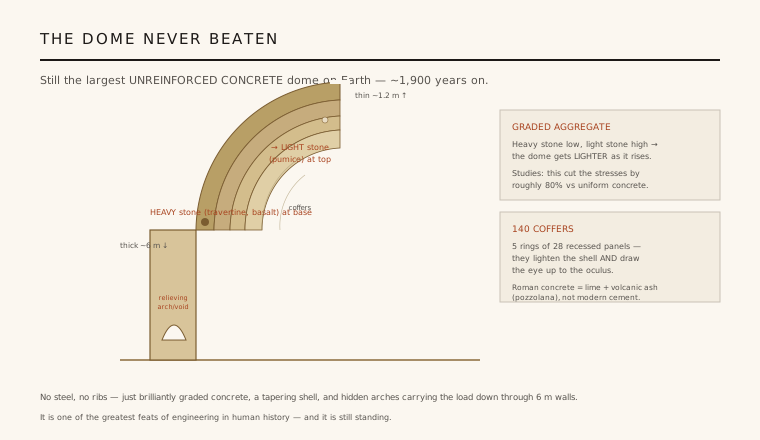
The dome is made of Roman concrete — not the steel-reinforced kind we use today, but the ancient recipe of lime and volcanic ash (pozzolana) mixed with stone rubble. A dome this size should, by rights, crack and collapse under its own weight. It has not, for three reasons the Romans worked out with astonishing intelligence. First, graded aggregate: the concrete is mixed with heavy stone (dense travertine and basalt) low down, and progressively lighter stone the higher it goes — ending in feather-light pumice near the top — so the dome literally grows lighter as it rises. (Studies estimate this cut the internal stresses by around 80% compared with using one uniform concrete.) Second, the shell tapers, from about 6 metres thick at the base to only about 1.2 metres at the rim of the opening. Third, the coffers — the five rings of 28 recessed square panels (140 in all) that give the dome its beautiful lattice — carve away yet more weight, while the massive 6-metre-thick drum walls below are themselves hollowed out with hidden relieving arches to funnel the load safely to the ground. None of this shows. You see only a serene, coffered heaven. The genius is invisible, and it has held for nineteen hundred years.
4. The eye
And then there is the single detail that turns a brilliant building into a sublime one — a hole.
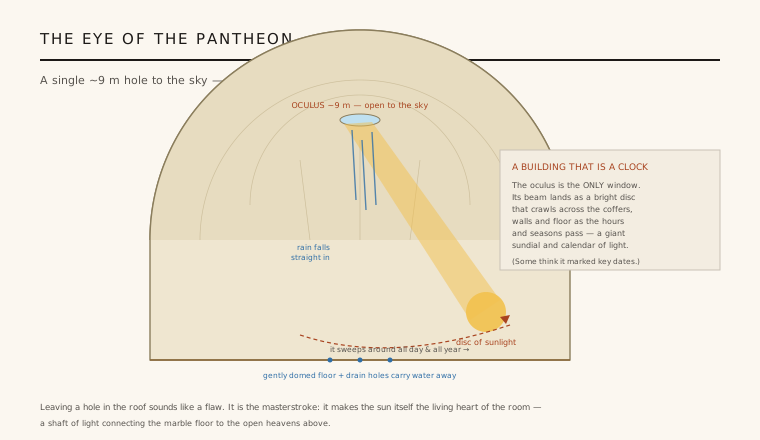
At the very top of the dome is the oculus — Latin for "eye" — a single round opening about 9 metres across, open to the sky. It is the building's only source of light. There are no windows; all illumination pours from this one bright disc of sky. And because it is a fixed hole and the sun is always moving, the shaft of light it admits becomes a living thing: it strikes the coffered dome and the marble walls as a great glowing disc that sweeps slowly around the interior through the hours of the day and the seasons of the year. The Pantheon is, in effect, a colossal sundial and calendar — a machine for catching the sun, in the same spirit as Stonehenge or Abu Simbel (or, aimed instead at the moon, the Newark Earthworks in Ohio). Leaving a permanent hole in your roof sounds like a defect; it is the masterstroke. (Yes, the rain comes straight in — but the marble floor is subtly domed and drilled with drains that carry the water away, a detail as clever as the dome itself.) That single beam of moving light, connecting the marble floor to the open heavens, is why people fall silent when they walk in. The building doesn't depict the divine; it stages an encounter with the sky.
5. Why it still stands
Almost every other great building of ancient Rome is a ruin. The Pantheon is not — and the reason is a quiet accident of faith.
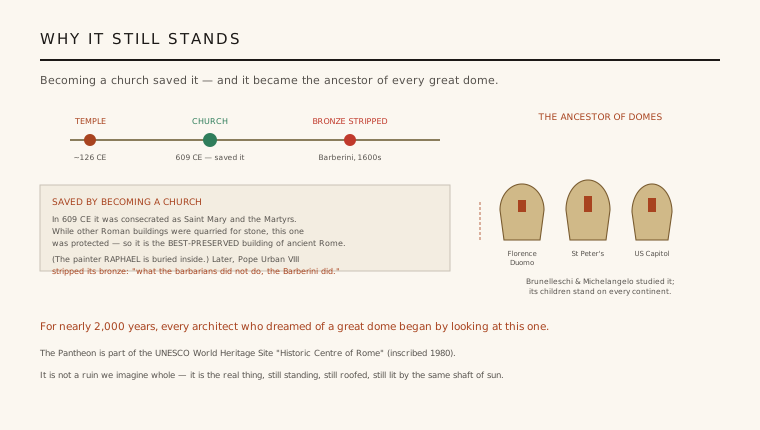
In 609 CE, the Pantheon was given to the Pope and consecrated as a Christian church — Santa Maria ad Martyres, "St Mary and the Martyrs." That single act saved it. While the temples and basilicas around it were stripped for building stone across the Middle Ages, the Pantheon, now sacred to a new faith, was protected — which is why it survives as the best-preserved building of ancient Rome, still roofed, still whole, still lit by the same shaft of sun. It did not escape entirely unscathed: in the 1600s Pope Urban VIII, of the Barberini family, had the ancient bronze stripped from the portico and melted down (largely for cannon), prompting a bitter Roman pun — "quod non fecerunt barbari, fecerunt Barberini" — "what the barbarians did not do, the Barberini did." Inside, among its tombs, lies the great Renaissance painter Raphael, who asked to be buried here. And the building's true legacy is everywhere: for nearly two thousand years, every architect who dreamed of a great dome began by studying this one. Brunelleschi's dome in Florence, Michelangelo's at St Peter's, the domes of the United States Capitol and countless capitols and rotundas and libraries around the world are all, in a real sense, children of the Pantheon. It is part of the UNESCO World Heritage Site "Historic Centre of Rome" (inscribed 1980) — and, unusually for this series, it is not a wonder we must imagine whole. It is simply still here.
6. What a modern architect can learn from the Pantheon
- Architecture can be about the space you enclose, not the mass you pile up. The Pantheon's subject is the void — the shaped emptiness inside. It is a permanent reminder that the material of architecture is not only stone and concrete but space itself, and that a room can be the masterpiece.
- Let one pure idea govern everything. A sphere that fits exactly inside the walls; a single circle of light. The Pantheon's power comes from radical simplicity — one geometric idea, followed without compromise. Clarity of concept can outshine any amount of decoration.
- Hide the cleverness; show the calm. The graded concrete, the tapering shell, the buried arches — all the brilliant engineering is invisible. The visitor feels only serenity. The highest craft often works hardest to look effortless.
- A single, well-placed opening can be worth a thousand windows. The oculus does more with one hole than most buildings do with a whole façade of glass. Where and how light enters is a design decision of the first order — sometimes the most powerful one available.
- Meaning can be permanence's price of admission. The Pantheon survived because it was given a living purpose — a temple that became a church. Buildings that stay useful, and loved, are the ones that last; a monument with no role becomes a quarry.
- Set a standard and it can stand for millennia. Nineteen centuries, and no one has poured a larger unreinforced concrete dome. Do one thing supremely well, and you may not merely influence what comes after — you may define its outer limit.
References & further reading
1. UNESCO World Heritage Centre — Historic Centre of Rome (inscribed 1980; includes the Pantheon). https://whc.unesco.org/en/list/91/
2. World History Encyclopedia — Pantheon. https://www.worldhistory.org/Pantheon/
3. Smarthistory — The Pantheon (Rome). https://smarthistory.org/the-pantheon-rome/
4. Encyclopaedia Britannica — Pantheon, Rome. https://www.britannica.com/topic/Pantheon-building-Rome
5. Moore, David — The Pantheon's dome and Roman concrete (engineering analysis; graded aggregate). https://www.romanconcrete.com/
6. Mark, R. & Hutchinson, P. — "On the Structure of the Roman Pantheon," The Art Bulletin (1986). https://www.jstor.org/stable/3050861
*Last verified 2026-07-04. Figures follow UNESCO, the World History Encyclopedia, Smarthistory, Britannica and standard structural analyses (Mark & Hutchinson; Moore), and are given as widely cited approximations that vary by source. The Pantheon stands in Rome; it is a former Roman temple, since 609 CE the church of Santa Maria ad Martyres ("St Mary and the Martyrs"). The present building was completed under the emperor Hadrian, probably dedicated c. 126 CE (construction c. 113/114–126 CE; dating uncertain because Hadrian re-used Agrippa's inscription — "M·AGRIPPA·L·F·COS·TERTIVM·FECIT"; some scholars date the start to Trajan's reign). It replaced Marcus Agrippa's original Pantheon (c. 27 BCE, under Augustus), which burned. "Pantheon" = Greek "of all the gods"; the exact dedication/function is debated. The portico has 16 Corinthian columns of Egyptian granite (~11.8 m, ~60 t each). The rotunda's interior is a cylinder + hemispherical dome with interior diameter ≈ height ≈ 43.3 m (a perfect sphere fits inside). The dome is the LARGEST UNREINFORCED CONCRETE DOME in the world (still, ~1,900 years on): Roman concrete (lime + pozzolana + aggregate), with graded aggregate (heavy travertine/basalt low → light pumice high, reducing stresses ~80% per Mark & Hutchinson), a shell tapering from ~6.4 m at the base to ~1.2 m at the oculus, 140 coffers (5 rings of 28), and ~6 m drum walls hollowed with relieving arches. The OCULUS is a ~9 m (≈8.9 m) opening at the dome's crown, open to the sky, the only light source; the sunbeam sweeps the interior like a sundial; rain enters and drains through the gently domed marble floor. SURVIVAL: converted to a church in 609 CE (Byzantine emperor Phocas → Pope Boniface IV), which preserved it as the best-preserved building of ancient Rome; Pope Urban VIII (Barberini) stripped the portico bronze in the 1600s ("quod non fecerunt barbari, fecerunt Barberini"; the roof-tile bronze had been removed earlier, 663 CE, by Constans II); Raphael and Italian kings are buried inside. INFLUENCE: the prototype for later domes (Brunelleschi's Florence Duomo, Michelangelo's St Peter's, the US Capitol, and countless others). Part of the UNESCO World Heritage Site "Historic Centre of Rome" (inscribed 1980).
Export this guide
Related Guides — Deep-dive reading
Hadrian's Villa at Tivoli: The Emperor Who Rebuilt the World He Loved
The Roman emperor Hadrian had travelled almost the whole of his vast empire — and then, in the hills outside Rome, he built himself a private pleasure-world the size of a city, where he recreated the places he had loved on his journeys. It is a memory-palace of an entire empire, a laboratory of daring curved concrete a millennium and a half ahead of its time, and a monument quietly shaped by grief. The fifth article in our chapter on the palaces and pleasures of worldly power.
Architectural WondersThe Newark Earthworks: A Cathedral of Earth Aligned to the Moon
Two thousand years ago, in what is now Ohio, Native American people raised the largest set of geometric earthworks on Earth — mile-wide circles, a perfect octagon, squares and avenues, all shaped from piled soil without metal, wheels or writing. And they aligned one of them, with astonishing precision, to the full 18.6-year cycle of the moon. Much was bulldozed for a city; one great piece spent over a century as a golf course; in 2023 it finally became a UNESCO World Heritage Site.
Architectural WondersĠgantija: The Oldest Temple Standing, Built by 'Giants'
How a Neolithic island people on Malta — with no metal and no wheel — raised the oldest free-standing stone temples on Earth a thousand years before Stonehenge or the pyramids, moving fifty-tonne blocks on stone balls into clover-leaf sanctuaries for a faith we can trace but cannot read, then vanished, leaving stones so vast that later islanders swore only giants could have built them.
Architectural WondersRelated Tools — Try Free
Concept Generator
Get 3 AI-generated design concepts for any room with style, materials, and cost estimate.
DesignAIMaterial Schedule Generator
Generate a room-wise finish schedule — walls, floors, ceilings, trim, and joinery by location.
Material ScheduleBefore & After Studio
Generate AI before-and-after renders to preview how your redesign could look.
DesignAI