
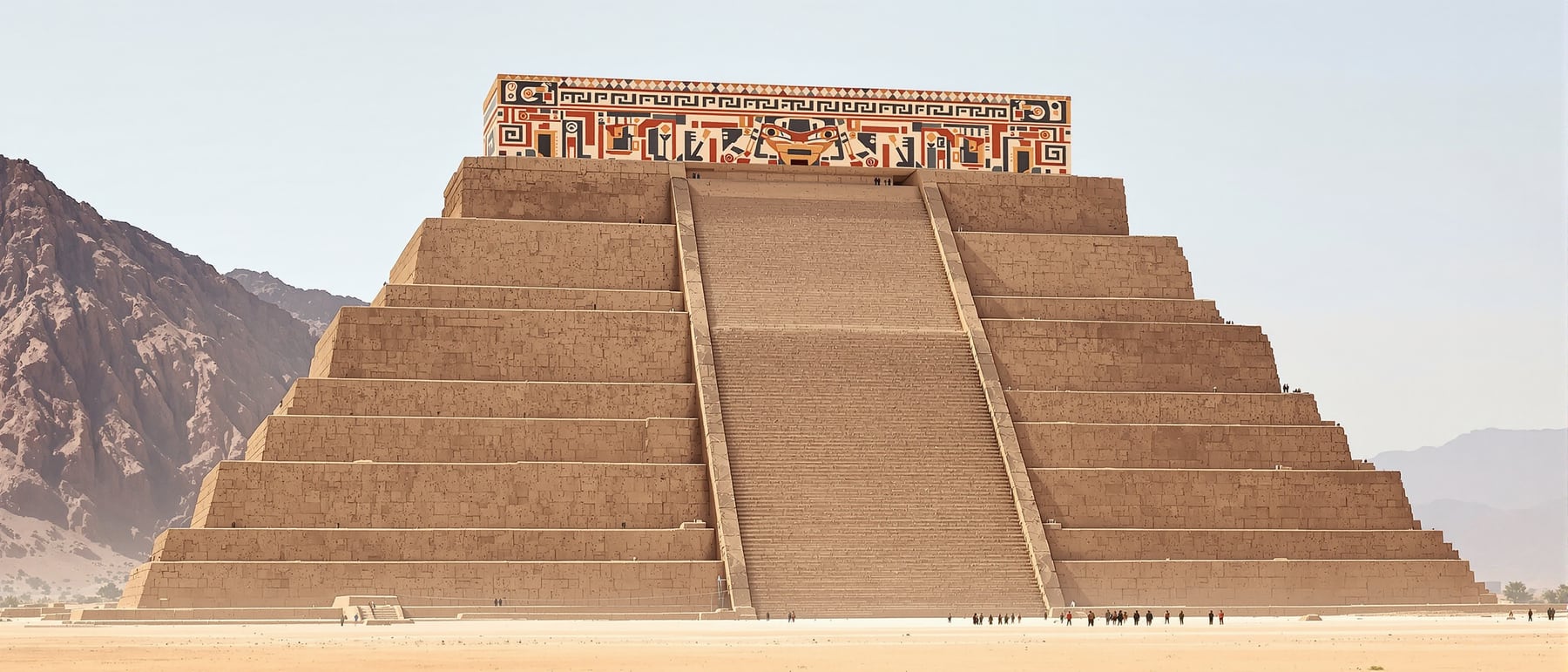
The Moche Pyramids: Mountains of Mud, Gods of Blood
How a writing-less people on Peru's desert coast raised the largest mud-brick structure in the Americas from 130 million hand-made bricks, buried temple within painted temple beneath the face of a fanged god who demanded human blood, hid a king in gold no looter found for 1,700 years — and were undone at last by the very floods they had killed to appease.
We cross an ocean now, to the desert coast of Peru, and to a people utterly unlike any we have met — a civilisation with no writing, no single empire, and no stone to build with, who nonetheless raised pyramids to rival the greatest in this series. They were the Moche, and they built their mountains not of granite or marble but of mud — sun-dried brick, shaped by hand and stacked by the hundred million, into the largest adobe structures in all the Americas.
And what they built for and inside those mountains is one of the most vivid, beautiful and disturbing stories in the whole history of tombs: painted temples buried within painted temples; the snarling face of a fanged god who held a knife and a severed head; courtyards where captives were sacrificed to appease the floods; and, hidden deep in the adobe, a king dressed in gold that no looter found for seventeen centuries. This is a civilisation that reached the heights of art and the depths of terror at once.
This is the forty-fourth article in our Architectural Wonders series.
1. Pyramids of mud
Begin with the sheer, improbable scale — because to build a pyramid out of mud, in the numbers the Moche did, is its own kind of miracle.
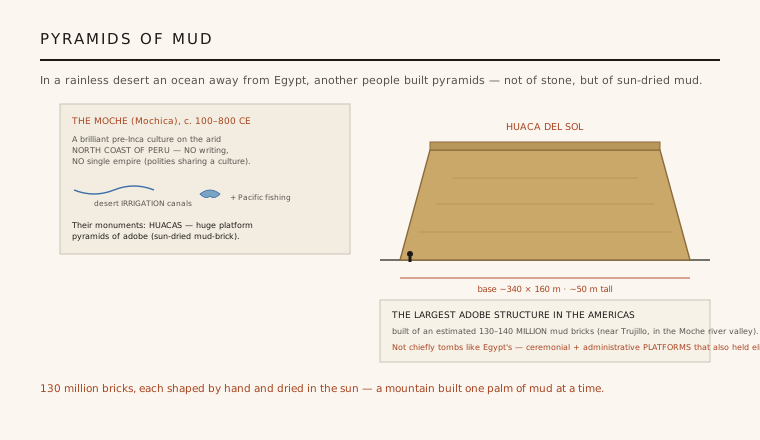
The Moche flourished on the arid north coast of Peru from around 100 to 800 CE — a brilliant pre-Inca culture with no writing and no unified state, a patchwork of polities sharing one religion and one dazzling art, kept alive in the desert by irrigation canals and rich Pacific fishing. Their great monuments are the huacas — massive platform pyramids of adobe, sun-dried mud-brick. The largest, the Huaca del Sol near modern Trujillo, is the biggest adobe structure in the Americas: an estimated 130 to 140 million mud bricks, on a base roughly 340 by 160 metres, rising perhaps fifty metres. But note a crucial difference from the Pyramids of Giza: the huacas were not primarily tombs. They were ceremonial and administrative platforms — stages for power and ritual — that also held elite burials among their other functions. A Moche pyramid was less a grave than a mountain of theatre, on which the drama of a whole society was performed.
2. A hundred communities, one mountain
How do you build a mountain of mud without writing, without the wheel, without iron? The bricks themselves may hold the answer — and, later, they hold the story of a catastrophe.
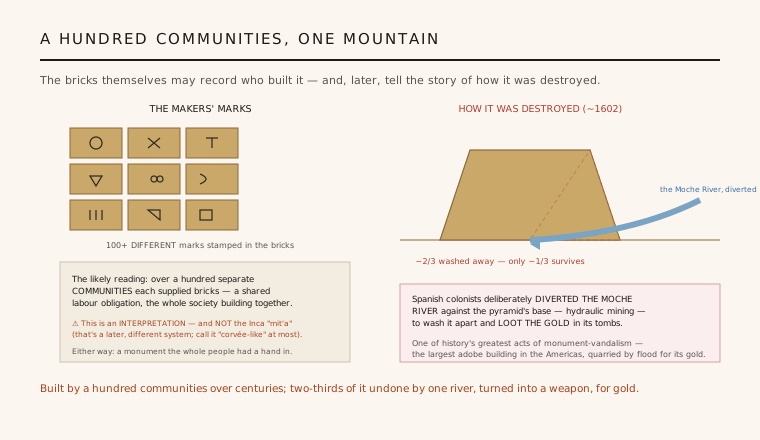
The adobe bricks of the Huaca del Sol carry more than a hundred different makers' marks — and the likeliest reading is that over a hundred separate communities each contributed bricks, a shared labour obligation that let a whole society build together, brick by brick, over generations. (That is an interpretation, not a proven fact — and it should not be called the Inca mit'a, which was a later, different system; think of it as a corvée-like duty at most.) Either way, it makes the huaca a monument the entire people had a hand in — a democratic mountain, if you like. And then comes the tragedy of its end. Around 1602, Spanish colonists did something almost unbelievable: they deliberately diverted the Moche River to run against the base of the pyramid, using the flood as a weapon to wash the structure apart and loot the gold in its tombs. This hydraulic mining destroyed an estimated two-thirds of the largest adobe building in the New World. Only about a third still stands — a mountain that a hundred communities spent centuries raising, undone by a single re-routed river, for gold.
3. The painted temple and the fanged god
For the Moche's religious heart, we turn to the smaller but far better-preserved Huaca de la Luna — a building that is really a stack of buildings, and a canvas for one of the most frightening images in ancient art.
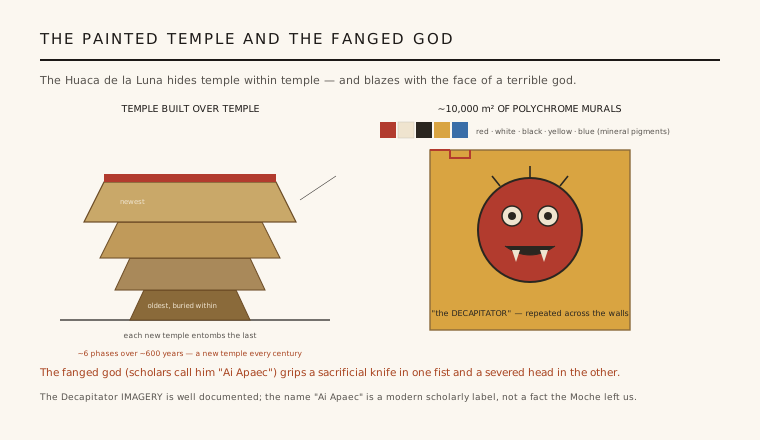
The Huaca de la Luna was rebuilt again and again as a series of superimposed temples — each new temple raised directly over and entombing the last, roughly six times across six centuries, so that the pyramid grew like the rings of a tree, an older sacred building sealed inside each newer one. This is the same instinct we will keep meeting: to renew the holy place by burying it inside a bigger version of itself. And its walls blaze with colour — thousands of square metres of polychrome relief murals in red, white, black, yellow and blue, their mineral pigments still vivid after fifteen hundred years. Repeated everywhere is a single terrifying face: the fanged, snarling deity that archaeologists call "the Decapitator" (or, by scholarly convention, "Ai Apaec") — a supernatural being who grips a sacrificial knife in one hand and a severed human head in the other. The most beautiful temple on the coast was dedicated to the most fearsome of gods. And that was not mere decoration, as the courtyard below would reveal.
4. Blood for the rain
The murals promised violence, and in the temple's own plaza, archaeologists found that the Moche kept the promise. This is the tomb-series' darkest chapter, and it must be told honestly.
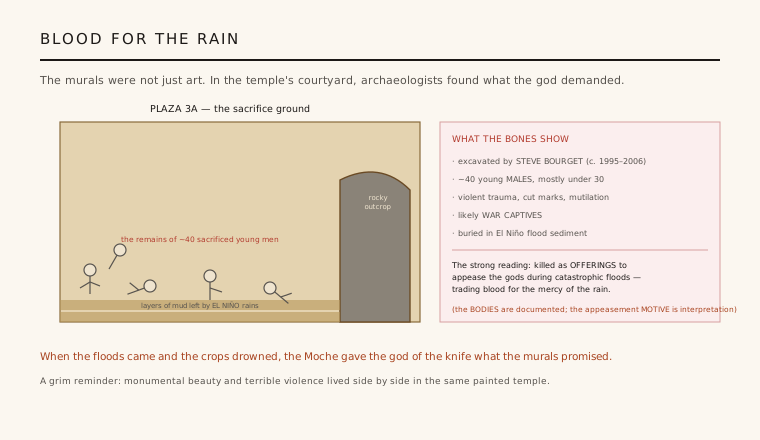
In a courtyard called Plaza 3A, the archaeologist Steve Bourget excavated the remains of about forty young men — mostly under thirty, likely war captives — bearing the marks of violent death and mutilation, laid against a rocky outcrop. Crucially, their bones lay within layers of mud deposited by El Niño rains. The strong interpretation is chilling and coherent: they were sacrificed as offerings to appease the gods during catastrophic flood events, blood traded for the mercy of the rain. (Be careful here: the bodies and their violent deaths are documented archaeology; the motive — appeasing the flood — is a compelling interpretation, not something the writing-less Moche recorded.) It is a hard truth about this wonder, and about many: the same society that painted the most gorgeous temple on the coast also killed young men on its steps when the waters rose. Beauty and terror shared the same painted wall — a reminder that greatness in building has never guaranteed goodness in the builders.
5. The Lord of Sipán, and the fall
We end with the Moche's greatest tomb, and their end — two discoveries that, together, make the whole civilisation suddenly, unbearably real.
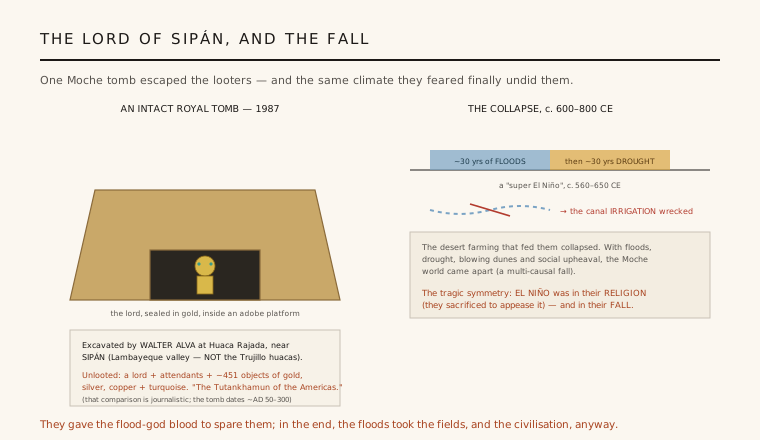
The Huaca del Sol's gold was looted long ago — but in 1987, at a different Moche mound, Huaca Rajada near Sipán (in the Lambayeque valley, well north of Trujillo), the archaeologist Walter Alva reached a tomb the looters had missed: the burial of a Moche lord, intact and unplundered, sealed inside an adobe platform. Around him lay his attendants and some 451 objects of gold, silver, copper and turquoise — masks, pectorals, headdresses of astonishing beauty. The "Lord of Sipán" is one of the richest undisturbed tombs ever found in the Americas — the "Tutankhamun of the Americas," the newspapers said (a comparison to take as journalism, not archaeology). Like the sealed chamber of the First Emperor of China, it is a reminder of how much these mounds still hide. And then there is the fall. The Moche declined around 600 to 800 CE, and a leading cause was climate: a decades-long "super El Niño" around 560–650 CE — perhaps thirty years of ruinous floods followed by thirty of drought — that wrecked the canal irrigation their desert civilisation depended on (the collapse was multi-causal, but climate looms largest). Here is the terrible symmetry that closes their story: El Niño was in their religion — they killed to appease it — and El Niño was in their fall. They gave the flood-god blood to spare them; in the end, the floods took the fields, and the civilisation, anyway. Their mud mountains still stand in the desert, painted gods still snarling on the walls, waiting for a rain that comes only rarely now — the most haunting ruins in the Americas.
6. What a modern architect can learn from the Moche
- The humblest material can build the grandest thing. Mud, shaped by hand and dried in the sun, raised the largest structure in the hemisphere. Do not despise a cheap, local, "primitive" material; in sufficient quantity and with sufficient will, it can do anything stone can.
- A monument can be a collective act. A hundred communities each set their bricks. Architecture at its best is not one genius's vision but a whole society's shared labour and belief, literally built into the fabric — a thing everyone can point to and say "we made that."
- Renew by building over. The Moche renewed their temple by entombing it inside a larger one, again and again. Layering the new over the sacred old is a profound way to honour continuity while growing — a lesson for every site with a history worth keeping.
- Beauty does not equal virtue — judge honestly. The loveliest temple on the coast hosted human sacrifice. We can admire the artistry and condemn the cruelty at once. Great architecture demands clear eyes, not uncritical awe, about the societies that made it.
- Build with the climate, or fall to it. The Moche lived and died by water — their canals made them, El Niño unmade them. Every building sits inside a climate system that will, over time, test it to destruction. Design for the floods and droughts you know are coming; it is the difference between enduring and vanishing.
- What is buried may survive best. The Lord of Sipán lasted 1,700 years because he was hidden; the exposed Huaca del Sol was looted to a stump. Sometimes protection means concealment, and the greatest treasures are the ones no one knew were there.
References & further reading
1. World History Encyclopedia — Moche Civilization. https://www.worldhistory.org/Moche_Civilization/
2. Encyclopaedia Britannica — Moche. https://www.britannica.com/topic/Moche
3. Smarthistory (Khan Academy) — The Moche and the Royal Tombs of Sipán. https://smarthistory.org/moche-royal-tomb-sipan/
4. Wikipedia — Huaca del Sol and Huaca de la Luna (dimensions, brick counts, makers' marks, Plaza 3A). https://en.wikipedia.org/wiki/Huaca_del_Sol
5. Wikipedia — Lord of Sipán (Walter Alva, 1987, Huaca Rajada, ~451 objects). https://en.wikipedia.org/wiki/Lord_of_Sip%C3%A1n
6. Proyecto Arqueológico Huacas del Sol y de la Luna (Universidad Nacional de Trujillo). https://huacasdemoche.pe/
Last verified 2026-07-04. Figures follow standard archaeological sources and are given as widely cited approximations that vary by source. The Moche (Mochica) flourished on Peru's north coast c. 100–800 CE, with no writing and a decentralised political structure (a debated point). The Huaca del Sol is the largest adobe structure in the Americas, built of an estimated ~130–140 million adobe bricks (base ~340 × 160 m, originally ~50 m, ~41 m surviving); the ~100+ makers' marks are read as community brick-contributions (an interpretation — not the Inca "mit'a"). Spanish colonists diverted the Moche River c. 1602 to loot it, destroying an estimated two-thirds. The Huaca de la Luna (better preserved) was built as ~six superimposed temples over ~600 years, with extensive polychrome murals of the fanged "Decapitator" deity ("Ai Apaec" is a modern scholarly label; the imagery is documented). Human sacrifices at Plaza 3A (~40 young men, excavated by Steve Bourget) are documented; the El Niño-appeasement motive is a strong interpretation. The Lord of Sipán — an intact Moche royal tomb with ~451 gold/silver/turquoise objects — was excavated by Walter Alva in 1987 at Huaca Rajada near Sipán (Lambayeque, not Trujillo; tomb dated ~AD 50–300); "Tutankhamun of the Americas" is popular shorthand. The Moche collapse (c. 600–800 CE) was multi-causal, with a severe El Niño episode (~560–650 CE) wrecking irrigation a leading factor. NOTE: the Huacas de Moche are NOT a UNESCO World Heritage Site and their tentative-list status is unconfirmed; do not confuse them with nearby Chan Chan (the later Chimú capital, UNESCO-inscribed 1986).
Export this guide
Related Guides — Deep-dive reading
Chan Chan: The Vast City of Mud Where Every King Built His Own Palace
On the desert coast of Peru sprawl the ruins of the largest city ever built of mud — a thousand-year-old capital of adobe walls three storeys high, carved with fish and seabirds, that survived only because it almost never rains. It was a city of ten royal palaces, one for each king, driven by a strange rule of inheritance; and today, an earthen city in a warming world, it is racing the rain to survive. The ninth article in our chapter on the palaces and pleasures of worldly power.
Architectural WondersCahokia and Monks Mound: The Great City America Forgot
A thousand years ago, across the river from where St Louis now stands, Native Americans built a city of perhaps twenty thousand people — larger than London at the time — with a hundred and twenty earthen mounds, a plaza the size of dozens of football fields, and a solar calendar of cedar posts. At its heart rose Monks Mound, the largest earthwork in the Americas, with a footprint to rival the Great Pyramid. Then, before Europeans ever arrived, it vanished — and almost no one remembers it.
Architectural WondersThe Templo Mayor: The Great Temple of the Aztecs, Buried Under a City
At the centre of Tenochtitlan — one of the largest cities on Earth, built on a lake where Mexico City now stands — rose a twin-peaked pyramid crowned by two temples, to the sun-god of war and the ancient god of rain. It was the beating heart of the Aztec universe, and the great theatre of their sacrifices. In 1521 the Spanish tore it down and built their cathedral on its ruins — until, in 1978, it rose again into the light. The finale of our chapter on the sacred places of the world.
Architectural WondersRelated Tools — Try Free
Material Compare — Side by Side
Compare materials side-by-side: granite vs quartz vs marble, laminate vs acrylic vs PU, and more.
ComparisonCross-Ventilation Analyzer
Estimate airflow and air changes per hour (ACH) from room size, window areas, layout, and local wind — with NBC 2016 Part 8 compliance check.
Ventilation CalculatorMaterial Comparison Sheet
India's interior material cheatsheet — plywood, finishes, hardware, countertops, paints, waterproofing.
Reference Guide