
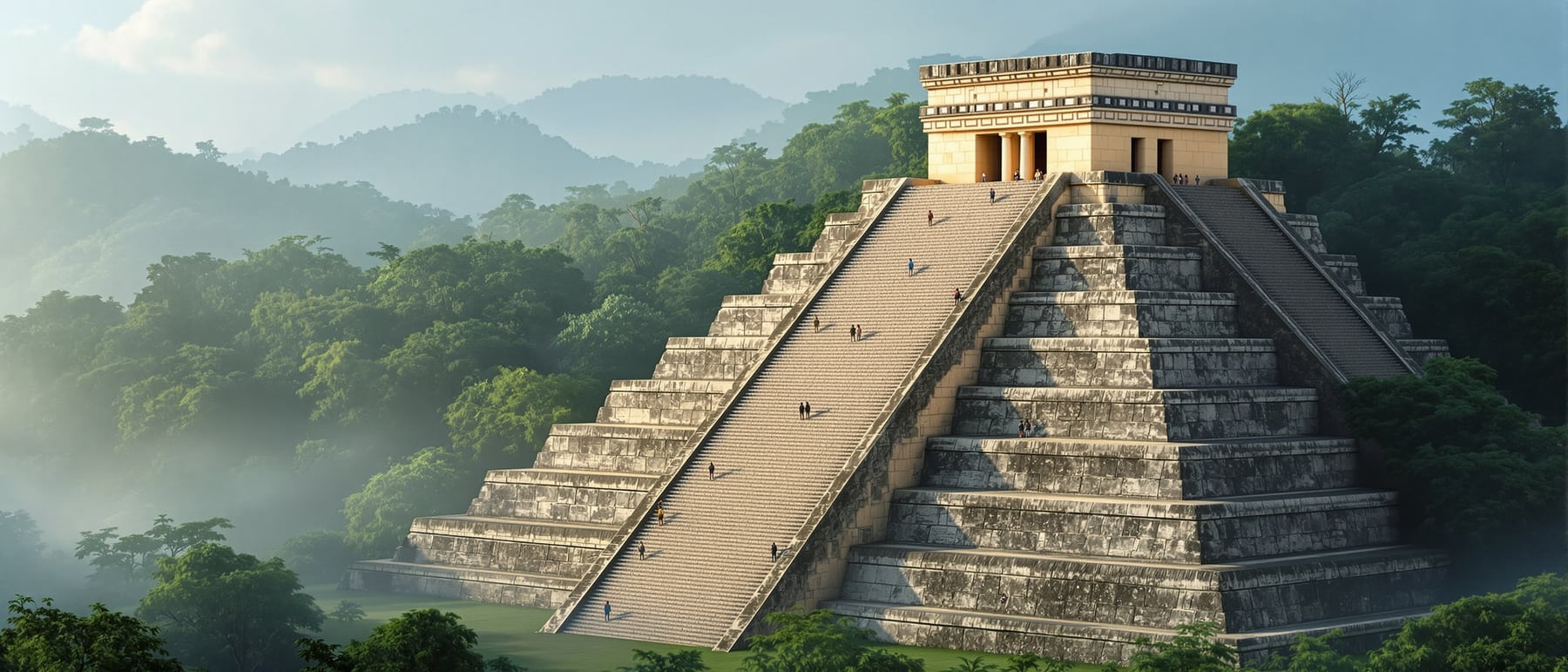
The Tomb of Pakal: A Maya King's Descent Into the Underworld
How a Maya king who took the throne at twelve and ruled for sixty-eight years hid his own tomb deep inside a jungle pyramid — sealed behind a rubble-choked secret stair, guarded by sacrificed attendants, his jade-masked body under a five-tonne carved lid that shows him falling into the underworld to be reborn as a god, and, no, not piloting a rocket.
We come to the jungles of Mexico, and to a tomb that stayed secret for thirteen centuries inside the one place no one thought to look: the solid heart of a pyramid. For a long time, scholars believed the Maya built their pyramids as temple-platforms only — stages for ritual, not resting-places for kings. Then, in 1952, an archaeologist followed a hunch down a hidden staircase buried in the rubble of a pyramid at Palenque, and found, at the bottom, the greatest royal tomb of the ancient Americas. It changed everything we thought we knew.
The king was K'inich Janaab' Pakal — "Pakal the Great" — who came to the throne as a boy of twelve and ruled for an astonishing sixty-eight years. His tomb, deep inside the Temple of the Inscriptions, holds a jade-masked body beneath one of the masterpieces of world art: a five-tonne carved lid showing the dead king falling into the underworld to be reborn — an image so strange and beautiful that some, refusing to credit the Maya with their own genius, have insisted it must be a picture of an astronaut in a rocket. It is not. The truth is far greater.
This is the forty-sixth article in our Architectural Wonders series.
1. The pyramid built to be a tomb
Start with the building, because in the Maya world it was a rare and deliberate thing: a pyramid raised not as a temple but as a grave.
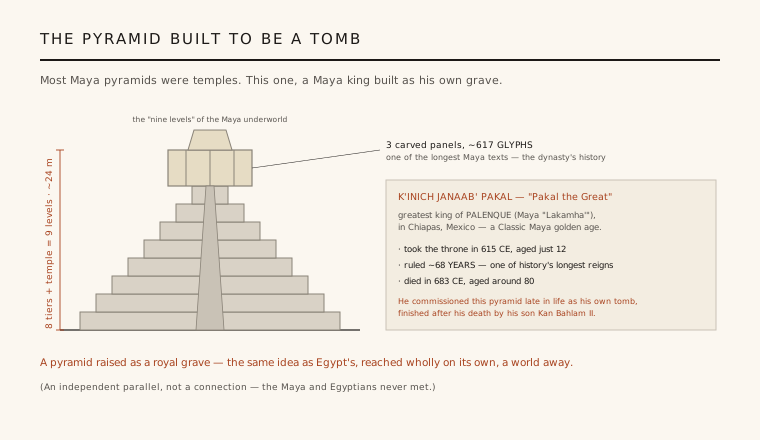
The Temple of the Inscriptions is a stepped pyramid of eight tiers crowned by a temple — nine levels in all, echoing the nine levels of the Maya underworld — rising about twenty-four metres from the jungle floor. It takes its name from three great carved panels in the summit temple, some 617 hieroglyphs together, among the longest Maya texts ever found, recording the deep dynastic history of Palenque. And it was built by K'inich Janaab' Pakal, the greatest king of Palenque, as his own funerary monument — begun late in his long life and finished, after his death in 683 CE, by his son. Consider Pakal's reign: he took the throne in 615 CE at the age of twelve, and ruled for roughly sixty-eight years, dying at around eighty — one of the longest verified reigns in all of human history. A pyramid raised deliberately as a royal tomb is exactly what we saw in Egypt at Giza — and yet the Maya reached the same idea entirely on their own, an ocean and an age apart, with no contact whatsoever. It is one of the great independent rhymes of human history.
2. The staircase inside the mountain
For thirteen hundred years the tomb kept its secret. The story of how it was found is one of the finest in all of archaeology.
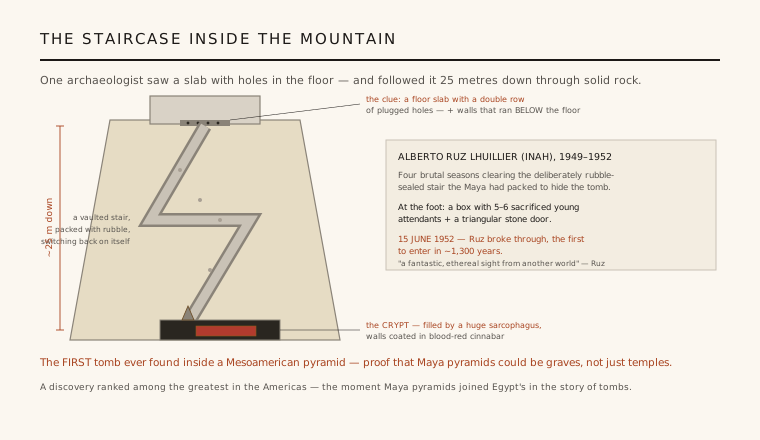
In the floor of the summit temple, the Mexican archaeologist Alberto Ruz Lhuillier noticed something odd: a large stone slab set with a double row of plugged holes, and walls that seemed to continue below the floor — as if the temple were not the top of a solid pyramid, but the lid of something. From 1949, over four gruelling field seasons to 1952, his team cleared a hidden, vaulted stairway that the Maya had deliberately packed solid with rubble to seal the tomb forever. It switched back on itself and plunged some twenty-five metres down through the body of the pyramid to near ground level. At the bottom lay a stone box holding five or six sacrificed young attendants, and a great triangular stone door. On 15 June 1952, Ruz broke through — the first person to enter in some thirteen centuries — into a vaulted crypt coated blood-red with cinnabar and almost entirely filled by a colossal sarcophagus. "A fantastic, ethereal sight from another world," he wrote. It was the first tomb ever discovered inside a Mesoamerican pyramid, and it rewrote the rules: Maya pyramids, it turned out, could be mausoleums as surely as Egypt's. It is the same descent into a hidden royal crypt we walked at the Tomb of Seti I — but here the stair had to be dug back out of the mountain, metre by rubble-choked metre.
3. The lid, and the lie about it
Inside the sarcophagus lay Pakal — and over him, a carved slab that is at once one of the supreme achievements of Maya art and the subject of the most famous piece of nonsense ever written about an ancient tomb.
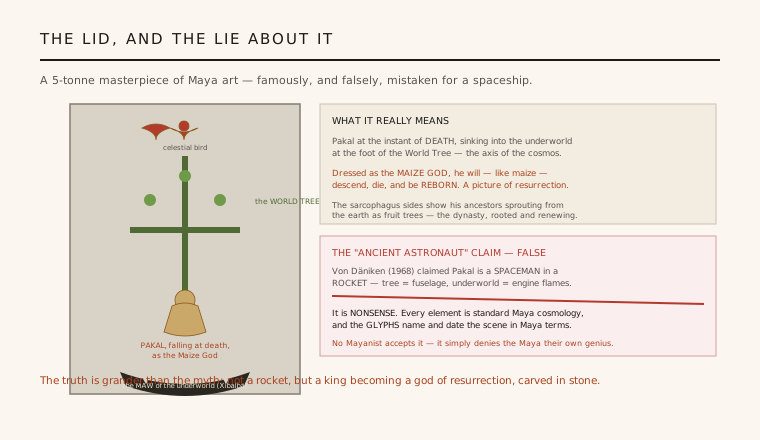
The lid is a single slab of limestone, about 3.6 by 2.2 metres and weighing some five tonnes, and every inch of it means something. It shows Pakal at the instant of death, falling backward into the maw of the underworld, Xibalba — poised at the foot of the great World Tree (the sacred ceiba), the axis that joins the layers of the cosmos. At the tree's crown perches the celestial bird; below gapes the skeletal jaw of the underworld; and Pakal himself wears the attributes of the Maize God — for as maize is buried in the earth to sprout again, so the king descends to die and will be reborn. It is, in short, a picture of resurrection: a king becoming a god. Now the nonsense. In 1968, the writer Erich von Däniken claimed the lid actually shows Pakal as a spaceman piloting a rocket — the World Tree as fuselage, the underworld's jaws as engine flames. This is completely false. Every single element is a standard, well-understood motif of Maya cosmology, repeated across hundreds of other Maya artworks, and the hieroglyphs carved around the scene name and date it in plain Maya terms. No serious Mayanist gives the astronaut reading a moment's credence; it is a piece of ethnocentric pseudoscience that, at bottom, refuses to believe a Native American civilisation could produce great art and thought on its own. The real image is not a rocket. It is something incomparably grander — a whole people's vision of death and rebirth, carved for their king.
4. A king dressed in jade
Beneath the lid, Pakal lay wrapped in the single most precious substance the Maya knew — and connected to the living world above by an extraordinary architectural thread.
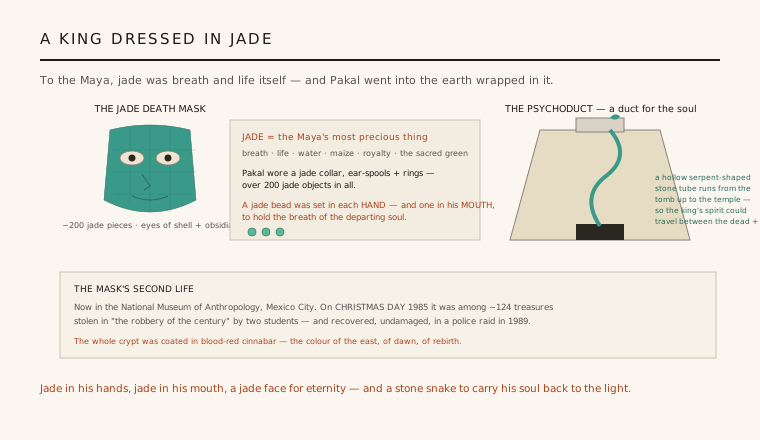
To the Maya, jade was the most sacred material of all — the green of new maize and still water, the colour of breath, life and royalty itself. And Pakal went into the earth covered in it: a mosaic death mask of some two hundred jade pieces, with eyes of shell and obsidian; a jade collar, ear-spools and rings; a jade bead placed in each hand and one in his mouth, to hold the breath of the departing soul — over two hundred jade objects in all. And then the detail that catches everyone's breath: running from the sarcophagus, up alongside the buried staircase, all the way to the temple floor high above, is a small hollow stone tube shaped like a serpent — the feature Ruz named the "psychoduct." It was, it seems, a channel for the king's spirit to travel between the sealed tomb and the world of the living — a literal architectural umbilical cord linking the dead god-king to his temple. (The jade mask has had an eventful afterlife: it was stolen from Mexico City's National Museum of Anthropology on Christmas Day 1985, in "the robbery of the century," and recovered undamaged in 1989.)
5. Palenque, and the American Tutankhamun
Step back from the crypt to the city that made it, because Pakal's tomb is the jewel of one of the most beautiful places the ancient Americas ever produced.
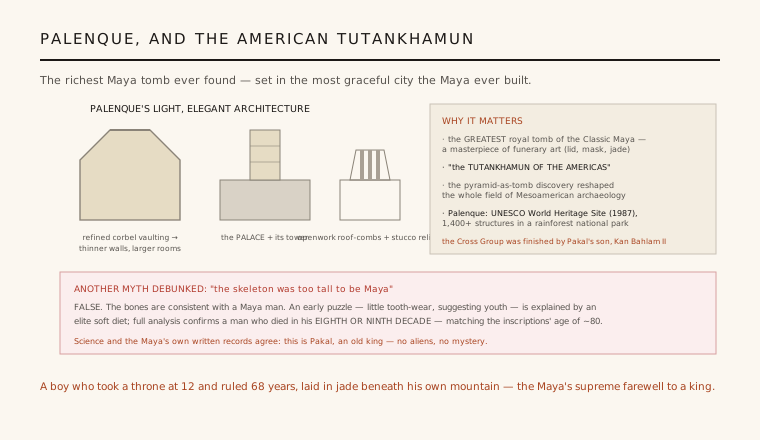
Pakal's long reign underwrote a golden age of building, and Palenque is prized above almost all Maya sites for the lightness and elegance of its architecture — refined corbel vaulting that let the Maya build thinner walls and airier interiors than anywhere else, delicate stucco-relief portraits, mansard roofs and openwork roof-combs. His works include much of the sprawling Palace with its unique tower, and his son Kan Bahlam II completed the exquisite temples of the Cross Group. And Pakal's burial itself is simply the greatest royal tomb of the Classic Maya world — a masterpiece of funerary art, and, through Ruz's discovery, a turning point that reshaped the whole field of Mesoamerican archaeology. It is, deservedly, often called "the Tutankhamun of the Americas." One last myth deserves burying: fringe writers once claimed Pakal's skeleton was "too tall to be Maya" (more grist for the alien mill). It is false — the bones are consistent with a Maya man, and careful analysis confirms an individual who died in his eighth or ninth decade, exactly matching the age of ~80 that Palenque's own inscriptions record for Pakal. Science and the Maya's own written history agree, and the truth needs no aliens: a boy who became a king at twelve, ruled for sixty-eight years, and was laid to rest in jade beneath his own mountain, carved with the promise that he, like the maize and the sun, would rise again.
6. What a modern architect can learn from the Tomb of Pakal
- Great ideas arise independently. The Maya invented the pyramid-tomb without ever knowing Egypt existed. Good solutions to deep human needs recur across cultures; originality is not diminished by parallels, and studying convergence teaches what is universal in building.
- Hide the treasure, and follow the clues. Pakal's tomb survived because it was concealed inside solid rock; it was found because one observer noticed a slab with holes. Both matter: design can protect by concealment, and discovery rewards patient attention to small anomalies.
- Let the whole building carry the meaning. The nine levels, the descending stair, the psychoduct, the cosmic lid — the entire pyramid is a single integrated statement about death and rebirth. The most profound architecture is thoroughly thought through, every part speaking to one idea.
- Connect the sealed to the living. The psychoduct is a small, poetic act of design — a channel joining the hidden dead to the temple above. Great buildings find ways to link the private and the public, the buried and the visible, the past and the present.
- Respect the intelligence of the makers. The "astronaut" and "too-tall skeleton" myths both spring from an inability to credit the Maya with their own brilliance. Read a building on its own terms, in its own culture's language, before reaching for a stranger explanation.
- The truth is usually grander than the myth. A rocket is a small, silly thing beside a whole civilisation's vision of a king becoming a god of resurrection. Look harder at what a work actually says; the real meaning almost always outshines the sensational one.
References & further reading
1. UNESCO World Heritage Centre — Pre-Hispanic City and National Park of Palenque (inscribed 1987). https://whc.unesco.org/en/list/411/
2. World History Encyclopedia — K'inich Janaab' Pacal. https://www.worldhistory.org/Kinich_Janaab_Pacal/
3. Encyclopaedia Britannica — Temple of the Inscriptions. https://www.britannica.com/place/Temple-of-the-Inscriptions
4. Smithsonian, National Museum of the American Indian — Palenque (Living Maya Time). https://maya.nmai.si.edu/gallery/palenque
5. Smarthistory (Khan Academy) — Palenque. https://smarthistory.org/palenque/
6. Mexicolore — The great Maya tombstone (on the sarcophagus lid and the astronaut myth). https://www.mexicolore.co.uk/maya/collaboration/great-maya-tombstone
Last verified 2026-07-04. Figures follow standard Maya epigraphy and archaeology and are given as widely cited approximations that vary by source. K'inich Janaab' Pakal I acceded in 615 CE at age 12 and died in 683 CE aged ~80 (a ~68-year reign) — dates securely read from Palenque's own inscriptions. The Temple of the Inscriptions is a stepped pyramid (8 tiers + temple = 9 levels), ~24 m high (sources ~21–27 m); its three panels carry ~617 glyphs. Alberto Ruz Lhuillier cleared the hidden internal stairway c. 1949–1952 and entered the crypt on 15 June 1952 — the first tomb found inside a Mesoamerican pyramid; five or six sacrificed attendants (accounts vary) lay at the entrance. The sarcophagus lid (~3.6 × 2.2 m, ~5 tonnes) depicts Pakal at death descending into Xibalba at the base of the World Tree as the Maize God (death/rebirth) — the scholarly consensus reading; the "ancient astronaut/rocket" interpretation (von Däniken, 1968) is pseudoscientific and false, contradicted by the iconography and the accompanying glyphs. The jade death mask (~200 pieces, shell/obsidian eyes) and over 200 jade objects, and the serpent-shaped "psychoduct" linking tomb to temple, are documented; the mask (now in the Museo Nacional de Antropología, Mexico City) was stolen in 1985 and recovered in 1989. The "skeleton too tall to be Maya" claim is false — the remains match a Maya man who died in his 8th–9th decade, corroborating the epigraphic age. Palenque is a UNESCO World Heritage Site (1987).
Export this guide
Related Guides — Deep-dive reading
Borobudur: The Mountain You Climb to Reach Enlightenment
In the volcano-ringed heart of Java, around 1,200 years ago, Buddhist kings built the largest Buddhist monument on Earth — not a temple you enter but a solid stone mountain you climb: a three-dimensional map of the universe, wrapped in 2,672 carved panels and 504 Buddhas, that turns the path to enlightenment into a walk you take with your feet. Then it was abandoned, buried under ash and jungle, and rebuilt, stone by million-stone, in our own age.
Architectural WondersThe Pyramid of the Sun: A Mountain Raised Over a Cave by a People With No Name
In the Valley of Mexico, a civilisation we cannot name built one of the largest pyramids on Earth — a man-made mountain of a million cubic metres — and set it precisely over a sacred cave they believed was the womb of the world. They left no writing we can read; even the words 'Pyramid of the Sun' were given, a thousand years later, by the Aztecs, who found the city in ruins and called it the birthplace of the gods.
Architectural WondersSomapura Mahavihara: The Buddhist University Hidden Inside a Hill
Twelve hundred years ago in Bengal, a Pala emperor built one of the largest monasteries the Buddhist world had ever seen — a walled quadrangle a fifth of a mile across, ringed by 177 monks' cells, with a great cross-shaped, terraced temple rising from its courtyard. For four centuries scholars came from as far as Tibet to study here; then it was abandoned, and slowly buried, until villagers knew it only as Paharpur — 'the hill-town.'
Architectural WondersRelated Tools — Try Free
Design Style Finder Quiz
Answer 10 visual questions to discover your Indian interior style profile with materials and colours.
Interactive QuizMaterial Schedule Generator
Generate a room-wise finish schedule — walls, floors, ceilings, trim, and joinery by location.
Material ScheduleBefore & After Studio
Generate AI before-and-after renders to preview how your redesign could look.
DesignAI