
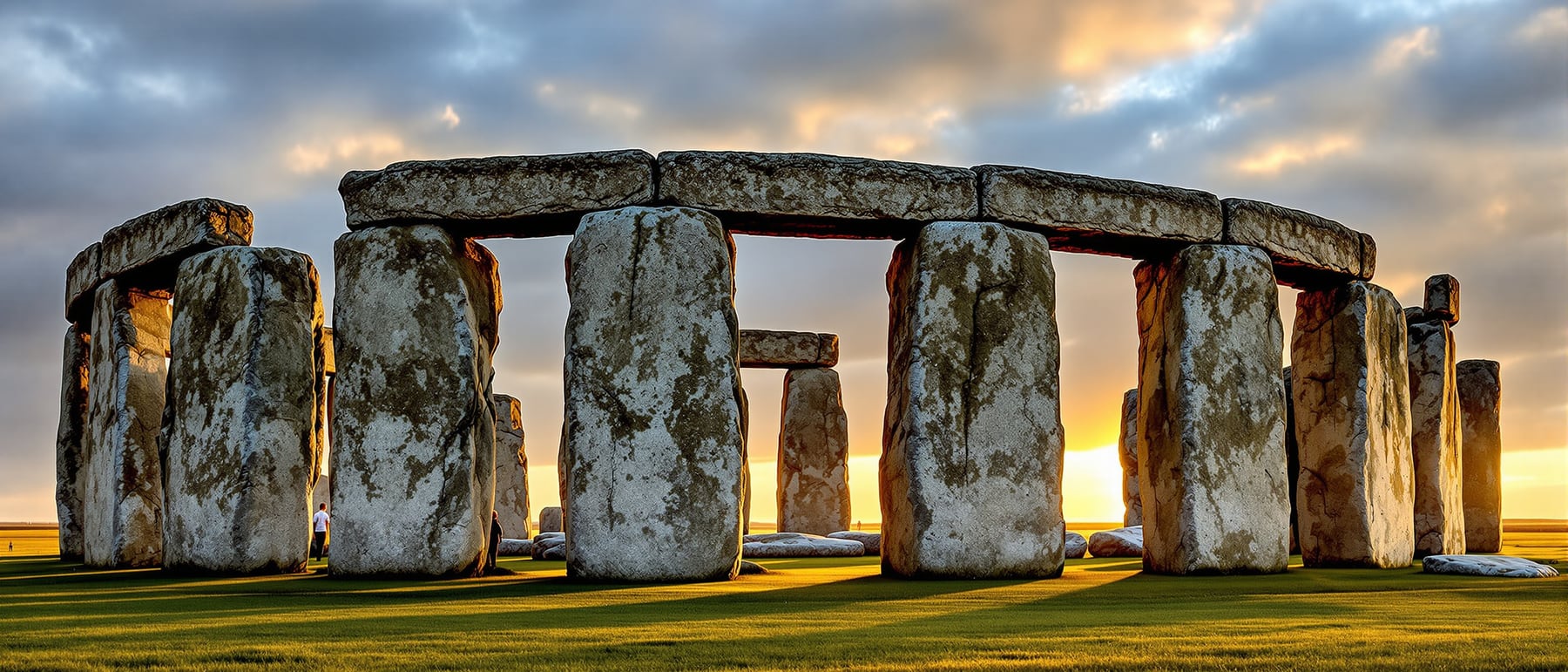
Stonehenge: The Stone Circle That Was Built Like Carpentry
How Neolithic Britons, over fifteen centuries and with nothing but antler picks and rope, dragged twenty-five-tonne sarsens and Welsh bluestones across an island to raise the only stone circle on Earth joined like woodwork — mortise, tenon, tongue and groove in solid stone — aligned it on the turning sun, filled it with the cremated dead, and left us a temple whose purpose we still cannot fully name.
From the dawn temples of Ġgantija on their Mediterranean island we cross to a windswept chalk plain in southern England — and to the most famous stone circle in the world. Stonehenge is so familiar that it is easy to stop seeing it: a picture on a biscuit tin, a solstice crowd on the evening news. But look again with an architect's eye and something astonishing appears. Alone among the hundreds of stone circles of prehistoric Britain, Stonehenge was shaped, dressed, and joined like a piece of furniture — its lintels pegged onto its uprights with the same mortise-and-tenon and tongue-and-groove joints a carpenter uses in wood, executed here in twenty-five-tonne blocks of stone.
This is the forty-ninth article in our Architectural Wonders series, and the second in our chapter on the great temples and sacred places of the world.
It was raised on Salisbury Plain, in Wiltshire, about thirteen kilometres north of the city of Salisbury — not in a single burst of building but across roughly fifteen hundred years, from about 3000 BCE to 2000 BCE, by pre-literate Neolithic and early Bronze-Age Britons who left not one word to tell us why. What they left instead was a monument of such precision and such reach — stones dragged from as far as Wales and, it now seems, Scotland — that it remains, five thousand years on, both a masterpiece and a mystery.
1. Not built in a day — fifteen centuries of building
The first myth to set aside is that Stonehenge was "built." It was built and rebuilt, over some fifty generations.
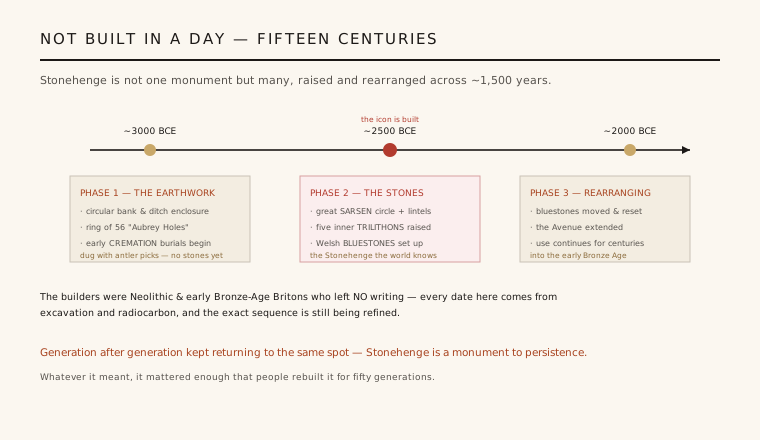
Around 3000 BCE, the first monument here was not stone at all but earth: a circular bank-and-ditch enclosure — a "henge" — about a hundred metres across, dug from the chalk with antler picks. Just inside the bank ran a ring of fifty-six pits, the "Aubrey Holes," and from this early phase the site was already a cremation cemetery, receiving the burnt bones of the dead. (What the Aubrey Holes originally held is itself debated — an early setting of bluestones, on the now-mainstream view, or timber posts on the older one.) Only around 2500 BCE — the monument's architectural peak — were the giant sarsen stones and the Welsh bluestones hauled in and raised into the famous arrangement: the outer lintelled circle and the five inner trilithons. For another five centuries, to about 2000 BCE, the bluestones were shifted and reset and the approach avenue extended. The Stonehenge we photograph is a snapshot of a monument that was continuously reimagined — and the fact that people kept returning to this one spot, rebuilding it in ever more ambitious form for fifteen hundred years, is itself the deepest clue to how much it mattered.
2. Two kinds of stone, from far apart
The stones fall into two utterly different families — and the wonder is not only their size but how impossibly far they travelled.
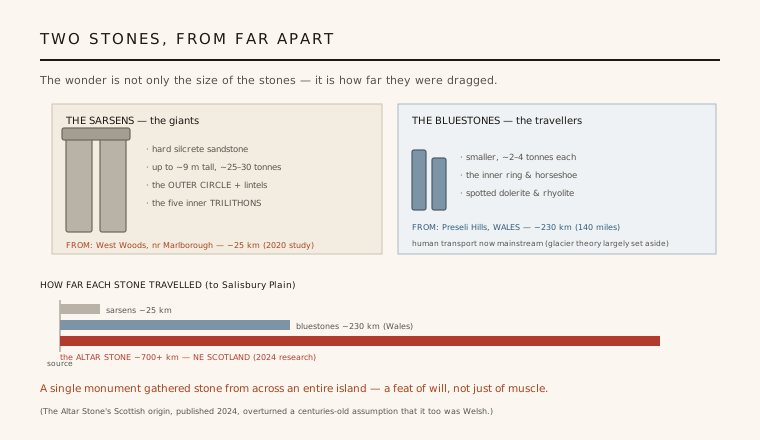
The giants are the sarsens — blocks of a very hard silica-cemented sandstone. They make up the outer circle of thirty uprights capped by a continuous ring of lintels and the five great trilithons of the inner horseshoe. The largest, the uprights of the Great Trilithon, stood some nine metres tall; the biggest stones weigh, by most estimates, on the order of twenty-five to thirty tonnes (some sources push the largest higher — the figure is best given as a range, not a single number). For centuries no one knew where they came from; then in 2020, geochemical fingerprinting matched almost all of them to West Woods, near Marlborough — about twenty-five kilometres north. The smaller stones are the bluestones — a mix of volcanic rocks, each two to four tonnes, forming the inner ring and horseshoe. These came from the Preseli Hills of Pembrokeshire, in southwest Wales — roughly 230 kilometres away. Whether human muscle or glacial ice carried them that distance was long argued; the human-transport view is now mainstream, and specific Welsh quarries have been identified. And then, in 2024, came the bombshell: mineral analysis showed that the Altar Stone, the great slab lying flat at the monument's heart, did not come from Wales at all but from northeast Scotland — over seven hundred kilometres away, most likely carried in part by sea. A single monument, in other words, gathered its stones from the length of an entire island. That is not just engineering; it is coordination across a continent's worth of Britain, by people with no writing and no wheel.
3. Carpentry, executed in stone
Here is the detail that lifts Stonehenge above every other stone circle on Earth — and the reason it is called architecture.
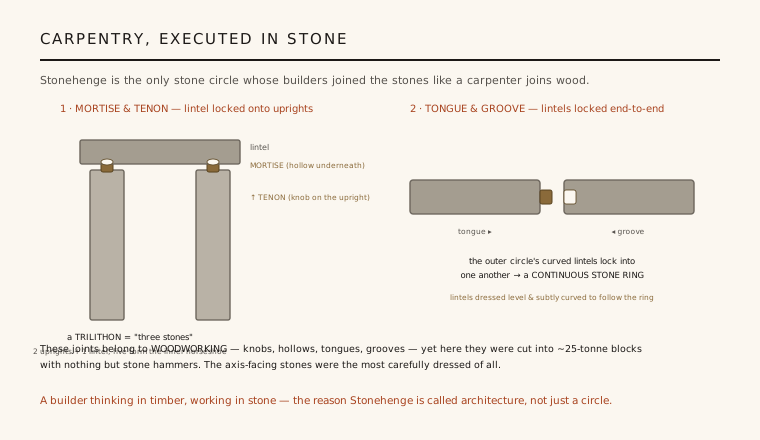
Almost every other prehistoric circle is a ring of rough, unworked boulders stood on end. Stonehenge's stones were deliberately shaped and smoothed with stone hammers — and then joined. Each lintel is held onto its uprights by a mortise-and-tenon joint: a projecting knob (a tenon) was carved on the top of each upright to fit snugly into a matching hollow (a mortise) cut into the underside of the lintel — locking the horizontal stone in place. Around the outer circle, the curved lintels are joined end to end to one another by tongue-and-groove joints, forming a continuous, level stone ring floating above the plain. These are the joints of a carpenter — the techniques of someone who thinks in timber — and yet here they were cut into blocks weighing as much as a loaded lorry, with nothing harder than other stones to cut them. The lintels were even dressed subtly curved to follow the circle and levelled across uneven ground; laser survey shows that the stones framing the solstice axis were the most carefully finished of all. How the stones were raised — on timber sledges and rollers, with ramps, levers, rope and A-frames — is reconstructed and debated, since no record survives. But the joinery is beyond dispute, and it is the heart of the claim: Stonehenge is not a heap of standing stones. It is a designed building, thought through as carpentry and realised in rock.
4. Aligned to the turning sun
Stonehenge is also a machine for catching the year's two great turning points — and the alignment is deliberate beyond reasonable doubt.
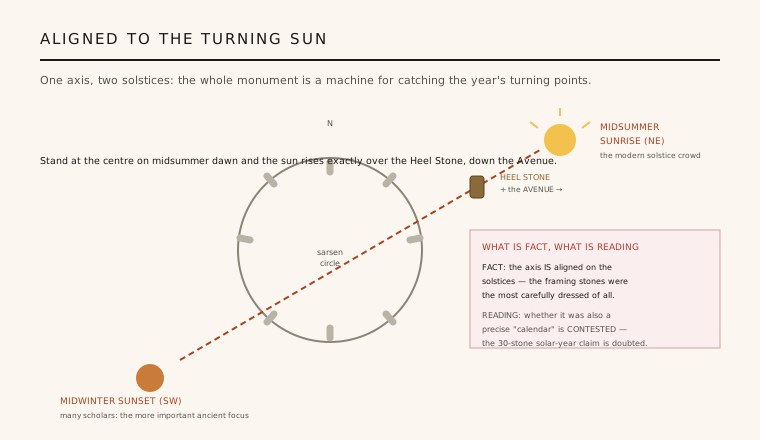
The monument's central axis is laid on the solstices. Look one way along it, out through the earthwork Avenue and past the outlying Heel Stone, and it points to the midsummer sunrise in the northeast; look the opposite way and it points to the midwinter sunset in the southwest. Stand at the centre at dawn on the longest day and the sun climbs into the sky beside the Heel Stone and throws its light into the heart of the circle. That the alignment was intended is as certain as anything here can be — the axis-framing stones were the most finely dressed, and the Avenue itself runs on the same line. What is interpretation is which solstice mattered most. The modern crowds come for the summer sunrise, but many archaeologists now think the midwinter sunset was the ancient focus — tied to feasting evidence nearby (see §5). And the stronger claim, that the thirty sarsens encode a precise 365-day solar calendar, is a stimulating recent idea that has been heavily criticised — worth knowing, but not to be stated as fact. The honest position is the simpler one: Stonehenge is unmistakably aligned on the sun's turning, and the people who built it plainly cared, deeply, about marking the year.
5. What was it for? — the question we cannot close
And so to the oldest question of all, the one every visitor asks: what was it? The truthful answer is that we do not fully know — and that it was probably several things at once.
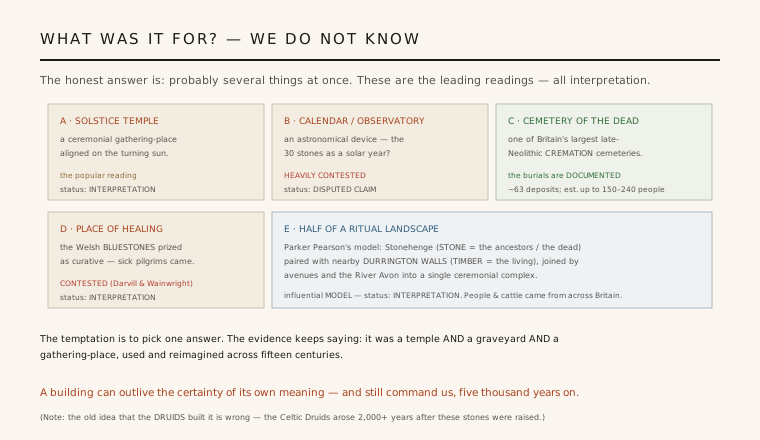
Five readings compete, and complement. A temple — a ceremonial gathering-place aligned on the sun: the popular view, and an interpretation. A calendar or observatory — the astronomical idea in its strong form, genuinely contested. A cemetery of the dead — this one rests on hard evidence: Stonehenge is one of the largest Late Neolithic cremation cemeteries known in Britain, with the burnt remains of an estimated up to a hundred and fifty or more people deposited there from around 3000 BCE. A place of healing — the theory that the bluestones were prized as curative stones drawing sick pilgrims; contested, on thin direct evidence. And most influentially, one half of a single vast ritual landscape: the archaeologist Mike Parker Pearson's model in which Stonehenge (stone = permanence, the ancestors, the dead) was paired with the great timber circle and settlement at nearby Durrington Walls (wood = the living), the two linked by avenues and the River Avon — the living feasting at Durrington, the dead honoured in stone here. Isotope studies show the people and even the cattle came from across Britain, some of the dead from the same corner of Wales as the bluestones. Set aside, gently, the medieval tale that Merlin flew the stones from Ireland, and the popular error that the Druids built it (the Celtic Druids arose more than two thousand years after these stones were raised). What remains is a monument that was, at once, a temple and a graveyard and a gathering-place — and a building that has outlived the certainty of its own meaning, and commands us still.
6. What a modern architect can learn from Stonehenge
- Design is joinery, not just mass. What makes Stonehenge architecture is not the size of the stones but the mortise, tenon, tongue and groove — the decision to join them with care. Detail and connection are where raw material becomes design. The joint is where the thinking shows.
- Think in one material, build in another. The builders reasoned like carpenters and worked in stone, carrying the logic of timber into rock. Great design often comes from importing the intelligence of one craft into another.
- Orient the building to something larger than itself. Stonehenge is aimed at the sun's turning; its most important stones frame the solstice. A building gains meaning when it is placed in conversation with its site, its sky, and its seasons — not dropped down indifferent to them.
- A great work can take generations. Fifteen hundred years, fifty generations, each inheriting and reimagining the last. The best places are rarely finished by their founders; build so that others can keep building.
- Be honest about the limits of knowledge. Purpose, transport method, which solstice mattered — much is genuinely unresolved. A responsible account of any building says clearly where evidence ends and interpretation begins, and resists the tidy single answer.
- Meaning can outlast certainty. We have lost the beliefs that raised Stonehenge, yet it still moves millions. What we make may be understood by people who no longer share our reasons — a case for building things worth keeping even when the "why" is forgotten.
References & further reading
1. UNESCO World Heritage Centre — Stonehenge, Avebury and Associated Sites (inscribed 1986). https://whc.unesco.org/en/list/373/
2. English Heritage — History of Stonehenge and Building Stonehenge. https://www.english-heritage.org.uk/visit/places/stonehenge/history-and-stories/
3. Encyclopaedia Britannica — Stonehenge. https://www.britannica.com/topic/Stonehenge
4. World History Encyclopedia — Stonehenge. https://www.worldhistory.org/Stonehenge/
5. Nash, D. J. et al. (2020), Science Advances — "Origins of the sarsen megaliths at Stonehenge" (West Woods provenance). https://www.science.org/doi/10.1126/sciadv.abc0133
6. Clarke, A. J. I. et al. (2024), Nature — "A Scottish provenance for the Altar Stone of Stonehenge." https://www.nature.com/articles/s41586-024-07652-1
7. Parker Pearson, M. — Stonehenge Riverside Project (Stonehenge and Durrington Walls; the dead and the living). https://www.ucl.ac.uk/archaeology/research/stonehenge-riverside-project
Last verified 2026-07-04. Figures follow UNESCO, English Heritage and standard archaeological sources and are given as widely cited approximations that vary by source. Stonehenge (Salisbury Plain, Wiltshire, England) was built and modified in stages c. 3000–2000 BCE, with the great sarsen-and-bluestone arrangement raised c. 2500 BCE; the builders were pre-literate Neolithic / early Bronze-Age Britons. The sarsens (outer lintelled circle + five trilithons) are silcrete sandstone, the largest up to ~9 m and on the order of ~25–30 tonnes (some estimates higher; give as a range); a 2020 geochemical study (Nash et al.) traced most to West Woods, near Marlborough, ~25 km away. The bluestones (~2–4 tonnes; inner ring and horseshoe) came from the Preseli Hills, Pembrokeshire, Wales (~230 km); human transport is now mainstream over the glacial hypothesis. The Altar Stone was shown in 2024 (Clarke et al., Nature) to originate in northeast Scotland (Orcadian Basin, ~700+ km), not Wales. The lintels are joined to uprights by mortise-and-tenon joints and to each other by tongue-and-groove joints — carpentry techniques unique among stone circles. The axis is aligned on the midsummer-sunrise / midwinter-sunset solstice line through the Avenue and Heel Stone (intent is documented; which solstice was primary, and the "solar calendar" claim, are interpretation/contested). Function is unresolved and probably multiple: temple, cremation cemetery (one of Britain's largest late-Neolithic cremation cemeteries; ~63 excavated deposits, estimated up to ~150+ individuals), possible healing place (contested), and part of a wider ceremonial landscape with Durrington Walls (Parker Pearson). The Druid and Merlin attributions are historically false. "Stonehenge, Avebury and Associated Sites" is a UNESCO World Heritage Site (1986); the monument is managed by English Heritage.
Export this guide
Related Guides — Deep-dive reading
Ġgantija: The Oldest Temple Standing, Built by 'Giants'
How a Neolithic island people on Malta — with no metal and no wheel — raised the oldest free-standing stone temples on Earth a thousand years before Stonehenge or the pyramids, moving fifty-tonne blocks on stone balls into clover-leaf sanctuaries for a faith we can trace but cannot read, then vanished, leaving stones so vast that later islanders swore only giants could have built them.
Architectural WondersThe Newark Earthworks: A Cathedral of Earth Aligned to the Moon
Two thousand years ago, in what is now Ohio, Native American people raised the largest set of geometric earthworks on Earth — mile-wide circles, a perfect octagon, squares and avenues, all shaped from piled soil without metal, wheels or writing. And they aligned one of them, with astonishing precision, to the full 18.6-year cycle of the moon. Much was bulldozed for a city; one great piece spent over a century as a golf course; in 2023 it finally became a UNESCO World Heritage Site.
Architectural WondersThe Pyramid of the Sun: A Mountain Raised Over a Cave by a People With No Name
In the Valley of Mexico, a civilisation we cannot name built one of the largest pyramids on Earth — a man-made mountain of a million cubic metres — and set it precisely over a sacred cave they believed was the womb of the world. They left no writing we can read; even the words 'Pyramid of the Sun' were given, a thousand years later, by the Aztecs, who found the city in ruins and called it the birthplace of the gods.
Architectural WondersRelated Tools — Try Free
Window Orientation Planner
Pick the best window type, glass and shading by wall direction — north, east, south and west.
Window ToolApartment Furniture Size Chart
Standard furniture dimensions for Indian apartments — sofas, beds, tables, dining, storage.
Reference ChartCross-Ventilation Analyzer
Estimate airflow and air changes per hour (ACH) from room size, window areas, layout, and local wind — with NBC 2016 Part 8 compliance check.
Ventilation Calculator