
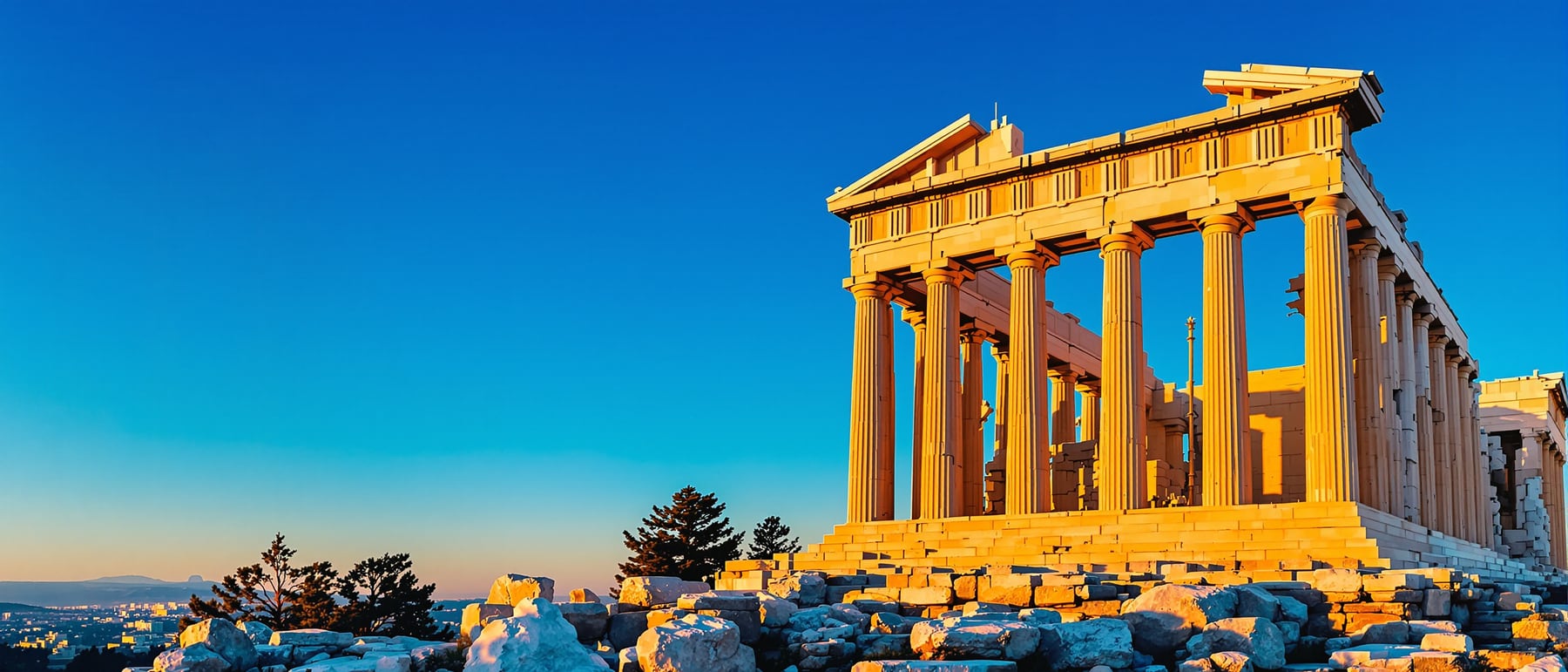
The Parthenon: The Perfect Temple That Has No Straight Lines
On a rock above Athens, a democracy at the height of its powers built a marble temple to its virgin goddess — and tuned it so subtly, with curved floors, swelling columns and walls that lean inward, that a building full of curves reads to the eye as flawlessly straight. Temple, treasury, church, mosque, gunpowder store and ruin by turns, blown apart in a single night in 1687 and stripped of half its sculpture, it remains the most imitated building in the Western world.
From Chavín de Huántar, a temple that ruled by darkness, terror and the hidden god, we come to almost its exact opposite — a temple of light, reason and serene mathematical calm, built in the open air by a democracy at the height of its confidence. On a rock above Athens stands the Parthenon, the most famous, most studied, and most copied building in the whole Western tradition. Where Chavín overwhelmed the mind, the Parthenon sought to satisfy it — to be so perfectly proportioned that a person standing before it would feel not fear but a deep, rational delight.
This is the fifty-fourth article in our Architectural Wonders series, and the seventh in our chapter on the great temples and sacred places of the world.
And yet the Parthenon's most astonishing secret is that its famous "perfection" is a trick. Almost nothing about it is actually straight. Its builders discovered that to make a building look perfect to the human eye, you must make it, in fact, full of subtle curves and tilts — and they carried that insight further than anyone before or since. To understand the Parthenon is to understand that beauty, here, is a piece of the most sophisticated engineering.
1. The temple of the virgin goddess
Before the trickery, the plain facts — because the Parthenon was born in a very particular moment of triumph.
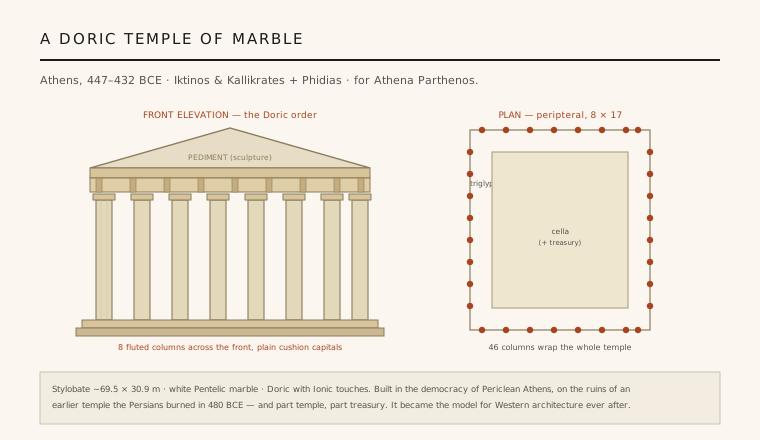
The Parthenon was built on the Acropolis — the sacred rock at the heart of Athens — between 447 and 432 BCE, in the golden age of the statesman Pericles, when Athens was the richest and most powerful city in Greece and its democracy was in full flower. It was raised on the ruins of an earlier temple that the Persians had burned in 480 BCE, and it was, in part, a monument of victory and civic pride. Its architects were Iktinos and Kallikrates, and the whole vast programme of sculpture was overseen by the greatest artist of the age, Phidias. It is a Doric temple — the sturdy, plain order, with fluted columns and simple cushion capitals — though it borrows elegant touches from the more slender Ionic order too. Built of gleaming white Pentelic marble quarried from a nearby mountain, it is peripteral: a rectangle (about 69.5 by 30.9 metres) wrapped by a single row of columns, eight across each end and seventeen down each side — forty-six in all. It was dedicated to Athena Parthenos, "Athena the Virgin," the warrior-goddess of wisdom who was the city's divine patron — and it doubled as the treasury where Athens (and its empire) kept its gold. It is, in short, the building on which almost all of Western architecture would later be modelled — and it earned that place through an obsession with getting every proportion exactly right. (Other civilisations would reach for the sublime by the opposite road — not refinement but sheer colossal scale, as at the Pyramid of the Sun in Mexico.)
2. The building with no straight lines
Here is the Parthenon's deepest secret, and the reason architects have studied it for 2,500 years: to make it look perfect, its builders made it, everywhere, subtly imperfect.
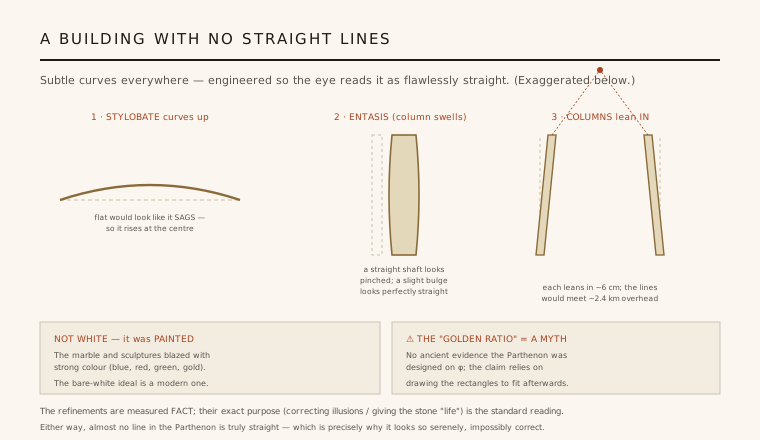
The human eye plays tricks. A long horizontal line, seen against the sky, appears to sag in the middle; a tall straight column looks slightly pinched; a row of perfectly vertical columns seems to splay outward at the top. The builders of the Parthenon knew all this — and corrected for it, with breathtaking precision. The stylobate, the marble platform, is not flat: it swells gently upward at the centre (by about 11 centimetres on the long sides), so it never looks as if it droops. Every column has entasis — a barely perceptible swelling at its midpoint — so that it reads as straight and taut rather than concave. Every column also leans slightly inward (by about 6 centimetres); if you extended their lines up into the sky, they would meet in an invisible point roughly 2.4 kilometres overhead. The corner columns are made a little thicker and set a little closer to their neighbours, because seen against the bright sky they would otherwise look too thin. The result of all these tiny departures from the straight is a building that the eye reads as serenely, impossibly correct — perfection achieved not by rigid geometry but by a subtle, curving compensation for how we actually see. (Two honest notes belong here. First, the Parthenon was not the gleaming white we imagine — it was brightly painted, its sculptures blazing with blue, red, green and gold; the bare-marble ideal is a modern invention. Second, the popular claim that the Parthenon was designed around the "golden ratio" is a modern myth: there is no ancient evidence for it, and the famous rectangles only "fit" if you draw them loosely after the fact.)
3. A gallery of marble
The Parthenon was not only a masterpiece of architecture; it carried the richest programme of sculpture in the ancient world — a whole mythology carved into stone.
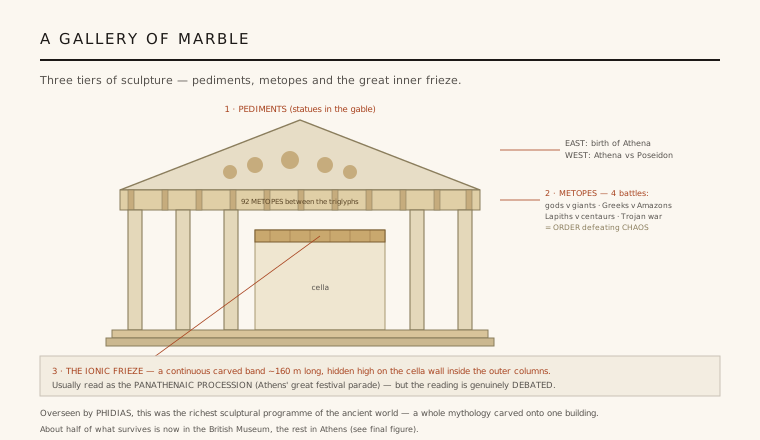
There were three great tiers of it. High in the two triangular pediments at the gable ends stood full, free-standing statues: the east pediment showed the miraculous birth of Athena (springing fully armed from the head of Zeus); the west, the contest between Athena and Poseidon for the patronage of Athens — the founding myth of the city. Below, running around the whole outside above the columns, were 92 square panels called metopes, carved in high relief with four mythic battles: gods against giants, Greeks against Amazons, Lapiths against centaurs, and the Trojan War. Every one of them stages the same theme — civilisation and order defeating savagery and chaos — a not-very-subtle message about how Athens saw itself. And then, set back on the wall of the inner building, high up and running for about 160 continuous metres, was the Ionic frieze, the subtlest and most beautiful of all. Its usual interpretation is that it depicts the Panathenaic procession — the great civic parade held in Athena's honour, which would have made it revolutionary, a temple showing not gods or myths but the Athenian people themselves. But this reading is genuinely debated (some scholars see instead a scene from myth), and it is honest to say we are not entirely sure what the frieze shows. Either way, it is one of the supreme achievements of world sculpture.
4. The golden goddess within
All of it — the temple, the columns, the carvings — existed to house one thing: a colossal statue that no longer exists.
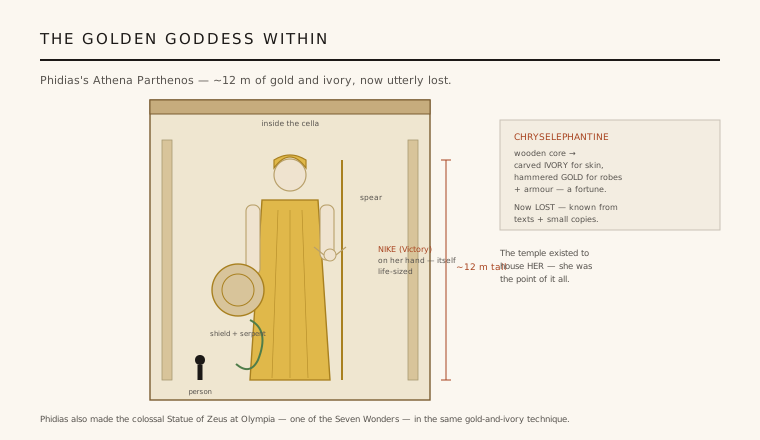
Inside the dim inner chamber, the cella, stood the Athena Parthenos — Phidias's masterpiece, a statue of the goddess about twelve metres tall. It was chryselephantine: built over a wooden core, then sheathed in carved ivory for the goddess's skin and hammered sheet gold for her robes and armour — a staggering fortune in precious material, so much that the gold was reportedly made removable, a reserve of the city's wealth. Athena stood helmeted and robed, a shield and a great serpent at her side, a spear in the crook of her arm, and on her outstretched right hand a winged figure of Nike (Victory) — a statue in its own right, itself life-sized. To step into the cella and meet her, gold and ivory glimmering in the half-light, must have been overwhelming. The statue is now completely lost — melted down, or carried off and destroyed, long ago — and we know it only from ancient descriptions (chiefly the traveller Pausanias) and small Roman copies. Its maker, Phidias, went on to create an even more colossal gold-and-ivory figure elsewhere: the Statue of Zeus at Olympia, which the ancient world counted among its Seven Wonders. The Parthenon, for all its fame as architecture, was in the end a magnificent house for a goddess who has vanished.
5. Temple, church, mosque — and the great explosion
The Parthenon's story does not end in ancient Greece. It stood, almost whole, for more than two thousand years — and then lost, in stages, almost everything.
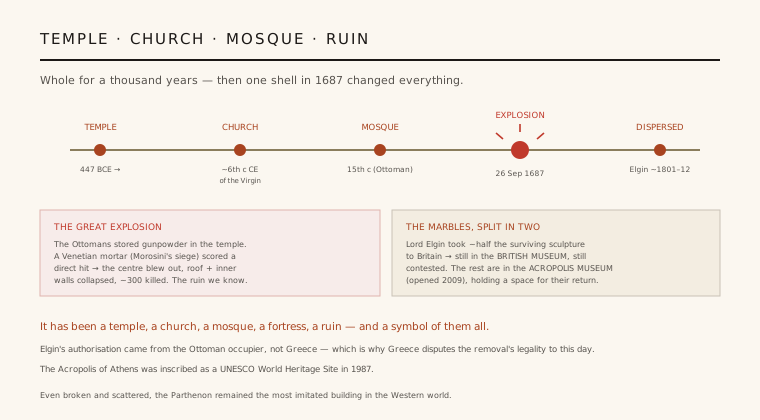
For its first millennium it remained a temple. Around the 6th century CE it was converted into a Christian church dedicated, fittingly, to another virgin — the Virgin Mary. After the Ottoman conquest, in the 15th century, it became a mosque, a minaret rising beside it. And then came the catastrophe. On the night of 26 September 1687, during a war between the Ottomans and Venice, the Ottoman garrison was using the Parthenon as a gunpowder magazine — believing, perhaps, that the enemy would not dare fire on so sacred a building. A Venetian mortar shell, fired from a nearby hill, scored a direct hit. The gunpowder detonated, and the centre of the Parthenon — intact after 2,100 years — blew apart in an instant: the roof gone, the long walls of the cella collapsed into rubble, columns thrown down, around 300 people killed. In one night, the temple became the ruin we know today. The wounds kept coming. Around 1801 to 1812, the British nobleman Lord Elgin removed roughly half of the surviving sculptures — pediment figures, metopes, long stretches of the frieze — and shipped them to Britain, where they remain in the British Museum as the "Elgin" or Parthenon Marbles. Greece has long sought their return, arguing that Elgin's permission came from the Ottoman occupier, not the Greek people; and the magnificent Acropolis Museum in Athens, opened in 2009, was built with a gallery deliberately kept empty and waiting for them. The Acropolis was named a UNESCO World Heritage Site in 1987. The Parthenon today is a monument not only to Athenian genius, but to everything that time, war and empire can do to even the most perfect of buildings — and to the enduring wish to see it made whole again.
6. What a modern architect can learn from the Parthenon
- True perfection accounts for the human eye, not the ruler. The Parthenon's builders understood that a building is experienced by a perceiving mind, not measured by a machine — and that to look right, it must be subtly made wrong. Design for how a thing is seen and felt, not merely for how it measures on the drawing.
- The deepest craft is often invisible. Almost no one notices the curves and tilts of the Parthenon; they simply feel that it is beautiful. The most refined work frequently hides its own effort — the labour disappears into the effect.
- Beware the myths we tell about great work. The "golden ratio" and the "pure white marble" are things later ages wanted the Parthenon to be. A good designer, like a good historian, separates what a building actually is from the romantic stories told about it.
- A building carries a message whether you intend it or not. Every metope of order-defeating-chaos, the whole civic frieze, said something about how Athens saw itself. Architecture is always, in part, propaganda and self-portrait — so choose, consciously, what yours says.
- Nothing built is safe forever. A temple survived two thousand years and was undone in a single night by gunpowder and a lucky shot. Permanence is never guaranteed; build well, but hold the work lightly, knowing that its meaning may outlast its stones.
- What is broken and scattered can still be honoured — and perhaps reunited. The empty gallery in Athens, waiting, is itself a kind of architecture: a space that keeps faith with the past and argues, quietly, for wholeness. Sometimes the most powerful thing a design can hold is a considered absence.
References & further reading
1. UNESCO World Heritage Centre — Acropolis, Athens (inscribed 1987). https://whc.unesco.org/en/list/404/
2. World History Encyclopedia — Parthenon. https://www.worldhistory.org/parthenon/
3. Smarthistory — The Parthenon (Iktinos and Kallikrates) and Phidias. https://smarthistory.org/parthenon/
4. The Acropolis Museum, Athens — The Parthenon Gallery. https://www.theacropolismuseum.gr/en/the-parthenon-gallery
5. British Museum — The Parthenon Sculptures (the museum's account of the collection and the debate). https://www.britishmuseum.org/about-us/british-museum-story/objects-news/parthenon-sculptures
6. Encyclopaedia Britannica — Parthenon. https://www.britannica.com/topic/Parthenon
*Last verified 2026-07-04. Figures follow UNESCO, the World History Encyclopedia, Smarthistory, the Acropolis Museum and Britannica, and are given as widely cited approximations that vary by source. The Parthenon stands on the Acropolis of Athens, Greece; it is a Doric peripteral temple (with Ionic elements) of Pentelic marble, built 447–438 BCE with sculpture completed by 432 BCE, in the age of Pericles, by the architects Iktinos and Kallikrates under the artistic direction of Phidias, dedicated to Athena Parthenos ("Athena the Virgin") and also used as the treasury. It replaced an earlier temple destroyed by the Persians in 480 BCE. Stylobate ~69.5 × 30.9 m; colonnade 8 × 17 (46 outer columns); columns ~10.4 m tall. OPTICAL REFINEMENTS (measured fact; their exact purpose is the standard interpretation): the stylobate curves upward at the centre (~11 cm on the flanks); columns have entasis (mid-shaft swelling) and lean inward ~6 cm (their lines would meet ~2.4 km up); corner columns are thicker and more closely spaced. The building was originally brightly PAINTED (polychromy), not white — confirmed by recent paint analysis (King's College London / British Museum / Art Institute of Chicago). The "golden ratio" design claim is a MODERN MYTH with no ancient evidence. SCULPTURE (overseen by Phidias): two pediments (east = birth of Athena; west = Athena vs Poseidon for Athens), 92 metopes (Gigantomachy, Amazonomachy, Centauromachy, Trojan War = order vs chaos), and a ~160 m continuous Ionic frieze usually read as the Panathenaic procession (interpretation debated). The cella held the Athena Parthenos, Phidias's ~12 m chryselephantine (gold-and-ivory) statue holding a life-size Nike; now lost, known from Pausanias and Roman copies. Phidias also made the Statue of Zeus at Olympia (a Seven Wonder). AFTERLIFE: temple → Christian church (~6th c CE, to the Virgin Mary) → mosque (15th c, Ottoman) → on 26 September 1687 a Venetian mortar (Morosini's siege) ignited Ottoman gunpowder stored inside, exploding the centre, collapsing the roof and cella walls, ~300 killed. Lord Elgin removed ~half the surviving sculptures c. 1801–1812 (now the British Museum's "Parthenon/Elgin Marbles"); Greece disputes the removal (Elgin's authorisation came from the Ottoman occupier) and seeks their return; the Acropolis Museum (opened 2009) reserves a gallery for them. UNESCO World Heritage Site "Acropolis, Athens," inscribed 1987. It is the most imitated building in the Western architectural tradition.
Export this guide
Related Guides — Deep-dive reading
The Statue of Zeus at Olympia: The God Made of Gold and Ivory
How the sculptor Phidias built a 13-metre seated Zeus of ivory flesh and golden robes — so vast that if the god stood he would unroof his own temple, so beautiful that men said it was a misfortune to die without seeing it — and how, uniquely among the lost wonders, we dug up the master's own workshop and perhaps his drinking cup.
Architectural WondersĠgantija: The Oldest Temple Standing, Built by 'Giants'
How a Neolithic island people on Malta — with no metal and no wheel — raised the oldest free-standing stone temples on Earth a thousand years before Stonehenge or the pyramids, moving fifty-tonne blocks on stone balls into clover-leaf sanctuaries for a faith we can trace but cannot read, then vanished, leaving stones so vast that later islanders swore only giants could have built them.
Architectural WondersThe Temple of Artemis at Ephesus: The Most Beautiful Wonder
How a marble forest of 127 columns at Ephesus became the most breathtaking of the Seven Wonders — the first Greek temple built wholly of marble, raised on a swamp by ingenious engineers — only to be burned down by a man who wanted his name to live forever, rebuilt grander, and finally lost to a single column in the reeds.
Architectural WondersRelated Tools — Try Free
False Ceiling Cost Estimator
Live ₹/sqft across 8 ceiling types — POP, gypsum, designer, metal, PVC, wooden — with cove and spot lighting for 20 Indian cities.
Cost CalculatorAI BOQ Generator
AI generates detailed Bill of Quantities with city-specific rates and labour breakdown.
ArchitectAIBefore & After Studio
Generate AI before-and-after renders to preview how your redesign could look.
DesignAI