
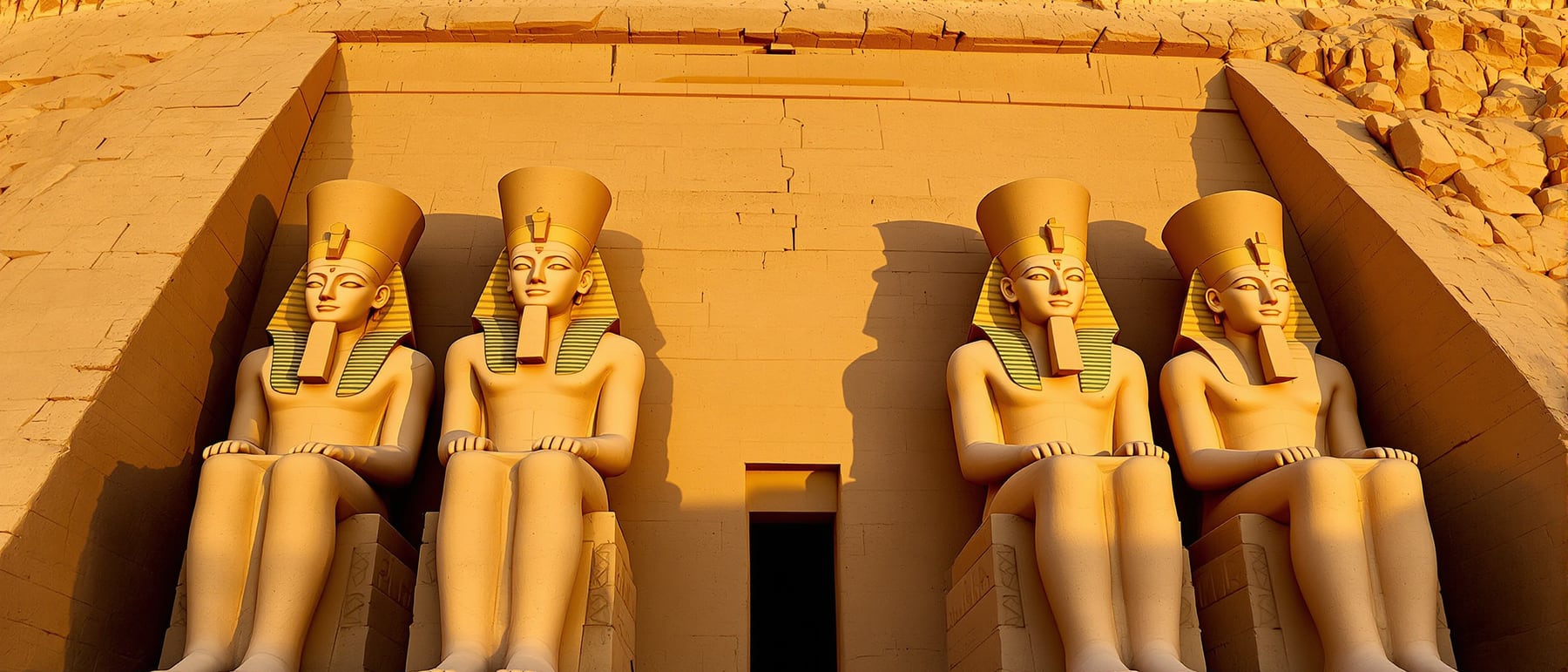
Abu Simbel: The Temple a Pharaoh Cut Into a Mountain — and the World Moved to Save It
How Ramesses the Great hollowed two temples out of a Nubian cliff, guarded them with four twenty-metre giants of himself, and aimed the whole mountain so precisely that twice a year the rising sun still races sixty metres into the dark to touch the gods at the very back — and how, three thousand years later, more than fifty nations sawed the temples into a thousand pieces and lifted them bodily up the cliff to escape a rising lake.
From the greatest temple-city of Egypt at Karnak — a place built up by thirty kings across two thousand years — we travel some three hundred kilometres south of Aswan, past the First Cataract of the Nile and deep into Nubia, almost to the edge of modern Sudan. Here the very same Ramesses II who carved his half of Karnak's Hypostyle Hall did something no builder before him had dared at this scale: instead of stacking a temple up from the ground, he ordered one cut into a mountain. This is Abu Simbel — two temples hollowed out of a solid sandstone cliff, guarded by four seated giants of the king himself, each about twenty metres tall.
This is the fifty-second article in our Architectural Wonders series, and the fifth in our chapter on the great temples and sacred places of the world.
Abu Simbel is a wonder twice over. It is a wonder of the thirteenth century BCE — a piece of architecture so precisely aimed that, twice each year, the rising sun reaches sixty metres into the dark to light the gods enthroned at the very back. And it is a wonder of the twentieth century CE — because when a modern dam threatened to drown it forever, the world did something unprecedented: it cut the mountain into a thousand numbered blocks and carried the temples, statues and all, to higher ground. Few buildings tell two such astonishing stories at once.
1. A mountain hollowed for a god-king
The first thing to understand about Abu Simbel is that it was not built — it was subtracted.
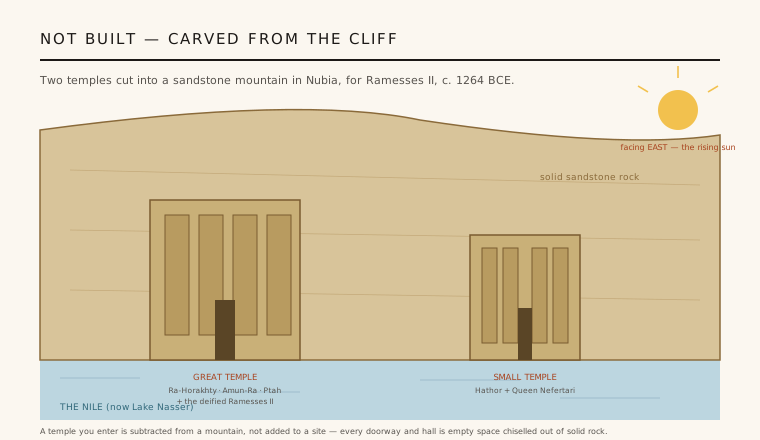
A temple like Karnak is added to a site, block on block. Abu Simbel is the opposite: every hall, every doorway, every colossus is empty space and solid form chiselled out of living rock. Ramesses II — Ramesses the Great, the most prolific builder in Egyptian history, son of Seti I — had his masons drive straight into a cliff on the west bank of the Nile and carve two temples where there had been only stone. Work is usually dated to around 1264 BCE and took roughly twenty years (some scholars prefer a slightly later start; the exact dates are approximate, as so often in Egypt).
Why here, so far from the great cities of the north? Because this was the frontier. Nubia was Egypt's gateway to the gold, ivory and trade of the African south, a land Egypt ruled but never wholly held. A colossal temple carved into the cliff, its giant kings staring downriver, was a message in stone to everyone sailing up from the south: this is Egypt, and this is its god-king. For that is the other daring thing about Abu Simbel — the Great Temple was dedicated to the state sun-gods Ra-Horakhty, Amun-Ra and Ptah, but also, openly, to Ramesses II himself, worshipped as a living god among them. Beside it, a smaller temple was cut for the goddess Hathor and the king's beloved wife, Queen Nefertari. The whole cliff faces east, toward the rising sun — a decision that, as we will see, was no accident.
2. Giants at the gate
Nothing prepares you for the front of the Great Temple: four seated colossi of one man, each as tall as a six-storey building, cut from the cliff as if the mountain itself had taken his shape.
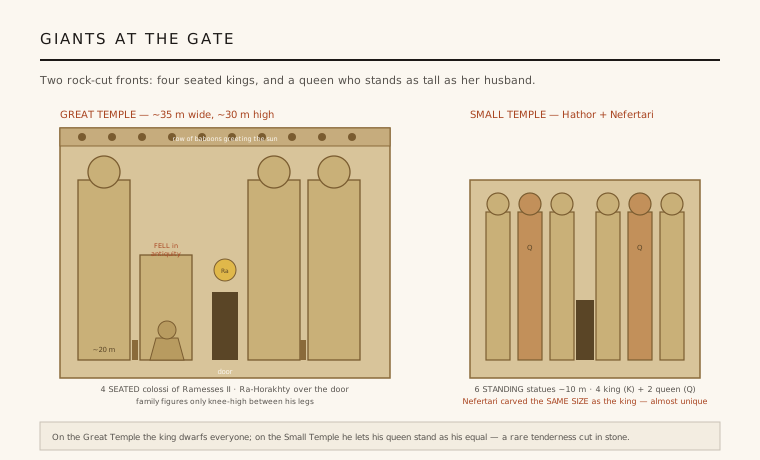
The Great Temple's facade is roughly 35 metres wide and 30 metres high, and it is dominated by four enormous seated statues of Ramesses II, each about twenty metres tall (some sources say a little more; the figures are approximate). They sit in pairs on either side of the entrance, wearing the striped nemes headcloth and the double crown, hands flat on their knees, gazing out over the river with an expression of vast, untroubled calm. One detail keeps the scene honest and human: the upper body of the second colossus fell in antiquity — probably shaken down by an earthquake not long after the temple was finished — and its head and torso still lie broken at the statue's feet. When the temple was rescued in the 1960s, the engineers deliberately left the fragments where they had fallen, rather than restore the figure, so the wound is still visible today.
Look lower and the scale becomes almost tender. Standing only knee-high against the king's colossal legs are small figures of the people he loved: his mother Mut-Tuy, his wife Nefertari, and several of his children. Above the doorway stands a statue of the falcon-headed sun-god Ra-Horakhty; and along the very top of the facade runs a row of carved baboons, arms raised — the animals the Egyptians believed screeched to greet the rising sun each dawn.
Beside the Great Temple, the Small Temple carries its own surprise. Its facade holds six standing statues about ten metres tall — four of Ramesses and two of Nefertari — and here the king did something almost unheard of in Egyptian art: he had his queen carved the same size as himself. In nearly every other Egyptian monument the royal wife stands knee-high beside her husband, as those little figures do next door. At Nefertari's temple she stands as his equal, and the dedication reads, in effect, "a temple for Nefertari, for whose sake the very sun shines." It is one of the great romantic gestures of the ancient world, cut permanently into a mountain.
3. Into the mountain: Osiris, Kadesh, and the sanctuary of four gods
Step through the doorway of the Great Temple and you enter a world driven sixty metres back into the cliff, growing darker and holier as you go.
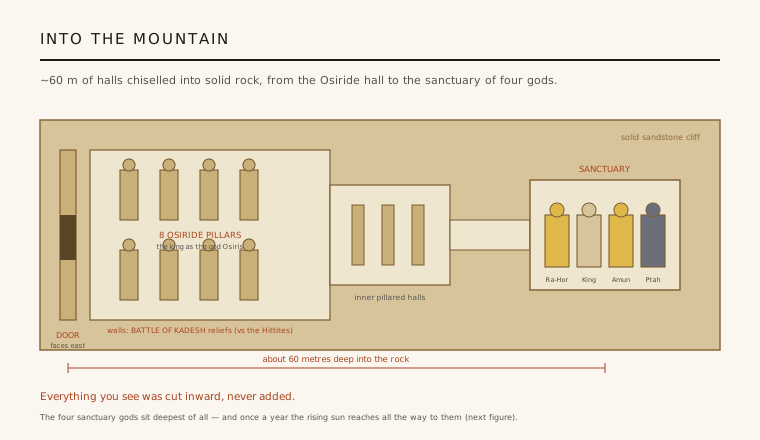
The first great hall is held up by eight massive pillars, and each is carved as Ramesses in the form of Osiris, god of the dead and of resurrection — the so-called Osiride pillars, so that the king stands guard, again and again, over everyone who enters. The walls around them are covered with some of the most famous reliefs in Egypt: vast scenes of the Battle of Kadesh, the clash with the Hittite Empire (around 1274 BCE) that Ramesses fought early in his reign. In truth Kadesh ended in a stalemate and one of history's first known peace treaties — but here, on his own walls, Ramesses is shown single-handedly turning the tide in his chariot, a giant among fleeing enemies. It is deliberate, monumental propaganda, and one of the earliest examples of a ruler using architecture to broadcast a carefully edited version of his own story.
Beyond the hall lie smaller, darker rooms, and then, at the deepest point of all, the sanctuary. Here sit four statues cut from the living rock: Ra-Horakhty, the deified Ramesses II, Amun-Ra, and Ptah — the king enthroned as an equal among the great gods of Egypt. For most of the year they sit in near-total darkness. But not on every day of the year — and that is Abu Simbel's greatest marvel.
4. The miracle of the sun
The whole temple, it turns out, is aimed like an instrument. Twice a year the dawn does something no one who sees it forgets.
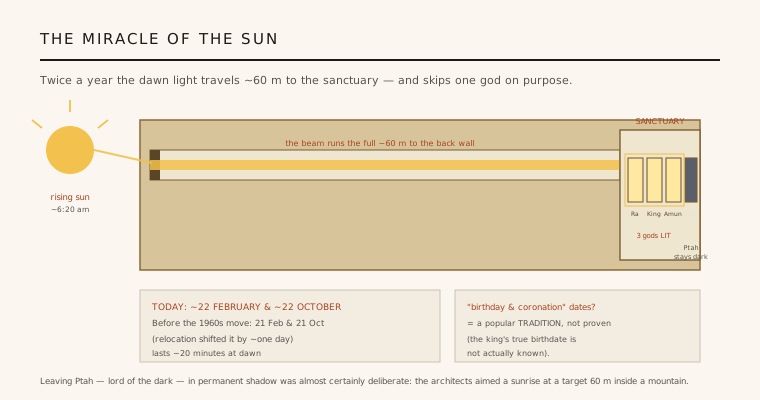
Because the Great Temple faces east and its axis was set with astonishing care, on two mornings each year the rising sun sends a single shaft of light straight through the entrance and along the entire sixty-metre length of the halls, all the way to the sanctuary at the very back. For about twenty minutes the beam falls across the enthroned gods and lights three of the four: Ra-Horakhty the sun-god, the deified Ramesses, and Amun-Ra. The fourth, Ptah — a god linked with the underworld and darkness — sits slightly apart in his corner and stays in shadow, every time, all year round. To place a statue sixty metres inside a mountain and then arrange for the sunrise to spotlight three of its four figures while sparing the god of darkness is a feat of astronomy, surveying and stone-cutting that still seems barely believable.
Today the alignment falls around 22 February and 22 October. It is often said that these mark Ramesses' birthday and his coronation day — a lovely idea, and you will hear it from every guide, but it is a tradition, not a proven fact: we do not actually know the king's birth date, and the claim cannot be verified. What we can say for certain is that the two-a-year event is real, deliberate, and old. One small, honest wrinkle: before the temple was moved in the 1960s the alignment fell one day earlier, on 21 February and 21 October. Lifting the whole mountain to safety shifted the sunrise geometry by a single day — a tiny, poignant sign of just how exact the original builders had been, and how nearly, but not perfectly, the modern engineers could match them. (Not every sacred builder wanted the sun inside: at Chavín de Huántar in the Andes, as we will see, a people aimed for the very opposite — perfect, permanent darkness.)
5. The temple that was moved to save it
Abu Simbel's second great story belongs to our own age — and it is the reason the temple still exists to be visited at all.
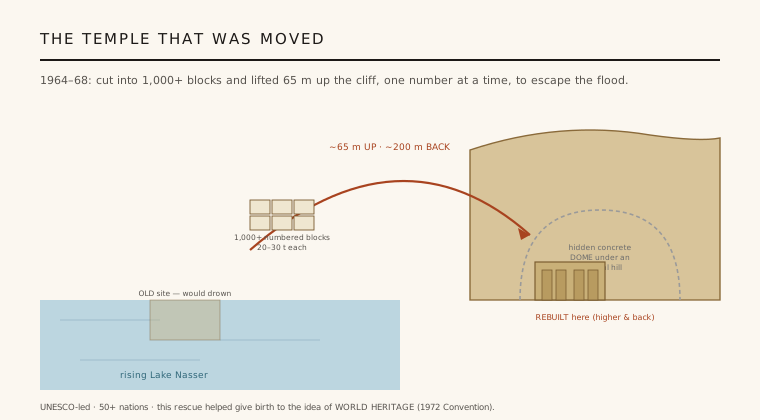
In the 1960s Egypt built the Aswan High Dam to tame the Nile's floods and generate power — and behind it rose a vast new reservoir, Lake Nasser. As the water climbed, it became clear that Abu Simbel, along with dozens of other Nubian monuments, would be drowned forever. What happened next had never been attempted. Led by UNESCO and backed by more than fifty countries, an international rescue campaign resolved to move the temples out of the water's reach. Between 1964 and 1968, engineers and archaeologists sawed both temples into more than a thousand carefully numbered blocks — around a thousand for the two temples, each weighing roughly twenty to thirty tonnes — lifted them out, and reassembled them on higher ground, about 65 metres up and 200 metres back from the original site.
To hide the seams and support the reconstructed cliffs, the rebuilt temples were tucked inside artificial hills raised over enormous reinforced-concrete domes — so that the visitor today, standing before the four colossi, has no sense that a hollow dome of twentieth-century concrete arches over the sanctuary behind them. Above all, the team laboured to preserve the sun alignment — and, as we saw, came within a single day of the ancient mark. The whole effort cost around 40 million US dollars (an enormous sum then) and it changed history in a quieter way too: the shock of nearly losing Abu Simbel helped give birth to the very idea of a shared World Heritage, leading to the 1972 World Heritage Convention. Today the temples are part of the UNESCO World Heritage Site "Nubian Monuments from Abu Simbel to Philae" (inscribed 1979). The place had, in fact, been lost once before: buried to the necks of its colossi in drifting sand, it was rediscovered by the Swiss traveller Johann Ludwig Burckhardt in 1813, and first dug open and entered in 1817 by Giovanni Belzoni — the same showman-explorer who, that very year, opened the tomb of Seti I, Ramesses' own father.
6. What a modern architect can learn from Abu Simbel
- You can build by taking away. Abu Simbel is architecture as subtraction — space carved out of solid rock rather than assembled from parts, like Kailasa at Ellora far to the east. It is a reminder that "construction" is only one way to make space; sometimes the most permanent architecture is the space you remove.
- Orientation is a design tool as powerful as walls. The sun miracle is not decoration added to the building — it is the building, aimed like a telescope. Which way a structure faces, and what the light does at a given hour, can be the whole point — and it costs nothing but foresight and precision.
- Scale is a language. Four twenty-metre kings on a frontier cliff say something no plaque ever could. Ramesses understood that size communicates — of power, of permanence, of who is in charge — and used it deliberately. A designer should know exactly what a building's scale is saying, because it is always saying something.
- Let the building carry the story you want told. The Kadesh reliefs turned a drawn battle into a blazing triumph. Architecture is never neutral; it frames a narrative. The honest designer at least knows whose story the walls are telling.
- A monument can honour a person as an equal. Nefertari's temple, where the queen stands as tall as the king, shows that architecture can encode respect and love, not just power — and that the choice to give someone equal stature in stone is itself a statement.
- What we build, we can choose to save — together. The greatest lesson of Abu Simbel is the modern one: faced with the loss of something irreplaceable, fifty nations chose to move a mountain rather than let it drown. Heritage is not automatic; it is a decision, made again by every generation, about what is worth carrying forward. That is the quiet creed of this whole series.
References & further reading
1. UNESCO World Heritage Centre — Nubian Monuments from Abu Simbel to Philae (inscribed 1979). https://whc.unesco.org/en/list/88/
2. UNESCO — The Rescue of Abu Simbel (the international salvage campaign). https://whc.unesco.org/en/story-abu-simbel/
3. World History Encyclopedia — Abu Simbel. https://www.worldhistory.org/Abu_Simbel/
4. Encyclopaedia Britannica — Abu Simbel. https://www.britannica.com/place/Abu-Simbel
5. Institute of Egyptian Art & Archaeology, University of Memphis — Great Temple and Small Temple at Abu Simbel. https://www.memphis.edu/egypt/resources/colortour/abusimbel-gtr2.php
6. Smarthistory — Great Temple of Ramesses II, Abu Simbel. https://smarthistory.org/rock-cut-temples-at-abu-simbel/
*Last verified 2026-07-04. Figures follow UNESCO, the World History Encyclopedia, Britannica, the University of Memphis Institute of Egyptian Art & Archaeology and Smarthistory, and are given as widely cited approximations that vary by source. Abu Simbel is a pair of rock-cut temples in Nubia, on the west bank of the Nile (now Lake Nasser), in the far south of Egypt near the Sudanese border, in Aswan Governorate. They were cut for Ramesses II (Ramesses the Great, 19th Dynasty; reign c. 1279–1213 BCE), construction usually dated c. 1264–1244 BCE, ~20 years (some scholars prefer a later start; dates approximate). The GREAT TEMPLE was dedicated to Ra-Horakhty, Amun-Ra and Ptah and to the deified Ramesses II; facade ~35 m wide × ~30 m high with four seated colossi of the king ~20 m tall (some sources ~21 m). The upper body of the second colossus fell in antiquity (probably an earthquake) and was left unrestored after the relocation. Smaller figures of the king's mother (Mut-Tuy/Tuya), his wife Nefertari and children stand at the colossi's legs; a statue of Ra-Horakhty is above the entrance and a row of baboons runs along the cornice. The interior runs ~60 m into the cliff: a great hall with eight Osiride pillars, walls carved with the Battle of Kadesh (c. 1274 BCE, in reality a stalemate, shown as a triumph), then inner halls and a sanctuary with four rock-cut seated statues: Ra-Horakhty, the deified Ramesses, Amun-Ra and Ptah. SOLAR ALIGNMENT: twice a year the rising sun penetrates ~60 m to the sanctuary and lights three of the four gods, leaving Ptah (associated with the underworld/darkness) in shadow; today ~22 February and ~22 October, before the 1960s relocation ~21 February and ~21 October. The popular claim that the two dates mark Ramesses' birthday and coronation is a tradition, not a verified fact (his birth date is unknown). The SMALL TEMPLE was dedicated to Hathor and Queen Nefertari; facade of six standing statues ~10 m (four of the king, two of the queen), with Nefertari exceptionally shown the same size as the king. Rediscovered (buried in sand to the colossi's necks) by J. L. Burckhardt in 1813; first entered by Giovanni Belzoni in 1817 (who also opened the tomb of Seti I that year). RELOCATION: to escape the rising Lake Nasser behind the Aswan High Dam, a UNESCO-led international campaign (50+ countries), 1964–1968, cut both temples into ~1,000+ numbered blocks (~20–30 tonnes each; figures vary, ~1,042 commonly cited) and rebuilt them ~65 m higher and ~200 m back, inside artificial hills over reinforced-concrete domes, preserving the sun alignment (which shifted ~1 day). Cost ~US$40 million. The campaign helped inspire the 1972 World Heritage Convention. Part of the UNESCO World Heritage Site "Nubian Monuments from Abu Simbel to Philae" (inscribed 1979).
Export this guide
Related Guides — Deep-dive reading
The Temples of Karnak: A Sacred City Built by Thirty Kings
How thirty pharaohs across two thousand years — from the Middle Kingdom to the age of Ramesses — kept adding to a single sacred precinct at Thebes until it became the largest religious complex of the ancient world, crowned by a hall of 134 colossal stone columns raised as a petrified papyrus marsh, a forest of stone built to be the very morning of creation for the King of the Gods, Amun-Ra.
Architectural WondersThe Pantheon: The Dome That Has Never Been Beaten
Nearly nineteen centuries ago the Romans poured a hemisphere of concrete 43 metres across, left a single round hole open to the sky at its summit, and walked away — and it is still, today, the largest unreinforced concrete dome on Earth. A temple to all the gods that became a church, the best-preserved building of ancient Rome, and the ancestor of every great dome from Florence to the United States Capitol.
Architectural WondersĠgantija: The Oldest Temple Standing, Built by 'Giants'
How a Neolithic island people on Malta — with no metal and no wheel — raised the oldest free-standing stone temples on Earth a thousand years before Stonehenge or the pyramids, moving fifty-tonne blocks on stone balls into clover-leaf sanctuaries for a faith we can trace but cannot read, then vanished, leaving stones so vast that later islanders swore only giants could have built them.
Architectural WondersRelated Tools — Try Free
Home Building & Interior Cost Calculator — 20 Cities
Construction + interior costs for 20 Indian cities across kitchen, wardrobes, flooring, painting, ceiling.
Cost CalculatorWindow Orientation Planner
Pick the best window type, glass and shading by wall direction — north, east, south and west.
Window ToolDesign Style Finder Quiz
Answer 10 visual questions to discover your Indian interior style profile with materials and colours.
Interactive Quiz