
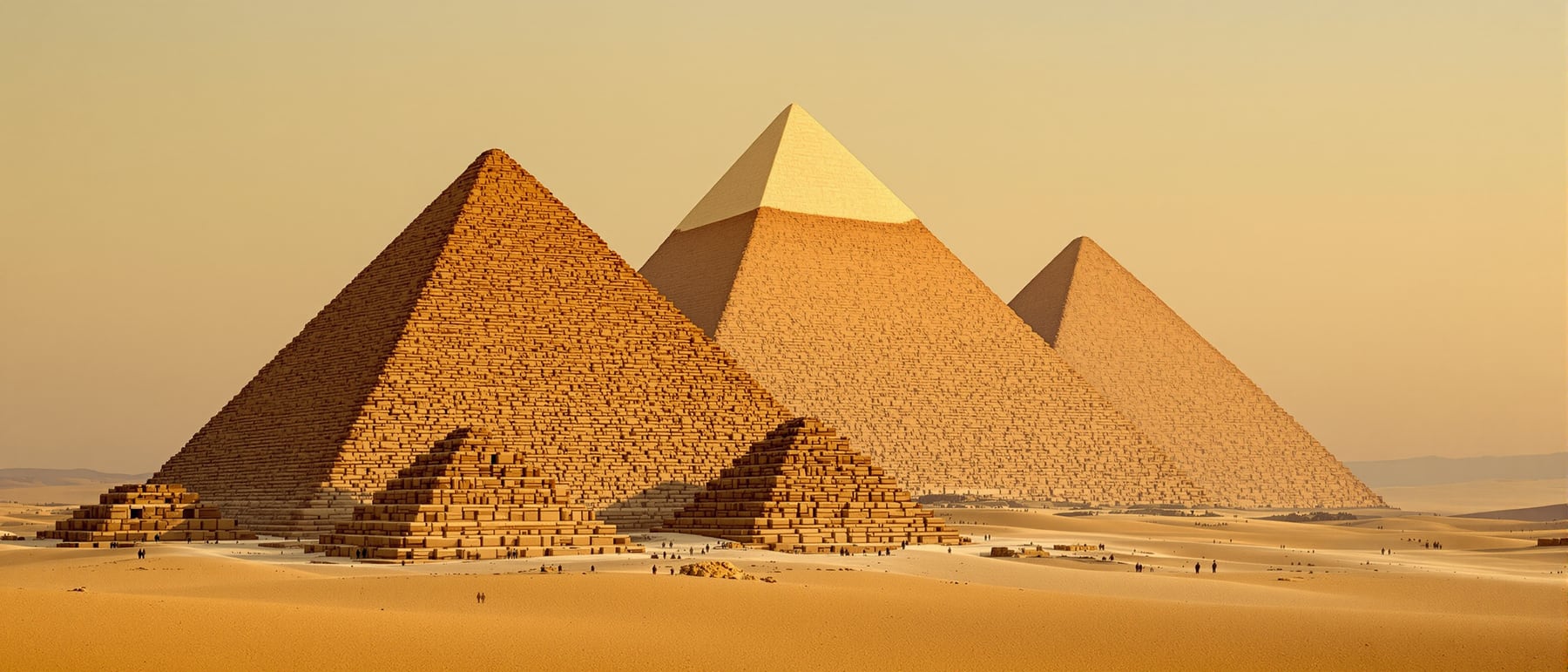
The Pyramids of Giza: The Only Wonder Still Standing
How three Fourth-Dynasty kings raised the greatest stone monuments on Earth — 2.3 million blocks placed with a precision that shames a modern surveyor, by a paid and well-fed town of workers, not slaves — and why the Great Pyramid, oldest of the Seven Wonders of the Ancient World, is the only one that has not vanished.
We come now to the beginning of everything — to the oldest wonder in this whole series, and the one against which all the others must, quietly, measure themselves. Long ago the ancient world drew up its own list of marvels: the Seven Wonders of the Ancient World, named by Greek writers who had travelled and gasped. Six of those seven are gone — thrown down by earthquake, burned, melted for scrap, quarried away. Only one still stands where it was built, and it was already two thousand years old when the other six were new.
It is the Great Pyramid of Giza, raised for the pharaoh Khufu around 2600 BCE, and it is the single most colossal survivor from the deep past of the human race. To stand before it is to stand before the last witness of a vanished list — and before the plainest, hugest statement architecture has ever made: we were here, and we built to outlast everything.
This is the thirty-first article in our Architectural Wonders series.
1. The only survivor
Begin with what makes the Great Pyramid unique, because it is easy to miss under the sheer size. It is not only a wonder. It is the last wonder.
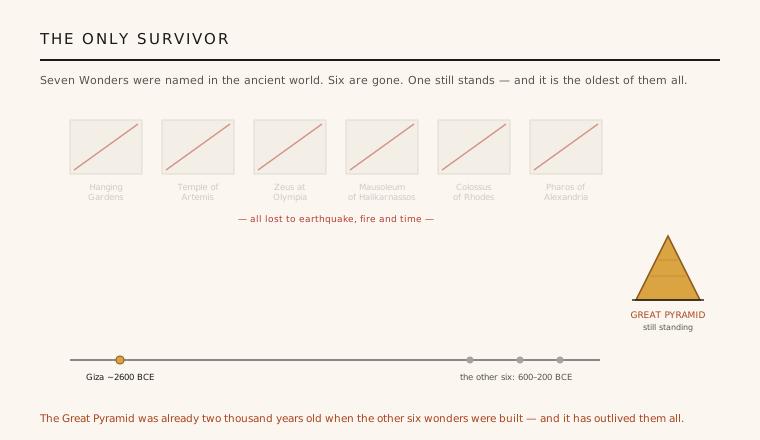
The classical list — shaped by Greek writers such as Antipater of Sidon around 100 BCE — gathered the seven most astonishing built things of the Mediterranean world: the Great Pyramid, the Hanging Gardens of Babylon, the Temple of Artemis at Ephesus, the Statue of Zeus at Olympia, the Mausoleum of Halicarnassus, the Colossus of Rhodes, and the Lighthouse (Pharos) of Alexandria. (The ancient lists were never quite fixed — different authors swapped one wonder for another — but that membership is the one history settled on.) Every single one of the other six has been destroyed; some, like the Hanging Gardens, are so lost that scholars argue whether they ever truly existed. The Pharos we will meet again through its successor, the Fort of Qaitbey, built from its very rubble. But the Great Pyramid needs no successor. It is still here. Built before the others, it has outlived them all — which is the first and deepest thing to understand about it.
2. Three kings on the plateau
The famous silhouette is not one pyramid but three, raised by three pharaohs of Egypt's Fourth Dynasty — grandfather, father and son — across roughly three generations around 2600–2500 BCE.
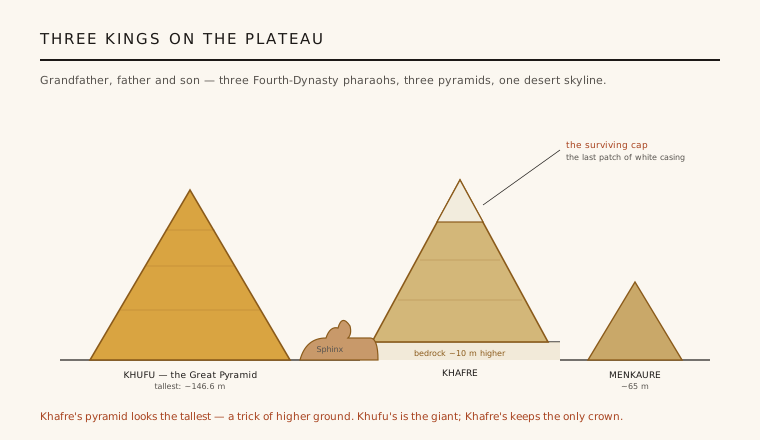
The largest belongs to Khufu (the Greeks called him Cheops) — the Great Pyramid, the Wonder itself. Beside it stands the pyramid of his son Khafre, and here is a lovely trick the plateau plays: Khafre's pyramid looks taller than Khufu's, but it is not — it only stands on bedrock about ten metres higher. Khafre's also holds a precious clue, a cap of smooth, pale casing stone still clinging near its apex: the last surviving patch of the polished skin that once sheathed all three (we will come to that). The third and smallest, off to the side, belongs to Khafre's son Menkaure. And crouched before them is the Great Sphinx, its face traditionally taken to be Khafre's — a lion's body with a king's head, carved from the living rock of the quarry that fed the pyramids. Three tombs, three generations, one of the most complete family monuments ever built.
3. A mountain built to the millimetre
Now the numbers — and they are the kind that stop conversation. The Great Pyramid is not merely big; it is impossibly precise, and that is the greater wonder.
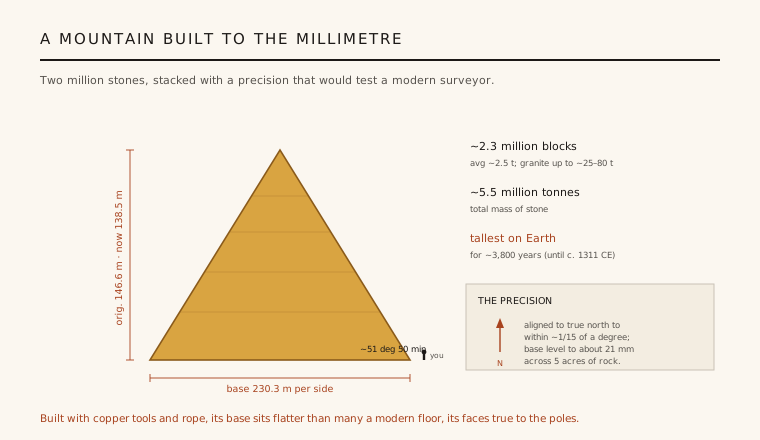
It was raised from roughly 2.3 million stone blocks, most weighing about 2.5 tonnes, some of the granite beams over its burial chamber weighing 25 to 80 tonnes — perhaps 5.5 million tonnes of stone in all. It rose originally to about 146.6 metres (it has lost its top, and stands near 138.5 m today), on a base 230.3 metres on every side, its faces climbing at a constant slope of about 51 degrees 50 minutes. It was the tallest structure on Earth for some 3,800 years — until a medieval cathedral spire finally passed it around 1311 CE. No building held that title remotely as long, before or since.
But size is not the miracle. The precision is. The four sides are aligned to true north to within about a fifteenth of a single degree. The base — five acres of it — is level to around 21 millimetres, flatter than many a modern concrete floor. All of it set out with copper tools, rope, water and sightlines, four and a half thousand years ago, with no instrument we would recognise. As at Brihadeeswara, where an 80-tonne capstone was raised without a crane, the deepest awe here is not "how heavy" but "how exact."
4. The town that built a mountain
Who built it? For centuries the answer, borrowed from Herodotus and multiplied by Hollywood, was slaves. Modern archaeology has overturned that completely — and the truth is far more moving.
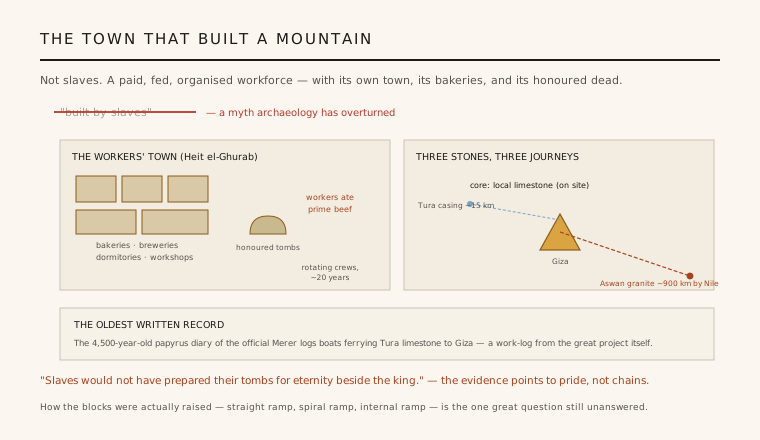
Just southeast of the pyramids, archaeologists Mark Lehner and Zahi Hawass unearthed an entire workers' town — bakeries, breweries, dormitories, workshops — and a cemetery where the workers were buried in prepared tombs, with honour, right beside their king. Their bones show they ate well, on prime beef; as Hawass put it, slaves "would not have prepared their tombs for eternity" next to the pharaoh. This was a paid, fed, proud workforce: a permanent core of skilled builders joined by rotating crews of ordinary Egyptians who came for a few months at a time — very likely during the Nile's flood, when the fields were underwater and there was no farming to do. Roughly two decades of this raised the mountain.
They worked three different stones, each with its own journey: the rough local limestone of the plateau for the vast core; fine white Tura limestone, ferried about 15 kilometres, for the smooth casing; and red Aswan granite for the burial chamber, floated an astonishing 900 kilometres down the Nile. We even have the oldest written record on Earth from the effort — the 4,500-year-old papyrus diary of an official named Merer, logging his boat-crews carrying Tura stone to Giza. What we still do not know is exactly how the blocks were lifted into place: a single straight ramp, a spiral ramp wrapping the pyramid, an internal ramp hidden inside it — every theory has a fatal objection, and none is proven. The greatest building of the ancient world keeps one honest secret to this day. (And no — it was not aliens, and the tidy notion that the three pyramids "map the stars of Orion" is a modern fancy, not Egyptian design.)
5. The mirror that vanished
Look at the pyramid today and you see a rough, brown, stepped mountain of bare core-stone. That is not what the Egyptians built. What they built has largely disappeared — and its loss is its own quiet lesson.
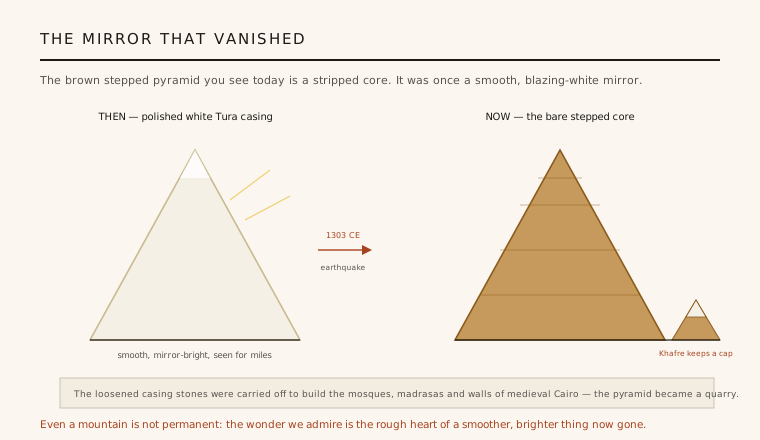
The finished pyramid was sheathed head to foot in polished white Tura limestone, dressed so smooth and fine that the whole mountain became a blazing white mirror, throwing back the desert sun so brightly it could be seen for miles — a beacon of pure geometry on the edge of the world. That gleaming skin survived for thousands of years. Then a great earthquake in 1303 CE shook the casing loose, and the people of a growing city did the practical thing: they carted the beautiful white stone away to build medieval Cairo — its mosques, its madrasas, its walls. The wonder became a quarry. Today only scattered casing blocks remain around Khufu's base, and that one cap near the top of Khafre's pyramid — the single surviving glimpse of how all three once blazed. It is a humbling thought, and a true one: even the most permanent thing humans ever made was, in the end, not quite permanent. The rough giant we revere is the stripped heart of something smoother and brighter, now gone.
6. What a modern architect can learn from Giza
- Precision is a deeper wonder than size. Anyone can pile stone high; aligning a five-acre base to true north within a fifteenth of a degree, with rope and copper, is the real marvel. Chase exactness, not just scale — it is what still stops people in their tracks 4,500 years on.
- Great buildings are built by valued people. The pyramids were raised not by slaves but by a fed, paid, honoured workforce with its own town. How you treat the hands that build is written into what they build. Dignity and craftsmanship rise together.
- One clear idea, carried to totality. A pure four-sided geometry, aligned to the cosmos, executed without compromise across two decades. As at Konark and Kailasa, the most powerful architecture is a single idea pursued without flinching.
- Match the material to the task, and move it if you must. Rough local stone for the mass, fine Tura limestone for the face, granite hauled 900 km for the chamber that mattered most. Spend effort where it counts; use humble material where it does not show.
- Nothing is truly permanent — so build meaning, not just mass. The blazing casing was quarried away; even a mountain was mined. What endures is not only the stone but the idea — that a people can reach across time. Build things that still mean something when their surfaces are gone.
- Leave the honest mystery. We still cannot say for certain how the blocks were raised, and that unanswered question is part of the awe. Not everything needs to be explained away; some greatness is allowed to keep its secret.
References & further reading
1. UNESCO World Heritage Centre — Memphis and its Necropolis – the Pyramid Fields from Giza to Dahshur (inscribed 1979). https://whc.unesco.org/en/list/86/
2. World History Encyclopedia — The Seven Wonders and Great Pyramid of Giza. https://www.worldhistory.org/The_Seven_Wonders/
3. Harvard Magazine — Who Built the Pyramids? (Lehner & Hawass, the workers' town). https://www.harvardmagazine.com/2003/07/who-built-the-pyramids-html
4. Smithsonian Magazine — The World's Oldest Papyrus and What It Tells Us About the Great Pyramids (the diary of Merer). https://www.smithsonianmag.com/history/ancient-egypt-shipping-mining-farming-economy-pyramids-180956619/
5. The Giza Project / Digital Giza, Harvard University. http://giza.fas.harvard.edu/
6. Encyclopaedia Britannica — Great Pyramid of Giza and Pyramids of Giza. https://www.britannica.com/place/Great-Pyramid-of-Giza
Last verified 2026-07-04. Figures follow standard Egyptological references and are given as widely accepted approximations that vary slightly by source: the Great Pyramid's original height is cited between about 146.5 and 147 m (now ~138.5 m), its base ~230.3 m per side, built of roughly 2.3 million blocks (~5.5 million tonnes) around 2600 BCE for Khufu. The Fourth-Dynasty attribution of the three pyramids (Khufu, Khafre, Menkaure) and the Sphinx to Khafre follow scholarly consensus (a minority view links the Sphinx to Djedefre). The ~3,800-year record as the tallest structure (ended c. 1311 CE by Lincoln Cathedral's spire) is the standard claim, subject to minor dispute over medieval spire heights. The paid-workforce evidence (Lehner/Hawass workers' town; the Merer papyrus), the three stone sources, the true-north alignment and ~21 mm base level, and the loss of the Tura-limestone casing after the 1303 CE earthquake follow the established archaeological record. Construction duration (~20 years) originates with Herodotus; the exact block-raising method remains unresolved. The "Orion correlation" and extraterrestrial-builder ideas are fringe notions rejected by mainstream scholarship and are noted only to set them aside.
Export this guide
Related Guides — Deep-dive reading
The Lighthouse of Alexandria: The Wonder That Became a Word
How Ptolemy's Egypt raised a 100-metre tower of light on the island of Pharos — the tallest building on earth after the Great Pyramid, the model for every lighthouse since, and so famous its island's name became the word for 'lighthouse' itself — which stood 1,600 years, fell to earthquakes, and was reborn as a fort and a field of ruins on the sea floor.
Architectural WondersSomapura Mahavihara: The Buddhist University Hidden Inside a Hill
Twelve hundred years ago in Bengal, a Pala emperor built one of the largest monasteries the Buddhist world had ever seen — a walled quadrangle a fifth of a mile across, ringed by 177 monks' cells, with a great cross-shaped, terraced temple rising from its courtyard. For four centuries scholars came from as far as Tibet to study here; then it was abandoned, and slowly buried, until villagers knew it only as Paharpur — 'the hill-town.'
Architectural WondersBrihadeeswara: The Chola Tower That Never Fell
How an 11th-century Tamil emperor raised a 216-foot tower of solid granite — with no mortar, no iron and no machine — and why this colossal corbelled mountain has stood for over a thousand years where Konark's fell. The engineering, the 80-tonne capstone, and the lesson.
Architectural WondersRelated Tools — Try Free
Material Schedule Generator
Generate a room-wise finish schedule — walls, floors, ceilings, trim, and joinery by location.
Material ScheduleAI BOQ Generator
AI generates detailed Bill of Quantities with city-specific rates and labour breakdown.
ArchitectAIBefore & After Studio
Generate AI before-and-after renders to preview how your redesign could look.
DesignAI