
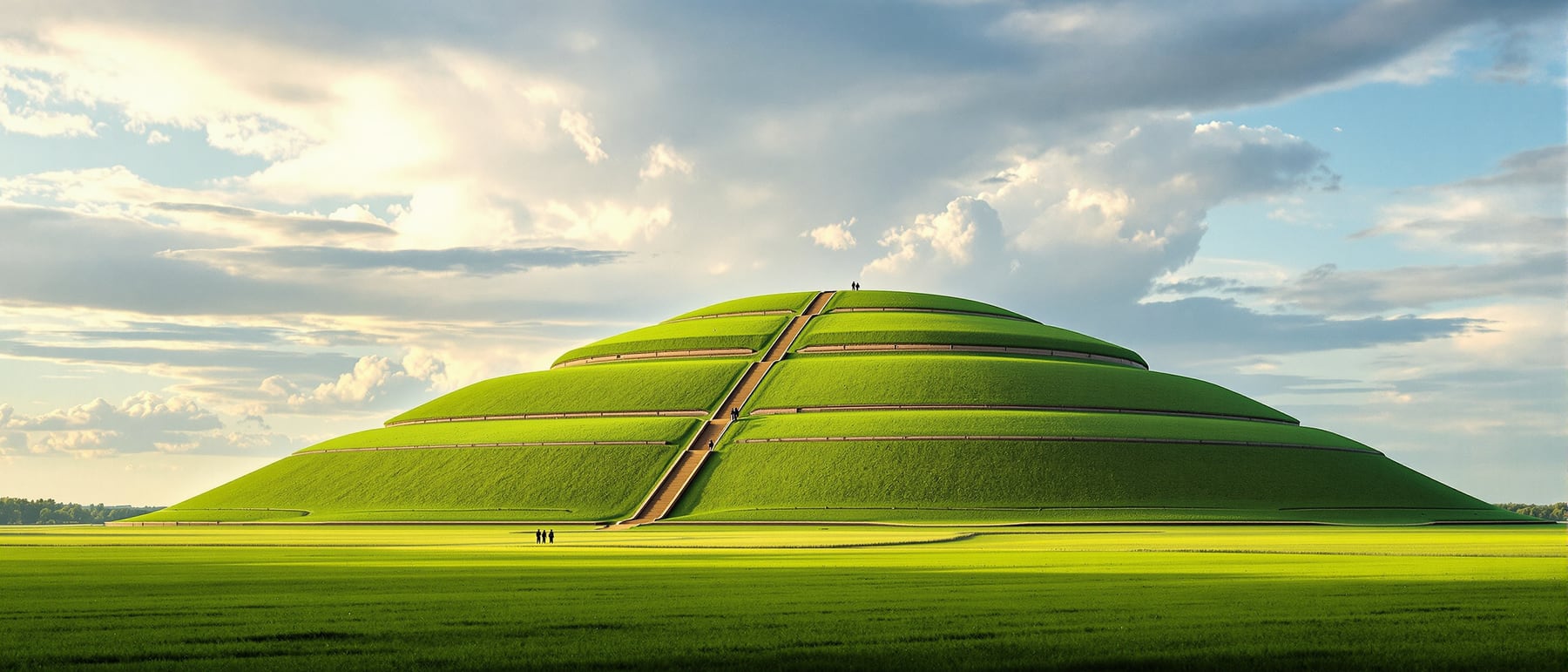
Cahokia and Monks Mound: The Great City America Forgot
A thousand years ago, across the river from where St Louis now stands, Native Americans built a city of perhaps twenty thousand people — larger than London at the time — with a hundred and twenty earthen mounds, a plaza the size of dozens of football fields, and a solar calendar of cedar posts. At its heart rose Monks Mound, the largest earthwork in the Americas, with a footprint to rival the Great Pyramid. Then, before Europeans ever arrived, it vanished — and almost no one remembers it.
We have just climbed the stone mandala-mountain of Borobudur — a monument that still stands, still whole, still climbed by pilgrims. Now we come to another great sacred mountain, on the other side of the world, that could hardly have met a more different fate. Across the Mississippi River from present-day St Louis once stood the largest city in the Americas north of Mexico — a metropolis of thousands, crowned by the largest earthwork ever raised in the Western Hemisphere. And then it disappeared so completely that most people who live an hour's drive away have never heard its name. This is Cahokia, and its great earthen mountain, Monks Mound.
This is the sixty-first article in our Architectural Wonders series, and the fourteenth in our chapter on the great temples and sacred places of the world.
It belongs beside the Newark Earthworks as one of the two supreme achievements of the mound-building peoples of ancient North America — and it is, if anything, even more astonishing: not a ceremonial landscape but a true city, planned, populous and powerful, that rose, ruled a wide world, and fell, entirely before Europeans arrived to write any of it down.
1. The city that America forgot
Begin with the fact that is hardest to believe, because we are so rarely taught it.
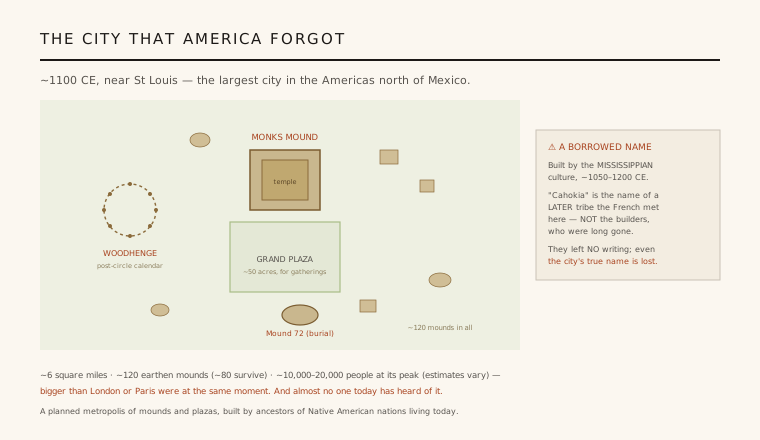
Around 1050 to 1200 CE, the Mississippian culture built, in the fertile Mississippi floodplain, a planned city covering about six square miles, with something like 120 earthen mounds (about 80 survive), broad plazas, neighbourhoods of thatched houses, and — at its peak around 1100 — a population estimated at 10,000 to 20,000 people. Let that land: this was larger than London or Paris at the same moment, one of the largest cities in the world, on the banks of the Mississippi, five centuries before the United States existed. And here is the humbling part, familiar now from Teotihuacan and Newark: we do not know what its builders called it, or themselves. They left no writing. The name "Cahokia" belongs to a different, later people — the Cahokia, a tribe of the Illinois Confederacy whom French explorers met in the area in the 1600s, long after the city had emptied. Even the great mound's name, "Monks Mound," merely recalls some French Trappist monks who gardened on its slopes around 1800. A whole civilisation's capital, and every name we have for it is borrowed.
2. Monks Mound: a mountain of earth
At the centre of that city rose the monument that makes Cahokia unforgettable.
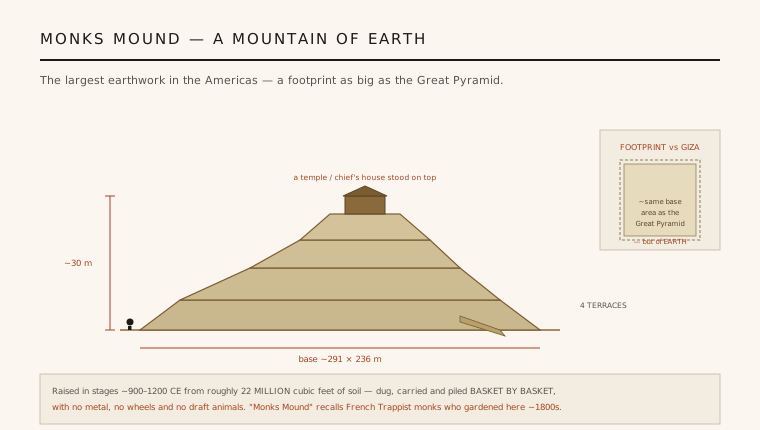
Monks Mound is the largest earthwork in the Americas and the largest earthen pyramid north of Mexico. It is a flat-topped mound rising in four terraces to about 30 metres high, roughly 291 by 236 metres at its base — which means its footprint is about the same size as the base of the Great Pyramid of Giza. But where Giza is cut stone, Monks Mound is earth: some 22 million cubic feet of soil, dug with wood and stone tools, carried on human backs in woven baskets, and piled up over some three centuries (recent work suggests parts rose startlingly fast). It had no metal, no wheels, no draft animals — just organised human labour on a colossal scale. On its broad flat summit once stood a great building — a temple, or the house of the paramount chief who ruled from this height, literally above everyone else in the city. To stand on top was to stand at the centre of the Mississippian world, halfway between the earth and the sky. It is, quite simply, one of the great monuments of humanity — and one of the least known.
3. Woodhenge and the ordered world
Cahokia was not a jumble of mounds. It was a planned city, laid out to a cosmic order — and it kept time by the sun.
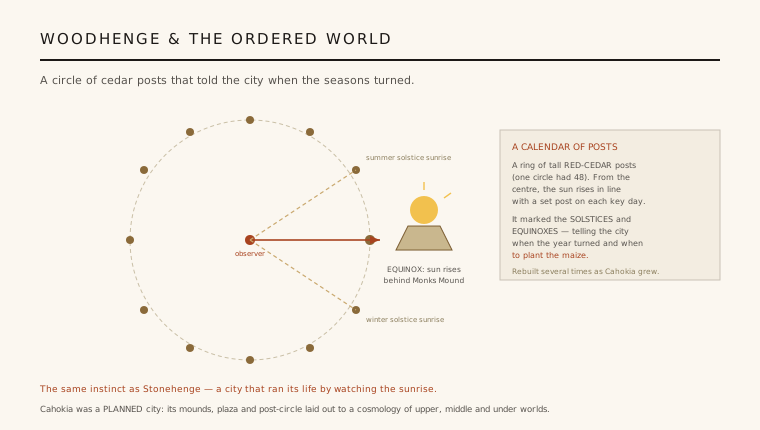
West of the great mound stood one of Cahokia's most evocative features: a huge circle of tall red-cedar posts that archaeologists nicknamed the "Woodhenge." It was a solar calendar. From a central observation post, an observer watching the horizon would see the sun rise in line with a particular post on each key day of the year — over one post at the midsummer solstice, another at midwinter, and, at the spring and autumn equinoxes, rising directly behind Monks Mound itself. These sunrise sightings told the city when the seasons turned and — crucially for a people who lived on maize — when to plant. It is the same instinct that raised Stonehenge and aligned the Newark Earthworks: a community running its life by carefully watching the sky. And it was one piece of a deliberately ordered city — mounds, the vast levelled Grand Plaza (some 50 acres, for gatherings, ceremony and the game of chunkey), and the post-circle, all laid out to a Mississippian cosmology of an upper, middle and lower world. Cahokia was not just big. It was designed.
4. The Birdman and the sacrificed
Beneath the ceremony lay a harder truth, and the earth of Cahokia preserved it starkly.
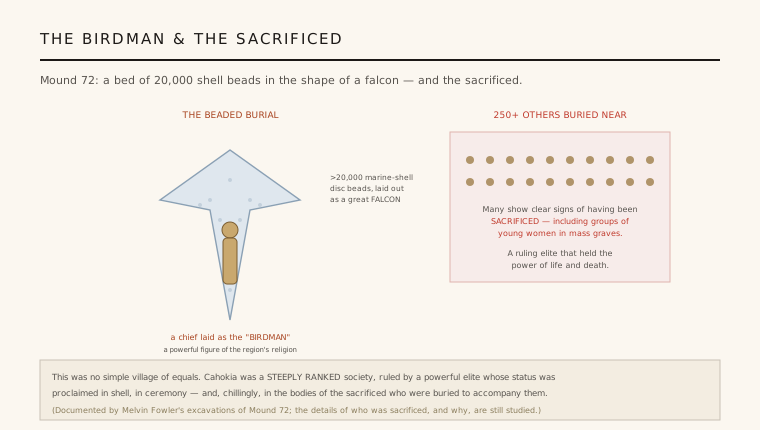
In a ridge-shaped burial mound known as Mound 72, archaeologists found one of the most extraordinary graves in North America. At its centre lay a high-status man placed on a bed of more than 20,000 marine-shell disc beads, arranged in the shape of a great falcon — its head, wings and tail spread beneath and around the body — marking him as a "Birdman," a powerful figure in the region's religion. He had been buried with immense ceremony and wealth. But he had not been buried alone. Nearby lay more than 250 other people — and many of them show unmistakable signs of having been sacrificed: ritually killed, including groups of young women laid in mass graves. It is a chilling window into what Cahokia's grandeur rested on: a steeply ranked society, ruled by an elite whose status was proclaimed in shell and ceremony — and, it seems, in the power of life and death over others. The mounds were not raised by equals for equals; they were the work, and the stage, of a hierarchy. (These are the findings of Melvin Fowler's excavations; who exactly was sacrificed, and why, is still carefully studied.)
5. The mystery of the collapse
And then — this is the part that haunts — all of it ended, and no one is quite sure why.
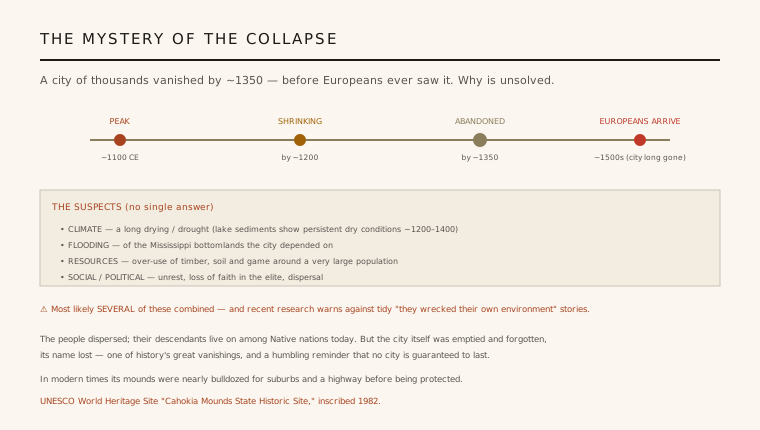
Cahokia peaked around 1100, began shrinking by about 1200, and was completely abandoned by around 1350 — roughly a century and a half before Europeans ever reached the region. Why remains one of the great open questions of American archaeology. Scholars have pointed to a long climate drying and drought (lake-sediment records show persistently dry conditions from about 1200 to 1400), to flooding of the river bottomlands the city depended on, to the exhaustion of timber, soil and game around so large a population, and to social and political breakdown — a loss of faith in the elite and their ceremonies. Most likely several of these combined, and, importantly, recent research has pushed back hard against the simple, once-popular story that the Cahokians simply "wrecked their own environment." We genuinely do not have a single answer. What we know is that the people dispersed — their descendants are among Native nations living today — and the great city was left to the grass. Worse, in modern times its mounds were nearly bulldozed for suburbs and a highway before being saved. In 1982 it was made a UNESCO World Heritage Site ("Cahokia Mounds State Historic Site"). It stands now as a vast green silence — and a sober reminder that no city, however great, is guaranteed to last.
6. What a modern architect can learn from Cahokia
- Cities are among our greatest works — and our most fragile. Cahokia was as populous as any city on Earth in its day, and it vanished utterly. Nothing about scale or success guarantees permanence; a great city is a living thing that must be continually sustained.
- You can shape a metropolis out of the ground itself. With no stone, metal or wheel, the Mississippians built a planned city of monumental earthworks. The material was never the limit — the vision was the achievement, a lesson in doing the most with the humblest means — the same truth written, half a world away, in the mud mosques of Timbuktu.
- Plan to the sky and the seasons. The Woodhenge, the aligned plaza, the sun rising behind the great mound — Cahokia bound its everyday life to the cosmos. Orientation and the calendar can be structural to a city's meaning, not mere decoration.
- Monuments encode power — for good and ill. Monks Mound literally raised a ruler above everyone; Mound 72 shows the human cost beneath the grandeur. Great architecture is rarely innocent of hierarchy — and honest design reckons with whose labour, and whose lives, it is built on.
- What is forgotten can be lost twice. Cahokia was abandoned once by history and nearly a second time by bulldozers. Heritage survives only when a later society actively chooses to protect it — remembering is itself an act of construction.
- Tell the whole story, and tell it with respect. This is the work of living peoples' ancestors, a civilisation most textbooks skip. The first duty is to give it its due — to teach that ancient North America held cities to rival the world's, built by people we should know far better than we do.
References & further reading
1. UNESCO World Heritage Centre — Cahokia Mounds State Historic Site (inscribed 1982). https://whc.unesco.org/en/list/198/
2. Cahokia Mounds State Historic Site (official) — Monks Mound and site guide. https://cahokiamounds.org/
3. World History Encyclopedia — Cahokia. https://www.worldhistory.org/cahokia/
4. Encyclopaedia Britannica — Cahokia Mounds and Monks Mound. https://www.britannica.com/place/Cahokia-Mounds
5. Pauketat, Timothy — Cahokia: Ancient America's Great City on the Mississippi (standard general history). https://www.worldcat.org/title/cahokia-ancient-americas-great-city-on-the-mississippi/oclc/262433711
6. Bird, Wilson et al. — Severe Little Ice Age drought… during the Mississippian abandonment of Cahokia, PNAS (2021). https://www.pnas.org/doi/10.1073/pnas.2018127118
*Last verified 2026-07-04. Figures follow UNESCO, the Cahokia Mounds State Historic Site, the World History Encyclopedia, Britannica, and archaeological scholarship (Pauketat; Fowler; Bird et al.), and are given as widely cited approximations that vary by source. Cahokia is near Collinsville, Illinois, USA (American Bottom floodplain, across the Mississippi from St Louis). Built by the Mississippian culture, it was the largest city in the Americas north of Mexico, peaking c. 1050–1200 CE (apex ~1100); population estimates ~10,000–20,000 (some higher) — larger than contemporaneous London/Paris. It covered ~6 sq mi with ~120 mounds (~80 survive), a ~50-acre Grand Plaza, and "Woodhenge" cedar-post solar calendars (solstice/equinox alignments; equinox sunrise behind Monks Mound). "Cahokia" is a borrowed name (from the later Cahokia/Illinois tribe met by the French; NOT the builders); "Monks Mound" recalls 19th-c. French Trappist monks; the builders left no writing and were ancestors of Native American nations. MONKS MOUND: the largest earthwork in the Americas / largest earthen pyramid north of Mexico; ~30 m high, ~291 × 236 m base (footprint ≈ the Great Pyramid of Giza, but of EARTH); four terraces; ~22 million cubic feet of soil, basket-carried; built in stages c. 900–1200 CE (parts rapidly); a temple/chief's building stood on the summit. MOUND 72: the "beaded burial" — a high-status man on a falcon-shaped bed of >20,000 marine-shell beads (a "Birdman," Southeastern Ceremonial Complex) — plus 250+ others, many sacrificed (including young women in mass graves) = a steeply ranked society (Fowler excavations). COLLAPSE: peaked ~1100, shrank by ~1200, abandoned by ~1350 (before European contact); causes DEBATED — climate drought (Little Ice Age; Horseshoe Lake sediments), flooding, resource exhaustion, social/political breakdown; likely multiple, and recent research (e.g., 2021) rejects simple self-inflicted-environmental-collapse narratives. Nearly destroyed by modern development; UNESCO World Heritage Site "Cahokia Mounds State Historic Site," inscribed 1982.
Export this guide
Related Guides — Deep-dive reading
The Newark Earthworks: A Cathedral of Earth Aligned to the Moon
Two thousand years ago, in what is now Ohio, Native American people raised the largest set of geometric earthworks on Earth — mile-wide circles, a perfect octagon, squares and avenues, all shaped from piled soil without metal, wheels or writing. And they aligned one of them, with astonishing precision, to the full 18.6-year cycle of the moon. Much was bulldozed for a city; one great piece spent over a century as a golf course; in 2023 it finally became a UNESCO World Heritage Site.
Architectural WondersThe Pyramid of the Sun: A Mountain Raised Over a Cave by a People With No Name
In the Valley of Mexico, a civilisation we cannot name built one of the largest pyramids on Earth — a man-made mountain of a million cubic metres — and set it precisely over a sacred cave they believed was the womb of the world. They left no writing we can read; even the words 'Pyramid of the Sun' were given, a thousand years later, by the Aztecs, who found the city in ruins and called it the birthplace of the gods.
Architectural WondersThe Mud Mosques of Timbuktu: The University Made of Earth
On the edge of the Sahara, a city that Europe turned into a byword for the middle of nowhere was in truth one of the great centres of learning in the medieval world — with a university of 25,000 students and libraries of hundreds of thousands of manuscripts. Its three great mosques are built entirely of mud, bristling with wooden beams, and must be re-plastered by the whole community every single year — which is exactly why, after seven centuries, they still stand.
Architectural WondersRelated Tools — Try Free
Window Orientation Planner
Pick the best window type, glass and shading by wall direction — north, east, south and west.
Window ToolCross-Ventilation Analyzer
Estimate airflow and air changes per hour (ACH) from room size, window areas, layout, and local wind — with NBC 2016 Part 8 compliance check.
Ventilation CalculatorFalse Ceiling Cost Estimator
Live ₹/sqft across 8 ceiling types — POP, gypsum, designer, metal, PVC, wooden — with cove and spot lighting for 20 Indian cities.
Cost Calculator