

Police Verification of Security Personnel in India (2026): Who Is Guarding You?
A homeowner's and RWA's plain-language guide to antecedent verification of the guards, drivers, cooks and domestic staff who hold the keys to your home, done properly, lawfully and with the person's knowledge and consent.
The night guard at your gate knows when your lights go off. The cook has a key to your kitchen. The driver knows when the house is empty, and the maid moves through every room. These are not strangers on the street; they are people you have handed real, repeated access to your home and your family. Verifying who they are is not suspicion, it is a basic form of care, and one of the quietest, most effective security measures a home or a society can take.
Police, or antecedent, verification is simply a check with the police to confirm a person is who they say they are and has no recorded criminal history that should worry you. For deployed security guards it is not optional: the law that regulates private security agencies requires an agency to verify the antecedents of every guard it deploys. For the driver, cook or maid you engage directly, it is something a careful homeowner or resident welfare association arranges. This guide explains who should be verified, how the process generally works, and, just as importantly, how to do it with dignity, because a verified worker is a trusted colleague, not a suspect.
Scope and how to read this. This is practical compliance literacy, not legal advice or authoritative code. Requirements vary by state and city and change over time, and the exact portal, form, fee and who applies differ from place to place. Always confirm the current position with the Authority Having Jurisdiction, here the local police and the state PSARA controlling authority, or a licensed professional, before you act.
Why verification matters, and what it actually is
A good deal of the crime that happens inside homes involves someone with legitimate access, or someone who once had it. That is not a reason to distrust the people who work for you; the overwhelming majority are honest and dependable. It is simply the reason a check exists. Verification protects the household, and it also protects the honest worker, who gains a clean record on file and the standing that comes with being properly vetted.
A police verification is an antecedent check. You, or an agency, submit the person's identity and address details, with their photograph and consent, and the police check their records for any adverse history and return a verification. It confirms two things: that the identity and address are genuine, and that there is no recorded criminal antecedent a reasonable employer would want to know about. It is a point-in-time check, not a character judgement, and it says nothing about how someone will behave tomorrow. Treat it as one sensible layer among several, alongside checking references and simply knowing who works in your home.
Who should be verified, and whose job it is
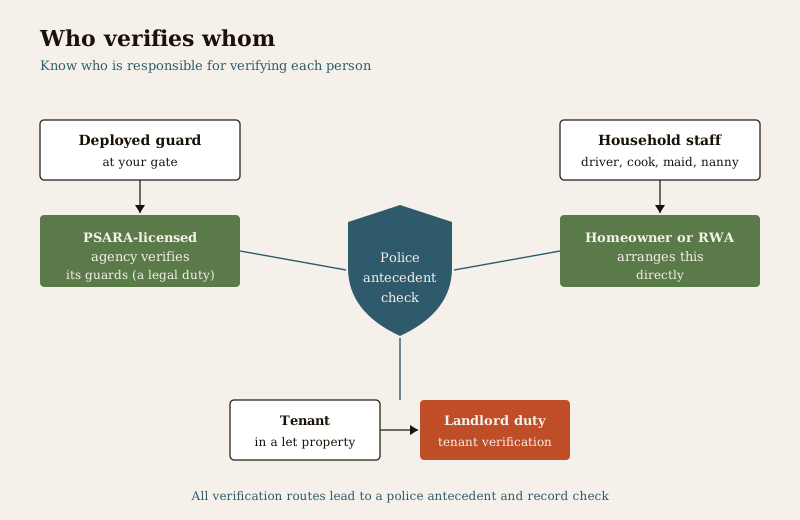
The single most useful thing to get straight is who is responsible for verifying whom, because the answer changes with the person.
Deployed security guards, the agency's duty. If your society or building is guarded by a private security agency, verifying each guard's antecedents is the agency's legal responsibility, not yours. Under the Private Security Agencies (Regulation) Act, 2005 (PSARA) and the corresponding state rules, an agency must be licensed and must verify the antecedents of the guards it deploys. Your job as a homeowner or RWA is to insist on it: engage only a PSARA-licensed agency, and ask to see that it has verified the guards posted to you. More on that below, and in the private security agency regulation guide and the security guard licensing and compliance guide.
Household staff you engage directly, your arrangement. The maid, cook, driver, nanny, gardener or caretaker you hire yourself sits outside the agency's duty entirely. Nobody verifies them unless you arrange it. Many states now actively encourage residents to get their domestic staff verified and provide a route to do so, precisely because these are the people with the deepest, most routine access to a home.
Tenants, the landlord's duty. If you let out a property, tenant police verification is a related and widely expected landlord responsibility, and in many cities the police specifically ask landlords to submit it. It is the same idea applied to the person living in your property rather than working in your home. See the security for tenants guide for the tenant's side of that relationship.
| Person | Who arranges verification | Nature of the duty |
|---|---|---|
| Deployed security guard | The PSARA-licensed agency | Legal duty of the agency under PSARA and state rules |
| Maid, cook, driver, nanny, caretaker | The homeowner or RWA who engages them | Prudent, often officially encouraged; you arrange it |
| Guard hired directly (not via an agency) | The homeowner or RWA | Treat like household staff; you arrange it |
| Tenant in a property you let out | The landlord | Widely expected landlord duty; police often require it |
Confirm locally. Exactly who may apply, through which portal or police station, and what is required, is set by the state and city and it changes. The pattern above is typical, not universal. Verify the current local position with your police commissionerate or the state PSARA controlling authority before you rely on it.
How the process generally works
The mechanics vary from state to state, but the shape of the process is remarkably consistent across India, and it is far less daunting than people expect. Many states and cities have moved it online, with dedicated portals or apps for domestic-help and tenant verification, so that a resident can apply without a trip to the police station.
The general flow looks like this. You gather the person's details with their cooperation: a government identity proof, an address proof for their current and permanent addresses, a recent photograph, and their consent to the check. You submit an application, increasingly through the state or city police online portal or app, or at the local police station where no online route exists. The police then run the antecedent check against their records, sometimes coordinating with the police in the person's home district, and return a verification, often as a certificate or a status you can view online.
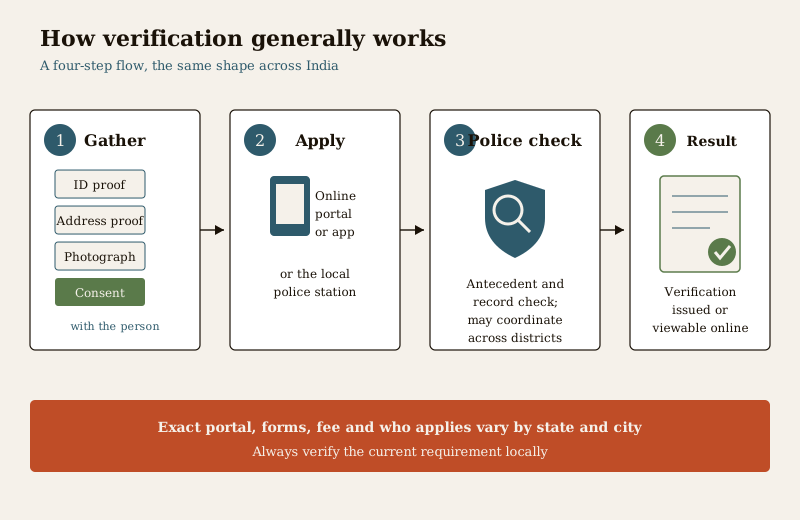
A few honest caveats sit around that flow. The exact portal name, the form, whether there is a fee, how long it takes, and who is permitted to apply, the resident, the agency, or the worker themselves, all differ by state and city and are revised from time to time. Do not rely on a number, a form name or a timeline you read anywhere, including here; check the current requirement on your own state or city police portal, or ask at the local police station. And the worker's cooperation is not a formality to be worked around, it is part of doing this lawfully and decently, which is the subject of the next section.
Doing it right: dignity, consent and data
This is the part that separates verification done well from verification done badly. A background check touches a person's identity, address, photograph and history. Done with their knowledge and agreement it is a normal, respectful condition of trusted work. Done behind their back, or used to profile, shame or control them, it becomes something else entirely, and in the case of their personal data it can cross legal lines.
Do it with the person's knowledge and consent. Tell the worker plainly that you would like to get a police verification done, why it is standard practice for anyone with access to the home, and what it involves. Ask for their cooperation rather than demanding their documents. A person who understands that this is routine, applied to everyone in the role and not aimed at them personally, will usually cooperate readily. Verification done openly builds trust; verification done secretly destroys it.
Handle their documents lawfully. The identity and address proofs, the photograph and the verification result are all personal data. Under the Digital Personal Data Protection Act, 2023 (DPDP), collect only what the check actually needs, use it only for that purpose, keep it securely, and do not retain or circulate it beyond what is required. Do not photograph a worker's Aadhaar and forward it around a residents' group chat; do not build a private dossier. The household context is covered in more depth in the domestic worker privacy guide, and the same discipline for visitor and staff records is in the visitor data protection guide.
A verified worker is not a suspect. The purpose of the check is to confirm there is no serious concern, and for almost everyone it will confirm exactly that. The result is confidential. It is not a licence to treat the person with suspicion or to hold a clean verification over them. Once verified, they are a trusted member of the household or the society's staff, and should be treated as one.
Consent and dignity are not optional extras. Verification protects the household, but it must never be used to surveil, profile or shame the people who work in it. Do it openly, take only the documents the check needs, keep them secure and private under DPDP, and remember that a person who has been verified has earned trust, not suspicion.
The RWA angle: agencies, records and the society's duty
For a resident welfare association or building management, verification is where good security governance shows. The society does not usually verify individual agency guards itself, that is the agency's job, but it is very much the society's job to make sure the agency is doing it, and to keep its own house in order for the staff it engages directly.
Insist on a PSARA-licensed agency. An agency operating without a PSARA licence has no business supplying guards, and cannot be relied on to have verified them. Ask to see the licence, and for confirmation that the specific guards deployed to your society have had their antecedents verified. A reputable agency will expect the question. The guardhouse design guide covers the record-keeping side of a well-run gate, where much of this lands in practice.
Keep records securely. A society should maintain, for its own accountability, a record that its guarding agency is licensed and its guards verified, along with verification for any staff, gardeners, plumbers or sweepers it engages directly. Those records are personal data and must be held securely and access-controlled under DPDP, not left in an open register at the gate. Handle tenant police verification the same way, as a landlord-and-society responsibility discharged openly and stored carefully.
Getting verification done: a practical checklist
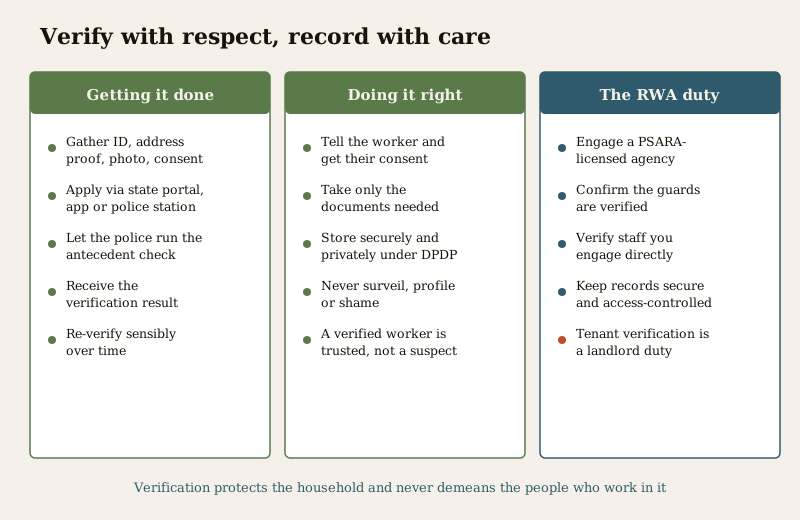
Whether you are a homeowner arranging it for a cook or an RWA member organising it across the staff, the steps are the same:
- Decide who needs it. Anyone with routine access to homes or common areas: directly engaged guards, drivers, cooks, maids, nannies, caretakers, and tenants if you are a landlord.
- Talk to the person first. Explain that verification is standard for the role, why it exists, and what it involves. Seek cooperation, not surrender of documents.
- Gather the essentials, with consent. A government identity proof, current and permanent address proof, a recent photograph, and their agreement to the check.
- Find the right route. Check your state or city police website or app for a domestic-help or tenant verification portal; where there is none, go to the local police station.
- Apply and let the police check. Submit the application; the police run the antecedent check and, where relevant, coordinate with the person's home district before returning a result.
- Store the result securely. Keep the verification and documents access-controlled and private under DPDP; use them only for their purpose; do not circulate them.
- Re-verify sensibly over time. Records can change; refresh verification periodically and whenever someone new is engaged, rather than treating a one-time check as permanent.
Do it right: the dignity checklist
- Openly, never secretly. The worker knows the check is happening and why.
- Consistently. Applied to everyone in a role, not singled out at one individual.
- Minimally. Only the documents the check genuinely needs, nothing extra collected as leverage.
- Securely. Documents and results held under DPDP, not shared in group chats or open registers.
- Respectfully. A clean verification means a trusted colleague, and is treated as confidential, not as a card to hold over anyone.
Where to go next
- Private security agency regulation — why the guarding agency must be PSARA-licensed, and what that licence obliges it to do.
- Security guard licensing and compliance — the standards a properly run guarding operation, and its guards, are held to.
- Domestic worker privacy and visitor data protection — handling the documents and records this generates lawfully and with dignity.
- Security for tenants — the related landlord-and-tenant side, including tenant police verification.
- The security and fire regulations hub and the security and fire regulations guide — where verification sits in the wider compliance picture.
References
- Private Security Agencies (Regulation) Act, 2005 (PSARA) and the corresponding state PSARA Rules — require private security agencies to be licensed and to verify the antecedents of the guards they deploy. The controlling authority and exact rules are set at state level; confirm the current position with your state PSARA controlling authority.
- State and city police domestic-help and tenant verification portals and apps — the practical route through which residents and landlords apply for antecedent verification; the exact portal, form, fee, timeline and who may apply vary by state and city and change over time. Verify on your own local police website.
- Digital Personal Data Protection Act, 2023 (DPDP) — governs how the identity documents, photographs and verification results of workers and tenants must be collected, used, stored and retained; collect only what is needed, hold it securely, and use it only for its purpose.
This is an educational compliance-literacy guide to police and antecedent verification of security personnel and household staff, not legal advice. The exact process, portal, forms, fees and timelines vary by state and city and change over time; always confirm the current requirement with your local police and state PSARA controlling authority, and consult a lawyer or Data Protection Officer for legal and data-handling questions.
Export this guide
Related Guides — Deep-dive reading
Security for Domestic Staff in Indian Homes (2026): Protecting the Home and the Worker's Dignity Together
Millions of Indian homes employ a maid, cook, driver, nanny, caretaker or gardener. Good practice keeps the home secure AND treats the worker as a trusted, verified human being with rights - never a suspect to be spied on. Lawful verification, dignified access control, the DPDP line on cameras, trust over surveillance, and a fair exit process.
SecuritySecurity and Fire Regulations Guide for India (2026): Know the Rules and How to Navigate Them
There is no single national rulebook you can read off. This is the map of the whole regulatory landscape for home, housing-society and commercial security and fire systems in India, and a calm way to navigate it: who sets the rules, who approves what, and how to stay on the right side of them.
SecurityDomestic Worker Privacy in India (2026): Security With Dignity
Maids, cooks, drivers, nannies and live-in help are people with rights, not permanent suspects to be watched. Use home cameras for real security, and never as a tool to monitor, control, shame or pressure the person who works in your home.
SecurityRelated Tools — Try Free
CPCB Compliance Checklist for STPs
Tick off CPCB/SPCB outlet standards, monitoring duties and record-keeping to score your sewage treatment plant's compliance readiness.
ChecklistCCTV Placement Compliance Checker
A quick DPDP-grounded privacy and safety self-check for where a camera is pointed — flags the items to fix.
ComplianceContract Studio
AI generates professional architecture service agreements with milestones and scope.
ArchitectAI