
Security Guard Licensing and Compliance in India (2026): The Rules Behind the Uniform
A plain-language guide for homeowners and RWAs to what actually makes a security guard compliant in India: the PSARA-licensed agency behind the guard, the eligibility, verification and training each guard should have, and the checklist you use before anyone stands at your gate.
There is a person standing at your gate, in a uniform, holding a register. For most residents that uniform is the whole story. It reads as authority, as reassurance, as "someone is in charge here." What the uniform does not tell you is whether that person is lawfully allowed to be doing this job, whether their background was ever checked, whether they were trained, and whether they are being paid and treated the way the law requires. Those are the questions that "guard compliance" is really about, and they matter as much for the guard's dignity as for your safety.
This guide is written for a homeowner or a Resident Welfare Association (RWA) or a small business that hires guards, and it explains the compliance side in plain language. It is not legal advice and it is not a rulebook. The single most important thing to understand up front is this: in India, an individual guard usually does not carry a personal "licence" the way a driver carries a driving licence. Instead, guards almost always work under a private security agency that holds a licence under the Private Security Agencies (Regulation) Act, 2005, known as PSARA. The agency is the licensed party, and the agency is responsible for the guard's eligibility, background verification, training and records. So "guard compliance", for you as a client, mostly comes down to two habits: use a properly licensed agency, and confirm that each guard actually standing at your gate has been onboarded the way the law expects.
Scope & how to read this. This is practical compliance literacy, not legal advice or authoritative code. Requirements vary by state and city and change over time — always confirm the current position with the Authority Having Jurisdiction (the state PSARA Controlling Authority, the police, or a licensed professional) and with the agency itself before you act. Nothing here is a substitute for the agency's own obligations under its state PSARA Rules.
The one idea that changes everything: the agency holds the licence, not the guard
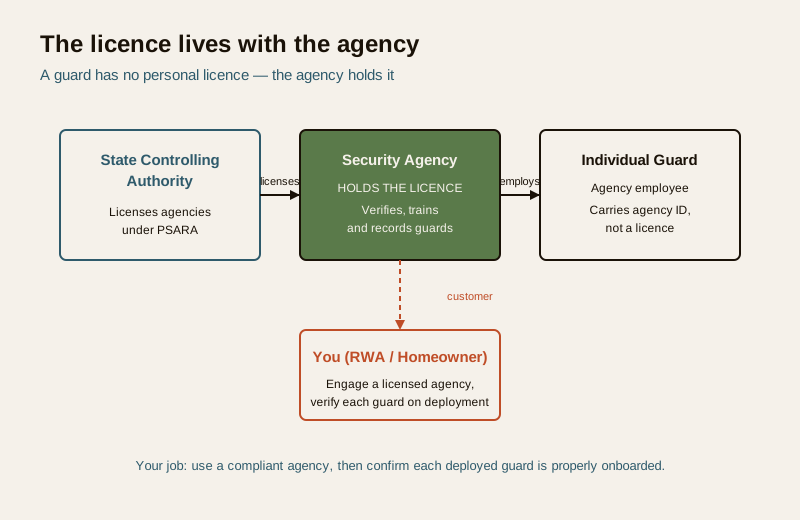
Picture the relationship as a chain. At one end is the state Controlling Authority set up under PSARA, which licenses agencies. In the middle is the private security agency, which holds that licence and takes on legal duties. At the other end is the individual guard, who is the agency's employee. You, the client, sit alongside that chain as the customer who engages the agency.
This is why you rarely ask a guard "show me your licence." A guard is not licensed as an individual the way a professional might be. What a guard should be able to show is evidence of proper onboarding by a licensed agency: an identity card issued by that agency, and a record that their background was verified and that they were trained. The licence itself lives with the agency.
The practical consequence is liberating. You do not have to become an expert in every eligibility rule. You have to pick a compliant agency and then verify, at deployment, that the specific humans they send you were put through the process. The heavy lifting of compliance is the agency's legal job. Our companion guide on the private security agency regulation explains how to check an agency's licence itself; this guide is about the guards that agency deploys.
What "guard compliance" generally involves
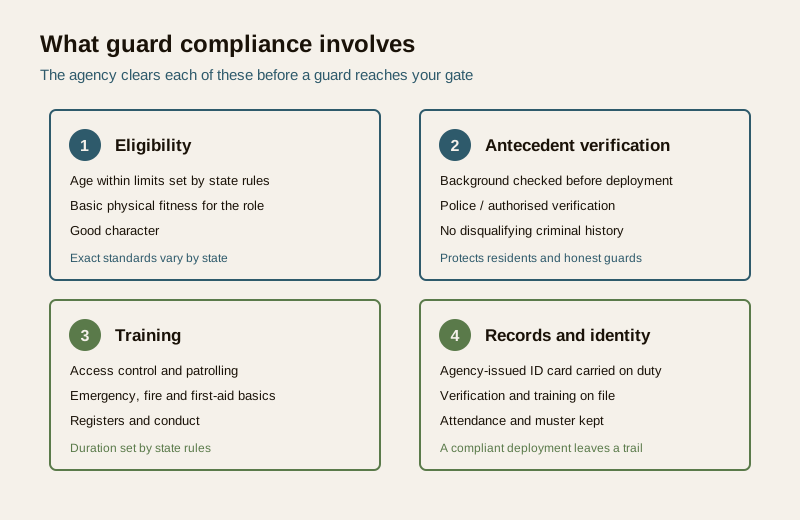
Under PSARA and the state PSARA Rules, an agency is expected to make sure each guard it deploys clears a set of gates before standing at your door. The exact requirements vary by state and change over time, so treat the following as the shape of the process rather than a fixed checklist, and confirm the current position with the agency and the state Controlling Authority.
Eligibility. A guard is generally expected to meet basic conditions of age, physical fitness and good character. There are typically minimum and maximum age bounds and a basic fitness expectation, because the job can involve standing for long hours, patrolling and responding to incidents. The precise ages and fitness standards are set by the rules and vary by state, so do not treat any specific number you hear as universal.
Character and antecedent verification. This is the one most people think of first. Before deploying a guard, the agency is expected to have the guard's antecedents verified, typically through police or an authorised verification process, to confirm there is no disqualifying criminal history. This protects residents and it protects the honest majority of guards from being tarred by the few. Because verification is so central, we treat it in its own companion guide on the police verification of security personnel — read that alongside this one.
Training. A guard is expected to receive prescribed training before or shortly after deployment, covering the basics of the role: access control, patrolling, handling registers, emergency and fire response, first aid, and conduct. The duration and syllabus are set by the rules and vary by state, so we will not quote a number of hours here. What matters is that training happened and can be evidenced, not that you memorise a figure.
Records and identity. A compliant deployment leaves a paper trail. Each guard should carry an identity card issued by the agency, and the agency should hold records of that guard's verification and training. On your side, you should be able to see the ID and, if you ask, get confirmation that verification and training are on file.
The client's checklist: what an RWA or homeowner should confirm
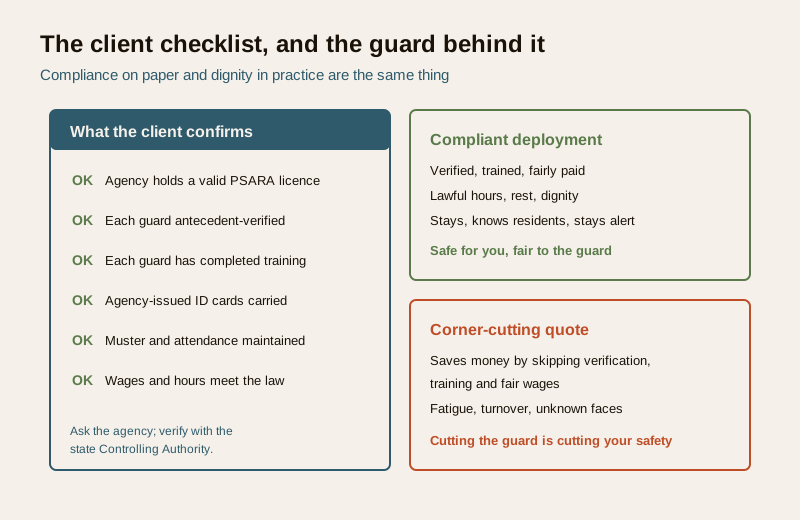
You are not the enforcing authority, and you cannot personally run background checks. But you are the customer, and a good customer asks the right questions. Here is the checklist that separates a serious engagement from a handshake.
| What to confirm | Why it matters | Who to ask |
|---|---|---|
| The agency holds a valid PSARA licence in your state | Everything downstream depends on the agency being lawfully licensed | The agency; verify with the state Controlling Authority |
| Each deployed guard has completed antecedent verification | Confirms background was checked before the guard reached your gate | The agency; see the police-verification guide |
| Each guard has completed the prescribed training | A trained guard handles access, emergencies and fire response competently | The agency; ask for training records |
| Every guard carries an agency-issued ID card | Ties the person at your gate to the licensed agency and their records | The guard on duty; the agency |
| Muster and attendance records are maintained | Shows who was actually on duty, and supports fair-wage and hours checks | The agency; your own gate register |
| Wages and hours meet legal requirements | Guards are workers with rights; underpayment is both unlawful and unsafe | The agency; the contract; ask how guards are paid |
Two of those rows deserve emphasis. First, ask for the agency's licence details and verify them rather than taking a logo on a letterhead at face value. Second, ask specifically how the guards are paid. A compliant agency pays guards through proper, traceable payroll that meets minimum-wage and working-hour law, and can show attendance and wage records. If the answer is vague, or if guards are paid in cash off the books, that is a compliance failure that also tends to signal wider corner-cutting.
Guards are workers with rights. A security guard is an employee, not a fixture. Fair wages, lawful working hours, weekly rest, and freedom from coercion or arbitrary treatment are not favours — they are legal entitlements. A deployment that is compliant on paper but exploits the guard is not truly compliant, and it is not the kind of arrangement a responsible RWA should sign.
Why cutting corners on compliance usually means cutting corners on the guard
It is tempting to treat compliance as paperwork and to reach for the cheapest quote. But the economics tell a quieter story. The largest cost in guarding is human: wages, statutory contributions, verification, training, supervision. An agency that undercuts everyone else has to find that saving somewhere, and it almost always finds it in the guard.
When an agency skips verification, skips training, skips proper wages and skips statutory contributions, the quote drops, but so does everything the compliance framework was there to protect. The guard is untrained when an emergency happens. The guard is unverified, so you never really knew who was at your gate. The guard is underpaid and overworked, which breeds fatigue, high turnover and a revolving door of unfamiliar faces at your entrance. The "saving" you booked reappears as risk on your side and hardship on the guard's side.
This is why the welfare angle and the safety angle are the same angle. A guard who is verified, trained, fairly paid, properly rested and treated with dignity is also the guard who stays, who knows the residents, who stays alert on the night shift, and who acts well in a crisis. Compliance is not a tax on good guarding; it is the definition of it. If you want to weigh guarding against technology in your security mix, our guide on CCTV vs physical guarding puts the two side by side.
Records the RWA should keep
Even though the agency carries the primary compliance burden, a diligent RWA keeps its own light file. It protects you, it protects the guards, and it makes the next audit or handover painless. Keep it simple:
- The engagement contract with the agency, including its licence details and the scope of the deployment.
- A note of each deployed guard's ID as issued by the agency, and confirmation from the agency that verification and training are on file for each.
- The gate attendance register or muster showing who was actually on duty, shift by shift.
- A record of any incidents and how they were handled, kept respectfully and only as long as genuinely needed.
- A point of contact at the agency for escalations, replacements and grievances, including grievances raised by the guards themselves.
Keep these records securely and share them only with people who genuinely need them; the guards' personal details deserve the same care you would want for your own. If your society is also building or upgrading the physical post the guards work from, our guardhouse design guide covers doing that humanely and functionally.
Who to ask, and the honest limits of this guide
When something is unclear, there is an order to who you approach. Start with the agency: most questions about a specific guard's verification, training or pay are theirs to answer, and a good agency answers them readily. For questions about whether an agency is genuinely licensed, or about the rules in your state, the state PSARA Controlling Authority and the police are the Authority Having Jurisdiction. For contractual, wage or labour-law questions, a lawyer or a labour-law professional is the right port of call. And because these are life-and-livelihood matters, when a situation is serious, get professional help rather than relying on a web guide.
Be honest with yourself about what this guide can and cannot do. It can help you ask better questions and recognise the difference between a compliant, humane arrangement and a cut-price one. It cannot tell you the exact age limits, training hours, fees or rule numbers that apply in your state today, because those are set by the rules, they differ across states, and they change. Anyone who quotes you a precise universal figure should be treated with mild suspicion. The reliable move is always to verify the current local position with the agency and the Controlling Authority.
Red flags that should stop an engagement
Some signs mean pause and ask hard questions before anyone in a uniform stands at your gate:
- No PSARA licence, or a licence the agency will not let you verify. The foundation is missing.
- No antecedent verification for deployed guards, or a shrug when you ask.
- No training, or no training records the agency can point to.
- No agency-issued ID cards on the guards themselves.
- Cash wages off the books, or an inability to explain how guards are paid.
- Suspiciously low pricing that only makes sense if verification, training or fair wages were skipped.
- Guards who seem overworked, unpaid or afraid to speak — a welfare red flag that is also a compliance red flag.
Any one of these is a reason to slow down. Several together mean you are looking at an arrangement that is neither safe for you nor fair to the guard.
Key takeaways
- The agency holds the licence, not the guard. In India, guards work under a PSARA-licensed agency, and the agency is legally responsible for their eligibility, verification, training and records.
- Your job is to use a compliant agency and verify each deployment. Confirm the agency is licensed, then confirm each guard has ID, verification and training on file.
- Guards are workers with rights. Fair wages, lawful hours, rest and dignity are legal entitlements, not extras — and a deployment that exploits the guard is not truly compliant.
- Cutting compliance means cutting the guard. The cheapest quote usually saves money by skipping verification, training and fair pay, which returns to you as risk.
- Keep a light record and verify locally. Hold the contract, IDs and attendance, and always confirm the current rules with the agency and the state Controlling Authority, because specifics vary by state and change.
Where to go next
- Security and fire regulations overview — how guarding rules sit within the wider compliance picture for a home or society.
- Private security agency regulation — how to check the agency's own PSARA licence, the layer this guide sits on top of.
- Police verification of security personnel — the antecedent-verification step in detail.
- CCTV vs physical guarding — weighing guards against technology in your security mix.
- The security regulations hub — the full library of compliance and rules guides.
References
- Private Security Agencies (Regulation) Act, 2005 (PSARA) and the state PSARA Rules — the framework under which private security agencies are licensed by a state Controlling Authority, and under which agencies carry the duty to ensure their guards are eligible, verified, trained and properly recorded. The specific eligibility, training and record requirements are set by the state rules, vary by state, and change over time; verify the current position with the agency and the state Controlling Authority.
- The state PSARA Controlling Authority and the police — the Authority Having Jurisdiction for whether an agency is genuinely licensed, for antecedent verification, and for the current rules in your state.
- Applicable labour and wage law — security guards are workers entitled to lawful wages, working hours and rest; confirm current obligations with the agency and, where needed, a labour-law professional.
This is educational compliance literacy for homeowners and RWAs engaging security guards, not legal advice, and not a statement of the exact rules in your state. Guard eligibility, verification, training and wage requirements are set by law, vary by state, and change over time. Always verify the current position with the licensed agency and the state PSARA Controlling Authority, and engage a professional for legal, contractual or labour-law questions.
Export this guide
Related Guides — Deep-dive reading
Private Security Agency Regulation in India (2026): PSARA Explained for Anyone Who Hires Guards
A plain-language guide for RWAs, businesses and homeowners to how the companies that supply security guards are regulated under PSARA, why hiring a licensed agency protects you, and how to check that the agency you are about to sign is legitimate.
SecuritySecurity and Fire Regulations Guide for India (2026): Know the Rules and How to Navigate Them
There is no single national rulebook you can read off. This is the map of the whole regulatory landscape for home, housing-society and commercial security and fire systems in India, and a calm way to navigate it: who sets the rules, who approves what, and how to stay on the right side of them.
SecuritySecurity for People Living Alone in India (2026): Calm, Practical Habits When There Is No Second Person to Notice
Living alone is an ordinary and growing part of Indian life - the student in a new city, the working single, the elder whose children are abroad, the person after a separation. It does not call for fear. It calls for a few deliberate habits, because there is no second person in the home to notice trouble, raise the alarm, or catch an accident. This is calm self-reliance, layer by layer.
SecurityRelated Tools — Try Free
Lift Safety Audit Checklist
Interactive checklist that scores your home lift on safety devices, compliance and upkeep.
ChecklistInterior Contract Clause Checklist
16 sections and 98 checkboxes covering scope, BOQ, milestones, penalties, warranty, and disputes.
Contract ChecklistCCTV Placement Compliance Checker
A quick DPDP-grounded privacy and safety self-check for where a camera is pointed — flags the items to fix.
Compliance