
Private Security Agency Regulation in India (2026): PSARA Explained for Anyone Who Hires Guards
A plain-language guide for RWAs, businesses and homeowners to how the companies that supply security guards are regulated under PSARA, why hiring a licensed agency protects you, and how to check that the agency you are about to sign is legitimate.
When you hire a security guard, you are almost never hiring a person directly. You are hiring an agency, a company that recruits, verifies, trains, pays and supplies the guards who stand at your gate. That agency, and the whole business of supplying private guards in India, is regulated. The law that does it is the Private Security Agencies (Regulation) Act, 2005, universally shortened to PSARA. Knowing what PSARA asks of an agency, and what it lets you demand as a client, is the difference between hiring accountable protection and inviting an unvetted stranger onto your premises.
This guide is written for the person doing the hiring: an RWA managing committee choosing a guarding contract, a shop or office owner engaging security, or a homeowner arranging a guard for the gate. It is not a manual for running a security agency, and it is not legal advice. Its job is to make you a confident, informed client, someone who knows the right questions to ask, understands why the answers matter, and can tell a legitimate agency from one to avoid.
Scope & how to read this. This is practical compliance literacy for people who hire security, not legal advice or authoritative code. PSARA is a central Act implemented through separate state Rules, so the exact licensing process, fees, validity and conditions vary by state and change over time. Always confirm the current position with the state Controlling Authority (the police or home-department body that administers PSARA in your state) or a qualified professional before you act.
What PSARA is, and why it exists
Before PSARA, anyone could hang out a board and start supplying guards. There was no common rule about who those guards were, whether their backgrounds had been checked, or whether the company behind them was accountable to anyone. A uniformed guard could be a well-trained professional or a person picked up that morning with no verification at all, and a client had no reliable way to tell the two apart.
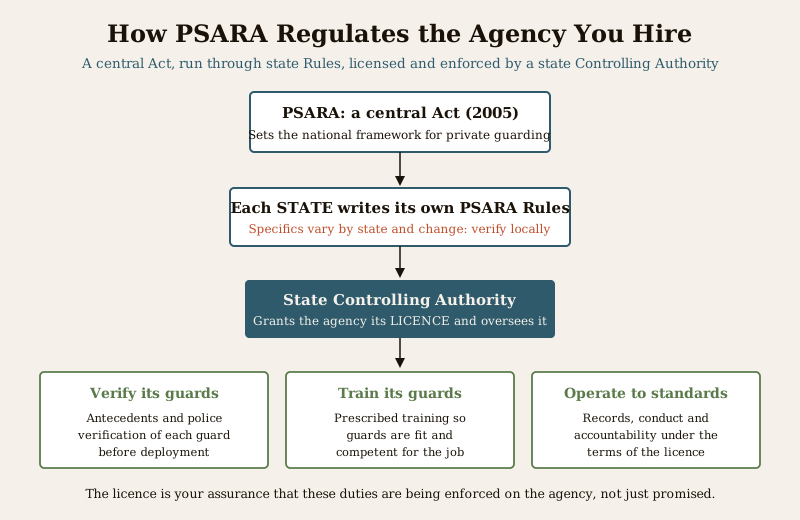
PSARA was brought in to close that gap. Its core idea is simple: a private security agency, meaning a company in the business of providing security guards or services to others for money, must hold a licence to operate, and it must meet ongoing conditions to keep that licence. The Act sets the national framework; the actual licensing, oversight and enforcement happen at the state level through each state's own PSARA Rules and a designated state Controlling Authority.
So PSARA exists to do three things at once: it brings the private-guarding industry into a regulated, licensed system instead of an informal free-for-all; it puts duties on agencies to verify, train and manage their guards properly; and it gives clients like you a baseline of assurance, because an agency that holds a genuine licence has submitted to oversight and can be held to account, which is exactly what an unlicensed operator cannot offer.
The core requirements, at a literacy level
You do not need to memorise the Act to hire well. You need to understand, in plain terms, what it requires of the agency you are considering. There are a few pillars.
A licence from the state Controlling Authority. This is the foundation. A private security agency must hold a valid PSARA licence granted by the Controlling Authority of the state where it operates. Because PSARA runs through state Rules, a licence is tied to a state (or states) the agency is authorised to work in, and the process, paperwork, fees and validity period are set by that state, not by a single national rulebook. This is why the honest answer to almost every detailed question is verify with your state's Controlling Authority. Do not assume the position in one state applies in another.
Verification of its guards. A licensed agency is expected to check the antecedents of the people it employs as guards, including police verification, before deploying them. This is the single most important protection you get from the system, because the guard is the person who will hold the keys to your gate, know your routines and have access to your premises. Verification is a duty on the agency, and the client is entitled to expect it has been done. For the detail of what that check involves, see police verification of security personnel.
Training and fitness of its guards. PSARA and the state Rules expect guards to be trained to a prescribed standard and to be physically and otherwise fit for the role, rather than simply handed a uniform. A trained guard knows how to control access, keep a proper register, respond to an incident and escalate correctly, which is the whole reason you are paying for one. Individual guards also carry their own compliance expectations; the companion guide on security guard licensing and compliance covers the guard-side of this.
Operating to standards, with records and accountability. Beyond licensing individual duties, a compliant agency keeps proper records, runs its people through documented processes, insures and pays its staff on the books, and remains answerable to the Controlling Authority. The licence is not a one-time sticker; it comes with conditions the agency must keep meeting.
Notice a pattern across all four: every one of them is something you, as a client, can ask to see evidence of. That is the practical value of the regulation to you.
Why it matters to you as the client
It is tempting to treat the agency's licence as the agency's problem, a bit of official paperwork that has nothing to do with the guard you want at the gate. That is the expensive mistake, because the licence is the mechanism that makes everything else real.
Hiring an unlicensed agency removes your protection on three fronts at once. First, the people: an unlicensed operator has no duty you can rely on to have verified or trained its guards, so you may be putting an unvetted stranger in a position of trust on your premises. Second, accountability: if a guard from a licensed agency behaves badly, there is a regulated company, answerable to a Controlling Authority, standing behind that guard, whereas with an informal supplier there may be nobody meaningfully answerable at all. Third, liability: engaging an unlicensed agency can expose you, the client, to risk and complications you would not face with a compliant one, quite apart from the harm an unvetted guard might do.
A licensed agency, by contrast, is your assurance. It signals that the people at your gate have been through verification and training, that a regulated entity stands behind them, and that there is a paper trail and a point of accountability if you ever need one. You are not paying a premium for a certificate; you are paying for the accountability the certificate represents.
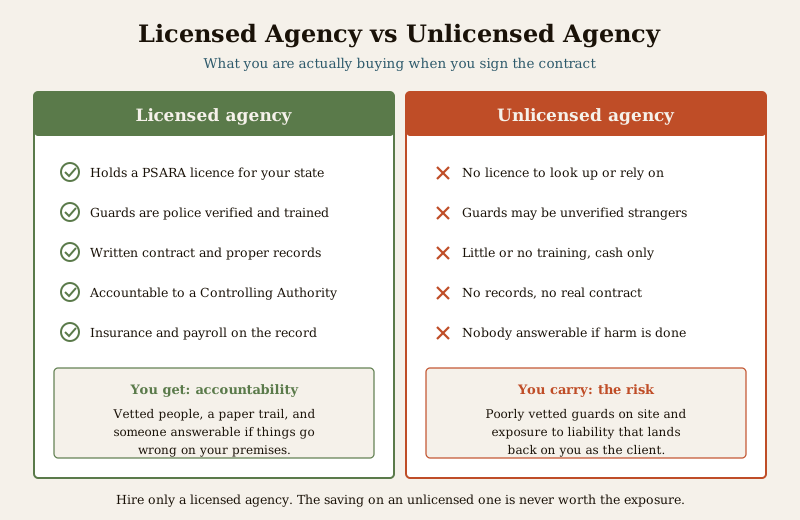
Hire only a licensed agency. This is the one non-negotiable. On guarding, the gap between a licensed and an unlicensed agency is not a matter of polish, it is the difference between vetted, accountable people and unknown ones. Whatever an unlicensed operator saves you is never worth the exposure. If an agency cannot show you a valid PSARA licence for your state, that is where the conversation ends.
How to check an agency before you sign
Turning the principle into practice is straightforward. You are not conducting an audit; you are asking a handful of fair questions and expecting solid answers.
Ask to see the PSARA licence, and note the state it covers. A legitimate agency will produce its licence without hesitation. Check that it is current and that it covers your state, since a licence is granted state by state. If you want to be sure the licence is genuine and in good standing, the state Controlling Authority is the body to confirm with, because it is the authority that issued it.
Ask how guards are verified. A compliant agency should be able to explain its verification process, including police verification of the guards it deploys, and show that it is done before a guard is placed with you rather than promised later. The guide on police verification of security personnel sets out what good practice looks like here.
Ask about training. Find out how the agency trains its guards and to what standard, and whether the specific guards assigned to you have completed it. A trained guard is the thing you are actually paying for.
Get it in the contract. The most important step, and the easiest to skip. A written contract should record that the agency holds a valid PSARA licence, that its guards are verified and trained, and who your point of contact is. A written agreement turns spoken assurances into commitments you can hold the agency to. Insist on it, and be wary of any supplier who resists putting these basics in writing.
Do your own due diligence. Even with a licensed agency, you remain the client on your own premises. Confirm the guards who actually turn up match who was promised, keep your own copy of the contract and licence details, and raise anything that looks off with your named contact. Regulation gives you a floor to stand on; sensible client habits build on it.
| What to ask the agency | What a good answer looks like | Why it matters to you |
|---|---|---|
| Do you hold a PSARA licence, and for which state? | Shows a current licence covering your state, no hesitation | It is the legal basis for the whole engagement |
| Are your guards police verified? | Explains the process; verification done before deployment | These are the people with access to your premises |
| How are your guards trained? | Describes a defined training standard for deployed guards | A trained guard is the service you are paying for |
| Will you put the licence, verification and training in the contract? | Willing to record it all in writing | Turns promises into commitments you can enforce |
| Who is my point of contact if there is a problem? | A named, reachable person | Accountability when something goes wrong |
Where the agency's duties meet the guard, and the site
Agency regulation does not sit on its own; it connects to the people and the place. On the people side, the agency's duty to verify and train flows through to the individual guard, whose own licensing and compliance and police verification are the guard-level expression of the same idea. A well-run agency makes both true as a matter of course.
On the place side, a guard is only as effective as the setup they work in. Whether guarding is even the right primary measure, versus or alongside technology, is worth thinking through with physical guarding compared to CCTV; and if you do post a guard, the guides on guardhouse design and guardhouse cost cover giving them a proper base. Regulation ensures the person is accountable; good site decisions let them do the job.
Is this agency legitimate? A checklist and the red flags
Pull it together into two short lists you can use on the spot. The first is what a legitimate agency should be able to satisfy. The second is the set of warning signs that should make you walk away.
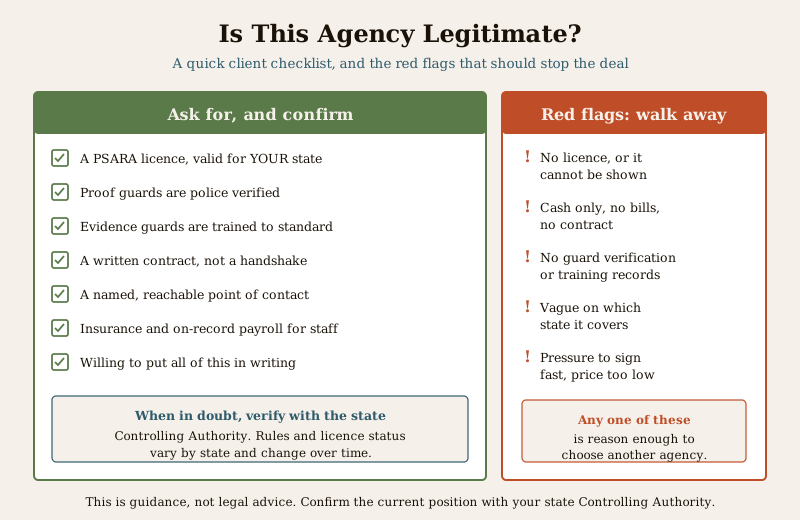
Is this agency legitimate? Confirm all of these.
- It holds a PSARA licence, current and covering your state.
- It can show that its guards are police verified before deployment.
- It trains its guards to a defined standard.
- It works on a written contract, not a verbal understanding.
- It gives you a named, reachable point of contact.
- It insures and pays its staff on the record.
- It is willing to put the licence, verification and training in writing.
Red flags: any one of these is reason to choose another agency.
- No licence, or an inability or unwillingness to show one.
- Cash only, with no bills, no contract and no paper trail.
- No guard verification or training records it can point to.
- Vagueness about which state its licence actually covers.
- Pressure to sign quickly, or a price so low it does not add up.
You do not need every box perfect to proceed, but the licence and verification are not negotiable, and any of the red flags on their own is enough to stop. A legitimate agency will meet these comfortably; an operator who bristles at being asked is telling you something.
Who to ask, and the honest caveat
The single most important authority here is your state Controlling Authority, the body designated under your state's PSARA Rules to license and oversee private security agencies. It is the right place to confirm whether an agency's licence is genuine and current, and to understand what your state requires. For the wider compliance picture around security and life-safety at a property, the security and fire regulations overview and the broader regulations sub-hub put agency regulation in context alongside the other rules that touch a building.
And the caveat, stated plainly because it genuinely matters: PSARA is a central Act delivered through state Rules, so the exact licensing process, fees, validity period, training expectations and penalties for non-compliance all vary from state to state and change over time. This guide deliberately does not quote specific fees, validity durations, section numbers or penalty figures, because a number that is right in one state or year can be wrong in another and would mislead you. Treat this as a map of how the system works and what to demand as a client, and confirm the current, local specifics with your state Controlling Authority or a qualified professional before you act.
Key takeaways
- You hire an agency, not just a guard, and the agency is regulated. Under PSARA, the Private Security Agencies (Regulation) Act, 2005, a company that supplies guards must hold a licence and meet ongoing duties.
- The licence comes from a state Controlling Authority. PSARA is a central Act run through separate state Rules, so specifics vary by state and change; verify locally.
- A licensed agency is your assurance. It signals verified, trained guards, a regulated company standing behind them, and a point of accountability. An unlicensed one removes all three and can expose you to liability.
- Check before you sign. Ask for the PSARA licence and the state it covers, confirm guard verification and training, and get it all in a written contract.
- Use the checklist and heed the red flags. No licence, cash-only, no verification, no training or pressure to rush are each reason enough to choose a different agency.
Where to go next
- Security guard licensing and compliance — the guard-level side of the same regulation.
- Police verification of security personnel — what verifying a guard actually involves.
- Physical guarding compared to CCTV — deciding whether a guard is the right primary measure.
- Guardhouse design and guardhouse cost — giving a posted guard a proper base to work from.
- The security and fire regulations overview and the regulations sub-hub — agency rules in the wider compliance picture.
This is educational compliance literacy for people who hire private security, not legal advice or an authoritative statement of the law. PSARA is implemented through state Rules, so licensing requirements, fees, validity and penalties vary by state and change over time. Always confirm the current position with your state Controlling Authority or a qualified professional before acting.
Export this guide
Related Guides — Deep-dive reading
Security and Fire Regulations Guide for India (2026): Know the Rules and How to Navigate Them
There is no single national rulebook you can read off. This is the map of the whole regulatory landscape for home, housing-society and commercial security and fire systems in India, and a calm way to navigate it: who sets the rules, who approves what, and how to stay on the right side of them.
SecuritySecurity Guard Licensing and Compliance in India (2026): The Rules Behind the Uniform
A plain-language guide for homeowners and RWAs to what actually makes a security guard compliant in India: the PSARA-licensed agency behind the guard, the eligibility, verification and training each guard should have, and the checklist you use before anyone stands at your gate.
SecurityCCTV vs Physical Guarding in India (2026): Cameras, Guards or Both?
An honest head-to-head between electronic CCTV surveillance and manned physical guarding for a home, villa, gated community, shop or small site in India — what each really does, where each wins, and why the best answer is almost always a layered combination rather than one or the other.
SecurityRelated Tools — Try Free
Contract Studio
AI generates professional architecture service agreements with milestones and scope.
ArchitectAILift Safety Audit Checklist
Interactive checklist that scores your home lift on safety devices, compliance and upkeep.
ChecklistCPCB Compliance Checklist for STPs
Tick off CPCB/SPCB outlet standards, monitoring duties and record-keeping to score your sewage treatment plant's compliance readiness.
Checklist