
Plumbing Pipes Guide: Every Material & How to Choose (India)
The section pillar for plumbing pipe materials in India — the full family of thermoplastics, metals, iron, concrete and clay, which pipe belongs on hot supply, cold supply, drainage, underground and sewer duty, a comparison-at-a-glance table, sizing basics, jointing methods, and a plain-language method for choosing.
Choosing a pipe is really choosing a promise: that water will arrive with pressure, that hot lines will not sag, that a buried main will outlive the driveway above it, and that waste will leave without smell. Get the material right for each job and the plumbing disappears into the walls and does its work for decades. Get it wrong and you are chasing leaks inside a year.
This is the section pillar for pipe materials in the Studio Matrx Plumbing Knowledge Hub. It maps the whole family of pipes used in India, tells you which material belongs on which duty, and hands you a simple method to choose — then links down to a deep-dive on each material. Start here for the overview; branch out when you need the detail. For the bigger picture of how pipes fit into supply and drainage networks, see the plumbing systems pillar.
There is no single "best" pipe — only the best pipe for a given duty. A material that is perfect for a hot geyser line is wrong for a buried sewer, and the pipe that carries drinking water should never carry it under UV in an open terrace. Match material to job first; price second.
The four ways a pipe can fail
Before the materials, understand what you are protecting against. Almost every pipe choice comes down to four stresses:
- Pressure — supply pipes are always full of water pushing outward. They need a pressure class matched to your pump and head.
- Temperature — hot water softens ordinary plastics. Hot lines need a material rated for it.
- Corrosion & scaling — metals rust and fur up from inside over years; plastics do not, which is why India has largely moved off galvanised iron for fresh supply.
- UV, soil load and crushing — pipes in sunlight go brittle; buried pipes must survive the weight of earth and traffic above.
Read every material below through those four lenses and the choices make themselves.
The material families at a glance
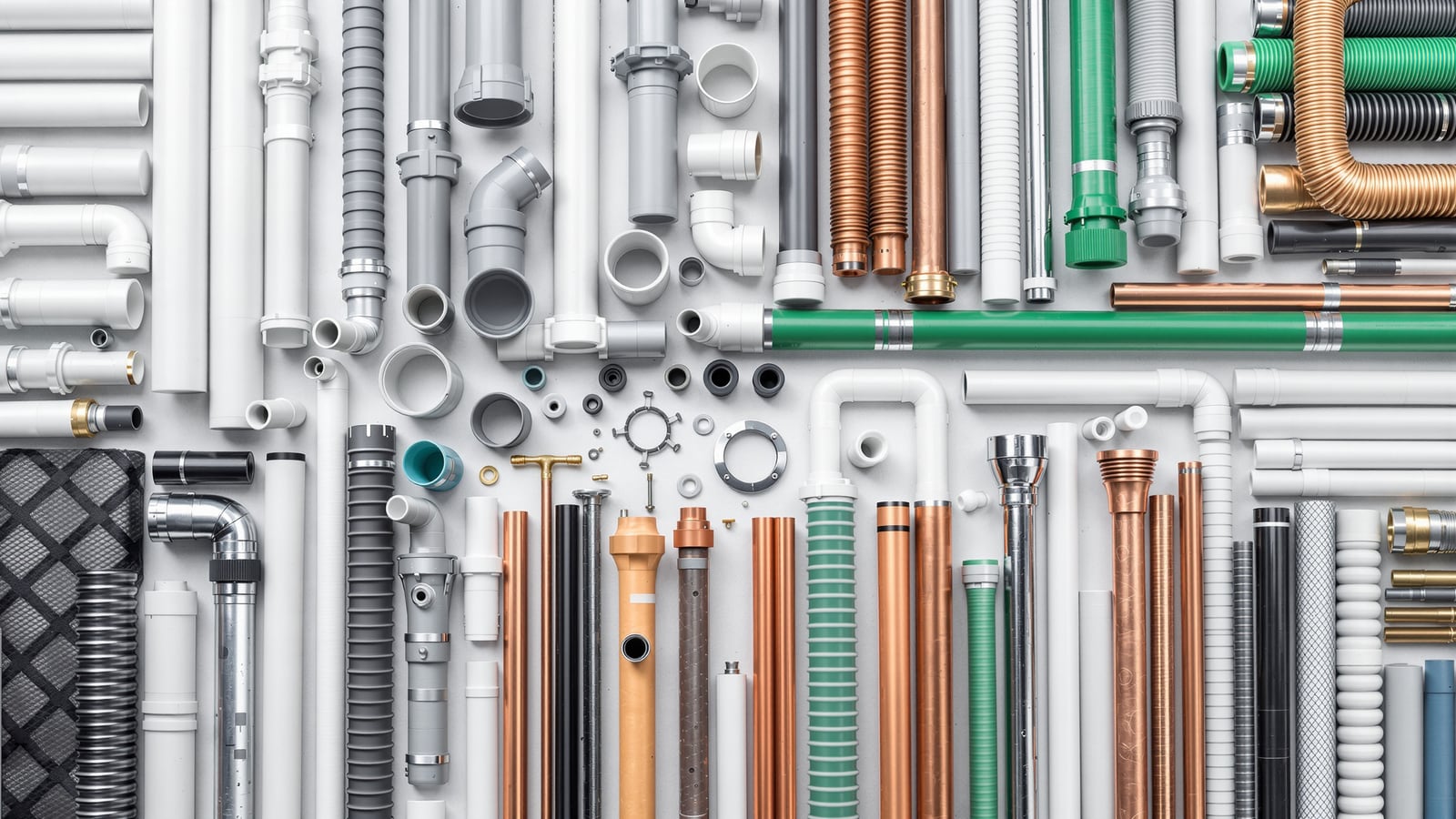
Indian plumbing draws on four broad families.
1. Thermoplastics — the modern default
Light, cheap, corrosion-proof and easy to joint, plastics now dominate Indian homes for both supply and drainage.
- CPVC (chlorinated PVC) — the standard for hot and cold potable supply. Cream-coloured, rated to about 93 °C, solvent-welded. This is what feeds your taps and geyser in most new homes. See the CPVC pipes guide.
- UPVC / PVC (unplasticised PVC) — rigid grey pipe for cold supply, drainage and waste. Cheap and durable but not for hot water. See the UPVC pipes guide. For the head-to-head choice between the two, read CPVC vs UPVC.
- HDPE (high-density polyethylene) — tough black flexible pipe, supplied in long coils. The workhorse for underground water mains, borewell rising mains and long external runs, heat-fusion jointed for a leak-free buried line. See the HDPE pipes guide.
- PPR (polypropylene random) — green, heat-fusion welded pipe used for hot and cold supply, common in apartments and solar/central hot-water risers.
2. Metals — durable, premium, specialist
- Copper — the long-life premium supply pipe: excellent for hot water and central systems, naturally antibacterial, but costly and needing skilled brazing. See the copper pipes guide.
- GI (galvanised iron) — the old standard for supply, now mostly retained for exposed, high-abuse or fire lines. It corrodes and scales internally over years; new fresh-water plumbing rarely specifies it.
- Stainless steel — corrosion-resistant and hygienic, used where appearance or purity matters, at a premium.
3. Iron — heavy drainage and mains
- Cast iron & ductile iron — heavy, strong, quiet pipe for soil stacks, large drainage and municipal water mains. Ductile iron in particular carries city water mains; cast iron soil stacks are prized in premium buildings for how silently they carry waste.
4. Concrete, clay & the rest — underground and sewer
- RCC / concrete pipe — large-diameter storm and sewer mains and culverts underground.
- Vitrified clay / stoneware — traditional acid-resistant underground sewer pipe.
- Composite & flexible — PEX for concealed hot-and-cold manifold plumbing, and flexible connectors for the last short hop to a fixture.
Which material for which job
The single most useful way to think about pipes is by duty, not by material. Here is the map most Indian homes actually use.
| Duty | First choice | Also seen | Avoid |
|---|---|---|---|
| Hot water supply | CPVC | PPR, copper | UPVC, ordinary PVC |
| Cold water supply (indoor) | CPVC | UPVC, PPR | bare GI (scales) |
| Underground / borewell rising main | HDPE | UPVC (medium/heavy) | thin-wall PVC |
| Waste & drainage (basins, floor traps) | UPVC / PVC (SWR) | — | supply-grade thin pipe |
| Soil stack (WC discharge) | UPVC SWR / cast iron | — | pressure PVC only |
| Underground sewer / storm | RCC, vitrified clay | ductile iron | thin plastic under load |
| Exposed / fire / high-abuse | GI, stainless steel | — | UV-exposed plastic |
A few rules that save the most grief:
- Hot water = CPVC, PPR or copper. Full stop. UPVC and ordinary PVC soften with heat and will sag or fail on a geyser line.
- Buried supply = HDPE, because heat-fusion joints leave no failure point to leak into the soil.
- Drainage is a different world from supply: it is low-pressure, large-bore and works by gravity slope, so it uses cheaper SWR-grade UPVC or, in premium builds, quiet cast iron. Never economise a supply line with drainage-grade pipe or vice versa.
Comparison at a glance: material, use, jointing and cost
This is the table to keep. Rates are indicative per running metre for common domestic sizes and vary widely with brand, class and city — treat them as a relative guide, not a quote.
| Material | Best-fit use | Jointing method | Indicative cost/metre |
|---|---|---|---|
| CPVC | Hot & cold potable supply | Solvent cement (special CPVC) | ₹90–₹260 |
| UPVC (supply) | Cold supply | Solvent cement / threaded | ₹70–₹200 |
| UPVC SWR (drainage) | Waste, soil, drainage | Rubber ring / solvent | ₹80–₹300 |
| PPR | Hot & cold supply, risers | Heat fusion (socket weld) | ₹120–₹320 |
| HDPE | Underground mains, borewell | Butt / electro heat fusion | ₹90–₹400 |
| Copper | Premium hot supply, central | Brazing / compression | ₹600–₹1,400 |
| GI | Exposed, fire, high-abuse | Threaded (screwed) | ₹200–₹550 |
| Cast iron | Soil stacks, quiet drainage | Push-fit / caulked | ₹500–₹1,200 |
| RCC / stoneware | Underground sewer, storm | Spigot-socket, sealed | Varies by diameter |
Copper and cast iron look expensive per metre, but on the duties where they belong — a fifty-year central hot line, a silent soil stack in a bedroom wall — they are often the cheapest choice measured over the life of the building. The reverse is also true: paying copper prices to carry cold water inside a wall, where CPVC would last just as long, is money spent on nothing you will ever see or benefit from. The skill is spending the premium only on the duty that rewards it.
Sizing basics
Pipe size is described by nominal bore in millimetres, and supply and drainage live at opposite ends of the scale.
- Supply pipes are small-bore, typically 15 mm (½") to fixtures, 20–25 mm (¾"–1") on branches and 32 mm+ on the main riser. Undersize a supply line and pressure drops the moment two taps open together.
- Drainage pipes are large-bore and sized by fixture load: 40 mm for a basin waste, 75 mm for a shower or floor trap group, and 110 mm for a WC soil stack. Bigger is not always better — drains rely on the flow keeping the pipe scouring clean, so an oversized drain can silt up.
Plastics also carry a pressure class — for supply pipe you will see ratings such as PN (nominal pressure) or a schedule/class number. Match the class to your pump head and building height. The spec table below shows the realistic envelope for the common domestic materials.
| Material | Nominal sizes (mm) | Pressure / class | Temp limit | Typical use |
|---|---|---|---|---|
| CPVC | 15–50 | SDR 11 / SDR 13.5 | ~93 °C | Hot & cold supply |
| UPVC (supply) | 15–160 | up to ~10–16 bar (class) | ~45 °C | Cold supply |
| UPVC SWR (drainage) | 40–160 | gravity (non-pressure) | ~60 °C intermittent | Waste, soil, drainage |
| PPR | 20–110 | PN 10–PN 25 | ~70–95 °C | Hot & cold supply |
| HDPE | 20–630 | PN 6–PN 16 | ~40 °C | Underground mains |
| Copper | 15–54 | high (metallic) | very high | Premium hot supply |
Jointing methods overview
How a pipe is joined is as important as the pipe itself — most leaks live at joints, not in the pipe wall.
- Solvent cement welding (CPVC, UPVC/PVC) — a chemical weld that fuses socket and pipe into one piece. Fast, cheap and reliable, but you must use the cement made for that material — CPVC cement for CPVC, PVC cement for PVC — and give it full cure time before pressurising.
- Heat fusion (HDPE, PPR) — pipe ends are melted and pressed together (butt or socket fusion) or joined with an electrofusion coupler. It leaves no separate sealing part to fail, which is why it is the standard for buried lines.
- Threaded / screwed (GI, some UPVC & metal fittings) — threads cut into the pipe end and sealed with tape or paste. Simple and demountable, but each thread is a potential leak and a corrosion start point in metal.
- Compression & push-fit — mechanical fittings that grip the pipe with a ring or collet. Quick, tool-light and demountable — excellent for repairs, connections to fixtures and copper work.
- Brazing / soldering (copper) — a molten filler alloy bonds the joint. Strong and permanent, but needs a skilled hand and heat.
- Spigot-and-socket, rubber-ring & caulked (drainage, iron, RCC) — one pipe end pushes into the flared socket of the next, sealed with a rubber ring or, in cast iron, caulked. Designed to flex slightly and handle gravity flow.
How to choose: a simple method
Work through five questions in order and the material almost always names itself.
1. What does the pipe carry? Potable supply, drainage, or sewer decides the whole family before anything else.
2. Hot or cold? Hot supply narrows you to CPVC, PPR or copper immediately.
3. Where does it run? Buried lines want HDPE and heat fusion; exposed terrace runs need UV-stable material or protection; concealed walls favour solvent-welded plastics.
4. What pressure and building height? Taller buildings and stronger pumps need a higher pressure class — check the class, not just the material.
5. What is the honest life-cost? Cheapest per metre is rarely cheapest over thirty years once you count leaks, chasing walls open, and re-doing joints.
When two materials both technically work, choose the one your local plumber joints every day. A perfectly-specified pipe joined badly still leaks; a good pipe in familiar hands lasts.
For the room-by-room detail of getting clean water to every tap, see domestic water distribution. Then dive into the material guides — CPVC, UPVC, HDPE and copper — for classes, brands and installation detail.
The takeaway
There is no universal best pipe. There is CPVC for the hot and cold taps, HDPE for the buried main, UPVC SWR for the drains, and copper or cast iron where a long, quiet life justifies the price. Match material to duty, size for flow not habit, joint it the way it was designed to be joined, and the plumbing will keep its promise for the life of the house.
References
- National Building Code of India (NBC) 2016, Part 9 — Plumbing Services — the governing code for building plumbing in India.
- IS 15778 — CPVC pipes and fittings for potable hot and cold water supply.
- IS 4985 — unplasticised PVC (uPVC) pipes for potable water supply.
- IS 13592 — uPVC pipes for soil and waste discharge (SWR) systems.
- IS 4984 — high-density polyethylene (HDPE) pipes for water supply.
- IS 1239 & IS 3589 — steel (GI / MS) tubes and pipes.
- IS 1536 / IS 1537 / IS 3006 — cast iron pipes for pressure and drainage.
- IS 458 — precast concrete (RCC) pipes.
- IS 651 — salt-glazed stoneware (vitrified clay) pipes.
Verify the current edition of any code and confirm pressure classes and rates with your supplier and a licensed plumber before you build.
Export this guide
Related Guides — Deep-dive reading
Pipe Jointing Methods in India: Solvent, Threaded, Fusion, Soldered & Push-Fit
How every plumbing pipe material is actually joined — solvent cement for PVC/CPVC/uPVC, threaded joints for GI and metal, heat fusion for PPR and HDPE, soldering and brazing for copper, compression and push-fit for quick work, flanged connections for large bore, and rubber-ring socket-and-spigot for drains. Which method suits which material, how reliable each is, and the skill it demands.
PlumbingCopper vs CPVC Pipes: Which to Use in India (2026)
A fair, India-first head-to-head: copper is the premium, decades-lasting, heat-proof metal that needs a skilled brazier and costs a fortune; CPVC is the cheaper, corrosion-proof, DIY-friendly plastic that has become the default modern Indian supply pipe. Cost, lifespan, heat, install skill, water quality, theft — and a clear verdict by use-case.
PlumbingGI Pipes in India: The Legacy Steel Water Pipe, Why It Rusts, and When It Still Makes Sense
Galvanised iron was the standard water pipe in Indian homes for decades. Here is what GI is, how its threaded joints work, why it corrodes and chokes flow, where it still earns its place, and how to read its sizes and IS 1239 classes.
PlumbingRelated Tools — Try Free
Plumbing Pressure-Test & Leak Checklist
Pre-closure pressure and leak test — 9 categories, 60+ checkpoints across water supply, drainage, fixtures, waterproofing, hot water, tanks.
Pre-Closure TestWindow Material Comparison Tool
Compare uPVC, aluminium, wood, steel and composite windows on cost, life, upkeep and insulation.
CompareApartment Video Door System Planner
Enter flats, entrances, floors and guard desk for a first-pass building intercom plan — door stations, indoor monitors, guard station, the right architecture and an indicative cost band.
Building Planner