
HDPE Pipes in India: PE80/PE100 Grades, PN Ratings, SDR, Fusion Jointing and Where to Specify Them
The flexible black polyethylene pipe that carries buried water mains, borewell rising mains and sewer force mains — how PE80 and PE100 grades, PN pressure ratings and SDR work together, why butt-fusion and electrofusion joints make it the default choice underground, and how to specify it to IS 4984.
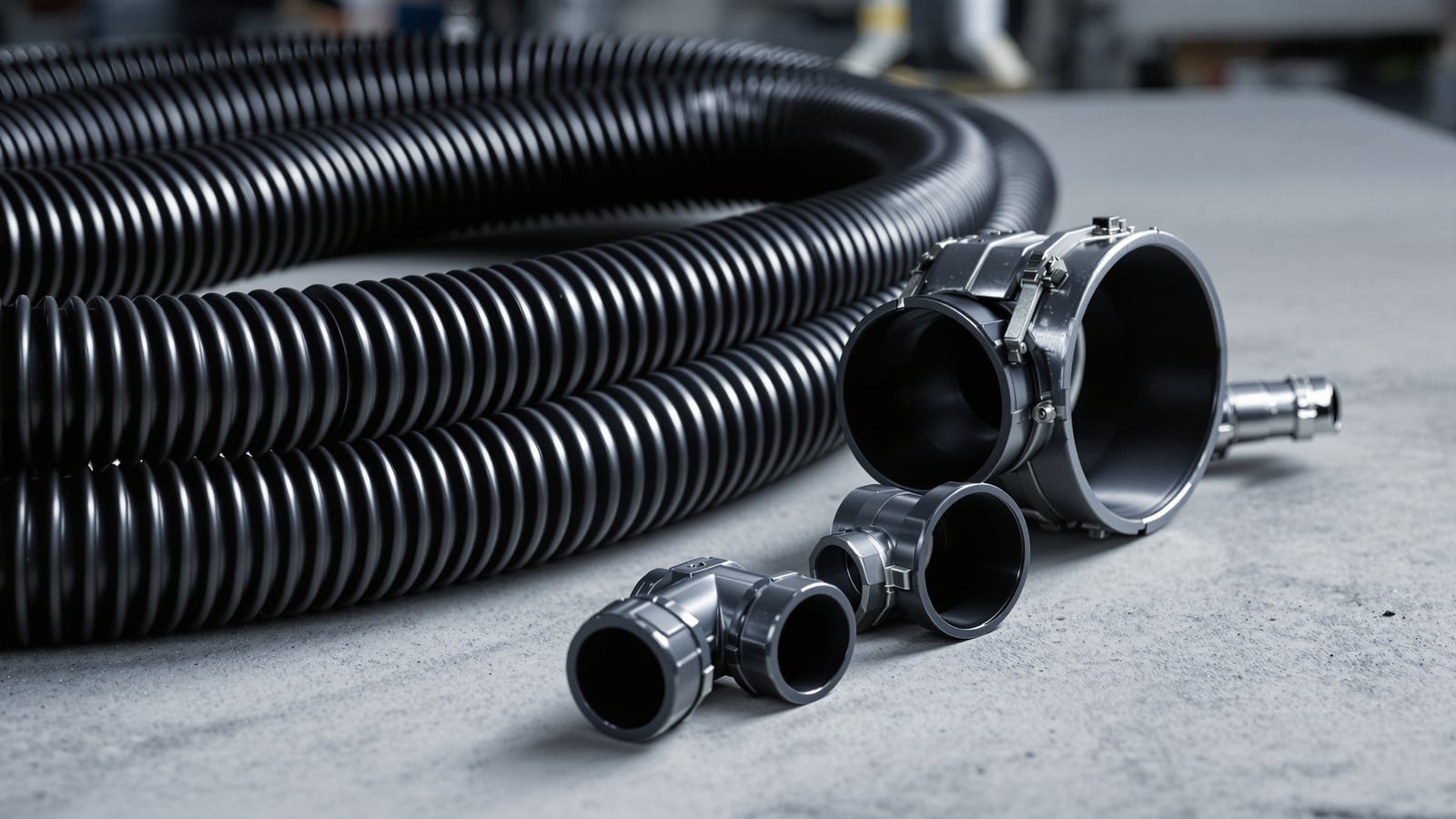
HDPE — high-density polyethylene — is the flexible black plastic pipe you see coiled beside trenches on almost every waterworks, layout-development and borewell job in India. It is not a bathroom or riser material; its home is underground and outdoors, where its flexibility, its immunity to corrosion, and above all its fully welded, leak-free joints make it the default for buried mains. This guide is a specifier's profile of the material: what it is, how the grade, pressure rating and wall thickness are named, how it is jointed, and where it earns its place.
This guide sits inside the Studio Matrx Plumbing Knowledge Hub. For the full material landscape, start at the pillar plumbing pipes guide; for the rigid plastic used above ground and in cold-water supply, see uPVC pipes; for large pressure mains in ductile metal, see ductile iron pipes. HDPE is the pipe most often specified for the rising main and delivery of a borewell water system.
The single reason HDPE dominates below ground is the joint. A butt-fused or electrofused HDPE joint is a continuous, monolithic weld — the joined pipe is as strong as the parent pipe and cannot pull apart or weep. Buried where you will never dig it up to fix it, that leak-free permanence is worth more than any spec-sheet number.
What HDPE actually is
HDPE is a thermoplastic — a polyethylene with a high density and a tightly packed molecular structure that gives it strength and stiffness while staying flexible enough to coil. In pipe form it is almost always black, because carbon black is added as the UV stabiliser; for potable water the pipe usually carries longitudinal blue stripes (or a full blue skin) to identify it as a drinking-water main. It is inert, tasteless, and does not corrode, rust, scale or support the tuberculation that chokes old metal pipe.
Two properties define where it is used:
- It is flexible. Small diameters ship in long coils, so a rising main or a service connection can be laid in one unbroken length with no joints in the run — a huge advantage underground, where every joint is a potential leak you cannot reach.
- It is tough and forgiving. HDPE has high impact resistance, tolerates ground movement, freeze-cycling and water hammer by flexing rather than cracking, and shrugs off the aggressive soils and acidic water that attack metal. That resilience is why it is trusted for buried, out-of-sight service.
The trade-offs that keep it out of the building: it is not rated for hot water, it must be protected from long-term direct sunlight in permanent above-ground runs, and it needs fusion equipment (or bulky compression fittings) to join — so it is a poor fit for the small, hot, exposed, frequently-branched pipework inside a house, which is CPVC and uPVC territory.
The three numbers that specify HDPE: grade, PN and SDR
An HDPE pipe is never specified by "class" alone. Three linked parameters fix its performance, and you need all three on a drawing or purchase order.
PE grade — the raw material strength
The polyethylene compound is graded by its long-term strength (the MRS, minimum required strength):
- PE80 — the older, mid-strength compound (MRS 8.0 MPa). Still common for smaller service pipes and non-critical mains.
- PE100 — the modern high-performance compound (MRS 10.0 MPa). For the same pressure rating it allows a thinner wall, so a PE100 pipe carries more water in the same outside diameter and is lighter and cheaper per metre of capacity. PE100 is the default specification for new pressure mains today.
PN — the pressure rating
PN (pressure nominal) is the pipe's allowable working pressure in bar at 20°C for water, over a 50-year design life. Common ratings are PN 4, PN 6, PN 8, PN 10, PN 12.5 and PN 16 — a PN10 pipe is rated for 10 bar continuous working pressure. Match PN to the actual head: a gravity distribution main may need only PN6, while a deep-borewell rising main or a pumped force main may need PN12.5 or PN16.
SDR — how the wall thickness is expressed
SDR (standard dimension ratio) is the outside diameter divided by the wall thickness. A lower SDR means a thicker wall and therefore a higher pressure rating. Grade, PN and SDR are locked together: for a given PE grade, choosing the PN fixes the SDR. For example, in PE100 an SDR 17 pipe is PN10, an SDR 11 pipe is PN16 — the same outside diameter, a thicker wall, a higher rating. This matters on site because fusion joints only mate pipes of the same OD and wall, so mixing SDRs on one run is a jointing problem, not just a paperwork one.
Sizes, ratings and typical use
HDPE water pipe to IS 4984 is specified by outside diameter (OD) in mm — from 20 mm service tubing up to 1000 mm and beyond for trunk mains. The table below gives an indicative PE100 spec picture; always confirm against the current IS 4984 dimension tables for the exact wall for each OD/PN pair.
| Nominal OD | PE grade | PN rating | Continuous working pressure | Temp limit | Typical use |
|---|---|---|---|---|---|
| 20-32 mm (coil) | PE80/PE100 | PN10-PN16 | 10-16 bar | 40°C | Service connections, borewell rising main (shallow) |
| 40-63 mm (coil) | PE100 | PN10-PN12.5 | 10-12.5 bar | 40°C | Borewell rising / delivery main, layout service lines |
| 75-160 mm | PE100 | PN8-PN12.5 | 8-12.5 bar | 40°C | Distribution mains, pumped sewer force mains |
| 180-315 mm | PE100 | PN6-PN10 | 6-10 bar | 40°C | Zonal water mains, effluent force mains |
| 355-1000 mm | PE100 | PN4-PN10 | 4-10 bar | 40°C | Trunk mains, outfall and intake pipelines |
Note the temperature limit. HDPE's pressure ratings are quoted at 20°C; capacity de-rates as temperature rises, and the pipe is not for hot water at all. For buried cold mains this is a non-issue, which is exactly why HDPE lives underground.
Small sizes (up to about 110-125 mm) come in coils of 50-100 m or more — laid in one continuous joint-free length. Larger sizes come in straight sticks (typically 6 m or 12 m), which must be jointed end to end.
Jointing — the reason HDPE wins underground
There are three ways to join HDPE, and the choice defines the installation.
- Butt-fusion welding. The two pipe ends are faced flat, heated against a hot plate until molten, then pressed together and held under controlled pressure until they fuse into one continuous piece. Done to procedure, the weld is as strong as the parent pipe — no fitting, no seal, nothing to fail. This is the workhorse joint for medium and large mains and needs a fusion machine and a trained operator.
- Electrofusion. A moulded coupler with an embedded heating coil is slid over the pipe ends; passing current through the coil melts and fuses the interface. It is faster in tight trenches and for repairs and branch saddles, and is the go-to where a butt-fusion rig will not fit. The couplers cost more than butt-welds but need less setup.
- Compression (mechanical) fittings. Threaded plastic or metal compression couplings clamp onto the pipe with an O-ring seal. They need no power or heat, so they suit small service pipes, borewell delivery heads and quick connections — but they are the one joint type that can be disturbed or weep, so they are used above ground or at accessible points, not buried on a critical main.
The practical rule: weld what you bury, clamp what you can reach. A fused main can be backfilled and forgotten; a compression joint should stay inspectable.
Where HDPE is specified in India
- Buried water mains and distribution. Layout and township water supply, zonal mains and service connections — HDPE's corrosion immunity and fused joints suit decades in aggressive or waterlogged soil.
- Borewell rising and delivery mains. Flexible coil pipe drops down the bore and runs to the tank in one length; PN-rated to take the pump head. See the borewell water system guide for how it fits the pump and delivery.
- Sewer and effluent force mains. Where sewage or treated effluent is pumped under pressure, HDPE's chemical resistance and leak-free welds prevent the exfiltration that plagues jointed gravity pipe. (Gravity drainage and the treatment plant itself are separate systems — a force main only carries the flow.)
- Cross-country and difficult ground. Pipeline crossings, trenchless (HDD) pulls, and reactive or rocky ground where the pipe's flexibility lets it be pulled or snaked into place.
Pros and cons at a glance
| Strengths | Limitations |
|---|---|
| Leak-free fused joints — monolithic, buriable | Needs fusion machine + trained operator for welds |
| Immune to corrosion, rust, scale, tuberculation | Not for hot water; ratings de-rate with temperature |
| Flexible — long coils, few joints, tolerates ground movement | Larger OD than metal for the same bore; wide trench |
| High impact and water-hammer resistance | Degrades under long-term UV if left exposed unprotected |
| Chemical-resistant — suits aggressive soils and effluent | Fittings/branches bulkier than solvent-weld plastics |
| Long design life (50 years) and light to handle | Compression joints must stay accessible, not buried |
Indicative cost
HDPE is priced by weight and metre, and the figure swings with the OD, the PN rating (a higher PN means a thicker, heavier wall and more polymer) and the polymer price of the day. As a rough guide for PE100:
- Small coil service pipe, 25-32 mm, PN10: roughly ₹40-₹90 per metre.
- Mid-size distribution main, 90-160 mm, PN10: roughly ₹250-₹800 per metre.
- Large main, 250-315 mm, PN8-PN10: several thousand rupees per metre — a 315 mm PN10 run can approach ₹3,000-₹4,500 per metre.
Treat all of these as indicative ex-works rates before fittings, fusion labour and laying; confirm live prices and the exact IS 4984 wall for your OD/PN with your supplier. Against ductile iron for a large main the material may look similar per metre, but HDPE's welded joints and lighter handling often win on installed cost.
References
- IS 4984 — High density polyethylene (HDPE) pipes for water supply — specification (the governing Indian Standard for HDPE pipe grades, dimensions and pressure ratings).
- For the wider material context and material-versus-material choices, see the Studio Matrx plumbing pipes guide, the uPVC pipes guide, the ductile iron pipes guide and, for the rigid-plastic supply comparison, CPVC vs uPVC pipes.
Always confirm the current edition of any standard and the manufacturer's data sheet before finalising a specification.
Export this guide
Related Guides — Deep-dive reading
Plumbing Pipes Guide: Every Material & How to Choose (India)
The section pillar for plumbing pipe materials in India — the full family of thermoplastics, metals, iron, concrete and clay, which pipe belongs on hot supply, cold supply, drainage, underground and sewer duty, a comparison-at-a-glance table, sizing basics, jointing methods, and a plain-language method for choosing.
PlumbingPipe Jointing Methods in India: Solvent, Threaded, Fusion, Soldered & Push-Fit
How every plumbing pipe material is actually joined — solvent cement for PVC/CPVC/uPVC, threaded joints for GI and metal, heat fusion for PPR and HDPE, soldering and brazing for copper, compression and push-fit for quick work, flanged connections for large bore, and rubber-ring socket-and-spigot for drains. Which method suits which material, how reliable each is, and the skill it demands.
PlumbinguPVC Pipes in India: Pressure Classes, Sizes, Joints, Borewell & Cold-Water Use, Cost and IS 4985
A homeowner's profile of rigid unplasticised PVC pressure pipe — the tough, chemical-proof cream or grey pipe that carries cold water supply, feeds rising mains and runs borewell and agricultural lines. What uPVC is, its pressure classes, the sizes it comes in, how it is jointed, why it is a cold-water pipe (not a hot-water one), and what it costs.
PlumbingRelated Tools — Try Free
Plumbing Pressure-Test & Leak Checklist
Pre-closure pressure and leak test — 9 categories, 60+ checkpoints across water supply, drainage, fixtures, waterproofing, hot water, tanks.
Pre-Closure TestAI BOQ Generator
AI generates detailed Bill of Quantities with city-specific rates and labour breakdown.
ArchitectAIApartment Furniture Size Chart
Standard furniture dimensions for Indian apartments — sofas, beds, tables, dining, storage.
Reference Chart