
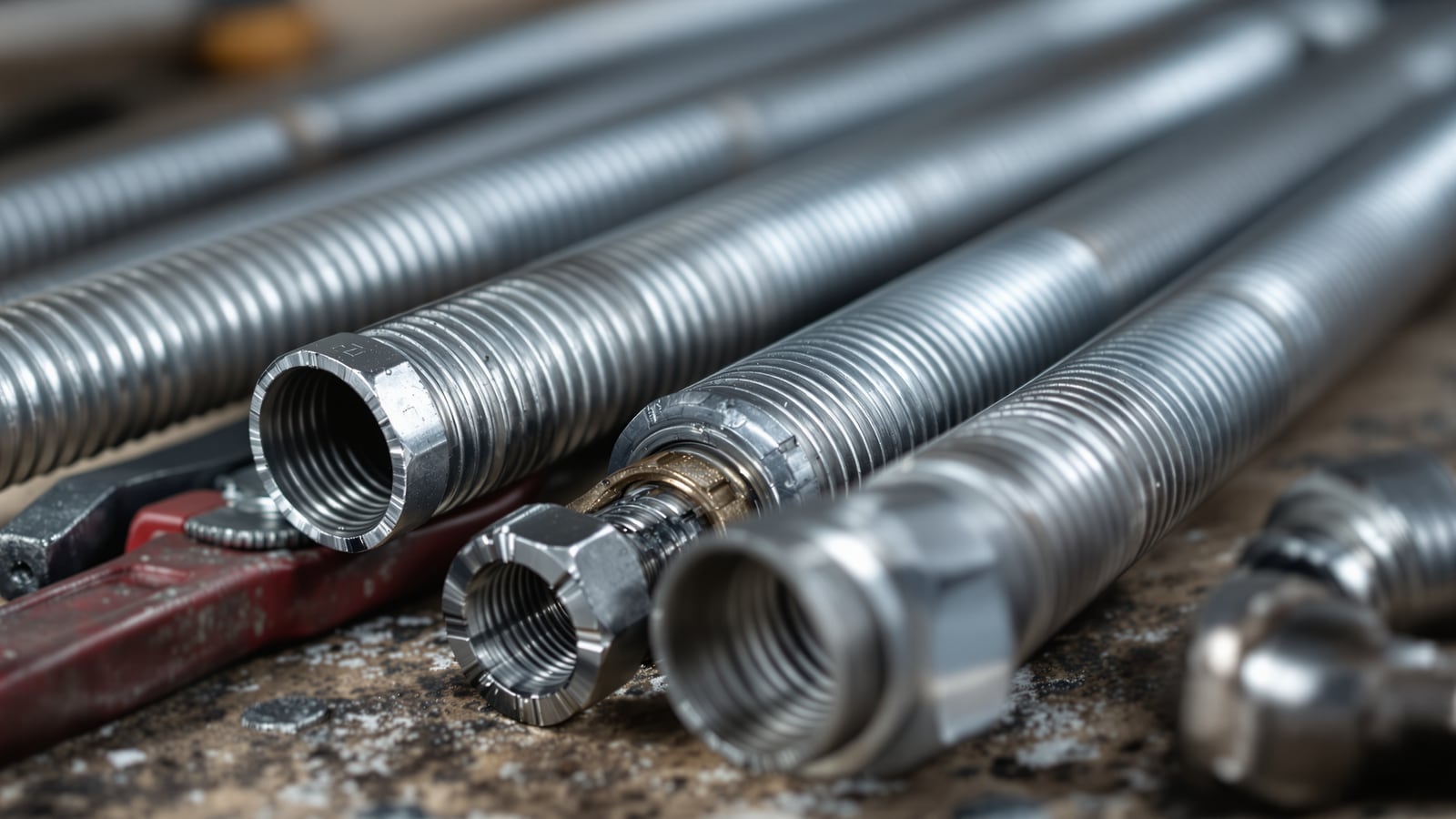
GI Pipes in India: The Legacy Steel Water Pipe, Why It Rusts, and When It Still Makes Sense
Galvanised iron was the standard water pipe in Indian homes for decades. Here is what GI is, how its threaded joints work, why it corrodes and chokes flow, where it still earns its place, and how to read its sizes and IS 1239 classes.
For most of the twentieth century, if you opened a wall in an Indian home you found GI pipe — galvanised iron, the grey threaded steel tube that carried water to every tap. It was strong, it was familiar, and every plumber knew how to cut and thread it. Then the plastics arrived, and within a generation GI went from default to legacy. This guide explains what GI actually is, why homes now re-pipe away from it, and the handful of jobs where it is still the right pipe.
This is a material profile in the Studio Matrx Plumbing Pipes hub. For the plastic that largely replaced GI on hot and cold water lines, see CPVC pipes; for the premium metal that has taken over GI's exposed and structural roles, see stainless steel pipes; and if you are living with old GI right now, the plumbing renovation guide covers the re-piping decision in full.
What GI pipe actually is
GI stands for galvanised iron — in practice, a mild-steel tube that has been hot-dip galvanised, meaning dipped in molten zinc so a protective zinc coating bonds to the steel inside and out. The steel gives the pipe its strength and rigidity; the zinc is a sacrificial skin meant to keep the steel underneath from rusting.
- The base tube is mild steel, made to IS 1239 (Part 1) for the sizes used in homes, or IS 3589 for larger welded steel pipe.
- The zinc coating is what "galvanised" means — a thin metallic layer that corrodes in place of the steel, buying the pipe years of protection.
- GI is rigid and threaded: it does not bend or glue like plastic. Lengths are joined by cutting threads into the pipe ends and screwing on cast fittings.
That zinc coat is the whole promise of GI — and also, as we will see, the reason it eventually fails. Once the zinc is gone, the steel beneath has no defence.
Galvanised iron is not a corrosion-proof pipe. It is a steel pipe wearing a zinc coat with a limited lifespan — protected only until that coat is spent.
Threaded jointing: how GI goes together
GI has no solvent cement and no heat fusion. It is joined the way steel plumbing has always been joined — by screwed threads. Understanding this explains both its durability and its labour cost.
- The pipe is cut to length with a pipe cutter or hacksaw, and the burr reamed out.
- A die (a hand stock-and-die or a powered pipe-threading machine) cuts external BSP taper threads into the pipe end. This is skilled, physical work.
- A sealant is wrapped or smeared onto the thread — traditionally zinc paste with jute yarn, today more often PTFE (Teflon) tape or a thread-sealing compound.
- The threaded end is screwed into a fitting — malleable-iron elbows, tees, sockets, reducers and unions, made to IS 1239 (Part 2) — and tightened with pipe wrenches.
Because each joint is mechanical, a good GI joint is genuinely strong and can be dismantled at a union for repair. But every joint depends on the plumber's thread-cutting and sealing; a poorly cut or over-tightened thread leaks, and re-doing it means unscrewing pipe back to the nearest union. It is slow, heavy work compared with gluing CPVC.
The corrosion problem: why GI chokes and rusts
This is the reason GI lost the home. The zinc coat protects the steel only for so long. In Indian water — which is often hard, sometimes chlorinated, sometimes slightly acidic — the zinc slowly erodes, and once it is gone the exposed steel begins to rust from the inside.
Two failures follow, and they compound each other:
- Scaling and tuberculation. Rust and hard-water mineral scale build up as knobbly deposits (tubercles) on the inner wall. The bore narrows year by year. A 15 mm pipe can lose much of its effective opening to scale over a couple of decades, so water pressure and flow drop — the shower weakens, taps trickle, and the problem creeps up so slowly the household barely notices until a new plastic-piped home reminds them what full flow feels like.
- Rusty, discoloured water. Flakes of internal rust colour the first draw of the morning brown or reddish and can stain fixtures and clothes. This is the classic tell-tale of ageing GI.
Eventually the wall thins enough to weep or burst, usually at a threaded joint where the wall is already cut thinnest and the zinc most disturbed. External corrosion attacks concealed pipe buried in damp masonry from the outside as well.
Old GI does not fail suddenly. It slowly strangles itself — the bore fills with rust and scale until flow is a memory — and that gradual choking, not a dramatic burst, is why most homes finally re-pipe.
Because scale forms at the cut threads and inside the run, there is no cleaning it out; the cure is replacement. This is exactly why so many older Indian homes re-pipe to CPVC during a renovation — the plastic bore stays smooth and full-flow for its whole life. The plumbing renovation guide walks through planning that changeover, and CPVC pipes covers the replacement material in depth. For a like-for-like metal upgrade that keeps the strength without the rust, stainless steel is the modern successor.
Where GI still makes sense
GI is legacy for concealed water supply, but "legacy" is not "useless." Its raw mechanical toughness still wins a few jobs that plastic cannot do as well:
- Exposed and external risers. On an outdoor wall or a shaft where pipe is exposed to sunlight, GI shrugs off UV and physical knocks that would embrittle unshielded plastic over years. Many terrace and external riser runs are still steel for this reason.
- Structural and support duty. GI tube is stiff and load-bearing, so it doubles as railings, handrails, scaffolding, pandal frames, fencing and support brackets — uses where it is not carrying water at all, just carrying load.
- Fire-fighting and hydrant lines. Fire lines demand a pipe that will not soften, melt or deform in heat. Steel (GI or heavier welded steel) is used for wet risers, hydrant and sprinkler mains where a plastic pipe is simply unacceptable in a fire.
- High-impact or high-temperature service points. Short exposed sections near pumps, gas lines and industrial connections sometimes stay steel for durability.
The pattern is clear: GI survives where strength, heat resistance or exposure matter more than a smooth, corrosion-free bore — and retreats everywhere the priority is clean, full-flow drinking water inside a wall.
Sizes and classes: reading a GI pipe
GI is sold by nominal bore (NB) — a traditional size name close to the internal diameter, still quoted in both millimetres and inches. Alongside size, GI to IS 1239 comes in three wall-thickness classes, identified by a painted colour band near the pipe end.
| Class (IS 1239 Part 1) | Colour band | Wall thickness | Typical use |
|---|---|---|---|
| Light (Class A) | Yellow | Thinnest | Low-pressure, non-critical lines |
| Medium (Class B) | Blue | Medium | General water supply — the common home choice |
| Heavy (Class C) | Red | Thickest | High-pressure, risers, fire and industrial lines |
The heavier the class, the thicker the steel wall, the higher the pressure it takes — and the more zinc-life and rust margin before the wall thins through. For water supply, medium class is the usual specification; heavy class is chosen where pressure, exposure or fire duty demand it.
Common nominal-bore sizes and where each is used:
| Nominal bore | Inch size | Typical home use |
|---|---|---|
| 15 mm | ½ inch | Tap and fixture branches |
| 20 mm | ¾ inch | Branch and short distribution runs |
| 25 mm | 1 inch | Distribution mains, risers |
| 32 mm | 1¼ inch | Risers, larger distribution |
| 40 mm | 1½ inch | Building mains, pump lines |
| 50 mm | 2 inch | Building mains, fire and bulk lines |
Sizes and classes indicative to IS 1239 (Part 1); always confirm the current standard, class band and pressure rating stamped on the pipe before buying.
Pros and cons at a glance
Where GI is strong:
- Mechanically tough — resists impact, crushing and rough handling far better than plastic.
- Heat and fire resistant — does not soften, melt or deform, so it suits fire lines and hot exposure.
- UV-stable — safe in the open sun on exposed risers and terraces where unshielded plastic ages.
- Rigid and self-supporting — needs fewer clips and can double as structural support.
- Repairable at joints — a union lets you dismantle and rework a run.
Where GI falls short:
- Internal corrosion, scaling and rust — the defining weakness; flow chokes and water discolours over its life.
- Reduced flow over time — tuberculation narrows the bore, weakening pressure at every tap.
- Heavy and labour-intensive — cutting and threading is slow, skilled, physical work.
- Every joint is a weak point — threads cut the wall thin and disturb the zinc, so leaks and failures cluster at joints.
- Not ideal for concealed drinking-water lines — which is precisely why CPVC displaced it indoors.
What GI costs in India
GI is a steel product, so its price rides on the steel market and moves more than plastic does. As an indicative guide, medium-class GI pipe runs roughly ₹80 to ₹220 per foot depending on size and prevailing steel rates, plus fittings (malleable-iron elbows, tees, sockets, unions) and, importantly, threading and installation labour, which is higher than for glued CPVC because each joint is cut and screwed by hand.
- A small internal re-pipe in GI can therefore land higher in labour than the equivalent CPVC job, even where material cost looks similar.
- Heavy-class and larger-bore pipe (risers, fire lines) costs more per foot and needs heavier fittings and supports.
- Treat every figure as indicative — steel prices and city labour rates vary widely; get a current local quote before budgeting. Where money appears, a full house re-pipe can run into ₹1,20,000 or more once labour and making-good are counted.
For most homeowners the honest verdict is: do not choose GI for new concealed water supply. Use CPVC (or PPR for hot) inside walls, and reserve GI or stainless steel for the exposed, structural and fire duties it genuinely does better. If your existing GI is choking flow or staining water, plan a staged changeover with the plumbing renovation guide.
The short version
GI pipe is a piece of plumbing history that has not fully left the building. As concealed water supply, it is legacy — the zinc coat wears out, the steel rusts, the bore scales up, and flow fades until a home re-pipes to CPVC. But as exposed risers, structural tube and fire lines, its strength, heat resistance and UV toughness still earn it a place. Know it by its grey galvanised finish, its screwed BSP threads, its nominal-bore sizes and its yellow, blue or red IS 1239 class band — and choose it deliberately, for the few jobs where a rigid steel pipe beats a smooth plastic one.
References
- IS 1239 (Part 1) — Steel Tubes — the Indian Standard for GI/mild-steel tubes in the light, medium and heavy classes used in homes.
- IS 1239 (Part 2) — Steel Tubulars and Other Wrought Steel Pipe Fittings — the standard for the malleable-iron threaded fittings used with GI pipe.
- IS 3589 — Steel Pipes for Water and Sewage — for larger welded steel pipe beyond the IS 1239 size range.
- National Building Code of India (NBC) 2016, Part 9 — Plumbing Services — the governing framework for building water supply and fire-fighting lines.
- Confirm the current edition, class band and pressure rating printed on the pipe, and verify sizing, sealing and installation with a licensed plumber; all cost figures here are indicative and move with steel prices.
Export this guide
Related Guides — Deep-dive reading
Copper vs CPVC Pipes: Which to Use in India (2026)
A fair, India-first head-to-head: copper is the premium, decades-lasting, heat-proof metal that needs a skilled brazier and costs a fortune; CPVC is the cheaper, corrosion-proof, DIY-friendly plastic that has become the default modern Indian supply pipe. Cost, lifespan, heat, install skill, water quality, theft — and a clear verdict by use-case.
PlumbingCPVC Pipes in India: The Cream Pipe Behind Your Hot & Cold Water
The tan-coloured plastic pipe that has quietly become the default for hot and cold water supply in Indian homes — what CPVC is, why it survives near-boiling water, how CTS sizing and SDR classes work, how solvent-cement joints are made, and what it costs.
PlumbingPlumbing Pipes Guide: Every Material & How to Choose (India)
The section pillar for plumbing pipe materials in India — the full family of thermoplastics, metals, iron, concrete and clay, which pipe belongs on hot supply, cold supply, drainage, underground and sewer duty, a comparison-at-a-glance table, sizing basics, jointing methods, and a plain-language method for choosing.
PlumbingRelated Tools — Try Free
Material Decision Framework (M-Score)
Score 30+ Indian construction materials across cost, durability, climate fit, maintenance, and sustainability.
MaterialsRainwater Tank Sizer
How big should your rainwater tank be? Computes annual harvest, recommended tank capacity in litres, water-bill savings, and payback — for 10 Indian cities.
RWH CalculatorAI BOQ Generator
AI generates detailed Bill of Quantities with city-specific rates and labour breakdown.
ArchitectAI