
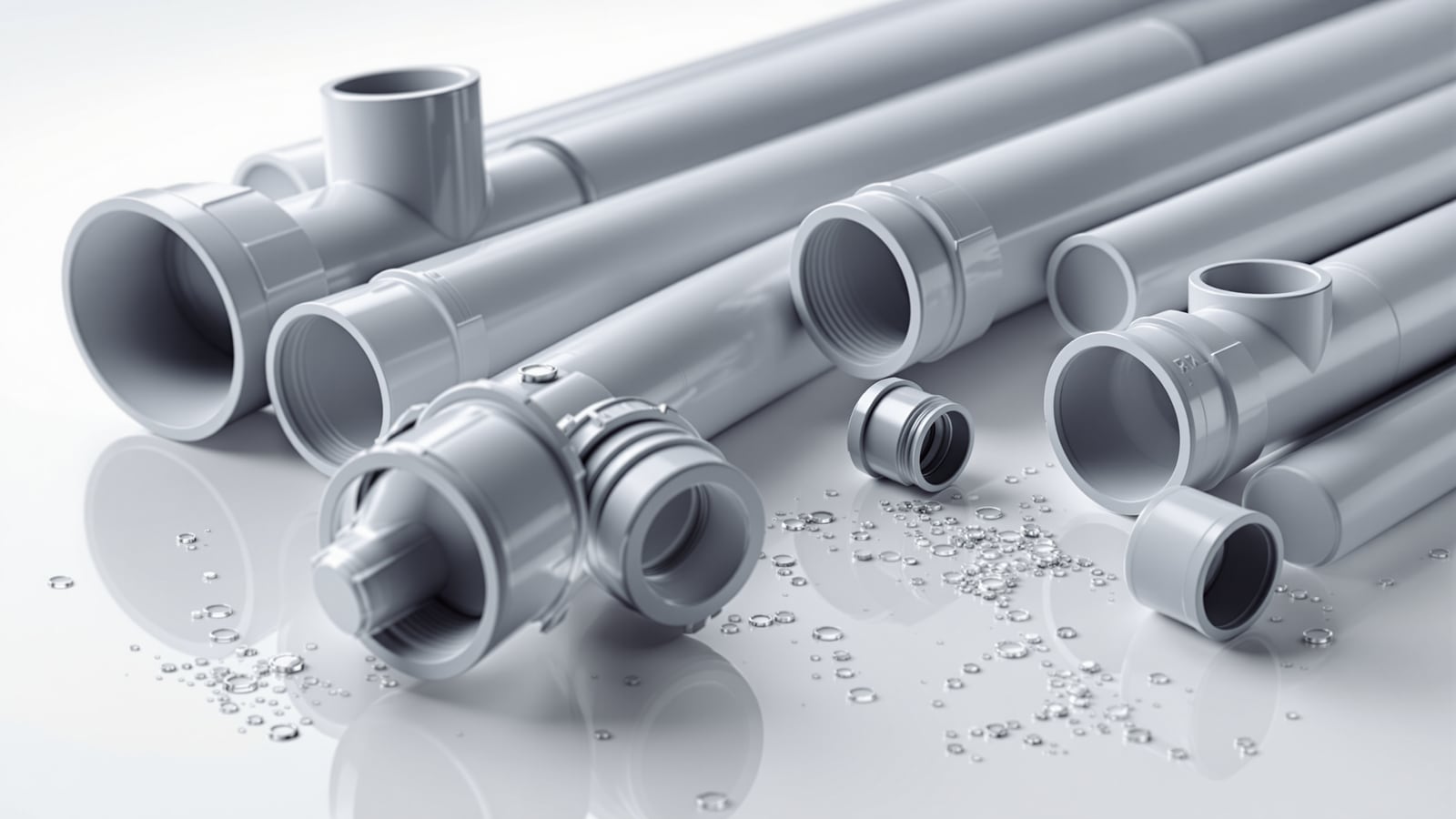
uPVC Pipes in India: Pressure Classes, Sizes, Joints, Borewell & Cold-Water Use, Cost and IS 4985
A homeowner's profile of rigid unplasticised PVC pressure pipe — the tough, chemical-proof cream or grey pipe that carries cold water supply, feeds rising mains and runs borewell and agricultural lines. What uPVC is, its pressure classes, the sizes it comes in, how it is jointed, why it is a cold-water pipe (not a hot-water one), and what it costs.
If you have ever seen a stack of stiff, cream-coloured or grey plastic pipe on an Indian construction site — the kind that does not bend, rings when you tap it, and carries the cold water main into a building — you have seen uPVC. It is one of the most widely used water-supply pipes in the country, and this guide is a plain-language profile of it: what the material actually is, where it belongs, and how to specify it correctly.
This guide sits inside the Studio Matrx Plumbing Knowledge Hub. It is a pipe-material guide — a standalone profile of one material. For the map of all the piping materials and where each is used, start at the pillar plumbing pipes guide. uPVC's closest cousins have their own profiles too: CPVC pipes for hot-and-cold indoor plumbing, and PVC pipes for drainage and non-pressure lines.
The single most important thing to know about uPVC: it is a cold-water pressure pipe. It carries incoming supply, rising mains, borewell and agricultural water beautifully — but it is not a hot-water pipe. For hot lines, that is CPVC's job.
What uPVC actually is
uPVC stands for unplasticised polyvinyl chloride. Ordinary PVC has plasticisers added to make it soft and flexible (think of a garden hose or electrical insulation). Take those plasticisers out and you get a rigid, hard, dimensionally stable plastic — that "u" for unplasticised is the whole point. The result is a pipe that is:
- Strong under internal pressure — the reason it can be rated to carry pressurised water, unlike soft PVC.
- Chemically inert and corrosion-proof — it will not rust, scale, or react with most water. This is its big advantage over galvanised iron (GI), which corrodes and chokes over the years.
- Smooth-bored — low friction inside, so flow stays strong and mineral scale does not cling the way it does inside old metal pipe.
- Non-toxic — approved for potable (drinking) cold water.
- Poor with heat — it softens as temperature rises and loses pressure capacity fast above roughly 45 °C. That single property is why uPVC and CPVC are different products for different jobs.
In India, uPVC pressure pipe for water supply is manufactured to IS 4985, the Bureau of Indian Standards specification for unplasticised PVC pipes for potable water supply. When you buy quality pipe, that IS number and the pressure class are printed right along the barrel.
Pressure classes — the number that matters most
uPVC pipe is not sold by a single "strength." It comes in pressure classes, each rated for a maximum sustained working pressure at a reference temperature (27 °C for IS 4985). Higher class means a thicker wall for the same nominal size. Choosing the right class is the core specifying decision.
| Pressure class (IS 4985) | Rated working pressure | Wall | Typical home / farm use |
|---|---|---|---|
| Class 1 | 2.5 kg/cm² (~0.25 MPa) | Thinnest | Low-pressure gravity feed, garden and low-head irrigation |
| Class 2 | 4 kg/cm² (~0.40 MPa) | Thin | General cold supply, tank-fed distribution, drip mains |
| Class 3 | 6 kg/cm² (~0.60 MPa) | Medium | Most common — municipal-connected cold mains, rising mains |
| Class 4 | 10 kg/cm² (~1.00 MPa) | Thickest | Pumped borewell lines, high-head or high-rise rising mains |
Rule of thumb: the more pressure your line will see, the higher the class. A gravity line off an overhead tank can be Class 1 or 2; a line fed by a pump or a deep borewell should be Class 3 or 4. When in doubt, size up — the cost difference is small next to the cost of a burst pipe in a wall.
Sizes uPVC comes in
uPVC pressure pipe is specified by nominal outside diameter in millimetres, and Indian ranges are wide — from small distribution branches to large mains.
| Nominal OD | Common home / site role |
|---|---|
| 20 / 25 mm | Small cold branches, garden and tap lines |
| 32 / 40 mm | Distribution sub-mains within a plot |
| 50 / 63 mm | Main cold-supply lines, small rising mains |
| 75 / 90 / 110 mm | Building rising mains, borewell delivery, agricultural mains |
| 140 / 160 mm and up | Bulk supply, estate and farm mains |
Some borewell and submersible applications also use a purpose-made uPVC column pipe (a threaded, square-thread jointed pipe designed to hang a submersible pump and carry water up the bore) — lighter and non-corroding compared with the traditional GI column. If you are planning a bore, read it alongside the full borewell water system guide.
How uPVC is jointed
uPVC does not weld with heat the way HDPE does. There are three practical jointing methods, and the pipe you buy is made for one of them:
- Ring-fit (push-fit / elastomeric seal): the socket end has a groove holding a rubber sealing ring. You chamfer and lubricate the spigot end and push it home. The joint seals on the ring and, crucially, allows the pipe to expand and contract with temperature — ideal for long buried mains, borewell and agricultural runs. Fast to assemble, no cure time.
- Solvent-weld (solvent cement): the mating surfaces are coated with uPVC solvent cement, which chemically softens and fuses them into a single mass as it cures. This makes a rigid, permanent, leak-proof joint — the go-to for above-ground and in-wall cold plumbing. It needs clean, dry, square-cut ends and a curing period before you pressurise.
- Threaded: used at transitions to taps, valves and pumps — usually via a moulded threaded fitting or a metal-insert adaptor, so you are not cutting threads into the pipe wall itself. Column pipe uses a robust integral square thread.
Match the method to the pipe: ring-fit pipe has the grooved socket; solvent-weld pipe has a plain socket. Do not improvise across the two.
Where uPVC belongs in and around the home
- Cold water supply: the incoming municipal or tanker connection, the line from the road to the underground sump, and cold distribution mains.
- Rising mains: the pumped line that lifts water from an underground sump up to the overhead tank — a natural fit for Class 3 or 4 pipe.
- Borewell and submersible lines: delivery pipe from the bore, and dedicated uPVC column pipe to hang the pump.
- Agriculture and irrigation: field mains, sprinkler and drip supply lines — where its corrosion resistance and low cost per metre shine.
- Underground service lines: ring-fit uPVC handles ground movement and thermal cycling well when buried.
Where it does not belong: hot-water lines, geyser outlets, or any line that will run above ~45 °C. That is CPVC territory.
Pros and cons
Strengths
- Corrosion- and scale-proof; will not rust like GI.
- Low cost per metre — among the cheapest pressure pipes.
- Light, easy to cut, handle and transport.
- Smooth bore keeps flow and pressure high.
- Long service life when correctly specified and buried or shaded.
Limits
- Cold water only — no hot lines, no geyser outlets.
- UV-sensitive: long sun exposure makes it brittle. Paint, wrap or bury exposed runs.
- More brittle than HDPE — cracks rather than bends under impact or ground stress.
- Solvent joints need clean, dry, square cuts and curing time; sloppy work leaks.
uPVC vs CPVC — the short version
uPVC and CPVC look similar and both are chlorinated PVC-family pipes, but they are not interchangeable: uPVC is a lower-cost cold-supply and outdoor pipe, while CPVC withstands hot water for indoor hot-and-cold plumbing. This is a common point of confusion, so rather than repeat the whole comparison here, read the dedicated head-to-head: CPVC vs uPVC pipes. If your line will ever carry hot water, the answer is CPVC — see the CPVC pipes guide.
Indicative cost
uPVC is one of the most affordable pressure pipes in India. Rates move with the size, the pressure class and the resin market, so treat these as indicative:
- 20–32 mm cold branch pipe: roughly ₹40 to ₹120 per metre.
- 50–63 mm rising-main pipe (Class 3/4): roughly ₹150 to ₹350 per metre.
- 90–110 mm mains / borewell delivery: roughly ₹350 to ₹800 per metre.
- Fittings (elbows, tees, couplers, adaptors): a few tens of rupees each for small sizes.
For a full independent-house cold-supply layout, uPVC piping and fittings typically land in the low tens of thousands — a modest slice of a plumbing budget that may run to ₹1,20,000 or more. Get current per-metre and per-foot rates from your local dealer before you buy, and always confirm the printed IS 4985 mark and pressure class.
References
- IS 4985 — Unplasticised PVC (uPVC) pipes for potable water supply (Bureau of Indian Standards specification, including pressure classes).
For the wider picture, return to the plumbing pipes guide, compare the family members in the CPVC and PVC profiles, settle the uPVC-versus-CPVC question at CPVC vs uPVC pipes, and plan groundwater lines with the borewell water system guide.
Export this guide
Related Guides — Deep-dive reading
Plumbing Pipes Guide: Every Material & How to Choose (India)
The section pillar for plumbing pipe materials in India — the full family of thermoplastics, metals, iron, concrete and clay, which pipe belongs on hot supply, cold supply, drainage, underground and sewer duty, a comparison-at-a-glance table, sizing basics, jointing methods, and a plain-language method for choosing.
PlumbingGI Pipes in India: The Legacy Steel Water Pipe, Why It Rusts, and When It Still Makes Sense
Galvanised iron was the standard water pipe in Indian homes for decades. Here is what GI is, how its threaded joints work, why it corrodes and chokes flow, where it still earns its place, and how to read its sizes and IS 1239 classes.
PlumbingPipe Jointing Methods in India: Solvent, Threaded, Fusion, Soldered & Push-Fit
How every plumbing pipe material is actually joined — solvent cement for PVC/CPVC/uPVC, threaded joints for GI and metal, heat fusion for PPR and HDPE, soldering and brazing for copper, compression and push-fit for quick work, flanged connections for large bore, and rubber-ring socket-and-spigot for drains. Which method suits which material, how reliable each is, and the skill it demands.
PlumbingRelated Tools — Try Free
Plumbing Pressure-Test & Leak Checklist
Pre-closure pressure and leak test — 9 categories, 60+ checkpoints across water supply, drainage, fixtures, waterproofing, hot water, tanks.
Pre-Closure TestRainwater Tank Sizer
How big should your rainwater tank be? Computes annual harvest, recommended tank capacity in litres, water-bill savings, and payback — for 10 Indian cities.
RWH CalculatorStamp Duty Calculator — All Indian States
Stamp duty + registration charges for all 28 states and 8 UTs — gender concessions, urban/rural variants, metro cess built in.
Stamp Duty