
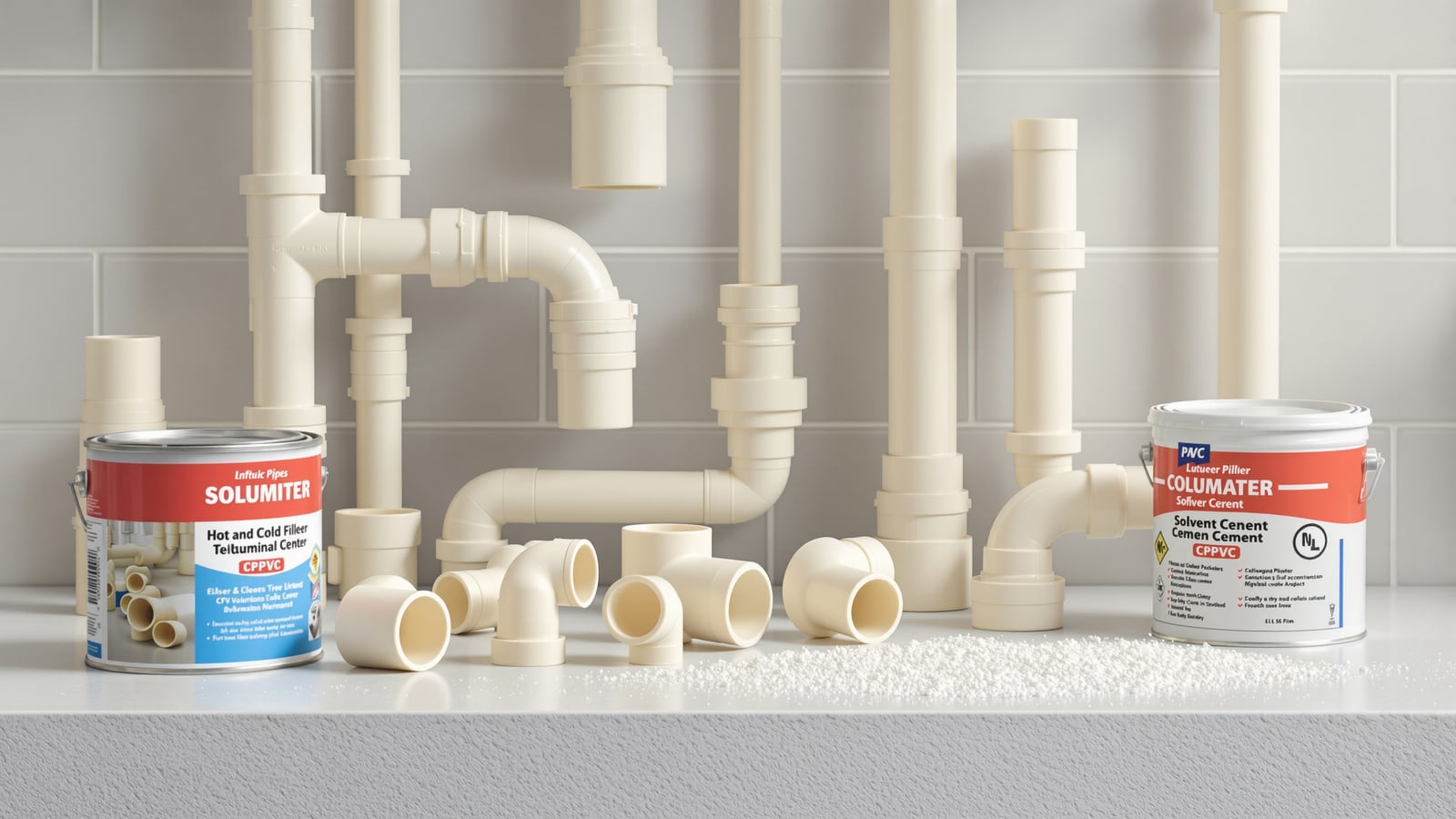
CPVC Pipes in India: The Cream Pipe Behind Your Hot & Cold Water
The tan-coloured plastic pipe that has quietly become the default for hot and cold water supply in Indian homes — what CPVC is, why it survives near-boiling water, how CTS sizing and SDR classes work, how solvent-cement joints are made, and what it costs.
Look inside the wall chase of almost any home built in India in the last fifteen years and you will find it: a slim, cream-to-tan plastic pipe, its elbows and tees welded on with a milky glue, carrying the water you drink, wash and bathe in. This is CPVC, and it has quietly become the default material for hot and cold water supply in Indian homes. It is not the same as the grey UPVC in your columns or the black pipe under your kitchen sink — CPVC is the one you can pour a bucket of near-boiling geyser water through without a second thought.
This guide is a standalone profile of one material within the Studio Matrx plumbing pipes hub. It sits closest to the domestic water distribution guide, since CPVC is the pipe that actually does that distributing indoors.
What CPVC actually is
CPVC stands for chlorinated polyvinyl chloride. It starts life as ordinary PVC — the same base polymer as the UPVC drainage and casing pipe — and is then put through an extra chlorination step that raises its chlorine content from about 57% to around 63–67%. That sounds like a small chemical tweak, but it changes the material's behaviour completely.
The extra chlorine makes the polymer chain far more heat-stable. Where UPVC starts to soften and lose pressure-holding strength above roughly 60°C, CPVC keeps its structural strength up to around 93°C — hotter than any geyser in an Indian home will ever deliver. That single property is why the two look similar but are used for opposite jobs: UPVC for cold, unpressurised or agricultural lines, CPVC for pressurised hot and cold potable supply.
- It is rigid, not flexible — you join it with fittings, not by bending.
- It is cream or tan, deliberately, so that on site nobody confuses it with grey UPVC.
- It is non-corroding and non-scaling — unlike GI (galvanised iron), it will not rust, tuberculate or narrow with lime scale over the years, so flow stays full for the life of the pipe.
- Its smooth bore is quiet and low-friction, giving good pressure at the tap.
The one-line reason CPVC won: it is the cheap, corrosion-proof plastic that does not mind hot water. GI rusts and scales; UPVC cannot take the heat; copper is expensive. CPVC threads the needle.
Why it handles hot water
A water pipe does not fail from heat alone — it fails from pressure at a temperature. All plastic pipes lose strength as they warm, so their safe working pressure is always quoted as a curve, not a single number. CPVC's curve simply sits high enough that at 82°C it still holds usable household pressure, and it tolerates brief excursions to about 93°C. For a country where an overheating geyser or a solar tank on a summer roof can push water past 70°C, that headroom is exactly the point.

For the full head-to-head, see the dedicated CPVC vs UPVC comparison; a fuller profile of the grey pipe lives in the UPVC pipes guide.
Sizes and classes: CTS, SDR 11 and SDR 13.5
Here CPVC has a quirk that trips up first-time buyers. Most CPVC pipe sold for homes in India is made to the CTS system — Copper Tube Size — because it was designed to drop straight into fittings originally sized for copper. So a CPVC pipe is called by its nominal size in inches: 1/2", 3/4", 1" and so on. The half-inch pipe has an outside diameter of about 15.9 mm, the three-quarter about 22.2 mm, and the one-inch about 28.6 mm.
The wall thickness — and therefore how much pressure the pipe can hold — is set by its SDR number, the Standard Dimension Ratio. SDR is simply the outside diameter divided by the wall thickness, so a lower SDR means a thicker, stronger wall.
- SDR 11 is the thicker-walled class, rated to a higher pressure (about 28 kg/cm² at 23°C). This is what you want for hot lines, high-rise risers and anywhere pressure is a concern.
- SDR 13.5 is thinner-walled and rated a little lower (about 22 kg/cm² at 23°C). It is fine for ordinary cold branches and low-rise homes.
For most independent houses and low-rise flats, SDR 11 for hot and SDR 13.5 (or SDR 11 throughout, for simplicity) covers everything. Do not mix CTS pipe with the larger SCH 40 / SCH 80 CPVC industrial system — the fittings are not interchangeable.
| CPVC size (CTS) | Nominal OD | Common use in the home | Typical class |
|---|---|---|---|
| 1/2" | ~15.9 mm | Final connection to a tap, WC, geyser | SDR 11 / 13.5 |
| 3/4" | ~22.2 mm | Branch feeding a bathroom or kitchen | SDR 11 / 13.5 |
| 1" | ~28.6 mm | Main indoor distribution line, riser | SDR 11 |
| 1.1/4"–2" | ~35–63 mm | Building riser, larger manifolds | SDR 11 |
Spec table — what the numbers mean
| Property | Indicative CPVC value | Notes |
|---|---|---|
| Standard (India) | IS 15778 | For CTS hot & cold water CPVC pipe |
| Max continuous temperature | ~93°C | Brief excursions tolerated |
| Recommended design temp | 82°C | Long-term hot service |
| Working pressure, SDR 11 @ 23°C | ~28 kg/cm² | Falls as temperature rises |
| Working pressure, SDR 13.5 @ 23°C | ~22 kg/cm² | Falls as temperature rises |
| Sizes (CTS) | 1/2" to 2" | Called by inch nominal |
| Colour | Cream / tan | Distinguishes it from grey UPVC |
| Corrosion / scaling | None | Unlike GI |
Treat the pressure figures as indicative — they drop steeply with temperature, and every manufacturer publishes its own de-rating chart against IS 15778. Always check the printed marking on the pipe you actually buy.
Jointing: solvent cement, not glue-guns or spanners
CPVC is joined by solvent welding, and this is genuinely different from gluing two things together. The CPVC-specific solvent cement — a one-step cement for CTS sizes — briefly softens and dissolves the outer surface of the pipe and the inner surface of the fitting. When you push them together, the two softened layers fuse and, as the solvent flashes off, they re-harden into a single continuous piece of plastic. Done right, the joint is stronger than the pipe wall itself.
The method, in order:
- Cut the pipe square with a proper wheel cutter or fine-tooth saw.
- De-burr the cut edge and wipe both surfaces clean and dry.
- Apply a uniform coat of CPVC solvent cement to the pipe end and lightly inside the fitting socket — use CPVC cement only, never the PVC or UPVC type.
- Insert and hold the pipe fully home with a quarter turn, and hold for about 30 seconds so it does not push back out.
- Cure before pressurising: allow the set and cure time the cement maker specifies (longer in cold weather and for larger sizes) before you turn the water on.
Two mistakes cause most CPVC leaks on site: using UPVC solvent cement instead of the CPVC-specific type, and pressure-testing before the joint has cured. Both are avoidable with patience.
CPVC also accepts brass-insert threaded fittings — a CPVC socket moulded around a brass thread — wherever the pipe meets a metal tap, valve or geyser inlet. That gives you a durable metal thread at the fixture without a corrodible metal pipe in the wall.

Concealed use — why CPVC suits chased walls
Most CPVC in India ends up concealed: chased into the wall and plastered over. That is exactly where its properties earn their keep. Because it neither corrodes nor scales, a buried CPVC line will not rust-stain the plaster or slowly choke itself the way buried GI does, so it can stay hidden and trouble-free for decades. Its solvent-welded joints are monolithic — there is no threaded union to weep — which is what makes it safe to bury in the first place.
A few rules keep concealed CPVC reliable:
- Cure fully, then pressure-test the whole line before plastering — never chase over an untested joint.
- Allow for thermal movement on hot lines; CPVC expands more than metal, so long straight buried hot runs need the small clearances and offsets the installer plans for.
- Keep it away from direct heat sources and do not let it touch hot flue or exhaust surfaces.
- Protect any exposed outdoor CPVC from sunlight — like most plastics it is not made for permanent UV exposure, so exposed terrace runs should be painted or lagged.
Pros, cons and cost
In its favour:
- Takes hot water to ~93°C — the reason it exists.
- Never corrodes, rusts or scales; flow stays full for life.
- Fast, cheap, tool-light installation by solvent welding.
- Smooth bore, quiet flow, good pressure retention.
- Lighter and cheaper than copper, safer for hot service than UPVC or GI.
Against it:
- Rigid and brittle if struck hard, especially in cold weather — handle and store with care.
- Solvent cement and joints are unforgiving of a rushed or dirty install.
- Not for UV exposure without protection.
- Higher thermal expansion than metal on long hot runs.
On cost, CPVC is mid-priced — dearer than UPVC, far cheaper than copper. As an indicative guide, 1/2" CPVC pipe runs roughly ₹60 to ₹120 per foot depending on brand and SDR class, with 3/4" and 1" proportionally more, plus fittings and solvent cement. Plumbing a modest two-bathroom home in CPVC supply pipe and fittings typically lands in the ₹25,000 to ₹60,000 range for material, against a full house build where the plumbing package might be ₹1,20,000 or more. Treat every figure here as indicative and get a local quote — brand, city and class move the number.
References
- IS 15778 — Chlorinated Poly(Vinyl Chloride) (CPVC) pipes for potable hot and cold water supply, the Indian standard this guide refers to by name.
For where this pipe fits in the whole supply system, return to the plumbing pipes hub and the domestic water distribution guide; to weigh it against its grey cousin, see CPVC vs UPVC, the UPVC pipes guide and the PPR pipes guide.
Export this guide
Related Guides — Deep-dive reading
Copper vs CPVC Pipes: Which to Use in India (2026)
A fair, India-first head-to-head: copper is the premium, decades-lasting, heat-proof metal that needs a skilled brazier and costs a fortune; CPVC is the cheaper, corrosion-proof, DIY-friendly plastic that has become the default modern Indian supply pipe. Cost, lifespan, heat, install skill, water quality, theft — and a clear verdict by use-case.
PlumbingGI Pipes in India: The Legacy Steel Water Pipe, Why It Rusts, and When It Still Makes Sense
Galvanised iron was the standard water pipe in Indian homes for decades. Here is what GI is, how its threaded joints work, why it corrodes and chokes flow, where it still earns its place, and how to read its sizes and IS 1239 classes.
PlumbingPlumbing Pipes Guide: Every Material & How to Choose (India)
The section pillar for plumbing pipe materials in India — the full family of thermoplastics, metals, iron, concrete and clay, which pipe belongs on hot supply, cold supply, drainage, underground and sewer duty, a comparison-at-a-glance table, sizing basics, jointing methods, and a plain-language method for choosing.
PlumbingRelated Tools — Try Free
Plumbing Pressure-Test & Leak Checklist
Pre-closure pressure and leak test — 9 categories, 60+ checkpoints across water supply, drainage, fixtures, waterproofing, hot water, tanks.
Pre-Closure TestHome Colour Studio
Colour every room — living, bedroom, dining, kitchen, bathroom — surface by surface in any HEX/RGB/CMYK colour, or from 80+ curated Indian shades.
Colour StudioMonsoon-Readiness Checklist
Pre-rain home audit across 9 categories — terrace, drains, waterproofing, electrical, HVAC, pest, vehicles, documents.
Seasonal Audit