
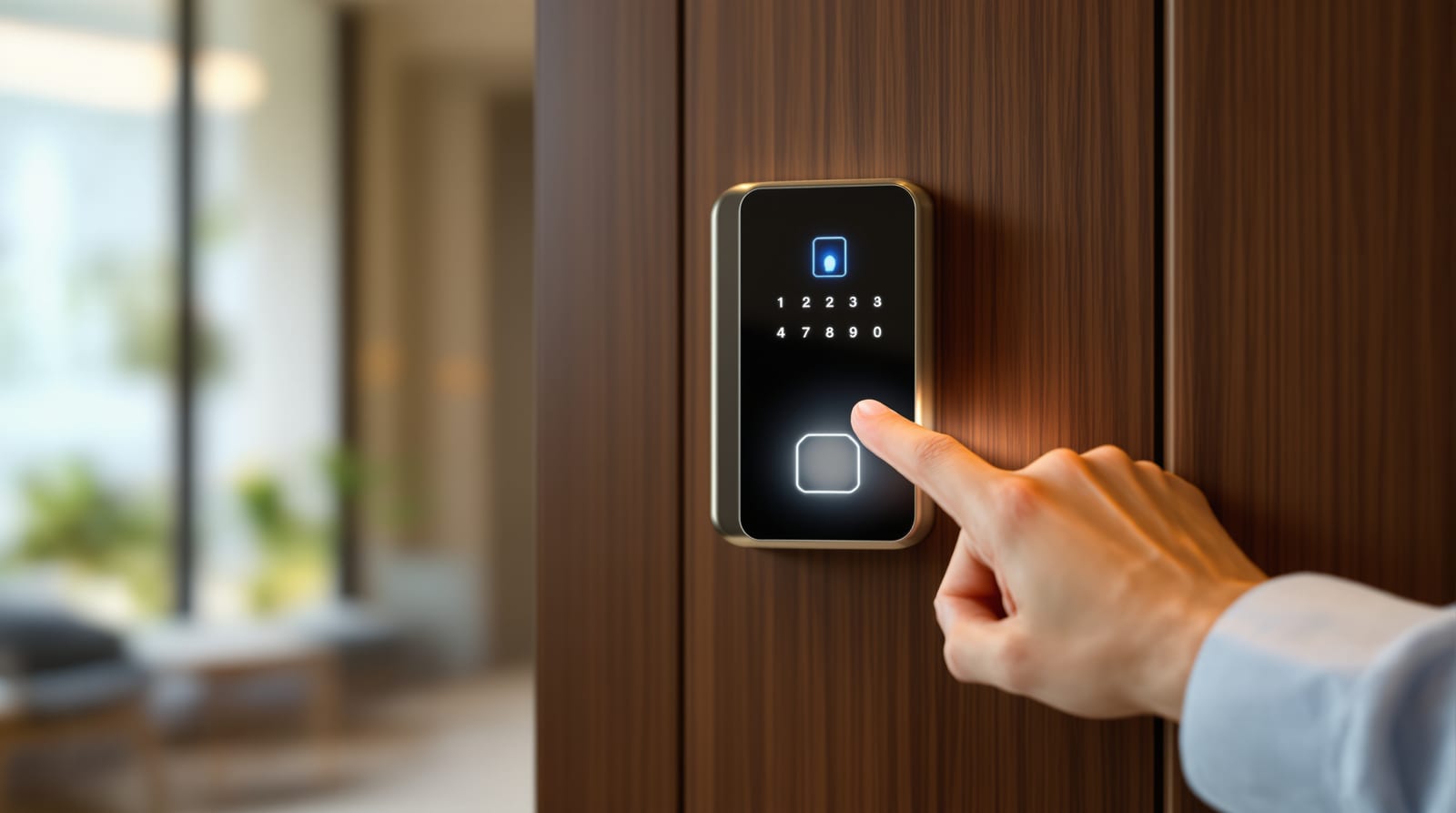
Fingerprint Door Lock Guide for Indian Homes: How the Sensor Works, Accuracy & Backup (2026)
How biometric fingerprint locks read your finger, why dry, wet or worn fingers fail in Indian heat and monsoon, and how to set up reliable backup access before you buy.
A fingerprint door lock turns your own finger into the key — no fumbling for keys at the gate after a long commute, no spare key left under the planter, no children locked out. But the convenience is only as good as the sensor, and in India the sensor has to cope with 44 degree Celsius summers that crack fingertip skin, monsoon humidity that leaves fingers damp, kitchen oil, mehndi, and the worn ridges of a grandparent's thumb. This guide explains exactly how the biometric sensor reads your finger, where it fails, and — most importantly — how to set up backup access so a failed scan never leaves your family standing outside.
This is a deep dive on the fingerprint method specifically. For the full smart-lock landscape (Wi-Fi, app control, integration), see our smart door locks guide; for the broader biometric category including face and palm, see biometric door locks; and to decide whether to go smart at all, read smart lock vs traditional lock.
How the fingerprint sensor actually works
A fingerprint is a pattern of ridges and valleys. The lock does not store a picture of it — it converts the unique points where ridges split or end (called minutiae) into an encrypted mathematical template. On a future scan, it extracts the same points and checks whether enough of them match. There are two sensor technologies sold in India, and the difference matters more here than in cooler, drier countries.
| Sensor type | How it reads | Strengths | Weakness in India | Typical tier |
|---|---|---|---|---|
| Optical | Tiny camera photographs the ridge pattern under LED light | Cheap, robust glass surface, hard to scratch | Struggles with very dry or worn fingers; can be fooled by a hi-res print on cheaper units | Budget and many mid units |
| Capacitive | Array of micro-capacitors senses the electrical difference between ridge (skin) and valley (air) | Far more accurate, harder to spoof, reads "live" skin | Dislikes wet/sweaty fingers (water shorts the field); needs clean dry pad | Mid and premium units |
| Semiconductor/3D capacitive | Higher-resolution capacitive array, sometimes with liveness detection | Best accuracy and anti-spoof; faster | Costliest; still hates standing water on the finger | Premium |
The practical takeaway: optical sensors fail on dry, cracked summer fingers; capacitive sensors fail on wet monsoon or just-washed fingers. A good lock mitigates both by letting you enrol the same finger several times and by accepting partial matches, but no sensor is immune. This is the single biggest reason to never rely on the fingerprint alone.
Enrolment — getting it right the first time
Enrolment quality decides daily reliability. When you set up a fingerprint lock:
- Enrol the same finger 2-3 times at slightly different angles and pressures. Most locks store 2-3 templates per "user" — use them all on one finger rather than three different fingers, then enrol a second finger as a fallback.
- Use the index or thumb of your dominant hand — the fingers you naturally present at the door.
- Enrol for the worst case, not the best. If your hands are usually dry, enrol with a slightly dry finger. Some installers wipe the finger before enrolment, which trains the lock on an unrealistically clean print.
- Enrol every family member individually, including elderly parents whose ridges may be faint — give them extra enrolment slots and a backup PIN.
- Skip very young children whose prints change as they grow; give them an RFID tag instead.
A typical home lock stores 50-200 fingerprints, far more than a joint family needs, so be generous with re-enrolments rather than stingy.
The real Indian accuracy caveat
Two numbers describe any biometric: the False Reject Rate (it is you, but the lock says no) and the False Accept Rate (it is a stranger, but the lock says yes). Manufacturers quote tiny FAR figures (often below 0.001%) and that is genuinely good for security. The number that bites you in India is the False Reject Rate, and conditions here push it up:
- Peak summer (April-June): fingertip skin dries and cracks; ridges flatten. Optical sensors lose contrast and reject. Apply a tiny bit of moisturiser, or just breathe on the finger before scanning.
- Monsoon and bathrooms: wet or sweaty fingers short out a capacitive sensor's field. Wipe the finger on dry cloth first.
- Kitchen and pooja: oil, ghee, turmeric, agarbatti soot and mehndi all coat the ridges. Cooks and homemakers see the most rejects — keep a backup method enrolled for them.
- Manual labour and ageing: masons, gardeners, farmers and the elderly often have worn or faint ridges. For these users, a fingerprint lock may simply be unreliable; lead with PIN or RFID for them.
- Cold (hill stations, North Indian winter): cold fingers shrink ridges and slow capacitive response.
None of this makes fingerprint locks a bad choice — for most family members in most conditions they work in under a second. It does mean the fingerprint must be the convenience layer, never the only layer.
Backup access — non-negotiable in India
A good Indian fingerprint lock ships with at least two backup methods beyond the finger. Confirm these before you buy:
- PIN code keypad — the universal fallback; works for guests, maids and visitors via temporary codes on better units.
- RFID card or fob — fast, reliable, ideal for children, elderly and household help; issue and revoke easily.
- Mechanical key override — a physical keyhole (usually hidden behind the sensor cover). Insist on this. When batteries die mid-monsoon at midnight, a metal key is the only thing that never fails. Keep the override key off-premises or with a trusted neighbour, not inside the locked house.
- App / Bluetooth / Wi-Fi unlock — on smart variants, unlock from your phone and grant time-bound access remotely. See smart door locks for how the app layer works.
Rule of thumb: every person who needs to enter should have at least two ways in, and the household should always retain the mechanical key as the ultimate failsafe.
Battery and emergency power
Almost all fingerprint locks run on 4x AA or a rechargeable pack, lasting roughly 6-12 months depending on traffic. They warn you with beeps or app alerts as the charge drops. The crucial Indian detail is what happens when you ignore the warnings:
- Emergency USB port: most locks have a micro-USB or USB-C contact on the underside. Touch a power bank to it and the lock wakes for one unlock — buy a lock that has this.
- 9V battery contacts: some Godrej/Lavna-style units accept a 9V cell pressed to two terminals as emergency juice.
- Mechanical key: the final fallback if you have no power bank.
Keep a small power bank in your bag or car. Do not store the only spare AA batteries inside the locked house.
Which doors suit a fingerprint lock
Fingerprint locks are designed primarily for internal-facing main doors, flats, and bedroom/office doors — places the door leaf is solid and the electronics stay reasonably sheltered.
- Best fit: flush doors, solid wood, engineered-wood and WPC leaves 35-45 mm thick on a covered porch, lobby or inside an apartment.
- Caution: fully exposed gates and doors in driving coastal rain or direct sun. Heat and water shorten sensor life. If the door is exposed, choose an IP-rated weather-resistant model and a deep chajja/canopy overhead. For metal main gates, consider keyless entry / access control hardware built for outdoor use.
- Door thickness matters: most fingerprint mortise locks fit 38-55 mm leaves. Measure first — see how to measure a door — a hollow-core flush door under 35 mm may need backing for the mortise body.
Installing on flush, wooden and metal doors
Most fingerprint locks are a motorised mortise design: a lock body is routed into the edge of the door, with the sensor escutcheon on the outside and the thumb-turn/battery housing inside, joined by a spindle and ribbon cable through the leaf.
- Flush and solid-wood doors: straightforward. A carpenter routs the mortise pocket and two through-holes. Pre-drilled "smart-lock-ready" flush doors are increasingly common.
- Hollow-core flush doors: the lock zone usually has a solid timber lock block; confirm it exists or have one inserted, or the screws will not hold.
- Metal/steel doors: need drilling with metal bits and often a template from the brand. Many steel security doors come pre-cut for a standard mortise; match the lock to that cut-out. Powder-coated steel can corrode at drill holes near the coast — seal them.
- Handing and direction: confirm left/right hand and inward/outward swing before fitting; Vastu tradition prefers the main door opening inward and clockwise — see vastu main door and entrance vastu.
Branded fitting typically costs ₹500-1,500 over the lock price (plus 18% GST on the lock). Get it fitted by the brand's technician where possible — a misaligned mortise jams the motor.
Price tiers and brands in India
Prices are indicative and vary by city, vendor and offer; add 18% GST.
| Feature / capability | Budget (₹5,000-9,000) | Mid (₹10,000-17,000) | Premium (₹15,000-30,000+) |
|---|---|---|---|
| Sensor | Optical | Capacitive | 3D/semiconductor capacitive, faster |
| Backup methods | Fingerprint + PIN + key | + RFID card | + app/Wi-Fi + OTP/time-bound codes |
| Fingerprint storage | ~50-100 | ~100-200 | 200+ with profiles |
| Emergency power | USB or 9V | USB-C | USB-C + low-battery app alerts |
| App / remote unlock | Usually none | Bluetooth, some Wi-Fi | Full Wi-Fi app + logs + voice assistant |
| Build / weather | Basic | Better mortise, partial weather seal | IP-rated options, premium finishes |
| Typical brands | Lavna, Qubo, Dorset entry | Godrej Advantis/Catus, Yale, Hafele entry | Yale, Hafele, Godrej premium |
Brand notes for Indian buyers:
- Godrej — deep service network and locksmith trust; the Advantis/Catus smart range pairs fingerprint with PIN/RFID/key/app. Strong after-sales reach in smaller cities.
- Yale — global lock specialist; reliable capacitive sensors and good app ecosystem on premium models.
- Hafele — German hardware house; well-built mortise bodies and finishes, popular with architects.
- Qubo (Hero Group) — value smart locks with app and decent backups; widely sold online.
- Lavna — budget-friendly fingerprint and smart locks; check the model has a mechanical key and USB emergency power.
- Dorset — established Indian hardware brand with mortise expertise across price points.
For a like-for-like cost comparison including fitting and accessories, run our smart lock cost calculator. For the wider hardware picture, see the door hardware guide.
Frequently asked questions
Will a fingerprint lock work for my elderly parents?
Often, but not always — faint or worn ridges raise false rejects. Enrol their finger several times, and crucially give them a backup PIN or RFID card as the primary method if scans keep failing. The RFID card is the most reliable option for older users and household help.
What happens if the power runs out?
Locks warn you for days or weeks first. If you ignore it, use the emergency USB port with a power bank (or 9V contacts on some models) for one unlock, or the mechanical override key. Never store the only spare batteries or the override key inside the locked house.
Can someone copy my fingerprint and break in?
The False Accept Rate on a decent capacitive lock is extremely low, and premium units add liveness detection that rejects flat copies. Cheap optical sensors are easier to fool with a hi-res print, so choose capacitive for a main door and keep a strong, unguessable backup PIN.
Is a fingerprint lock safe in the monsoon?
The electronics are fine on a sheltered door, but wet fingers cause rejects on capacitive sensors — wipe your finger first. For a fully exposed door, pick an IP-rated weather-resistant model and add a canopy. See smart door locks for outdoor-rated options.
Fingerprint, PIN or traditional key — which should I trust most?
Use the fingerprint for daily convenience, keep a PIN/RFID for family and guests, and always retain a mechanical key as the failsafe. The strongest setup layers all three. To weigh the trade-offs in full, read smart lock vs traditional lock.
Export this guide
Related Guides — Deep-dive reading
Fingerprint Locks in India (2026): How Biometric Door Locks Really Work, and Their Honest Limits
How a fingerprint sensor reads a finger and matches it to enrolled templates, the genuine appeal of nothing to carry, and the wet-finger, elderly, privacy and backup realities every Indian buyer must weigh before choosing one.
SecuritySmart Lock vs Traditional Lock in India (2026): Which Should Guard Your Door?
An honest, even-handed head-to-head for Indian homes — keyless convenience, e-keys and remote access on one side, simple key-in-hand reliability with no power dependence on the other — ending in a clear verdict by household, and one rule both must obey: never trap anyone inside.
SecurityFingerprint vs PIN Lock (2026): Which Keyless Entry Suits Your Indian Home?
A neutral head-to-head between the two most common keyless ways to open a smart lock in India — a fingerprint (biometric) and a PIN (code) — across convenience, everyday reliability in Indian conditions, who can use each, security, and privacy, ending in the honest verdict that you rarely have to choose.
SecurityRelated Tools — Try Free
Smart Lock Cost Calculator
Estimate smart door lock cost by access type, tier and number of doors — and compare it to a mechanical lock.
Door CalculatorSmart Lock Finder
Find the right smart lock — access methods, tier and must-haves like a mechanical override — for your door and budget.
Door ToolDoor Lock Selector
Answer a few questions and get the right lock type — mortise, multipoint, deadbolt, privacy or smart — for any door.
Door Tool