
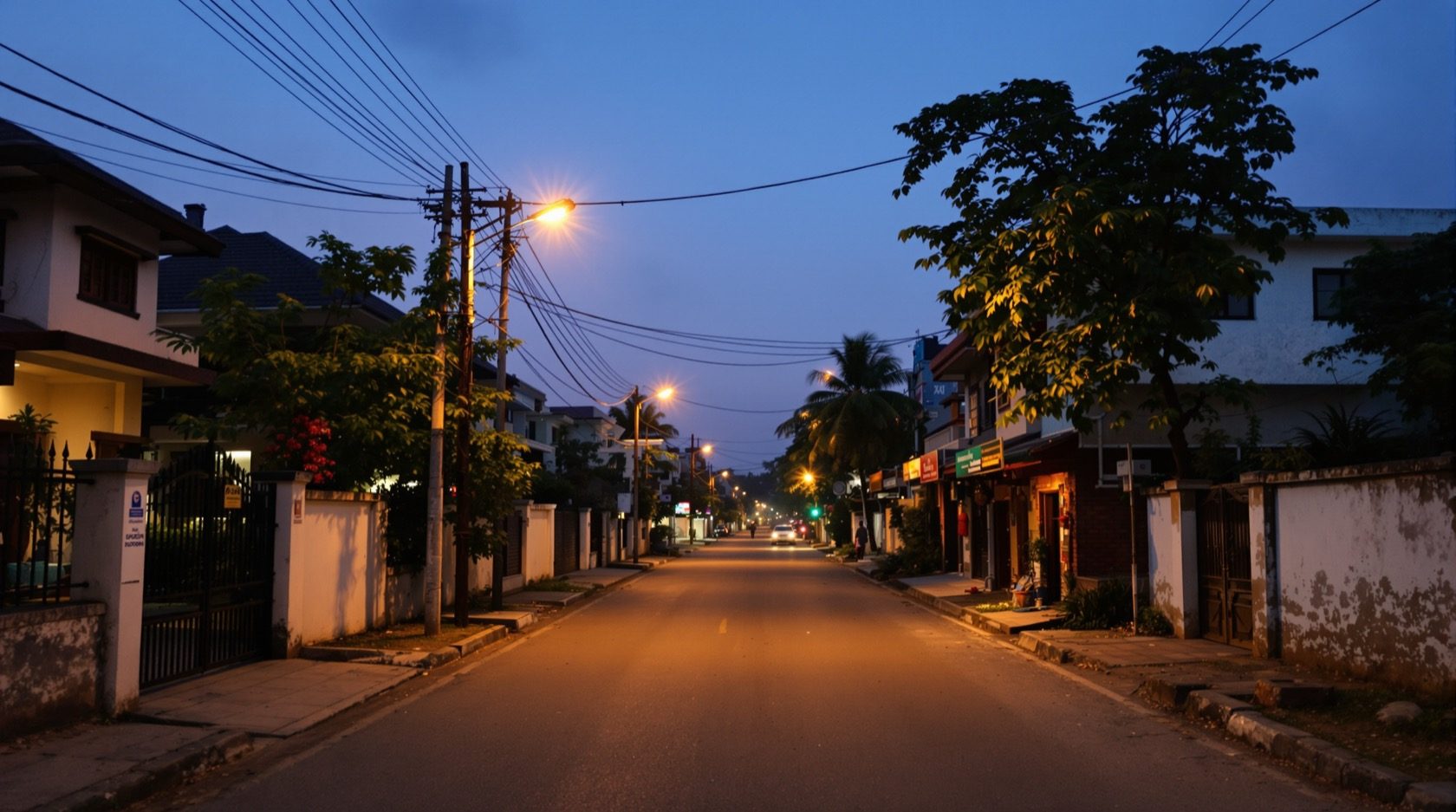
Neighbourhood Risk Assessment for Indian Homes
How to read the RISK of the locality around your home — using published crime data, police and RWA channels, local news and environmental signals like lighting, footfall, isolation and response time — and turn that read into a risk rating, all without ever profiling people or communities.
Your home is only as secure as the street it sits on. Two identical houses — same gate, same locks, same cameras — carry very different real-world risk if one is on a busy, well-lit lane overlooked by neighbours and the other is at the dead end of a dark, isolated road with the nearest help twenty minutes away. Before you decide how much security to build, you need to read the neighbourhood honestly: its patterns, its signals, and how quickly help arrives when something goes wrong.
This is a focused deep-dive within Studio Matrx's Security Planning Prerequisites. It sits one level below the master Home Security Risk Assessment Guide, which covers your whole risk picture; here we zoom in on just the surroundings. Read it alongside the site security assessment, which looks inward at your plot, and the crime risk mapping guide, which turns these signals into a map.
Scope, ethics & safety. This is a defensive planning guide about environment and patterns — never about people. You will assess lighting, activity, isolation and response, and you will use public, legitimate information: published crime statistics, the local police station, your RWA, local news, insurance patterns. You will never profile, suspect, watch or label individuals or communities, and nothing here explains how to exploit a weakness. Reading an area responsibly is about how well-lit and overlooked a street is, not about who lives on it.
Why the neighbourhood read comes first
Most home-security decisions are made in a vacuum — a camera here, a grille there — with no reference to the actual environment. But the environment sets the baseline. Criminologists call the useful lens CPTED (Crime Prevention Through Environmental Design), and its plain-language idea is simple: places that are watched, lit, active and cared-for deter opportunistic crime, while places that are isolated, dark, empty and neglected invite it. Your job is to read where your street sits on that spectrum, because it tells you how much detection and hardening you have to add yourself.
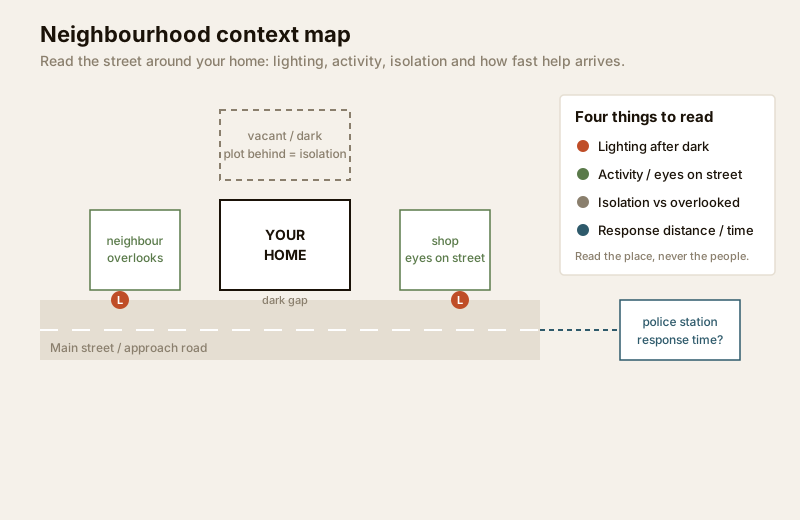
The read rests on four environmental dimensions, all of which you can observe without ever watching a person:
- Lighting — how well the street, approaches and your gate are lit after dark.
- Activity and natural surveillance — how many ordinary eyes are on the street through the day and night: shops, passers-by, overlooking windows.
- Isolation — whether your home is exposed and cut-off, or embedded in a busy, overlooked fabric.
- Response — how far and how fast real help is: a neighbour, the RWA guard, the police station.
The public, legitimate signals to use
Gather facts from channels that exist precisely to be asked. None of this requires you to observe or judge any individual.
Published crime statistics and police data. India's National Crime Records Bureau (NCRB) publishes annual district- and city-level figures, and many state and city police forces now run public dashboards and citizen portals. These are broad, but they tell you whether property crime in your city or zone is rising or falling and which categories dominate. Treat them as trend and texture, not a verdict on your specific lane.
The local police station. Your jurisdictional station is a legitimate first stop. Beat officers and the station house genuinely know local patterns — which stretches have had break-ins, when, and how. Many cities run community-policing or beat-officer schemes; introduce yourself, ask about recent property-crime trends in the area, and note the station's distance and typical response time. This is a conversation about the area, framed neutrally.
The RWA or housing society. Your Resident Welfare Association or apartment society is often the richest source: incident history, guard arrangements, gate discipline, and whether a gated-community setup is tight or leaky. Ask to see any incident log and the security SOP.
Local news and verified community channels. Local newspapers and established neighbourhood or RWA groups surface incident clusters and civic issues (a stretch of failed street lights, an unmanned gate). Weigh these carefully — online chatter can be alarmist or unverified, and it must never tip into naming or suspecting individuals. Use it to spot environmental patterns, then confirm the important ones with the police or RWA.
Insurance patterns. Home-insurance premiums and underwriting reflect aggregate loss experience for an area. If cover is unusually priced or hedged for your pincode, that is a quiet market signal worth noting.
The environmental read: walking the area
Now do your own observation — of the place, not its people. Walk or drive the immediate surroundings, ideally twice: once in daylight and once after dark, because the two tell completely different stories.
Street lighting
After dark, check whether the road, the approach to your gate, and the stretch a person would cross are actually lit, or whether pools of darkness let someone work unseen. Note failed or missing municipal lights — a fixable civic issue you can raise with the ward office or RWA. Well-lit approaches are one of the cheapest deterrents that exist.
Footfall and natural activity by hour
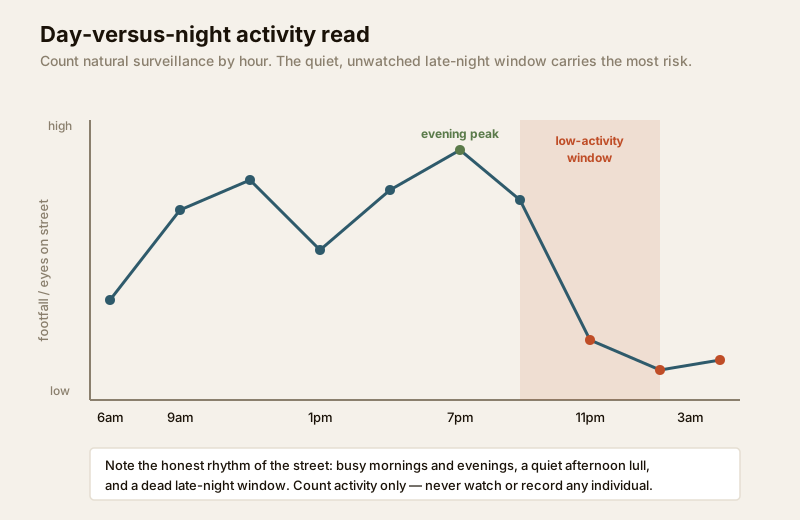
Natural surveillance means ordinary, unpaid eyes on the street: a corner shop open till late, a chai stall, kids playing, people on balconies, regular passers-by. Note the honest rhythm across the day — busy morning, quiet mid-afternoon, active evening, dead after 11 pm. The quiet windows matter most, because opportunistic crime prefers an empty, unwatched street. You are counting activity, never watching individuals.
Isolation versus overlooked
Is your home embedded and overlooked, or exposed and cut-off? Note things like: a dead-end or through-road; whether neighbouring windows and terraces can see your approach; large blank walls, vacant plots, or an unlit park backing onto you; and any secluded side or rear that no one else can observe. Isolation is the single biggest neighbourhood multiplier — the perimeter vulnerability assessment then looks at how that isolation meets your boundary.
Quality of common infrastructure
Neglect signals opportunity; care signals eyes. Note the state of shared infrastructure: are roads, drains and street furniture maintained; are common gates and guard posts staffed and working; is there rubbish-strewn or overgrown ground that hides movement? A well-kept commons usually means an engaged community, which is itself a deterrent.
Response distance and time
Finally, the read that decides how self-reliant you must be: how fast does real help arrive? Note the actual distance and realistic response time for the nearest neighbour who would help, the RWA or society guard, and the police station. In an isolated location with a slow response, your own detection and delay measures have to be stronger, because you are buying time no one else can give you quickly.
Neighbours and community organisation
Organised neighbours are a security asset. Note — at the level of arrangements, not personalities — whether there is an active RWA, a functioning community-watch or neighbourhood-watch scheme, a residents' group that shares verified alerts, and simple mutual habits like keeping an eye on a house when its family travels. A street where people know and cover for each other is materially safer than one where nobody does.
Neighbourhood risk-factors checklist
Walk the area with this table and rate each factor Low / Medium / High for the contribution it makes to risk (High = the signal points to more risk). Anything you mark High feeds straight into how much security your home needs — and, where it is a civic fix like a dead street light, into what you raise with the RWA or ward office.
| Factor | What signal to read (environment only) | Rates as HIGHER risk when... |
|---|---|---|
| Street lighting | Lit road, approach and gate after dark | Dark stretches, failed/missing lights |
| Footfall / activity | Ordinary eyes on the street across the day | Long dead, unwatched windows (esp. late night) |
| Natural surveillance | Overlooking windows, shops, balconies | Blank walls, vacant plots, no one overlooks you |
| Isolation | Embedded and overlooked vs exposed | Dead-end, secluded side/rear, cut-off location |
| Common infrastructure | Maintained roads, gates, guard posts | Neglected, overgrown, non-functional gates |
| Published crime trend | NCRB / city-police data for the zone | Rising property-crime trend for the area |
| Police response | Distance + realistic response time | Far station, slow or uncertain response |
| RWA / gate discipline | Staffed gate, logged entry, tailgating control | No RWA, unmanned gate, routine tailgating |
| Community organisation | Active watch, residents' alerts, mutual cover | No RWA, no watch, neighbours do not know each other |
| Escape routes / permeability | How easily an area invites quick, unseen exit | Many unwatched through-routes and dark exits |
On that last row: opportunistic crime is easier where an area offers quick, unseen ways in and out — multiple through-lanes, dark cut-throughs, unwatched back exits. You are reading the routes and layout, never anyone using them; a more overlooked, less permeable pocket is simply harder for opportunistic crime.
Turning the read into a risk rating
Count your High marks across the ten factors and let that drive a simple neighbourhood risk band. This is deliberately coarse — its job is to point your budget, not to be precise.
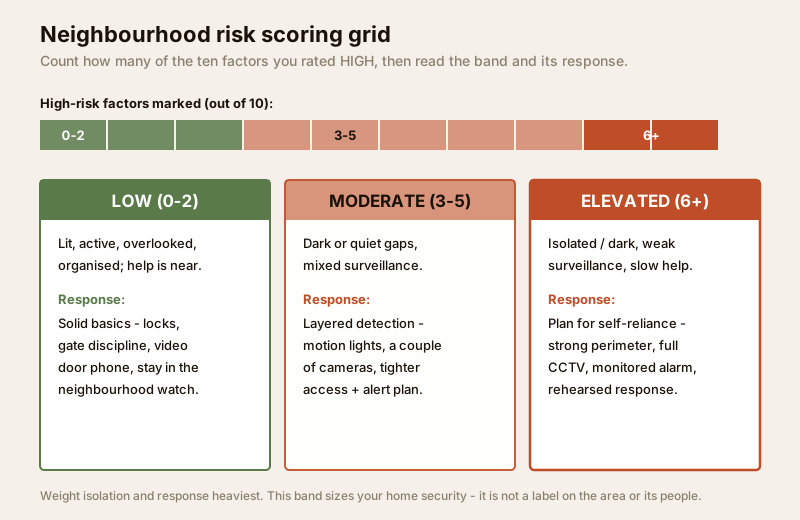
| Neighbourhood risk level | Typical read | Recommended security response for the home |
|---|---|---|
| Low (0-2 factors High) | Lit, active, overlooked, organised; help is near | Solid basics: good locks, gate discipline, a video door phone, and staying part of the neighbourhood watch |
| Moderate (3-5 factors High) | Some dark or quiet gaps, mixed surveillance, average response | Add layered detection: motion lights on dark approaches, a couple of cameras on entry paths, tighter access control, and a clear alert-a-neighbour plan |
| Elevated (6+ factors High) | Isolated and/or dark, weak surveillance, slow response | Assume self-reliance: strong perimeter and boundary, full CCTV of approaches, alarm with monitoring, delay-and-detect layering, and a rehearsed response plan; consider a one-off professional survey |
Two cautions keep this honest. First, weight response and isolation heavily — a High on those two does more to raise real risk than a High on, say, a maintenance signal, because they decide whether you are on your own when something happens. Second, this rating sizes your home's security; it is not a label on the locality or its residents. A moderate-risk area with a great neighbour network can feel safer than a low-risk one where nobody knows anybody.
Feeding it into your home plan
Your neighbourhood band sets the baseline your home has to overcome. A Low band means your money goes into good basics; a Moderate band pushes you toward layered detection and access control; an Elevated band means you plan for self-reliance — strong perimeter, full detection, monitored response — because outside help is slow. Carry the band straight into the master risk assessment, then score the whole picture with the Home Security Risk Scorecard, which turns your findings into a ranked, phased action list.
When to bring in a professional
The neighbourhood read is something you can and should do yourself — you live here and you will observe it honestly. But bring in qualified help when: the picture is genuinely Elevated and you want an independent security survey; you are a housing society or RWA formalising an area-wide plan; or any resulting work touches life-safety or structure — fire and alarm systems, mains electrical, electric locks and electronic access control, or structural perimeter such as boundary walls, gates and grilles. Specify what the assessment tells you to, then let licensed installers size, fit and certify it. Nothing you add may ever obstruct fire-escape or egress.
Re-read the area periodically
A neighbourhood is not static. Street lights fail, a new market changes the footfall, a vacant plot gets built up and adds eyes, an RWA guard contract lapses, or a run of incidents shifts the trend. Re-run this read at least once a year, and always after any incident nearby or any visible change in the area's lighting, activity or gate arrangements. Keep raising the civic fixes — a dead light, an unmanned gate — through the RWA and ward office; improving the shared environment lowers risk for the whole street, not just your home.
Key takeaways
- Read the area before you buy hardware — lighting, activity, isolation and response set the baseline your home has to overcome.
- Use public, legitimate signals — NCRB and city-police data, the local station, your RWA, local news and insurance patterns — and confirm the important ones.
- Assess environment and patterns, never people — count activity and read layout; never profile, suspect or watch any individual or community.
- Weight isolation and response most — they decide whether you are on your own when something happens.
- Convert the read into a Low / Moderate / Elevated band and let it size your home's security — then score the full picture with the risk scorecard and re-read the area at least once a year.
Continue with the site security assessment to look inward at your plot, the crime risk mapping guide to map these signals, or browse the full security guides collection.
This is an educational planning guide. It is strictly defensive, uses only public and legitimate information, and never profiles individuals or communities or explains how to defeat any measure. Fire, alarm, electrical, electronic-lock and structural work is qualified professional work — engage licensed installers and verify any applicable National Building Code or municipal bye-law requirement for your project.
Export this guide
Related Guides — Deep-dive reading
Open Parking Security in India: Open-Air and Stilt Lots
An open lot and a stilt park feel safer than a basement in daylight, but they are exposed on every side and usually unmanned after dark. Here is how to secure open parking from the boundary in, without ever blocking a fire tender or an escape route.
SecuritySecurity for People Living Alone in India (2026): Calm, Practical Habits When There Is No Second Person to Notice
Living alone is an ordinary and growing part of Indian life - the student in a new city, the working single, the elder whose children are abroad, the person after a separation. It does not call for fear. It calls for a few deliberate habits, because there is no second person in the home to notice trouble, raise the alarm, or catch an accident. This is calm self-reliance, layer by layer.
SecurityApartment Security in India: The Resident's Security Guide
Securing a flat is a shared job. This guide draws the line between what you control from your own front door inward and what the society, RWA or facility manager runs outside it — the flat-specific threats, the checklist by zone, and how to raise security at the AGM. India-grounded, renter-aware.
SecurityRelated Tools — Try Free
Home Security Risk Scorecard
Score your home across six security layers — perimeter, entry points, lighting, detection, alarm and habits — and get a prioritised action plan.
Security ScorecardApartment Interior Planning Checklist
51-item checklist across structural, ceiling, lighting, furniture, storage, electrical, kitchen, bathroom.
ChecklistApartment Video Door System Planner
Enter flats, entrances, floors and guard desk for a first-pass building intercom plan — door stations, indoor monitors, guard station, the right architecture and an indicative cost band.
Building Planner