
Overhead vs Underground Water Tank: Which Do You Need in India?
A fair, India-first head-to-head: an overhead tank gravity-feeds your taps but holds little; an underground sump stores huge volumes from erratic supply but needs a pump. Capacity, pressure, cost, cleaning, contamination — and why most Indian homes quietly run both.
Almost every Indian home faces the same problem: municipal water arrives for a few hours, at low or unpredictable pressure, and you have to catch it, store it, and then deliver it to taps on every floor with decent flow. Two tanks solve two different halves of that problem — and the honest answer for most homes is that you need both, not one.
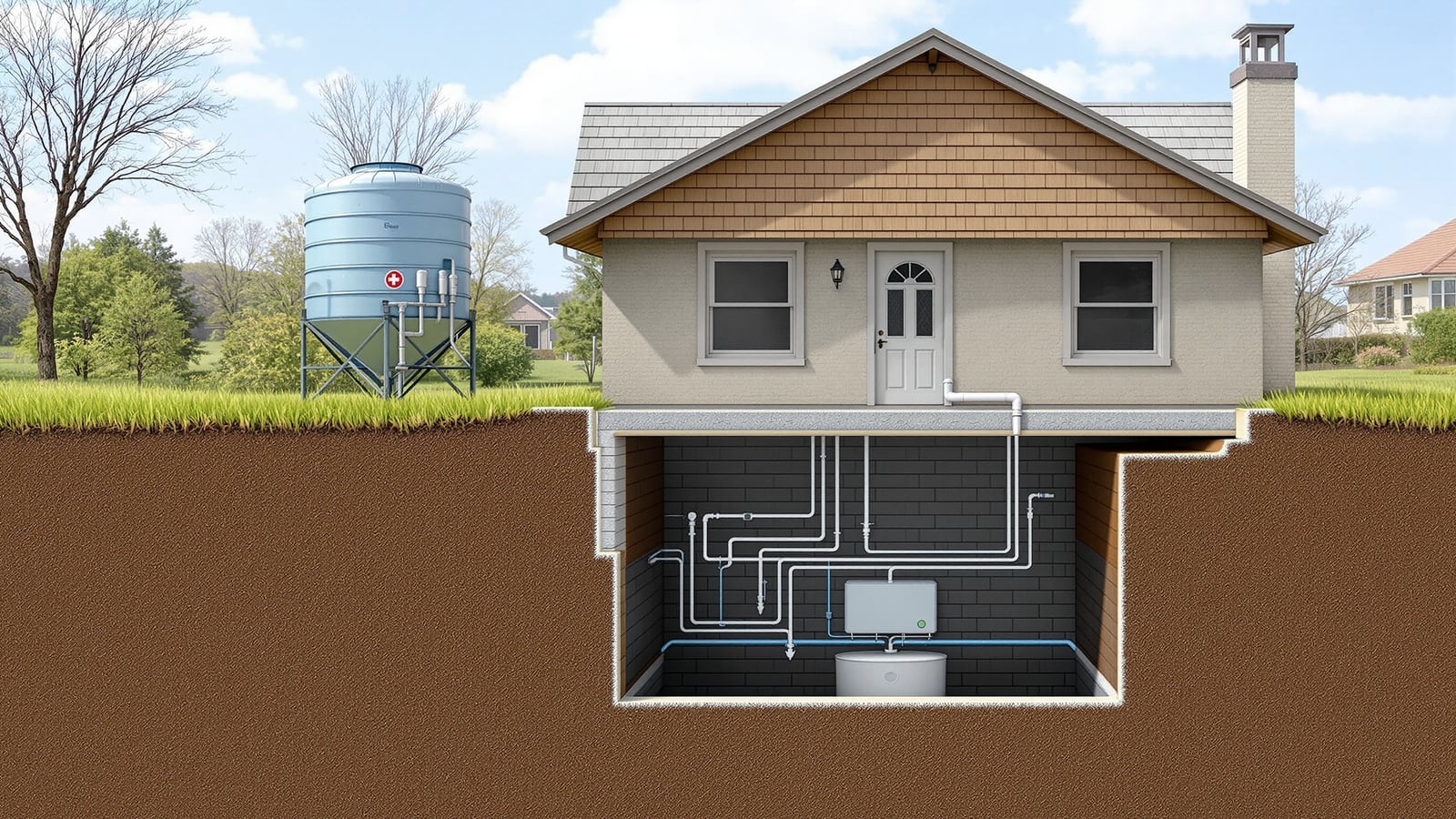
This is a fair, head-to-head verdict between the overhead tank (on the roof, gravity-feeding your taps) and the underground sump (buried at plinth level, storing bulk water). Neither is "better" outright. They do opposite jobs: the sump is about catching and hoarding water; the overhead tank is about delivering it with pressure. Get the roles right and you understand why the combined setup exists.
For how each one actually works, install and size, read Overhead Water Tanks (India) and Underground Sump Tanks (India). For the whole storage system see the pillar, Water Storage Tanks Guide (India).
The one difference that decides everything
Overhead tank — gravity is the whole point. Sitting a few metres above your taps, it converts height into pressure with no electricity: roughly 0.1 bar per metre of height. A tank on a two-storey roof gives ground-floor taps a comfortable, uninterrupted feed even during a power cut. But a rooftop can only carry so much weight, so overhead tanks are small — typically 500 to 2,000 litres for a home.
Underground sump — volume is the whole point. Built into the ground (usually RCC, sometimes plastic), a sump can hold 5,000, 10,000, 20,000 litres or more because the earth carries the load, not your slab. That lets it bank days of water from a supply that runs for two hours a day. But it sits below your taps, so it has no pressure of its own — you need a pump to lift that water anywhere useful.
That is the crux. The sump stores; the overhead tank pressurises. One cannot do the other's job, which is exactly why they pair up.
Capacity, pressure and the roof-load trade-off
- Capacity. The sump wins decisively. Ground-supported storage is cheap volume; rooftop storage is load-limited. If your street water is erratic, you need the sump's litres — an overhead tank alone will run dry between supply hours.
- Pressure. The overhead tank wins decisively, and for free. The sump delivers zero pressure until a pump runs; the overhead tank delivers steady gravity pressure even when the power is out.
- Roof load. This is the overhead tank's real constraint. Water weighs about 1 kg per litre, so a full 1,000-litre tank plus its stand is over a tonne on one point of your slab — it must sit on a designed support or beam, never an afterthought. The sump has no such limit.
| Factor | Overhead tank | Underground sump |
|---|---|---|
| Typical home capacity | 500–2,000 L (roof-load limited) | 5,000–20,000+ L |
| Water pressure at taps | Good, gravity-fed, works in power cuts | None on its own — needs a pump |
| Handles erratic municipal supply | Poorly (small buffer) | Excellently (bulk storage) |
| Pump needed | No (fills from sump/main) | Yes, to lift water out |
| Material | Mostly plastic (PE), some RCC | Mostly RCC, some plastic |
| Ease of cleaning | Easier — accessible, drain via tap | Harder — confined space, manual entry |
| Contamination risk | Lower (sealed, elevated) | Higher (groundwater/sewage ingress if cracked) |
| Structural load concern | High — needs designed roof support | Low — earth carries the weight |
| Indicative cost | Lower (tank + stand) | Higher (excavation + RCC waterproofing) |
| Best for | Delivering pressure to taps | Storing bulk water from poor supply |
Cost, cleaning and contamination
Cost. The overhead tank is cheaper to install — a moulded plastic tank plus a stand or slab support. The sump costs more because it is a civil job: excavation, an RCC or brick chamber, and proper waterproofing plastering so groundwater cannot seep in or stored water seep out. Add the pump the sump needs, and the buried side is comfortably the pricier of the two. Figures move with city, size and material, so treat all of this as indicative and confirm against the Water Tank Cost (India) guide.
Cleaning. The overhead tank is easier to service — it is accessible, you can drain it via a tap and scrub the inside without a confined-space job. A sump is harder: it is a below-ground chamber you often have to enter physically, and a large RCC sump should be cleaned and disinfected at least twice a year. Both need a routine; the sump simply demands more of one.
Contamination. This is where the sump carries real risk and the overhead tank is safer:
- A cracked or poorly waterproofed sump can let in groundwater — or, worse, seepage from a nearby leaking sewer line or soak pit. This is a genuine cause of water-borne illness in Indian homes.
- Because it is at ground level and larger, a sump is also easier for silt, insects and stray runoff to reach if the lid or cover is not sealed.
- The overhead tank, sealed and elevated, is far less exposed — its main enemies are a missing lid, algae from a translucent tank in sunlight, and neglect. Keep the lid closed and shade a plastic overhead tank, and contamination is easy to control.
A sump must be built like a water-retaining structure, not a soak pit. Good waterproofing, a tight cover, and a clear separation from any drainage or sewer line are non-negotiable — the biggest sump failures in India are seepage and cross-contamination, not the tank running dry.
Why most Indian homes use both
Here is the setup you will see on the vast majority of Indian plots, and now you can see why it exists:
1. Municipal water fills the underground sump during the short supply window. The sump's job is to hoard as much of that erratic supply as it can.
2. A pump lifts water from the sump up to the overhead tank on the roof (often on a float switch or timer so it does not overflow or run dry).
3. The overhead tank gravity-feeds every tap in the house — steady pressure, no electricity, working even during a power cut.
Each tank does the one thing it is good at. The sump gives you volume you could never carry on a roof; the overhead tank gives you pressure a buried tank could never provide on its own. Neither alone is a complete water system for a home on unreliable municipal supply.
The verdict
This is not really "overhead versus underground" — it is "pressure versus storage," and each tank owns one of those. Match your situation to the recommendation:
| Your situation | Recommended setup |
|---|---|
| Erratic / low-pressure municipal supply (most homes) | Both — sump stores, pump lifts, overhead gravity-feeds |
| Multi-storey home needing pressure on every floor | Both, with overhead tank sized per floor |
| Reliable, well-pressurised supply + small home | Overhead only |
| No room to bury a tank | Overhead only (accept smaller buffer) |
| Roof cannot take the load, single floor | Sump + pump to taps (accept pump dependency) |
| Want power-cut-proof tap pressure | Overhead tank essential |
| Need days of storage from a 2-hour supply | Underground sump essential |
Reading that as prose:
- For steady tap pressure with no pump and no power dependency — you need an overhead tank. Nothing else gives you free, power-cut-proof pressure.
- For banking bulk water off an erratic or low-pressure municipal supply — you need an underground sump. Nothing else gives you that many litres without loading your roof.
- For a normal Indian home on typical municipal supply (the common case) — install both: sump for storage, pump to lift, overhead tank for gravity feed. This is the default for a reason.
- Overhead-only makes sense only where supply is genuinely reliable and pressurised, the home is small, and you have no room to bury a tank.
- Sump-only (pumping straight to taps) is rare and generally worse for the home — you lose gravity pressure and become fully dependent on the pump running.
Whichever way you lean, size the tanks to your household and supply pattern with Choosing a Water Tank (India), and see the full set of head-to-head guides in the Plumbing Comparisons Guide (India).
Bottom line: the sump catches and stores your water; the overhead tank delivers it with pressure. They are partners, not rivals — and for most Indian homes the right answer is not to choose between them but to use both, each doing the one job it does best.
References
- National Building Code of India (NBC) 2016, Part 9 — Plumbing Services (water supply and storage).
- IS 12701 — Rotational moulded polyethylene water storage tanks — Specification (overhead plastic tanks).
- IS 3370 — Concrete structures for the storage of liquids — Code of practice (RCC sumps and overhead tanks).
- CPHEEO Manual on Water Supply and Treatment, Ministry of Housing and Urban Affairs, Government of India — storage and disinfection practice.
Export this guide
Related Guides — Deep-dive reading
Plastic vs RCC Water Tank in India: Which Should You Build? (2026)
A head-to-head decision guide for Indian homes — cheap, movable plastic tanks versus permanent cast-concrete RCC tanks, compared on cost, lifespan, hygiene, structural load and the right size range.
PlumbingOverhead Water Tank on the Roof (India): Why It's Up There, Sizing, Structural Load, Fittings & Care
The rooftop tank is what gives your taps and showers their pressure. Why height creates head, how to size it, what a full tank weighs and how to support it on the slab, materials, staging height, overflow and vent, sun and algae, cleaning access, and when to run more than one tank.
PlumbingUnderground Water Sump Tanks in India: Sizing, Waterproofing and Safe Placement
The below-ground reservoir that catches municipal and borewell water at ground level before a pump lifts it to your overhead tank — how it fits the supply chain, why waterproofing is make-or-break, how big to build it, where to keep it away from the sewer, and how to keep the pump from running dry.
PlumbingRelated Tools — Try Free
Rainwater Tank Sizer
How big should your rainwater tank be? Computes annual harvest, recommended tank capacity in litres, water-bill savings, and payback — for 10 Indian cities.
RWH CalculatorPlumbing Pressure-Test & Leak Checklist
Pre-closure pressure and leak test — 9 categories, 60+ checkpoints across water supply, drainage, fixtures, waterproofing, hot water, tanks.
Pre-Closure TestCross-Ventilation Analyzer
Estimate airflow and air changes per hour (ACH) from room size, window areas, layout, and local wind — with NBC 2016 Part 8 compliance check.
Ventilation Calculator