
Water Storage Tanks Guide for India: Sump, Overhead, Sizing, Materials & Fittings
The master overview of how an Indian home stores water — why storage exists at all, the sump to pump to overhead-tank to gravity chain, how much to hold, underground versus overhead placement, plastic versus RCC versus steel, food-grade and hygiene, the inlet-outlet-overflow-vent-washout fittings, and cleaning at a glance.
Almost every Indian home stores its own water, because the tap does not run all day. Municipal supply arrives for a few hours, a borewell runs only when you switch it on, and a tanker comes when it comes — so between deliveries the house lives off water it has already collected. This guide is the Studio Matrx master overview of that storage: why it exists, how the sump, pump and overhead tank chain together, how much to hold, where to put the tanks, what they are made of, and the fittings and hygiene that keep the water usable.
It is the pillar for a family of deeper guides. For how water reaches and moves through the house, see the water supply systems guide. For each half of the storage chain, see overhead water tanks and underground sump tanks. For the most common tank material, see plastic water tanks. And to actually size your tank in litres, use the bathroom water tank calculator.
Why Indian homes store water
The single reason is intermittent supply. Very few Indian towns run a continuous, pressurised 24x7 water grid; most deliver "intermittent" supply for a fixed window each day, and even that can skip a day. A borewell or open well gives water only while its pump runs. A tanker fills you up once or twice a week. None of these can be relied on to flow at the exact minute you open a tap.
Storage bridges that gap. It turns an unreliable, on-and-off source into a buffer the house can draw from at any hour, at steady pressure. It also lets the plumbing work by gravity, so a tap on the ground floor runs even when the mains is dry and the pump is off.
Think of storage as the household's battery for water. Supply charges it when available; the family discharges it steadily through the day. Size the battery for the longest gap you realistically face, not the average.
The storage chain: sump, pump, overhead, gravity
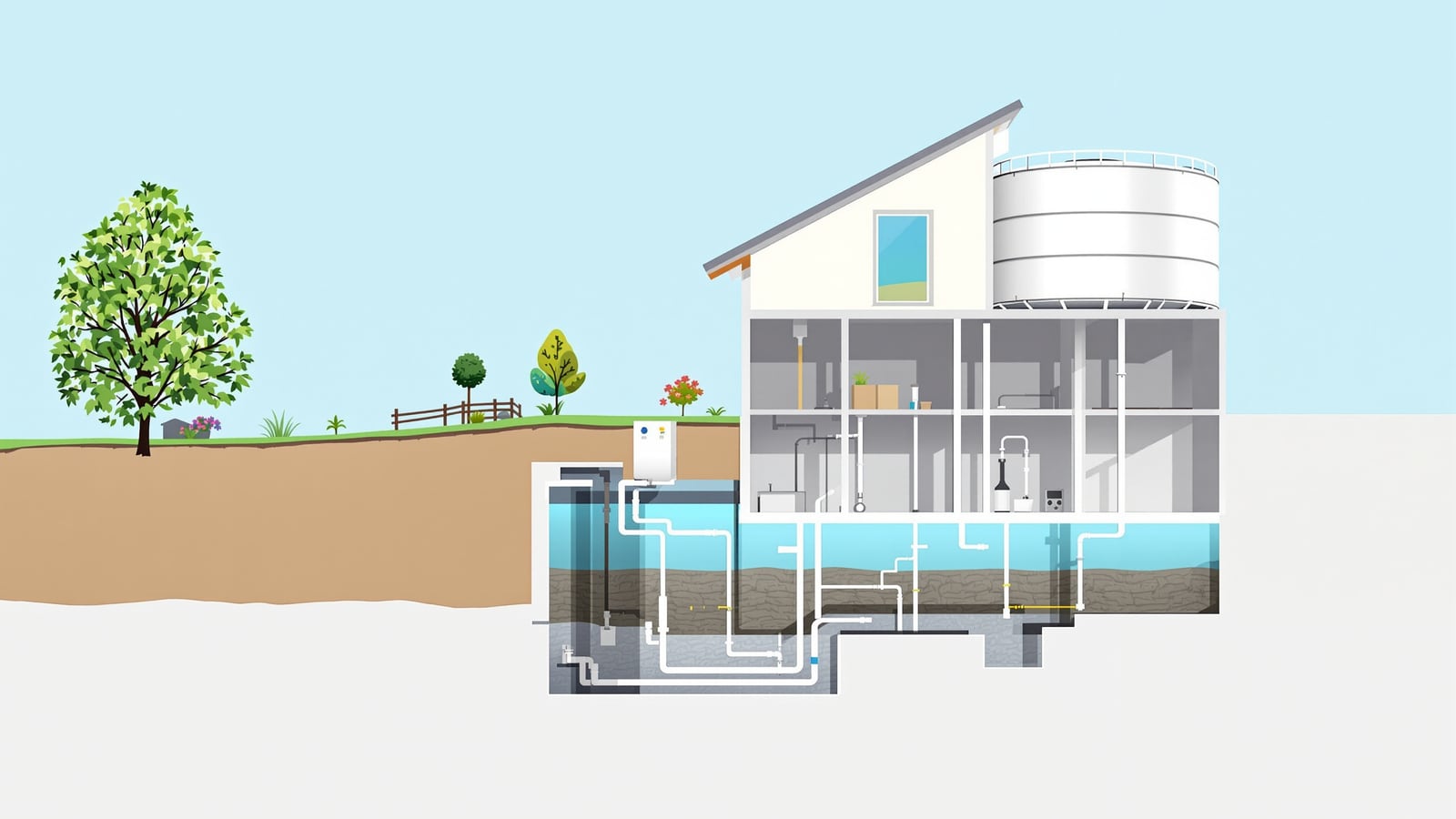
A typical independent Indian house stores water twice, in a sequence worth understanding as a chain:
1. Source to sump. Municipal or borewell water first fills an underground sump tank at or below ground level. Low storage catches water even when it arrives at weak pressure, and holds the bulk of the day's supply cheaply. See underground sump tanks.
2. Sump to overhead by pump. A pump lifts water from the sump up to a tank on the roof. The pump is the only part of the chain that needs electricity, and it runs for a short while to fill the overhead tank.
3. Overhead to taps by gravity. From the roof, water falls to every fixture under its own weight. Each metre of height adds pressure, so the tank sitting several metres up gives a usable head at showers, taps and flush cisterns with no pump running. See overhead water tanks and the water supply systems guide.
An apartment or high-rise uses the same idea at a larger scale, sometimes with intermediate tanks on the way up, but the pattern is identical: store low, pump up, feed down.
How much water to store
The honest answer is: enough to ride out the longest gap between refills, plus a margin. Indian design practice commonly assumes a domestic consumption of about 135 litres per person per day (lpcd) for a home with full plumbing — drinking, cooking, bathing, washing and flushing together. That figure is indicative; a frugal household uses less, a large one with a garden uses more.
From there, the arithmetic is simple in principle:
- Daily demand = people x 135 litres (indicative).
- Storage target = daily demand x number of days of buffer you want.
Most independent homes aim to hold one to two days of supply split between sump and overhead — often the bulk in the sump and roughly half a day overhead. A four-person home at 135 lpcd needs about 540 litres a day, so a day of buffer is comparable to a 500 litre overhead tank topped from a larger sump.
Do not oversize the overhead tank beyond what the roof and stand can safely carry, and do not undersize the sump below one full supply delivery — a sump that cannot catch a whole day's municipal window wastes water back to the drain.
We deliberately keep sizing to guidance here and do not repeat a full formula, because a calculator already does it. Enter your household size and bathrooms into the bathroom water tank calculator and it returns a litre figure and a suggested tank size directly.
Placement: underground versus overhead
Where a tank sits changes what it is for, what it costs and how it behaves.
| Aspect | Underground sump | Overhead tank |
|---|---|---|
| Purpose | Bulk storage, catches weak supply | Pressurised feed to fixtures |
| Location | Below or at ground level | Roof or elevated stand |
| Fill method | Gravity from mains / tanker | Pump from sump |
| Gives pressure? | No (needs pump) | Yes (gravity head) |
| Typical size | Larger (bulk) | Smaller (half to one day) |
| Structural load | Ground bears it | Roof / stand must carry it |
The key structural point about overhead tanks is weight. Water is heavy — one litre is one kilogram — so a full 1,000 litre tank plus its own mass is over a tonne concentrated on one spot. The roof slab, or a dedicated steel or masonry stand, must be designed to carry it; do not improvise a large tank onto an unverified roof. Underground sumps avoid that problem but must instead resist ground water pushing in and be sealed against contamination and tree roots.
Tank materials at a glance
Four material families dominate Indian storage. Each has a natural home in the chain.
| Material | Typical use | Indicative cost (1,000 L) | Lifespan | Notes |
|---|---|---|---|---|
| Rotomoulded plastic (PE) | Overhead, roof | ₹6,000 - ₹15,000 | 10 - 20 yrs | Light, seamless, food-grade grades common. See plastic water tanks |
| RCC (cast concrete) | Underground sump, large overhead | Built in place (varies) | 30+ yrs | Heavy, durable, ideal below ground; needs good waterproofing |
| Stainless / GI steel | Premium overhead, terrace | ₹18,000 - ₹40,000 | 15 - 25 yrs | Hygienic, strong, higher cost; avoids algae |
| Modular / panel (GRP, pressed steel) | Large commercial, bulk | Project-priced | 20 - 30 yrs | Bolted panels assembled on site for big volumes |
- Plastic (rotomoulded polyethylene) is the default for household overhead tanks: cheap, light, seamless and quick to install, and widely sold in food-grade layers. Detailed in plastic water tanks.
- RCC (reinforced cement concrete) is cast in place and suits large underground sumps and big built-in tanks, where its weight is an advantage, not a problem.
- Stainless steel is the premium terrace choice — hygienic and long-lived, resisting the algae growth that light-transmitting plastics can allow.
- Modular / panel tanks are bolted together on site for the large volumes that apartments and commercial buildings need.
Food-grade and hygiene
Any tank that holds water people drink, cook or bathe with should be food-grade — made of, or lined with, material certified safe for potable water so it does not leach taste, colour or chemicals. Reputable rotomoulded tanks offer a food-grade inner layer; steel is inherently hygienic. Beyond the material, hygiene depends on keeping the tank dark, sealed and vented:
- Dark stops sunlight driving algae. This is why household overhead tanks are usually black or multi-layer opaque, not translucent.
- Sealed with a close-fitting lid keeps out dust, insects, lizards and leaves.
- Vented lets air in and out as the level changes, but through a screened opening, not an open hole.
The tank fittings
A storage tank is only as good as its connections. A properly plumbed tank has a defined set of fittings, each with one job:
- Inlet — where water enters (from the mains, tanker, or the pump riser).
- Outlet — where water leaves to feed the house, taken a little above the floor so settled sediment is left behind.
- Overflow — a pipe near the top that carries excess safely away if the tank over-fills, sized at least as large as the inlet so it can never be out-run.
- Vent — a screened air opening so the tank breathes without drawing in dust or insects.
- Washout / drain — a low outlet at the very bottom to empty the tank fully for cleaning.
- Float valve — the automatic filler that shuts the inlet when the tank is full. It is covered in full in the float valves guide, so we only place it here; it is what makes the tank stop filling by itself and the first line of defence against overflow.
The overflow is a safety net, not the normal way the tank stops. If you ever see water pouring from the overflow routinely, the float valve has failed — fix it rather than living with the waste.
Cleaning at a glance
Even a sealed food-grade tank collects fine sediment and, over time, biofilm on its walls, so it needs periodic cleaning — commonly twice a year as an indicative rhythm, more often if your supply is silty. In brief: close the inlet, drain the tank through the washout, remove the settled sludge, scrub the walls, rinse thoroughly, and refill. A full cleaning schedule and disinfection method belong to the forthcoming Studio Matrx maintenance guides; here it is enough to know that easy access and a proper washout make cleaning possible, which is why lid size and a bottom drain matter when you buy or build a tank.
Putting it together
For a typical Indian home, the reliable pattern is: a generously sized underground sump to catch bulk supply, a pump to lift it, and a food-grade overhead tank sized for about half a day to a day of use, feeding the house by gravity. Choose plastic for a light rooftop tank, RCC for a built sump, steel where hygiene and longevity justify the cost. Fit it with a working float valve, a proper overflow, a screened vent and a bottom washout — and keep it dark, sealed and cleaned. Size it with the calculator, and read the sump and overhead guides for the detail behind each half of the chain.
References
- IS 12701 — Rotational moulded polyethylene water storage tanks (specification for domestic PE tanks), Bureau of Indian Standards.
- CPHEEO Manual on Water Supply and Treatment, Ministry of Housing and Urban Affairs — source of the commonly cited ~135 lpcd domestic demand figure.
- National Building Code of India — general provisions on water storage and plumbing for buildings.
Export this guide
Related Guides — Deep-dive reading
Overhead Water Tank on the Roof (India): Why It's Up There, Sizing, Structural Load, Fittings & Care
The rooftop tank is what gives your taps and showers their pressure. Why height creates head, how to size it, what a full tank weighs and how to support it on the slab, materials, staging height, overflow and vent, sun and algae, cleaning access, and when to run more than one tank.
PlumbingPlastic (Polyethylene) Water Tanks in India: Layers, Food-Grade, Sizes, Lifespan & Cost
The black or blue rotomoulded PE tank on almost every Indian roof — how rotational moulding works, single versus triple and four or five layer construction, food-grade FDA and BIS material, black anti-algae versus white and coloured bodies, common 500, 1000, 2000 and 5000 litre sizes, UV degradation and lifespan, cleaning, fittings, pros and cons against RCC and steel, and indicative prices.
PlumbingUnderground Water Sump Tanks in India: Sizing, Waterproofing and Safe Placement
The below-ground reservoir that catches municipal and borewell water at ground level before a pump lifts it to your overhead tank — how it fits the supply chain, why waterproofing is make-or-break, how big to build it, where to keep it away from the sewer, and how to keep the pump from running dry.
PlumbingRelated Tools — Try Free
Rainwater Tank Sizer
How big should your rainwater tank be? Computes annual harvest, recommended tank capacity in litres, water-bill savings, and payback — for 10 Indian cities.
RWH CalculatorWindow Cleaning Cost Calculator
Estimate professional window cleaning cost per visit and per year by access and frequency.
Window CalculatorOverhead Tank Size Calculator
Size the overhead roof water tank for a home from occupants, per-person use and the share of the day's water it holds, with a standard tank size.
Plumbing Calculator