
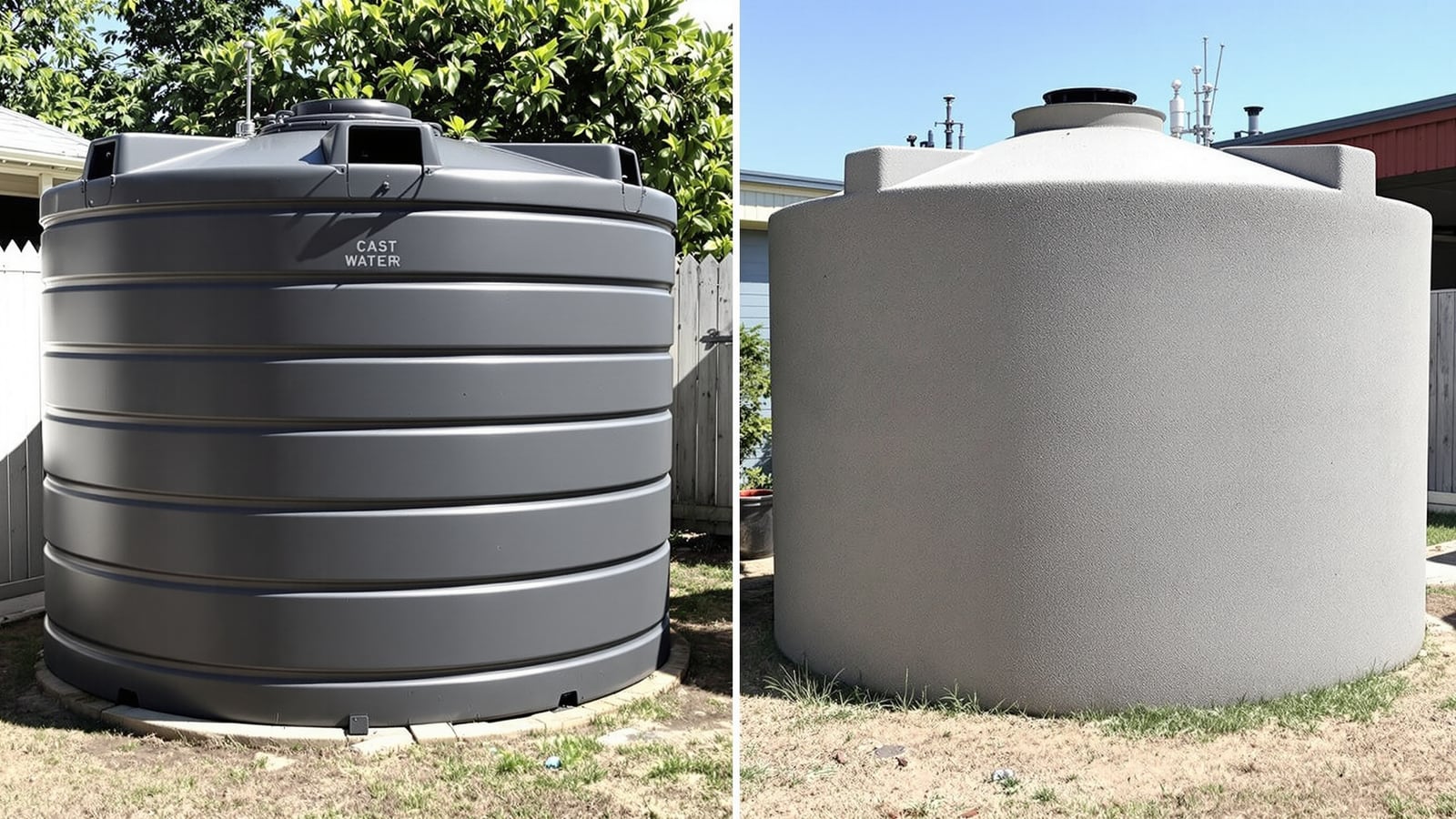
Plastic vs RCC Water Tank in India: Which Should You Build? (2026)
A head-to-head decision guide for Indian homes — cheap, movable plastic tanks versus permanent cast-concrete RCC tanks, compared on cost, lifespan, hygiene, structural load and the right size range.
Almost every Indian home storing water lands on one fork in the road: a ready-made plastic (poly / HDPE) tank you buy and hoist into place, or an RCC (reinforced cement concrete) tank cast in situ by a mason. They solve the same job very differently. The short version: for overhead storage plastic usually wins, and for a large underground sump RCC often wins — this guide shows exactly why, and where the line sits for you.
Deciding on the tanks themselves first? Read the Plastic Water Tanks guide and the RCC Water Tanks guide for how each is made and installed. This article is only the head-to-head — where they differ and which to pick.
The core trade-off in one line
A plastic tank is a product: cheap, standard, delivered in a day, and movable later. An RCC tank is a structure: cast to any shape, effectively permanent, built to outlast the plastic several times over — but slower, costlier upfront, and unforgiving if the concrete work is done badly. Everything below is that same tension seen through five lenses.
Cost: plastic is cheaper to buy, RCC costs to build
For small-to-medium sizes there is no contest — a moulded plastic tank is far cheaper per litre than pouring concrete, shuttering and steel. RCC only starts to make economic sense at large volumes (roughly beyond the point where a single plastic tank stops being practical), because the cost of formwork and labour is spread over many more litres.
- Plastic: low, predictable, off-the-shelf price. What you see on the invoice is nearly the whole cost.
- RCC: priced as a small civil job — cement, steel, aggregate, shuttering, mason labour and waterproofing all add up, and quality waterproofing is not optional.
Any rupee figure swings by city, size and finish, so treat comparisons as indicative and budget from the real numbers in the Water Tank Cost Guide.
Lifespan: RCC lasts decades, plastic is a 10-15 year item
This is RCC's strongest card. A well-built, well-waterproofed RCC tank can serve for decades — often the life of the building. A plastic tank is a consumable by comparison: quality food-grade tanks are typically warrantied for years and last roughly 10 to 15 years before UV, brittleness and cracking retire them.
The catch is the word well-built. A poorly cast RCC tank with weak concrete or skipped waterproofing will leak, crack and sweat within a few years — and it is far harder to repair than simply swapping a plastic tank. RCC rewards good execution and punishes bad execution severely.
Hygiene, cleaning and water quality
Both can be perfectly safe; they get there differently.
- Plastic: a food-grade ISI-marked tank (India's polyethylene tanks fall under IS 12701) has a smooth, non-porous inner surface that is easy to scrub. A black or dark inner layer starves algae by blocking light. A translucent or pale single-wall tank in full sun, by contrast, can grow algae — so colour and layers matter.
- RCC: concrete is opaque, so light-driven algae is a non-issue, and the thermal mass keeps water cooler. But bare concrete is porous and alkaline — it needs a proper internal waterproof / food-safe lining, or it can leach lime, taste chalky and harbour growth in surface pores. Interior corners are harder to clean than smooth plastic.
Net: plastic is easier to keep clean; RCC keeps water cooler and darker but depends entirely on a good internal finish.
Weight and structural load
This is what usually decides the overhead question.
- A plastic tank is light — an empty poly tank is trivial to lift onto a roof, and the loaded weight is essentially the water. It rarely needs anything more than a level base and, for larger sizes, a supporting structure.
- An RCC overhead tank adds the dead weight of the concrete itself on top of the water, all of it hanging off the roof slab or a column-supported structure. That has to be designed into the building by an engineer; you cannot bolt a heavy RCC tank onto a slab that was never sized for it.
For a sump sitting on the ground / underground, load is a non-issue — the earth carries it — which is exactly why RCC is so at home underground.
Best size range: where each one belongs
- Plastic shines from a few hundred litres up to the mid-thousands — the everyday overhead tank, and small sumps. Beyond a single tank's capacity you simply add more tanks, which stays cheap but eats floor and roof space.
- RCC is inefficient for small jobs but comes into its own for large, permanent bulk storage — the big underground sump that feeds the pump, tanker-fill storage, apartment and commercial reserves — where you want one custom-shaped volume that fits the plot and lasts the life of the building.
Head-to-head: plastic vs RCC across the factors
| Factor | Plastic (poly / HDPE) | RCC (cast concrete) |
|---|---|---|
| Upfront cost | Low, off-the-shelf | Higher — a small civil job |
| Cost at large volume | Adds up (many tanks) | More economical per litre |
| Lifespan | ~10-15 years | Decades if well-built |
| Install time | Same day, delivered | Days to weeks (cure + cure) |
| Weight / roof load | Light — easy overhead | Heavy — must be engineered |
| Custom size / shape | No — standard sizes | Yes — any shape to fit plot |
| Hygiene / cleaning | Smooth, easy; food-grade ISI | Needs lining; cool and dark |
| Movable later | Yes — lift and shift | No — permanent |
| Repairability | Just replace the tank | Hard, messy crack repair |
| Best for | Overhead tanks, small sumps | Large underground sumps |
The verdict
Pick by where the tank sits and how big it is, not by loyalty to one material:
| Your situation | Pick | Why |
|---|---|---|
| Overhead / rooftop tank | Plastic | Light load, cheap, same-day install |
| Large underground sump | RCC | Custom shape, decades of life, ground bears weight |
| Small underground sump | Plastic | Ready-made, leak-proof, no casting risk |
| Tight budget / rented site | Plastic | Cheap now, movable later |
| Very large permanent reserve | RCC | Cheaper per litre at scale, one custom volume |
Two caveats the table can't hold: an RCC overhead tank only makes sense when it is engineered into the building from the start — never bolted onto a slab that wasn't sized for it. And RCC only pays off if the concrete and waterproofing are done right, so for a large sump hire a mason with a real track record on water-retaining concrete; a badly cast box will leak and cost you far more than the plastic you skipped.
Not sure which category you fall into? Walk through the How to Choose a Water Tank guide, and for the full menu of tank types see the Water Storage Tanks pillar.
Can you use both? Often the smartest answer
For many Indian homes the best setup is not one or the other but a split: a large RCC underground sump for bulk storage, and a plastic overhead tank the pump lifts water into for daily gravity supply. You get RCC's durability and custom volume where weight doesn't matter, and plastic's light, cheap, easy-clean convenience where it does.
Bottom line
Overhead and small - go plastic; large and underground - go RCC, and for most homes a plastic overhead tank fed from an RCC sump beats forcing either material to do both jobs. Compare more matchups in the Plumbing Comparisons Guide, and price your choice with the Water Tank Cost Guide. Studio Matrx builds these guides so you pick on the trade-offs, not on what the shop happens to stock.
References
- Bureau of Indian Standards (BIS) — IS 12701, specification for rotational moulded polyethylene water storage tanks (look for the ISI mark and licence number on plastic tanks).
Export this guide
Related Guides — Deep-dive reading
Plastic (Polyethylene) Water Tanks in India: Layers, Food-Grade, Sizes, Lifespan & Cost
The black or blue rotomoulded PE tank on almost every Indian roof — how rotational moulding works, single versus triple and four or five layer construction, food-grade FDA and BIS material, black anti-algae versus white and coloured bodies, common 500, 1000, 2000 and 5000 litre sizes, UV degradation and lifespan, cleaning, fittings, pros and cons against RCC and steel, and indicative prices.
PlumbingRCC Water Tank in India: Cast-in-Place Concrete Sumps & Overhead Tanks, Waterproofing, Cost & IS 3370
The reinforced cement concrete water tank — cast in place for large underground sumps and big overhead terrace tanks — how it is built to M25 watertight concrete, why waterproofing and IS 3370 detailing decide whether it leaks, food-grade lining, cleaning access and ventilation, life, indicative cost and where it beats plastic.
PlumbingHow to Choose a Water Tank in India: Buyer's Guide (2026)
A homeowner's shopping guide to buying the right water tank — layers, food-grade ISI mark, capacity, warranty and a brand-vs-local checklist so you pay for quality, not marketing.
PlumbingRelated Tools — Try Free
Rainwater Tank Sizer
How big should your rainwater tank be? Computes annual harvest, recommended tank capacity in litres, water-bill savings, and payback — for 10 Indian cities.
RWH CalculatorHome Building & Interior Cost Calculator — 20 Cities
Construction + interior costs for 20 Indian cities across kitchen, wardrobes, flooring, painting, ceiling.
Cost CalculatorMaterial Decision Framework (M-Score)
Score 30+ Indian construction materials across cost, durability, climate fit, maintenance, and sustainability.
Materials