
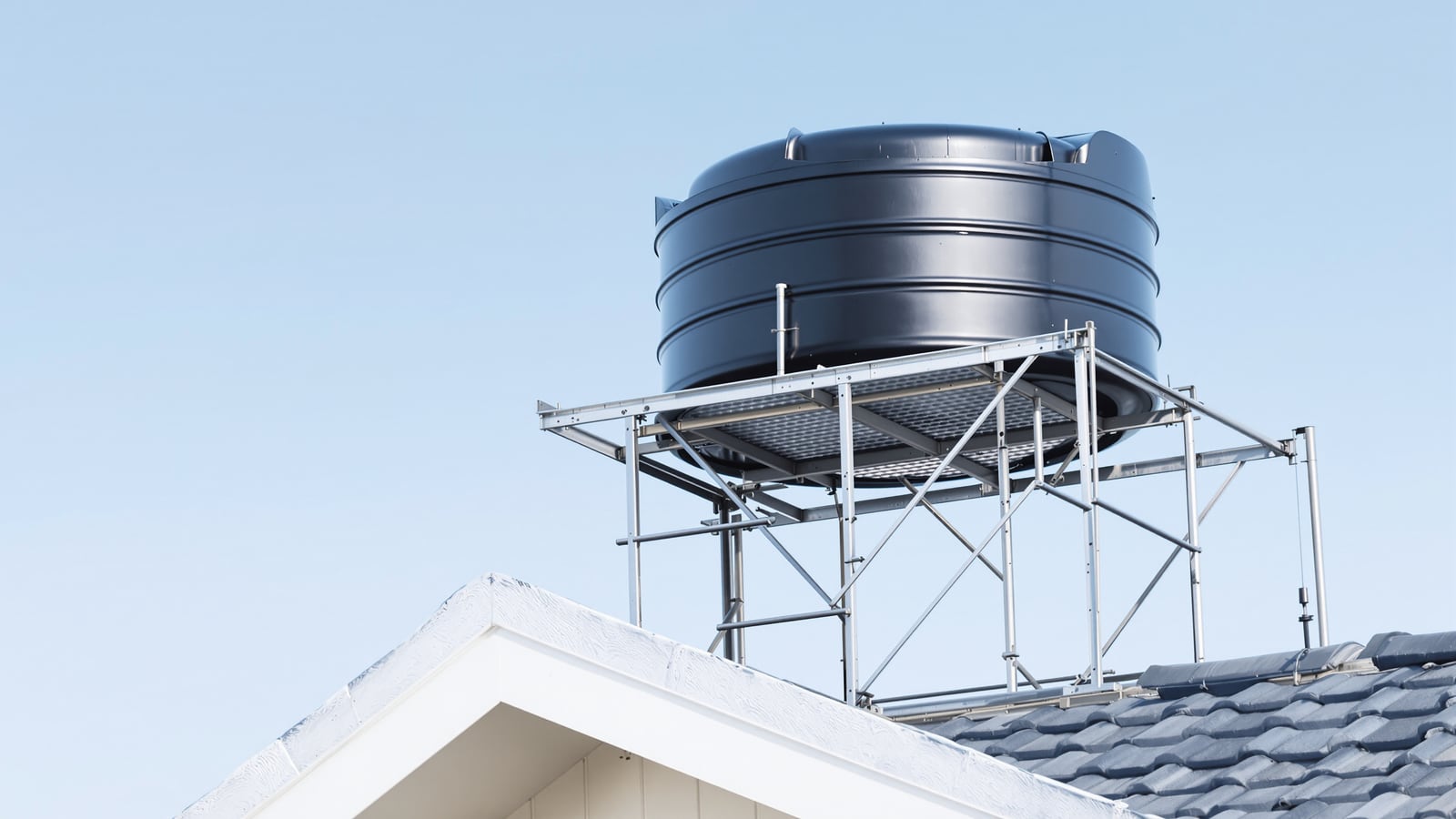
Overhead Water Tank on the Roof (India): Why It's Up There, Sizing, Structural Load, Fittings & Care
The rooftop tank is what gives your taps and showers their pressure. Why height creates head, how to size it, what a full tank weighs and how to support it on the slab, materials, staging height, overflow and vent, sun and algae, cleaning access, and when to run more than one tank.
The overhead water tank on your terrace is the quiet workhorse of the whole house. It is where water waits between the pump filling it and your taps, showers and flush cisterns drawing it out — and because it sits high up, it is also what gives that water its pressure. Almost every Indian home runs on the same chain: the municipal main or borewell fills an underground sump, a pump lifts that water to the tank on the roof, and from there it flows down to every fixture under gravity.
This guide is part of the Studio Matrx water storage tanks guide. It explains why the tank belongs on the roof, how big it should be, and — the part most homeowners skip — what a full tank actually weighs and how to support it safely.
Why the tank goes on the roof
The overhead tank is high up for one reason: gravity gives it pressure for free. Water has weight, and a column of water pushes down at roughly 0.1 bar for every metre of height — so a tank whose water level is 6 metres above a ground-floor tap delivers about 0.6 bar there with no pump running. That static push is called head, and it is what makes your taps flow and your shower work when the power is off. The full logic of this is in the gravity-fed plumbing system guide.
- The higher the water level above a fixture, the more pressure that fixture sees.
- Fixtures on the top floor sit closest to the tank, so they get the least head — often the weak-shower complaint.
- A tank sitting flat on the terrace slab may give a top-floor shower barely 1–1.5 m of head, which feels like a dribble. Raising the tank on a staging buys back that height.
Rule of thumb: keep the bottom of the tank at least 1.5–2 m above the highest fixture it feeds. A rain shower or a first-floor bathroom on a flat terrace almost always needs the tank up on a stand.
Sizing at a glance
Sizing is about storing enough for a comfortable day (and ideally a day of buffer), without buying a tank so large it is dead weight and stagnant water. A common planning figure in India is roughly 135 litres per person per day for all domestic uses, though many households run leaner.
- A family of four at ~135 lpcd needs on the order of 500–600 litres a day; a 1,000-litre overhead tank gives roughly a day of buffer.
- Homes with erratic supply, more bathrooms or a garden step up to 2,000 litres or beyond, or split storage between overhead and sump.
Rather than reproduce a formula here, use the Studio Matrx bathroom water tank calculator to size by people and number of bathrooms. Treat the number as indicative and round up to the nearest standard tank — common sizes are 500, 1,000, 2,000 and 5,000 litres.
| People / home | Indicative daily use | Suggested overhead tank |
|---|---|---|
| 1–2 (small flat) | ~250–350 L | 500 L |
| 3–4 (family) | ~500–650 L | 1,000 L |
| 5–6 (large family) | ~750–900 L | 1,000 + 1,000 L or 2,000 L |
| Independent house + garden | 1,000 L and up | 2,000 L or split tanks |
Placement and structural load — the part not to skip
A full water tank is heavy, and homeowners routinely underestimate it. Water weighs about 1 kg per litre, so a full 1,000-litre tank is roughly 1,000 kg — one tonne — plus the tank's own weight and any staging. A 2,000-litre tank sitting full is two tonnes concentrated in one spot on the roof slab.
That load has to be handled deliberately:
- Sit the tank over a beam or supported edge, not in the unsupported middle of a large slab span, unless the slab was designed for it.
- Spread the load. A tank standing on its narrow moulded base concentrates the weight on a small footprint. Set it on a flat, level platform — a full-width RCC or masonry base — so the load is distributed across the slab, not punched into it.
- Level matters. A tank on an uneven base sits with its weight on one edge and can crack over time; it also holds a slug of water below the outlet that never gets used.
- On an existing house, if you are adding a large tank or a staging, it is worth a quick check with a structural engineer. Roof slabs are designed for a certain live load, and two tonnes in one place is not nothing.
Staging height is the trade-off. A taller stand gives top-floor fixtures more head (better showers), but it also raises the centre of gravity and the wind load, and needs a properly built, braced structure — not a wobbly angle-iron frame. For most homes a 0.6–1.5 m masonry or RCC staging is enough to fix weak top-floor pressure while staying stable.
What the tank is made of
The overwhelming default for Indian overhead tanks is plastic — rotationally moulded polyethylene (PE). It is light, seamless, food-grade, rust-proof, and cheap to replace. Multi-layer tanks add a UV-stable outer layer, a middle insulating layer and a food-grade inner layer. The details of grades and layers are in the plastic water tanks guide.
| Material | Typical capacity | Indicative price band | Life | Best for |
|---|---|---|---|---|
| Plastic (rotomoulded PE, triple-layer) | 500–5,000 L | ₹4,000–₹30,000 | ~10–15 yrs | Almost all homes — the default |
| Stainless steel | 500–2,000 L | ₹12,000–₹40,000+ | 20+ yrs | Premium, hygiene-focused, taste-sensitive |
| RCC / masonry (cast in place) | Any (custom) | Cost of construction | Decades | Large / built-in terrace tanks |
(Prices are indicative and vary by brand, city and capacity — confirm locally.)
Sun and algae are the main enemies of a rooftop plastic tank. Sunlight passing through a translucent tank feeds algae, turning water green and slimy. This is why most terrace tanks are black or opaque — the dark, light-blocking wall starves algae of light. The downside of black is heat: an exposed black tank can make the top run of water quite warm on a summer afternoon. The better answer is an insulated (multi-layer) tank, which blocks light and slows heating, or shading/painting the tank white on the outside over an opaque wall.
Fittings, overflow and vent
A well-connected tank has more than an inlet and an outlet:
- Inlet — where the pump or mains delivers water, controlled by a float valve so the tank stops filling by itself when full. Do not skip the float valve; it is what prevents endless overflow.
- Overflow — a pipe at least one size larger than the inlet, taking any excess safely down and away from the wall. If the float valve ever sticks, the overflow is your last line of defence against a flooded terrace.
- Vent / breather — the tank must breathe as water rises and falls; a covered vent lets air in and out while keeping insects, dust and light out. A sealed tank can deform.
- Outlet — the supply take-off, set a little above the very bottom so settled sediment stays put rather than feeding your taps.
- Washout / drain — a low connection or plug at the bottom used to empty and flush the tank when cleaning.
Cleaning access and lids
An overhead tank collects dust, sediment and biofilm over time and needs periodic cleaning. Design for it:
- A tight, opaque, lockable lid keeps out light, lizards, insects and debris — the single most important hygiene feature.
- Leave standing and working room around the tank on the terrace so a person can open the lid, reach in and scrub.
- Keep the tank a hand's width off the slab on its platform so the base and pipe joints can be inspected for damp.
- Plan to clean the tank periodically; a detailed tank cleaning and disinfection schedule will be covered in the forthcoming Studio Matrx plumbing maintenance section.
When to use more than one tank
Larger and taller homes often run multiple overhead tanks rather than one giant tank:
- Splitting a big requirement (say two 1,000 L tanks instead of one 2,000 L) keeps each tank a manageable weight and footprint on the slab, and lets you clean one while the other stays in service.
- Separate tanks for separate uses — one for a dual-supply layout keeping potable and non-potable (borewell / recycled) water apart. See underground sump tanks for how sump storage pairs with this.
- Zoning tall buildings — different tanks or tank levels feed different floors so pressure stays even. Interconnected tanks should be linked at the bottom so they fill and empty together, with a common overflow.
The most common overhead-tank mistake in Indian homes is not the size — it is putting a heavy tank flat on the slab with no thought to load or head, then wondering why the top-floor shower is weak and the terrace is damp.
References
- IS 12701 — Rotational-moulded polyethylene water storage tanks (materials and requirements for common plastic tanks).
- National Building Code of India — general guidance on water storage provision and per-capita design figures.
Always verify capacities, loads and staging against your own slab design and local conditions; the figures here are indicative planning values.
Export this guide
Related Guides — Deep-dive reading
Plastic (Polyethylene) Water Tanks in India: Layers, Food-Grade, Sizes, Lifespan & Cost
The black or blue rotomoulded PE tank on almost every Indian roof — how rotational moulding works, single versus triple and four or five layer construction, food-grade FDA and BIS material, black anti-algae versus white and coloured bodies, common 500, 1000, 2000 and 5000 litre sizes, UV degradation and lifespan, cleaning, fittings, pros and cons against RCC and steel, and indicative prices.
PlumbingWater Storage Tanks Guide for India: Sump, Overhead, Sizing, Materials & Fittings
The master overview of how an Indian home stores water — why storage exists at all, the sump to pump to overhead-tank to gravity chain, how much to hold, underground versus overhead placement, plastic versus RCC versus steel, food-grade and hygiene, the inlet-outlet-overflow-vent-washout fittings, and cleaning at a glance.
PlumbingLow-Rise Plumbing Systems in India: Houses, Villas & Buildings up to 4 Storeys
How plumbing is organised for independent houses, villas and low-rise buildings up to about four storeys — the simple overhead-tank gravity model, when a small booster is still worth adding, single- versus multi-floor distribution, and the simpler stack and venting a low building can get away with.
PlumbingRelated Tools — Try Free
Rainwater Tank Sizer
How big should your rainwater tank be? Computes annual harvest, recommended tank capacity in litres, water-bill savings, and payback — for 10 Indian cities.
RWH CalculatorShower Pump Calculator
Check whether your shower needs a pressure-boost pump and what size — available vs required pressure from your tank height or supply.
Bathroom CalculatorBathroom Water Tank Calculator
Size the overhead storage tank and sump a home needs for its bathrooms and daily use, by people, bathrooms and reserve days.
Bathroom Calculator