
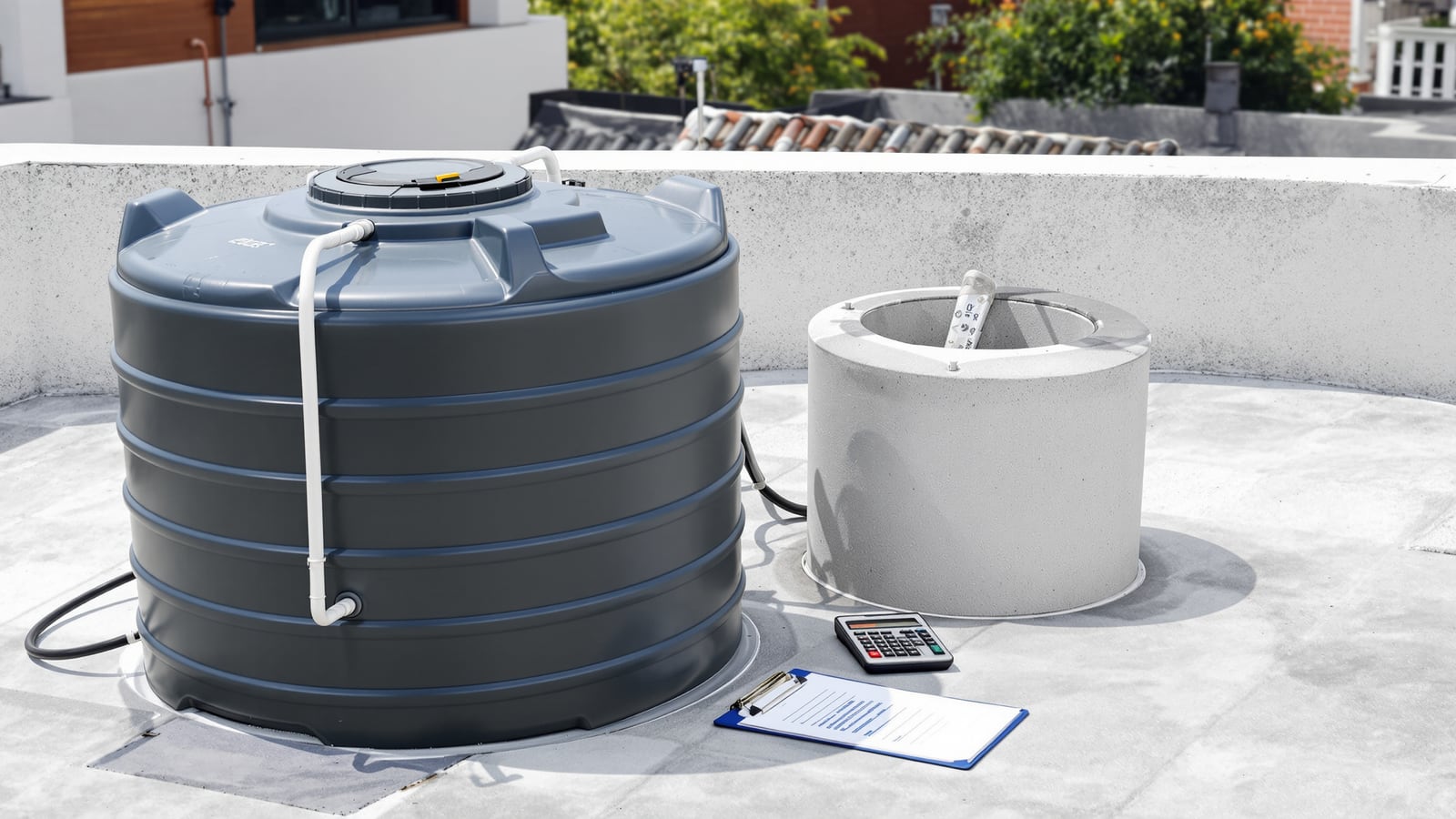
Water Tank Cost in India 2026: Plastic, RCC Sump, Steel & Modular Tank Prices
What overhead and underground water storage actually costs in 2026 — plastic tank prices by capacity and layer, RCC sump per-litre rates including excavation and waterproofing, premium steel and stainless prices, large modular tank rates, plus staging, fittings, float valve and installation.
A water tank price in India in 2026 can mean anything from a few thousand rupees for a small plastic drum to over a lakh for a built-in-place RCC sump. The cost swings on capacity, material, layer count and whether the tank sits on the roof or goes underground. This Studio Matrx guide gives realistic, budget-focused ₹ ranges for each type so you can plan before you call a vendor.
This guide sits under the Studio Matrx plumbing cost guide and the water storage tanks guide. For product detail — how each tank is made, sized and maintained — read the plastic water tanks guide and the RCC water tanks guide. To fix the litres you actually need before pricing, use the bathroom water tank calculator rather than guessing.
What you are actually paying for
A water tank cost is never just the tank body. A finished, working installation bundles several line items, and skipping any of them in your estimate is how budgets blow out:
- The tank itself — plastic body, RCC casting or steel vessel.
- The staging or base — a masonry platform, RCC slab or steel/PVC stand for an overhead tank, or the excavation for an underground one.
- Fittings — inlet, outlet, overflow, washout connectors, gaskets and a float valve so the tank stops filling on its own.
- Waterproofing — mandatory for any RCC or masonry tank, negligible for plastic.
- Installation labour — plumbing the connections, lifting to the roof or excavating below.
Plastic tanks are cheap because the body dominates and everything else is light. RCC and underground tanks flip that: the body is concrete but excavation, shuttering, steel and waterproofing make up most of the bill.
Plastic (polyethylene) tanks — the cheapest option
The rotomoulded PE tank on most Indian roofs is the lowest-cost way to store water. Price tracks capacity and layer count — single-layer is cheapest, triple-layer is mainstream, and four or five-layer insulated tanks cost more. As a rough rule the per-litre rate falls as tanks get bigger, so a 5000 L tank costs less per litre than a 500 L one.
| Capacity | Single-layer ₹ | Triple / 4-layer ₹ | Approx per-litre ₹ |
|---|---|---|---|
| 500 L | ₹2,500 – ₹4,000 | ₹3,500 – ₹5,500 | ₹6 – ₹11 |
| 1000 L | ₹4,500 – ₹6,500 | ₹6,000 – ₹10,000 | ₹5 – ₹10 |
| 2000 L | ₹9,000 – ₹13,000 | ₹12,000 – ₹18,000 | ₹5 – ₹9 |
| 5000 L | ₹22,000 – ₹30,000 | ₹28,000 – ₹42,000 | ₹5.5 – ₹8.5 |
Branded tanks (Sintex, Vectus, Plasto, Ashirvad and similar) sit at the upper end and carry longer warranties; unbranded local tanks are cheaper but thinner-walled. Four and five-layer food-grade or insulated tanks add roughly 15–30% over a plain triple-layer body of the same size.
The full ₹ cost breakdown by material and capacity
The table below is the core budgeting reference — indicative all-in ranges for a 1000 L class overhead installation and a 2000 L class underground one, broken into body, base/excavation, fittings and labour. Numbers are 2026 India averages; metro rates run higher, and every figure is indicative — get 2–3 local quotes as rates vary by city and spec.
| Item | Unit | Indicative rate ₹ | Notes |
|---|---|---|---|
| Plastic tank body, triple-layer 1000 L | each | ₹6,000 – ₹10,000 | Branded higher; single-layer cheaper |
| Masonry / staging platform for overhead tank | each | ₹2,500 – ₹8,000 | Brick base to RCC slab / steel stand |
| Fittings set (connectors, gaskets, valves) | set | ₹800 – ₹2,500 | Inlet, outlet, overflow, washout |
| Float valve | each | ₹250 – ₹1,500 | Plastic ball-cock to brass |
| Installation labour (overhead plastic) | job | ₹1,000 – ₹3,000 | Lifting, plumbing connections |
| RCC underground sump (built in place) | per litre | ₹8 – ₹20 | Incl. excavation, RCC, shuttering, waterproofing |
| RCC sump — excavation only | per litre | ₹2 – ₹5 | Soil-dependent; rock costs far more |
| RCC sump — waterproofing | per litre | ₹1.5 – ₹4 | Crystalline / coating on cured concrete |
| Stainless / SS overhead tank 1000 L | each | ₹18,000 – ₹35,000 | Premium; long life, food-safe |
| Modular (bolted panel) tank, large | per litre | ₹6 – ₹12 | 10,000 L+ ; adds base + assembly |
RCC underground sump — priced per litre
An RCC (reinforced concrete) underground sump is built in place, so it is quoted per litre of capacity, typically ₹8 to ₹20 per litre all-in. That range covers the excavation, the RCC walls and slab, shuttering, reinforcement steel and — critically — waterproofing on the cured concrete. A 5000 L sump therefore lands roughly between ₹40,000 and ₹1,00,000 depending on soil, depth and finish.
The big swing factor is what you dig through. Soft soil excavates cheaply; hard murram or rock can double the excavation line and push the whole job past ₹20 per litre. Waterproofing is not optional — an unwaterproofed sump seeps groundwater in and stored water out — so never let a quote drop it to look cheaper.
Steel and stainless — the premium tier
A stainless steel (SS) water tank is the premium overhead option: food-safe, long-lived and rust-resistant, but the dearest per litre. A 1000 L SS overhead tank runs roughly ₹18,000 to ₹35,000 — three to five times a plain plastic tank of the same size. Galvanised or mild-steel pressed tanks sit a little lower but need coating maintenance. Steel earns its price where hygiene, appearance or a very long service life justify the premium; for most homes plastic is the value pick.
Modular tanks for large capacity
For big volumes — apartment blocks, campuses, 10,000 L and above — modular (bolted-panel) tanks made of pressed steel or GRP/HDPE panels are assembled on site and priced per litre, around ₹6 to ₹12, plus a prepared base and assembly labour. They avoid the huge single moulding of a giant plastic tank and can be dismantled and moved. See the modular tanks reference for construction detail; here the point is the low per-litre rate at scale.
City variation and quality tiers
The same tank costs more in a metro than in a tier-2 town, mostly through labour, transport and staging rather than the tank body — a moulded plastic tank is priced nationally by the brand, but the mason who builds its platform or the crew who dig your sump are local. As a broad guide, Mumbai, Delhi-NCR and Bengaluru rates sit 10–25% above the ranges in the table above, while smaller towns can run a little below. Underground sumps show the widest spread because excavation depends entirely on local soil and how deep the water table sits.
Across every material, think in three tiers: a budget job uses unbranded bodies, a brick base and basic ball-cock valves; a standard job uses a branded triple-layer tank or well-waterproofed RCC with brass fittings; and a premium job means stainless steel or a five-layer insulated tank with a proper RCC stand. Moving up a tier typically adds 30–60% to the same capacity, and most of that buys longer life and better hygiene, not just looks.
Ways to save without cutting corners
- Right-size, do not oversize. Every extra thousand litres is real money — fix capacity with the calculator first.
- Buy bigger, single units. One 2000 L tank costs less per litre than two 1000 L tanks and needs one set of fittings.
- Combine sump work with foundation digging so excavation shares mobilisation cost.
- Do not skip waterproofing or a proper base to save a little now — a sagging plastic floor or a seeping sump costs far more later.
Hidden and extra costs to budget for
Beyond the headline tank price, keep a buffer for a pump to lift water to an overhead tank, a stand or platform if none exists, longer pipe runs to reach the tank, a lockable lid, and any crane or manual lifting charge for a large tank onto a high roof. For whole-house plumbing context and how tank cost fits the total, see the plumbing cost guide. All figures here are indicative for planning — always get 2–3 local quotes, as rates move with resin, steel, cement and labour prices.
Export this guide
Related Guides — Deep-dive reading
Plastic (Polyethylene) Water Tanks in India: Layers, Food-Grade, Sizes, Lifespan & Cost
The black or blue rotomoulded PE tank on almost every Indian roof — how rotational moulding works, single versus triple and four or five layer construction, food-grade FDA and BIS material, black anti-algae versus white and coloured bodies, common 500, 1000, 2000 and 5000 litre sizes, UV degradation and lifespan, cleaning, fittings, pros and cons against RCC and steel, and indicative prices.
PlumbingHouse Plumbing Cost Guide: What It Costs in India (2026)
The section pillar for house plumbing cost in India — how plumbing is priced (per point, per sqft, per BHK, or as a percent of construction), an indicative rupee breakdown of pipes, fittings, rough-in, labour, tank and pump for 1, 2 and 3 BHK, Budget / Standard / Premium tiers, what drives the cost, city variation, and honest ways to save.
PlumbingWater Storage Tanks Guide for India: Sump, Overhead, Sizing, Materials & Fittings
The master overview of how an Indian home stores water — why storage exists at all, the sump to pump to overhead-tank to gravity chain, how much to hold, underground versus overhead placement, plastic versus RCC versus steel, food-grade and hygiene, the inlet-outlet-overflow-vent-washout fittings, and cleaning at a glance.
PlumbingRelated Tools — Try Free
Rainwater Tank Sizer
How big should your rainwater tank be? Computes annual harvest, recommended tank capacity in litres, water-bill savings, and payback — for 10 Indian cities.
RWH CalculatorBathroom Water Tank Calculator
Size the overhead storage tank and sump a home needs for its bathrooms and daily use, by people, bathrooms and reserve days.
Bathroom CalculatorWater Storage Days Calculator
Find how many days your water storage lasts in a supply cut from total capacity, occupants and per-person use.
Plumbing Calculator