
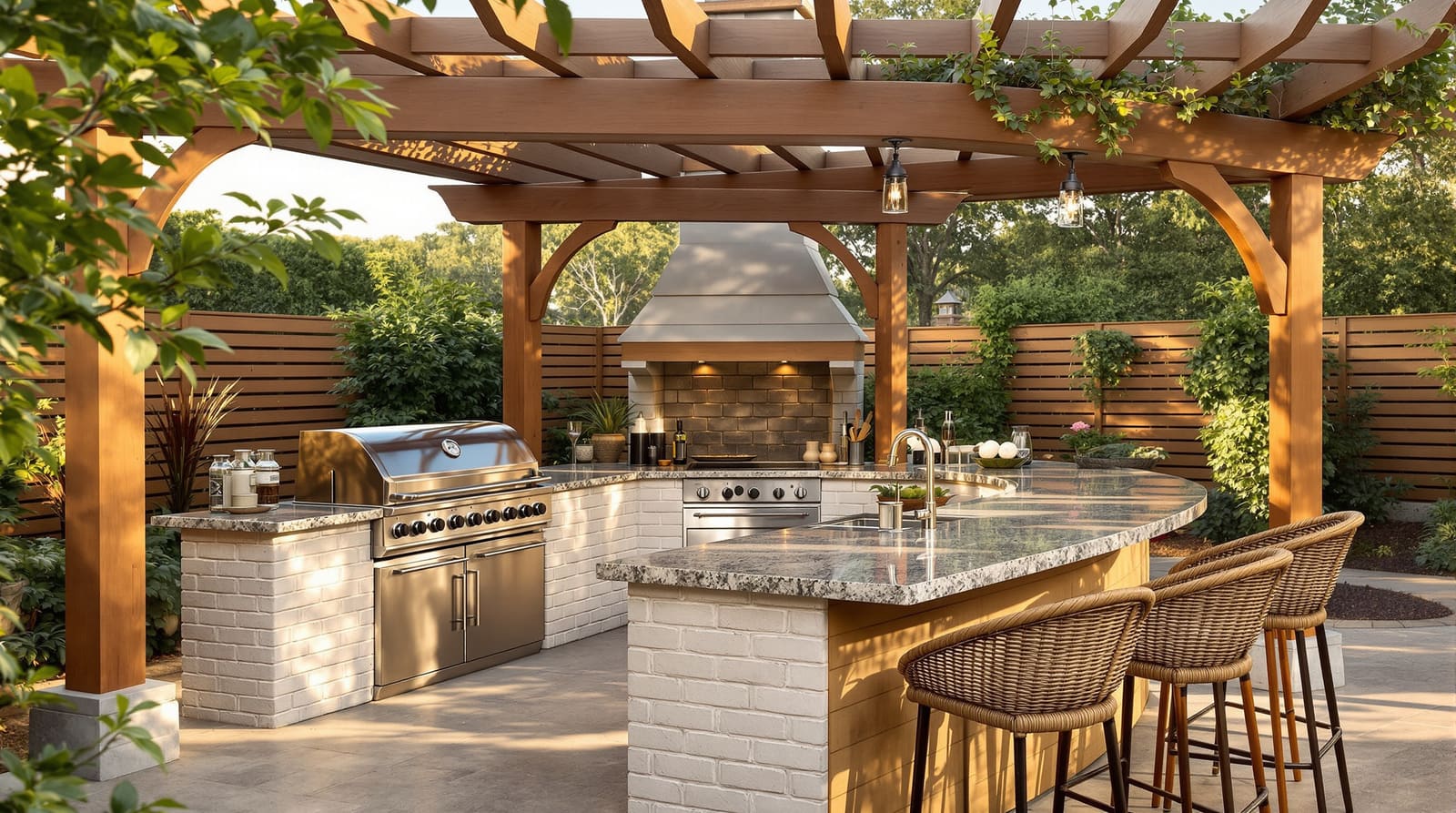
Outdoor Kitchen Design
Designing an outdoor kitchen — siting and wind, the zones and work triangle, appliances for India, weatherproof materials, the utilities to plan early, roofing and cost
An outdoor kitchen earns its keep in an Indian home the moment you stop cooking your Sunday tandoori chicken indoors — it keeps smoke, heat and char-smell out of the house while turning the terrace or backyard into the place everyone wants to be.
We Indians have always cooked in the open air. The village chulha, the roadside tandoor, the dum biryani sealed over coals, the festive degh — open-fire cooking is in our DNA. A well-planned outdoor kitchen simply brings that tradition home with proper infrastructure, so that grilling, frying and entertaining no longer fog up the curtains or set off the smoke alarm. Done right, it is one of the highest-joy additions you can make to a terrace, backyard or farmhouse. Done casually, it becomes a rusted grill under a leaking sheet that nobody touches by the second monsoon. This guide is about doing it right, India-real.
Why build an outdoor kitchen
The case is part practical, part emotional.
- Keep the mess outside. Searing, deep-frying, tadka and barbecue throw off smoke, oil aerosol and strong smells that settle into soft furnishings indoors. Cook outside and your living room stays fresh.
- Heat management. In a Hot-Dry or Warm-Humid Indian summer, an indoor hob plus oven can push the kitchen past 40°C. Moving the heat-heavy cooking outdoors keeps the house cooler and your air-conditioning bills lower.
- Entertaining is the point. The cook stays in the party instead of being exiled to the kitchen. A bar counter, some seating and a grill is a better host than any dining table.
- Our cooking suits it. Tandoor, sigri/bhatti grilling, wood-fired cooking, even a large kadai for a community fry — these want open air and are genuinely unpleasant indoors.
It is not a replacement for your main kitchen; it is a specialised entertaining and high-smoke annexe. Plan it as a companion to the indoor one, not a substitute.
Siting: get this right before you spend a rupee
Location decides whether the kitchen is used weekly or abandoned. Walk the site and weigh five factors.
1. Distance to the indoor kitchen. You will ferry ingredients, plates and forgotten salt back and forth constantly. Keep the outdoor unit within an easy, ideally covered, walk of the indoor kitchen — and on the same level if you can, so you are not carrying a tray of marinated paneer up a ladder.
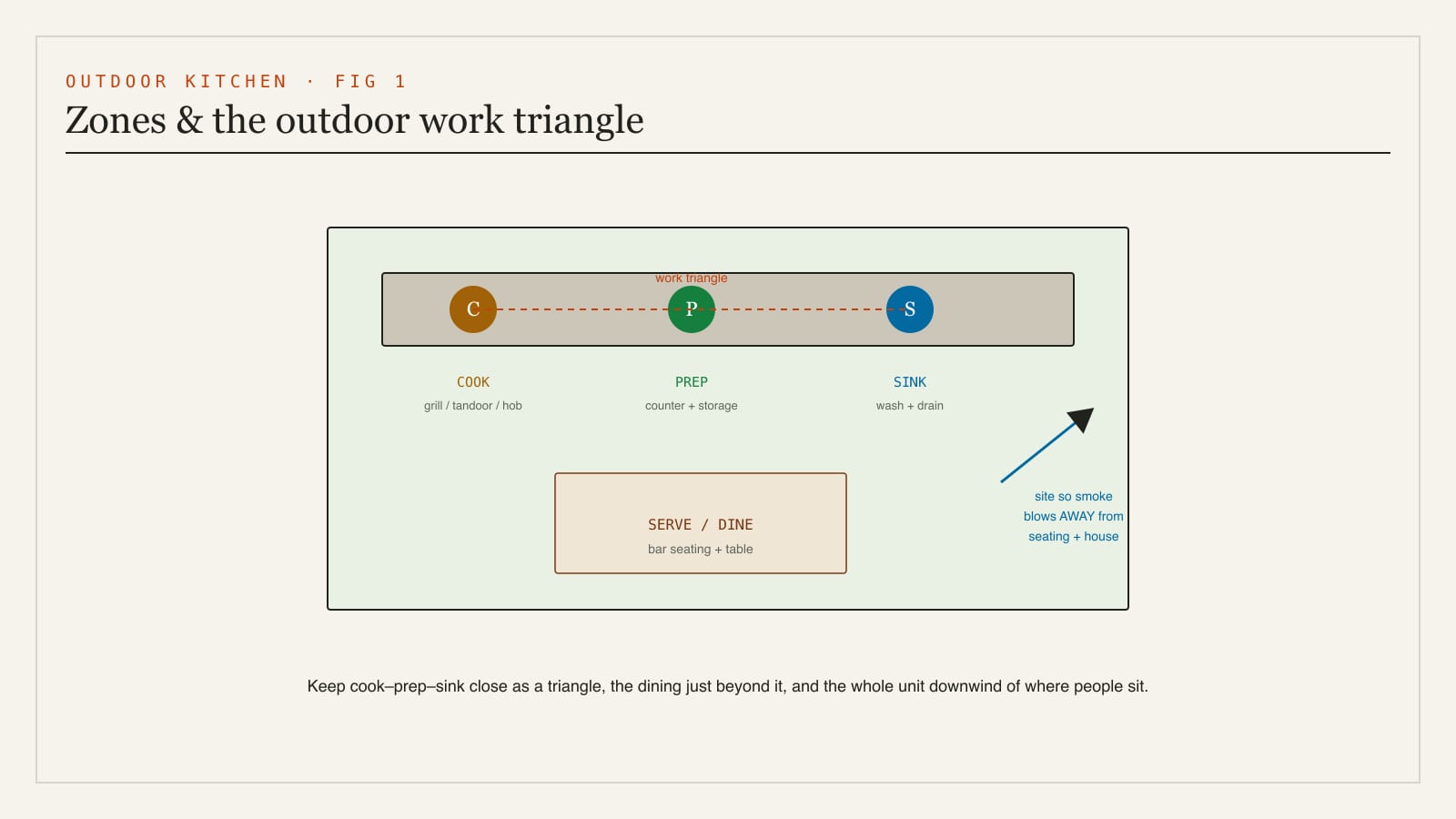
2. Wind direction — the single most-ignored rule. Smoke from a grill or tandoor must blow away from the seating and away from the house and bedroom windows. Note your site's prevailing breeze (in much of India the summer wind is south-westerly; coastal and hill sites vary). Place the cook zone downwind of the dining/lounge area. Get this wrong and every gathering ends with watering eyes and a smoky drawing room.
3. Shade and rain cover. Direct April-May sun on a steel grill and granite counter makes the whole zone unusable by 11 a.m., and an open setup is dead for four monsoon months. Plan overhead protection from day one (covered below).
4. Drainage and the slab below. Outdoor kitchens are wet zones — you will wash, drain and hose down. Site over a slab that can take a waterproofing membrane and a slope to a drain, never over an unprotected terrace waterproofing layer you don't want to disturb.
5. Views and connection. Orient the cook and the seating toward the garden, the pool or the best aspect — not toward the compound wall or the neighbour's water tank.
If you're shaping the wider space at the same time, the circulation logic in The Architecture of Pathways and the planting strategy in Backyard Design Ideas will keep the kitchen from feeling bolted-on.
Zones and the outdoor work triangle
Borrow the kitchen-design discipline of the indoor world and adapt it. An outdoor kitchen has four functional zones plus a serve/dine zone.
| Zone | What lives here | Design notes |
|---|---|---|
| Hot / cook zone | Grill, tandoor, gas burner, wood-fired oven | Downwind; non-combustible surround; min. 600 mm clear counter on the working side |
| Cold / prep zone | Chopping, marinating, plating; under-counter fridge | Largest run of counter; shaded; nearest to seating |
| Wet / sink zone | Sink, tap, drainboard, dustbin | Needs water supply + drainage; sits between prep and cook |
| Storage | Cabinets, drawers, gas-cylinder bay, utensils | Lockable, weatherproof; ventilated cylinder bay |
| Serve / dine | Bar counter, stools, dining table | Upwind of the grill; flows to lounge/garden |
The outdoor work triangle is the same principle you'd apply indoors: the cook (grill/hob), the sink and the cold/prep store should form a compact triangle with each leg roughly 1.2-2.7 m and the total perimeter under about 8 m. Keep traffic — guests reaching for drinks — out of that triangle. A common, comfortable layout is an L-shape: grill and burner on one leg, sink and prep on the other, with a bar counter forming the open serving face.
Allow generous counter: at least 600 mm of landing space beside the grill and another 900 mm or more for prep. Skimping here is the most common regret.
Appliances and features for the Indian cook
Buy for how you actually cook, not for a magazine photo. A typical Indian outdoor kitchen mixes Western barbecue with desi fire-cooking.
- Built-in barbecue / grill. The anchor. A built-in gas or charcoal grill (304-grade stainless, ideally) drops into the masonry counter. Charcoal gives the flavour Indians love; gas gives convenience. Many homeowners build a simple masonry "sigri" charcoal pit and add a gas grill alongside.
- Tandoor or bhatti. A clay tandoor (drop-in or freestanding) is the showpiece for naan, tikka and tandoori chicken. It runs hot (350-480°C) and throws heat and smoke — keep it at the downwind end with clearance from cabinets and any pergola timber.
- Gas hob / burner. A high-flame single or double burner ("bhatti" style) handles the kadai, the dum pot and the chai. This is the workhorse for anything you'd fry or simmer.
- Pizza / wood-fired oven. Optional but loved — a masonry or pre-cast wood-fired oven doubles for pizza, roasts and breads. Heavy; needs structural support and a proper flue.
- Sink. A single stainless bowl with a tap is non-negotiable for a real kitchen; for a basic BBQ counter you can run a hose to a garden tap, but a plumbed sink transforms usability.
- Under-counter fridge / cooler. A weather-tolerant beverage fridge keeps drinks and marinades close. Choose outdoor-rated; a normal indoor fridge corrodes and struggles in summer heat.
- Storage. Drawers for tools, a ventilated bay for the LPG cylinder, and a lockable cabinet for crockery you don't want to carry in and out.
Countertops and cabinets that survive outdoors
This is where outdoor kitchens are won or lost. Indoor materials fail fast outside — sun, rain, dust and temperature swings are brutal.
| Material | Use | Outdoor verdict | Indicative cost |
|---|---|---|---|
| Granite | Countertop (the Indian default) | Excellent — UV-stable, heat-tolerant, cheap and local; seal periodically | ₹120-350 per sqft (stone) |
| Stainless steel (304) | Cabinets, grill, sink, doors | Excellent if 304-grade; 202-grade rusts at the coast | ₹premium, units sold per piece |
| Masonry (brick/block, plastered + clad) | Carcass / base | Excellent — the most durable, monsoon-proof base; clad in tile or stone | Built on site, labour-led |
| Marine / WPC ply cabinets | Shutters, drawer fronts | Acceptable if marine-grade (IS 710) + laminate; WPC better near water | Marine ply ₹120-180 per sqft |
| Vitrified / ceramic tile | Cladding, splashback | Good — wipeable; use exterior-grade, anti-skid on any floor | ₹40-120 per sqft |
The reliable recipe in India: a masonry (brick or AAC-block) base carcass, plastered and clad in tile or stone, with a granite top and stainless-steel grill and doors. It shrugs off the monsoon and lasts decades. Avoid: ordinary commercial ply, MDF, particle board, indoor laminates, untreated softwood, mild-steel frames, and indoor modular-kitchen carcasses — all of these swell, delaminate or rust within a season or two outdoors. Marble is best avoided too: it etches with citrus/oil and dulls under monsoon and UV. For surfaces underfoot, follow the slip and weathering logic in the pillar Outdoor Flooring Guide.
Utilities — plan these early, not as an afterthought
The single biggest mistake is treating the outdoor kitchen as furniture rather than as a serviced room. Every utility must be designed in before the masonry goes up, because retrofitting a gas line or a drain through finished stone is painful and expensive.
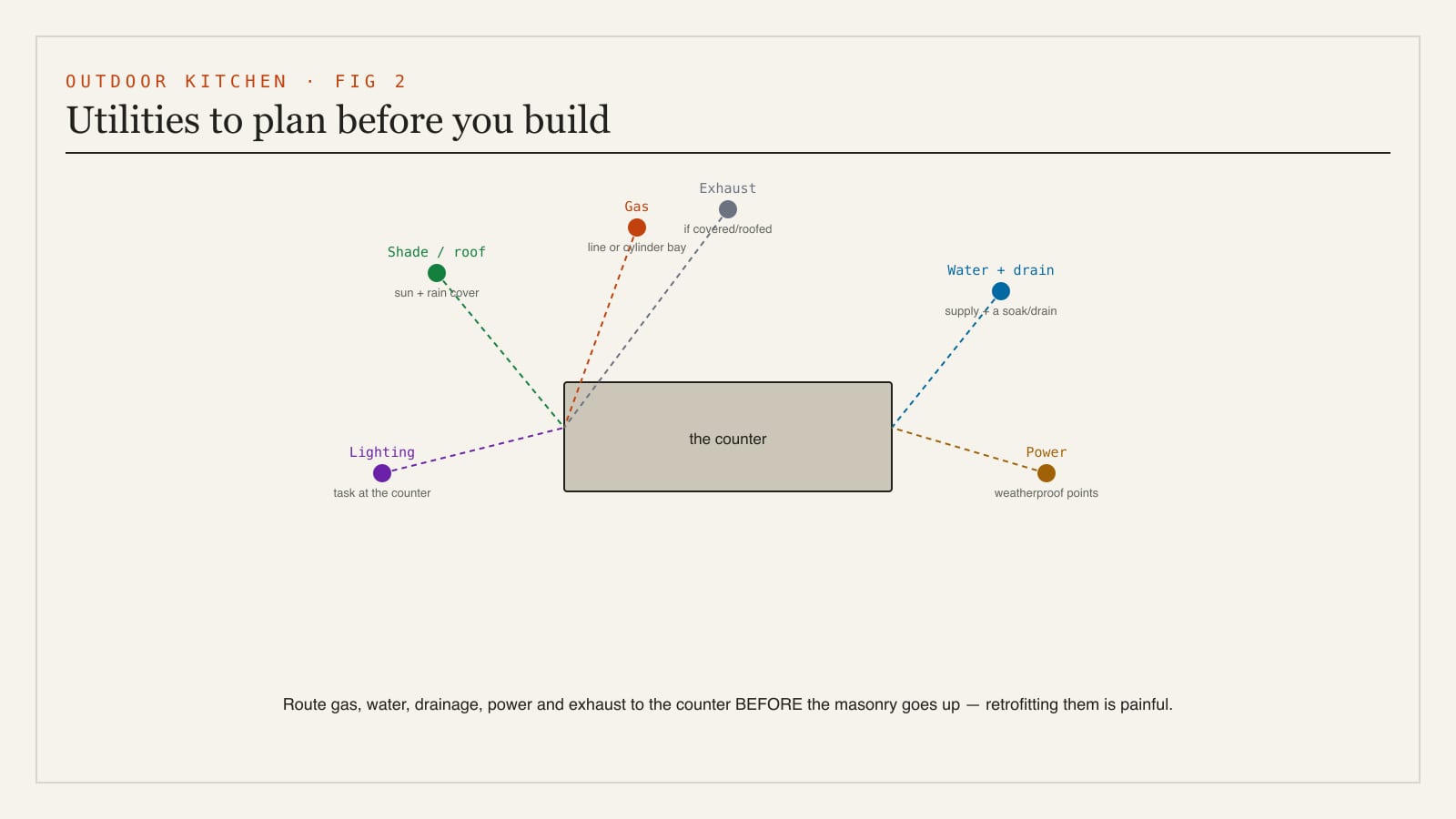
- Gas. Either a piped connection from a bank/PNG line, or a ventilated under-counter bay for a single LPG cylinder. The bay must vent at floor level (LPG is heavier than air and pools low). Use approved hoses, a regulator, and keep the cylinder away from the tandoor's heat.
- Water and drainage. Run a dedicated water line to the sink and a properly trapped waste line to the building drainage — not a pipe that dribbles onto the terrace. Slope the floor (about 1:80 to 1:100) to a drain so wash-water and rain clear quickly. Waterproof the slab beneath the whole unit.
- Power. Provide weatherproof, RCD-protected socket outlets rated at least IP55 for the fridge, lights and small appliances. All outdoor circuits must be on an earth-leakage breaker. Keep sockets out of direct splash from the sink.
- Exhaust / ventilation. An open-air kitchen self-ventilates. The moment you put a roof or pergola with a solid cover over a grill or tandoor, you must add an extraction hood and flue, or smoke and grease will collect and stain. Ensure the cook zone always has open sides or a powered hood.
- Lighting. Layer it: bright, glare-free task light over the cook and prep zones (so you can see whether the chicken is done after dark), plus warm ambient light over the seating. Use IP65 fittings and warm-white (2700-3000K) for the social glow.
Roofing, shade and weather protection
Without overhead cover, an Indian outdoor kitchen is a fair-weather toy. Your options, roughly in rising order of cost and comfort:
- Pergola with planting or a retractable canopy — handsome, lets breeze through, but offers limited rain protection. Pair with a waterproof sail or louvre.
- Motorised aluminium louvre (opening-roof) pergola — the premium choice: open for breeze and sun, close for rain. ₹650-1,400 per sqft fitted.
- Polycarbonate or toughened-glass roof on a steel/aluminium frame — full rain cover with light. Add adequate slope and good guttering for monsoon volumes.
- Solid RCC or tiled-roof "garden room" — the most permanent; effectively a covered outdoor kitchen. Demands proper extraction for any grill.
Whatever you choose, the cook zone needs either open sides or mechanical extraction, and the seating wants protection from both sun and the sudden monsoon shower. Check your local byelaws and RWA rules first — a permanent roofed structure on a terrace or in a setback can count as covered area or breach FSI and setback norms.
Maintenance and monsoon survival
- Before the monsoon: deep-clean and oil the grill grates, reseal the granite, check that all drainage runs clear, and confirm the cylinder bay and electricals are dry and protected.
- During: keep the grill and any movable appliances under breathable covers (not airtight plastic, which traps condensation and breeds rust). Run the sink tap occasionally so traps don't dry out and let smells back up.
- Year-round: wipe stainless steel with a soft cloth — never steel wool, which scratches the passive layer and starts rust. Treat any timber pergola annually. Empty and clean charcoal ash so it doesn't hold moisture against the steel.
- Pests: keep food storage sealed; ants, squirrels and crows are enthusiastic guests at an outdoor kitchen.
What it costs
Costs swing enormously with whether you build a simple counter or a full serviced kitchen. Indicative all-in ranges for a metro/Tier-1 build:
| Tier | What you get | Indicative cost |
|---|---|---|
| Basic BBQ counter | Masonry counter, granite top, drop-in charcoal grill, hose-fed | ₹40,000-90,000 |
| Mid outdoor kitchen | L-shaped masonry units, granite, gas grill + burner, plumbed sink, storage, basic pergola | ₹1.5-4 lakh |
| Full outdoor kitchen | Add tandoor/wood-fired oven, 304-SS doors, under-counter fridge, louvre roof, layered lighting, full utilities | ₹5-12 lakh+ |
Spend first on the things you can't easily change later — the slab, waterproofing, gas, water, drainage and the masonry base. You can upgrade the grill or add a fridge any time; you cannot easily add a drain under a finished stone counter. For how an outdoor kitchen fits within a whole-garden budget, see the Landscape Cost Guide, and if wellness and quiet zones are also on your wishlist, Outdoor Wellness Spaces shows how to balance the active and the calm.
The bottom line
An outdoor kitchen is the rare home upgrade that pays back in pure pleasure. Get the siting right — close to the indoor kitchen, smoke blowing away from your guests, shaded and drained. Plan the four zones and the work triangle. Use granite, stainless steel and masonry, never indoor materials. Run the gas, water, drainage, power and lighting in before the stone goes down. Cover it for the monsoon. Do that, and you'll be hosting tandoori evenings on the terrace for the next twenty years.
References & further reading
- National Building Code of India (NBC) 2016, Part 10 — Landscape Development, Signs and Outdoor Display Structures, Bureau of Indian Standards — guidance on outdoor structures, paving and site development.
- NBC 2016, Part 8 (Building Services) and Part 9 (Plumbing Services), BIS — for outdoor water supply, drainage and electrical service planning.
- IS 710: Marine Plywood, Bureau of Indian Standards — the standard to specify for any plywood used in wet/outdoor cabinetry.
- IS 4985 / IS 1239 (UPVC and GI pipes) and IS 3043: Code of Practice for Earthing, BIS — for safe outdoor plumbing and electrical earthing/RCD protection.
- Liquefied Petroleum Gas (Regulation of Supply and Distribution) guidance, PESO / Petroleum and Explosives Safety Organisation — for safe LPG cylinder storage, ventilation and clearances.
- Time-Saver Standards for Landscape Architecture (Harris & Dines) — recognised reference for outdoor zoning, grading and drainage principles.
Export this guide
Related Guides — Deep-dive reading
Bathroom Planning for New Homes in India: Get It Right Before You Build
The bathroom decisions you cannot undo once the slab is cast — location and stacking, sunken vs non-sunken slabs, waterproofing, and the plumbing, electrical and ventilation you must coordinate with the civil work, stage by stage.
BathroomsDining Room Door in India: Best Partition & Opening Choices (2026)
How to choose the right door for the dining area of an Indian home - kitchen-dining partitions that trap cooking smells and smoke while keeping flow, plus open dining-to-living and dining-to-garden options - ranked picks, drivers and indicative costs.
Home Doors & EntrancesRoof Access & Walkways
Someone will need to get onto your roof several times a year — to clear a drain, service the tank, wash the solar panels, check the waterproofing. Access designed into the house is far safer and cheaper than a ladder propped against a wall. This guide covers the ways up (mumty stairs, fixed ladders, hatches, loft ladders), the ways around (walkways and duckboards over fragile or waterproofed surfaces), and the guardrails and anchor points that make maintenance safe.
RoofingRelated Tools — Try Free
Cross-Ventilation Analyzer
Estimate airflow and air changes per hour (ACH) from room size, window areas, layout, and local wind — with NBC 2016 Part 8 compliance check.
Ventilation CalculatorMonsoon-Readiness Checklist
Pre-rain home audit across 9 categories — terrace, drains, waterproofing, electrical, HVAC, pest, vehicles, documents.
Seasonal AuditWindow Maintenance Cost Calculator
Estimate annual window upkeep by frame material — yearly, per-window and 5-year cost.
Window Calculator