
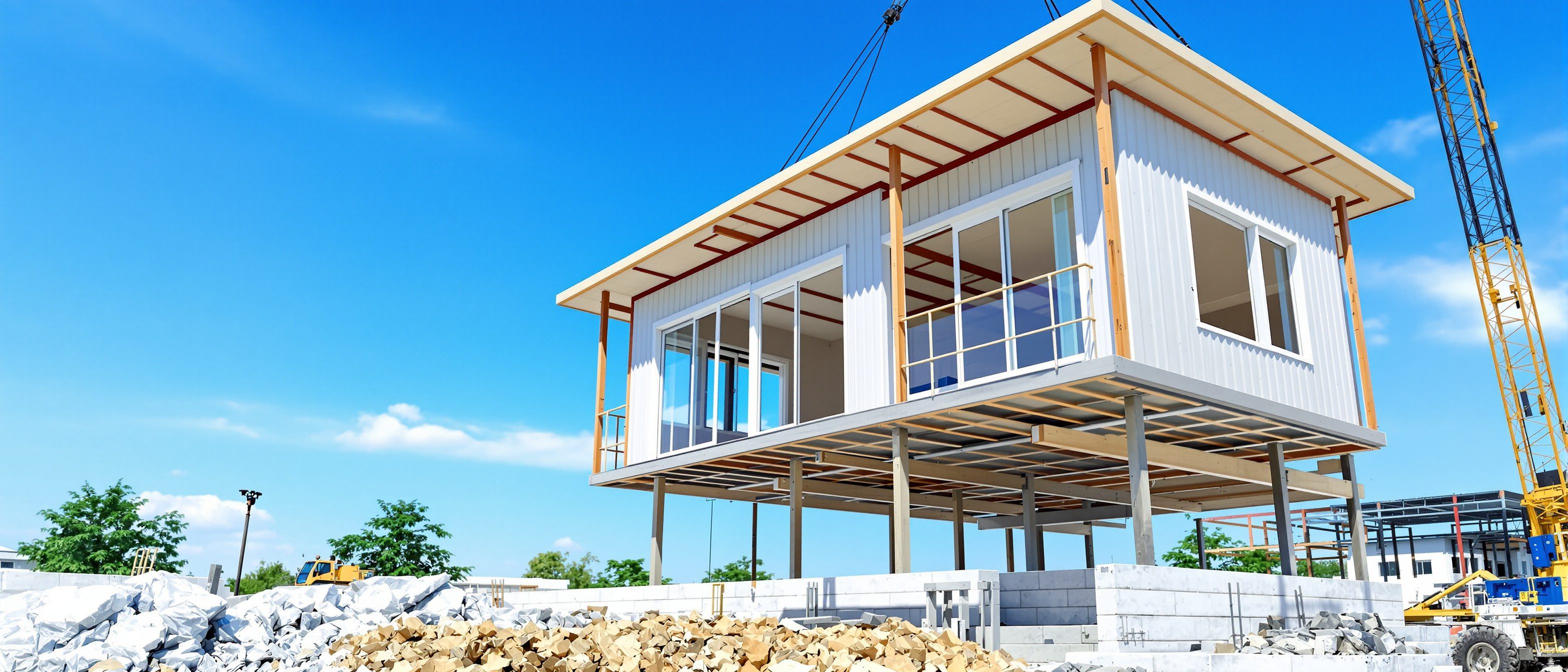
Modular & Prefab Homes in India: An Honest Guide
What prefab, precast, LGSF and 3D-printing really mean for an Indian home — the speed, the trade-offs, and where they actually make sense.
Walk past almost any plot in India where a house is going up and the scene is the same: a tangle of bamboo scaffolding, a heap of river sand curing in the sun, a slab being poured by hand, and a board outside promising possession that everyone privately knows will slip by six months. We have built homes this way — brick by brick, on the wet plot, in the open — for so long that it feels like the only way. It isn't.
Somewhere else, in a covered shed with a level floor and no monsoon overhead, a different version of your house can be taking shape at the same time your foundation is being dug. Steel frames or concrete panels are made to the millimetre, wiring and insulation tucked in, quality checked under a roof, and then trucked to your site and bolted together in days. This is prefabrication, and after decades of being the stuff of site offices and labour quarters, it is quietly becoming a serious option for the Indian home.
But it arrives wrapped in heavy marketing — "build your dream home in 30 days," "50% cheaper," "the future of construction." Some of that is true. A lot of it is not, or not yet, or not for your particular plot. The honest picture is more interesting than the brochure.
Prefab is not a magic discount or a guaranteed time machine; it is a different way of organising construction — moving work off the messy site into a controlled factory — and it pays off brilliantly in some situations and poorly in others, so the real skill is knowing which one you are in.
1. The words, demystified — prefab, precast, modular, LGSF, PEB, 3D-print
The single biggest source of confusion is that "prefab" is an umbrella, not a product. Under it sit several quite different technologies, and a salesperson saying "prefab" could mean any of them. Here is what each actually is.
- Prefabrication is just the umbrella idea: making building parts somewhere other than the final site. Everything below is a flavour of it.
- Panelised construction ships flat parts — wall panels, floor cassettes, roof trusses — that get stood up and joined on site. It packs efficiently onto a truck and suits a wide range of designs.
- Volumetric (modular) construction ships whole three-dimensional boxes — a finished bathroom pod, a complete room — that get stacked and connected like LEGO. Fastest on site, but the boxes are bulky to transport and the design has to fit a grid of module sizes.
- LGSF (Light-Gauge Steel Framing) uses thin, cold-rolled, often galvanised steel sections as the skeleton, in place of an RCC frame or load-bearing brick. The frame is light, made to precise drawings, erected fast, and clad with boards and insulation. It is the most mature "modern" prefab system for homes in India.
- Precast concrete casts elements — walls, slabs, staircases, columns — in a factory mould, cures them properly, and lifts them into place. Strong, fire-resistant, familiar to Indian engineers, but heavy: it needs cranes and good road access.
- PEB (Pre-Engineered Buildings) are steel-portal-frame structures — the warehouses, factories and showrooms you see along highways. PEB is rarely the right system for a normal home, but the term gets thrown around, so know that it belongs to large clear-span buildings, not bedrooms.
- 3D-printed concrete extrudes a special concrete mix layer by layer from a robotic nozzle, building walls directly without conventional shuttering. In India it is real but still early — pilot houses and a handful of buildings, not a mainstream home option yet.
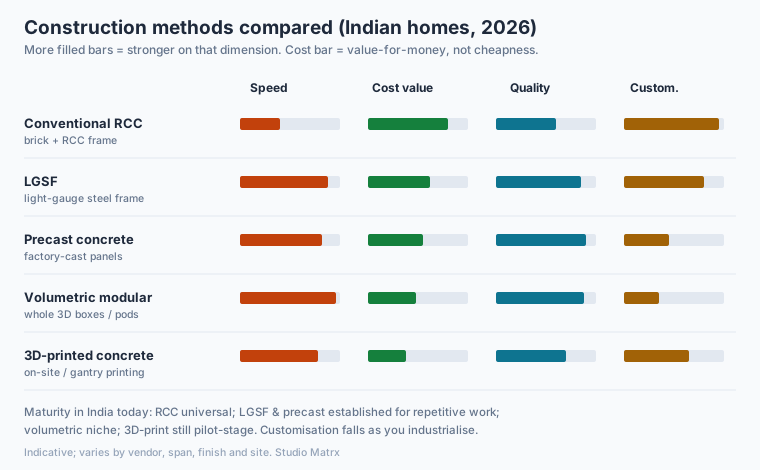
Figure 1: The five methods score very differently. The more you industrialise (towards volumetric and 3D-print), the faster and more consistent the build — but the harder it becomes to customise late, and the smaller the proven Indian track record.
This guide is about the method of construction. If you want the step-by-step journey of an ordinary build — approvals, slab, brickwork, finishing — that lives in the complete guide to building a house in India. If your question is which materials to specify, see modern construction materials for Indian homes. Here we stay on the question of how the structure gets made.
2. India's honest status report, system by system
Marketing collapses these into one shiny "prefab" promise. The reality in 2026 is uneven.
| System | Maturity in India today | Best fit | Watch out for |
|---|---|---|---|
| LGSF | Established; many vendors, growing | Extra floors, farmhouses, fast 1–2 storey homes | Frame quality, corrosion protection, fire-board spec |
| Precast | Mature for repetitive / large projects | Townships, repetitive housing, boundary work | Crane access, joint detailing, heavy transport |
| Panelised (boards) | Common, varied quality | Quick builds, additions, remote sites | Thermal & acoustic spec, waterproofing at joints |
| Volumetric modular | Niche; few serious players | Hotels, hostels, repetitive units, site offices | Module size limits, transport, low customisation |
| 3D-printed concrete | Pilot stage | Demonstration, future affordable housing | Codes still catching up; very few finished homes |
A grounding fact for the 3D-print hype: India's first 3D-printed house was a roughly 600 sq ft single-storey unit built by Tvasta, an IIT-Madras startup, on the IIT campus — printed in a matter of days and inaugurated in 2021. It is a genuine engineering milestone, and the sector has grown since. But "a few landmark buildings" is a very different thing from "a system you can reliably hire to print your three-bedroom house in a tier-2 town next year." Treat 3D-printing as a thrilling preview, not a 2026 procurement option.
A useful rule when a vendor quotes you a "prefab" price: ask which of these six systems they are actually selling, and ask to visit a finished home built with it that is at least two monsoons old. A method with no weathered, lived-in local example is a method you are beta-testing on your own savings.
3. The real trade-offs versus brick-and-RCC
Conventional Indian construction — load-bearing brick or an RCC frame with brick infill — is the benchmark every prefab pitch is measured against. It has one enormous advantage: every engineer, contractor, mason, bank, valuer and neighbour understands it. Prefab has to beat that familiarity. Here is the honest scorecard.
Speed — real, but measure the right thing. Prefab's headline is speed, and it is true for the structure and envelope: a small LGSF or panelised home can be weather-tight in 45–120 days where an equivalent RCC build takes 8–18 months. The catch is that finishes — flooring, kitchen, paint, joinery — still take their own time and aren't magically faster. So "30-day home" usually means the shell, not your move-in date.
Quality consistency — prefab's quietest, strongest argument. A wall cast or framed in a factory, under a roof, on a flat floor, by the same crew every day, is simply more consistent than one built by a rotating site labour force in the rain. Less honeycombing, straighter walls, fewer surprises. This is the benefit that doesn't fit on a banner but matters most over twenty years.
Cost — comparable, not magic. This is where brochures oversell hardest. Quality prefab is usually in the same band as good RCC, not dramatically cheaper. Indicative finished prefab home costs in India in 2026 run roughly ₹1,800–₹3,500 per sq ft depending on system, finish and site, with basic residential builds nearer ₹1,200–₹2,500. Good RCC sits in a similar range. Prefab's saving is mostly in time (less interest paid, faster occupation, earlier rent), not a slashed headline number.
Customisation — falls as you industrialise. Panelised and LGSF systems are fairly flexible. Volumetric modular forces your design onto a grid of box sizes. The more factory-made the system, the less you can change your mind once production starts — late changes are expensive or impossible.
Finance, resale, logistics, joints — the four things nobody mentions in the pitch. We give each its own section below, because each can quietly sink an otherwise sensible prefab decision.
4. Off-site, transport, on-site — and where time actually disappears
Understanding why prefab is faster also reveals its main constraint. The work splits into three stages.
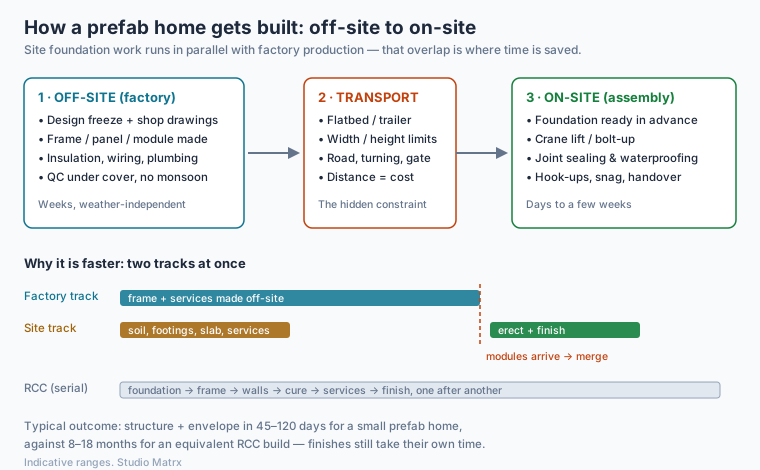
Figure 2: The time saving comes from running two tracks at once — your foundation is dug on site while your walls are made in the factory — then merging them. Conventional RCC does everything in series, one step waiting on the last.
The saving is not magic; it is parallelism. In an RCC build, the frame waits for the foundation, the walls wait for the frame, the curing waits for the pour, and the services wait for the walls — a long single file. In prefab, the factory builds your superstructure while site crews prepare the ground, and the two halves meet. That overlap, plus weather-independent factory work, is the whole trick.
The constraint hiding in the middle is transport. A volumetric module is a box several metres wide and tall; it has to clear road widths, low cables, narrow lanes, your society gate and a turning circle, and often needs a crane with room to swing. For a tight urban plot down a 3-metre lane, that alone can rule out big modules. Panelised and LGSF parts pack flatter and travel more easily — one reason they dominate the Indian home market while true volumetric stays niche. And every kilometre between factory and site adds cost, so prefab economics improve the closer you are to the manufacturer.
5. Where prefab genuinely makes sense in India today
Strip away the hype and a clear shortlist emerges of situations where off-site building is not just viable but often the better choice.
- Adding a floor to an existing house. This is prefab's sweet spot. LGSF is light, so a new top floor adds far less load than a brick-and-RCC storey — sometimes the difference between needing to strengthen the existing structure and not. The build is fast and disrupts the family below far less.
- Farmhouses and weekend homes. Often on the city's edge with road access, less fussy society approval, and an owner who values a quick, clean, low-maintenance build over deep customisation.
- Fast builds against a deadline. A rental block you want earning quickly, staff housing, a home you must occupy before a posting or a school year.
- Repetitive housing. Several identical units — a small layout of plots, township housing — where the factory's repetition advantage compounds.
- Remote or difficult sites. Hills, islands, sites where skilled site labour is scarce or material delivery is brutal. Making the home elsewhere and shipping it can beat fighting the site.
And where it usually doesn't make sense yet: a one-off, highly customised dream home on a cramped urban plot down a narrow lane, where you want to change details as you go, where transport is hard, and where local resale buyers and valuers expect familiar RCC. In that case conventional construction, done well, is often the calmer choice.
This maps neatly onto the cluster's bigger idea. If your family is likely to grow — a floor for a married child, a rentable unit later — designing now for a future LGSF addition is a textbook provision: stub the structure and services so the future floor is a clean add-on, not a demolition. That logic runs right through designing flexible homes for changing families and the cluster pillar, designing Indian homes for 2040.
6. Durability, seismic and climate performance
The instinctive worry — "a steel-and-board house can't be as solid as brick and concrete" — deserves a straight answer.
Structural and seismic. Lightness is actually a seismic advantage: earthquake force is proportional to mass, so a lighter LGSF home attracts smaller forces than a heavy masonry one, and well-engineered steel framing is ductile (it bends before it breaks). A properly designed prefab home, signed off by a structural engineer to Indian codes, is not a compromise on safety. The phrase doing the work there is "properly designed" — the risk in prefab is rarely the concept and almost always poor execution by a cut-price vendor.
Climate. A factory wall can hold far more insulation than a bare brick wall, which is a real comfort and energy advantage in our climate extremes — done right, prefab dovetails with the thinking in naturally energy-efficient Indian homes and passive design for India's climate zones. The flip sides to specify hard: lightweight walls can transmit sound and heat more readily if cheaply built, so insist on proper acoustic and thermal layers; and steel must be galvanised and detailed against our humidity and coastal salt to avoid corrosion. Brick has thermal mass that steel lacks — solvable with insulation and design, but only if you ask for it.
The recurring theme: prefab's performance is a specification question, not a category question. A well-specified LGSF home outperforms a sloppy brick one and vice versa. Read the spec sheet, not the brochure.
7. Joints, waterproofing and the maintenance truth
If there is one technical place prefab earns its bad stories, it is joints. A conventional wall is more or less monolithic; a prefab wall is an assembly of panels, and every panel-to-panel and panel-to-floor junction is a potential path for water, air and sound. In Indian monsoon conditions, a badly sealed joint is not a cosmetic issue — it is the leak that stains your ceiling every July.
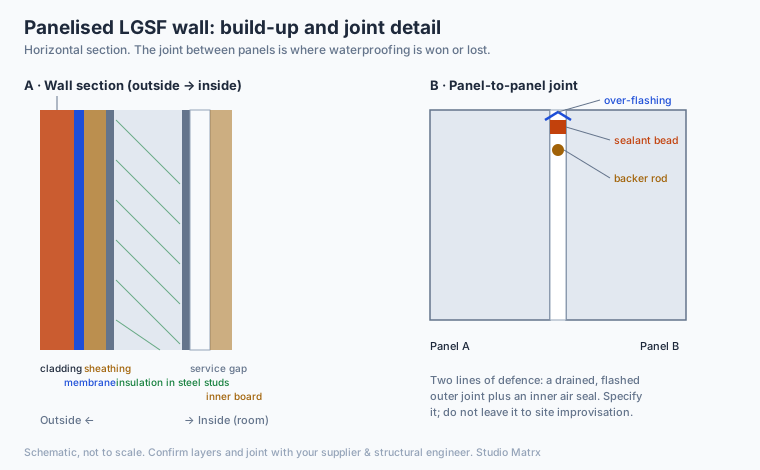
Figure 3: A good prefab wall is a deliberate sandwich — cladding, weather membrane, sheathing, insulated steel studs, a service gap, inner board — and the panel joint gets two lines of defence: a flashed, drained outer joint plus an inner air seal. Specify this; never leave it to on-site improvisation.
The practical takeaways:
- Ask your vendor for the joint detail drawing and the waterproofing system, in writing, before signing. A vendor who can't produce one is winging it.
- Insist on a weather-resistant membrane behind the cladding and proper flashing over openings and joints, exactly as in Figure 3.
- Get the warranty in writing — on the structure, and separately on water-tightness — and check who honours it if the vendor disappears.
- Budget for periodic joint and sealant maintenance; sealants age, and a prefab home rewards inspection every few years far more than a forgiving brick wall does.
None of this is a reason to avoid prefab. It is a reason to choose a serious vendor and a documented joint system over the cheapest quote.
8. Approvals, lending and resale — the paperwork reality
This is where a sound technical choice meets an Indian system still built around RCC, and it catches people out.
Approvals. Municipal sanction processes, FSI, setbacks and structural sign-off were written with conventional construction in mind. Your prefab home still needs the same municipal sanction and a structural engineer's certification — prefab does not exempt you from approvals. Some authorities and society/RWA committees are unfamiliar with LGSF or modular and ask more questions; build in time for that conversation, and keep your structural drawings and code-compliance papers ready.
Lending — the big one. Home loans in India are sized off a valuer's assessment, and many valuers and banks are most comfortable with familiar RCC. A prefab or LGSF home can attract more scrutiny, a conservative valuation, or stage-wise disbursal that doesn't match a factory's payment schedule (the factory may want money before anything stands on your site, while the bank wants to release funds as visible work rises). This mismatch is real and worth solving up front: talk to your lender early, pick a vendor who has financed projects with that bank before, and model the cash-flow gap. Use the EMI calculator to test how a faster build — and earlier occupation or rent — changes the interest you actually pay over the loan, which is often where prefab's true saving sits.
Resale perception. Indian resale buyers still largely expect RCC, and an unfamiliar method can mean a thinner buyer pool or harder negotiation, especially in conservative markets. This is changing, and a well-built, well-documented prefab home with warranties shows beautifully — but factor it in if resale matters to you. The broader resale logic is covered in the cluster's future resale value guide.
9. Costing it honestly before you commit
Because prefab's pitch is so often a number, do your own number. The trap is comparing a prefab shell quote against a fully finished RCC house, or ignoring transport, crane, foundation and finishing.
| Line item | Conventional RCC | LGSF / panelised prefab |
|---|---|---|
| Structure + envelope | ₹/sq ft, included | ₹/sq ft, factory quote — confirm what's in it |
| Foundation | Standard footings/raft | Often lighter, but still site-built |
| Transport & crane | Negligible | Real cost; grows with distance & module size |
| Finishes (floor, kitchen, paint) | Site, your pace | Site, your pace — not faster |
| Time to occupy | 8–18 months | 3–6 months for shell + finishing |
| Interest paid during build | Higher (longer) | Lower (shorter) — model this |
| Joint/sealant upkeep | Low | Periodic — budget for it |
The honest provisioning question across the cluster — what does it cost to provide for this now versus retrofit it later — applies here too. If you are even considering a future LGSF floor or a rentable add-on, designing the foundation and stub services for it now costs little; discovering later that your structure can't take the addition costs a teardown. Build your apples-to-apples comparison with the cost calculator, price both routes to the same finished standard, and judge them on total cost-to-occupy, not on a tempting shell figure.
10. The 2026 → 2040 trajectory: why industrialised construction is coming
Step back from your single plot and the direction is clear. Construction is one of the last big industries still mostly hand-made on the open ground, in the weather, with enormous waste and wildly variable quality. Almost every other industry — cars, electronics, furniture — moved into the factory decades ago because factories deliver precision, speed and consistency that a wet site never can. Building is now, slowly, making the same move.
For India the pressures are specific and strong: a vast housing need, rising labour costs and shrinking skilled-labour availability on site, growing demand for energy-efficient envelopes (which factory walls do better), and government and industry interest in faster, less wasteful methods. None of that means brick-and-RCC vanishes by 2040 — it won't, and for many one-off homes it will stay the sensible choice. But the share built off-site, especially repetitive housing and additions, will keep climbing, banks and valuers will catch up, and the methods that feel exotic in 2026 will feel ordinary.
For you, building today, the practical posture is neither hype nor dismissal. It is to know the six systems, match the method honestly to your situation, choose a serious vendor over a cheap one, nail the joints and the financing, and — true to this whole cluster — provision now for the additions a future-ready home will want, whether you build the rest of it in brick today or steel tomorrow.
Sources & further reading
- Bureau of Indian Standards (BIS) — IS 800 (steel structures, relevant to LGSF/PEB), IS 456 (plain & reinforced concrete, relevant to precast), IS 1893 (seismic design) and IS 875 (loads). bis.gov.in
- National Building Code of India (NBC 2016), BIS — structural safety, fire and life-safety provisions that apply to prefab and conventional homes alike.
- Ministry of Housing & Urban Affairs / BMTPC — Building Materials & Technology Promotion Council, performance appraisal certificates (PACs) for emerging construction systems including LGSF and modular technologies. bmtpc.org
- Eco Niwas Samhita / Bureau of Energy Efficiency (BEE) — residential building energy-conservation code, relevant when specifying insulated prefab envelopes. beeindia.gov.in
- RERA (Real Estate Regulation Act) — registration and disclosure obligations where prefab is used in projects for sale; see the RERA guide.
- Tvasta / IIT Madras — India's first 3D-printed house (~600 sq ft, IIT Madras campus, inaugurated 2021), a reference point for the current maturity of 3D-printed concrete in India.
- Reputable Indian LGSF and precast manufacturers' published technical and pricing material (2026), used for indicative cost and timeline ranges — always re-confirm against live quotes for your site.
Pairs with the cluster pillar, designing homes for 2040 in India, and its siblings on flexible homes for changing families and future resale value.
Export this guide
Related Guides — Deep-dive reading
How to Choose a Security System (2026): The Master Buying Guide for Indian Homes and Buildings
The mental model that ties the whole buying decision together: start from your own risk, not a product; build the layers your situation actually needs; make the big architecture choices (wired vs wireless, local vs cloud, DIY vs professional); tell real product quality from marketing; and choose a vendor you can trust.
SecurityDesigning a Naturally Energy-Efficient Indian Home
Comfort first, gadgets last — passive design, orientation, insulation, ventilation and the climate wisdom that cuts Indian energy bills
SustainabilityHow to Choose a Bathtub in India: Size, Material, Fit & Budget (2026 Buyer's Guide)
A buyer's decision guide to picking a bathtub for an Indian home — the first checks on bathroom size, floor load and geyser capacity, freestanding vs built-in vs corner by space, acrylic vs cast iron vs FRP, whether a whirlpool is worth it, good/better/best rupee tiers, delivery and install, warranty, and how to spot thin flexing acrylic.
BathroomsRelated Tools — Try Free
Cross-Ventilation Analyzer
Estimate airflow and air changes per hour (ACH) from room size, window areas, layout, and local wind — with NBC 2016 Part 8 compliance check.
Ventilation CalculatorBefore vs After — Cost Reality Check
Compare what you expected to pay vs what you actually paid, category by category.
Reality CheckMaterial Schedule Generator
Generate a room-wise finish schedule — walls, floors, ceilings, trim, and joinery by location.
Material Schedule