
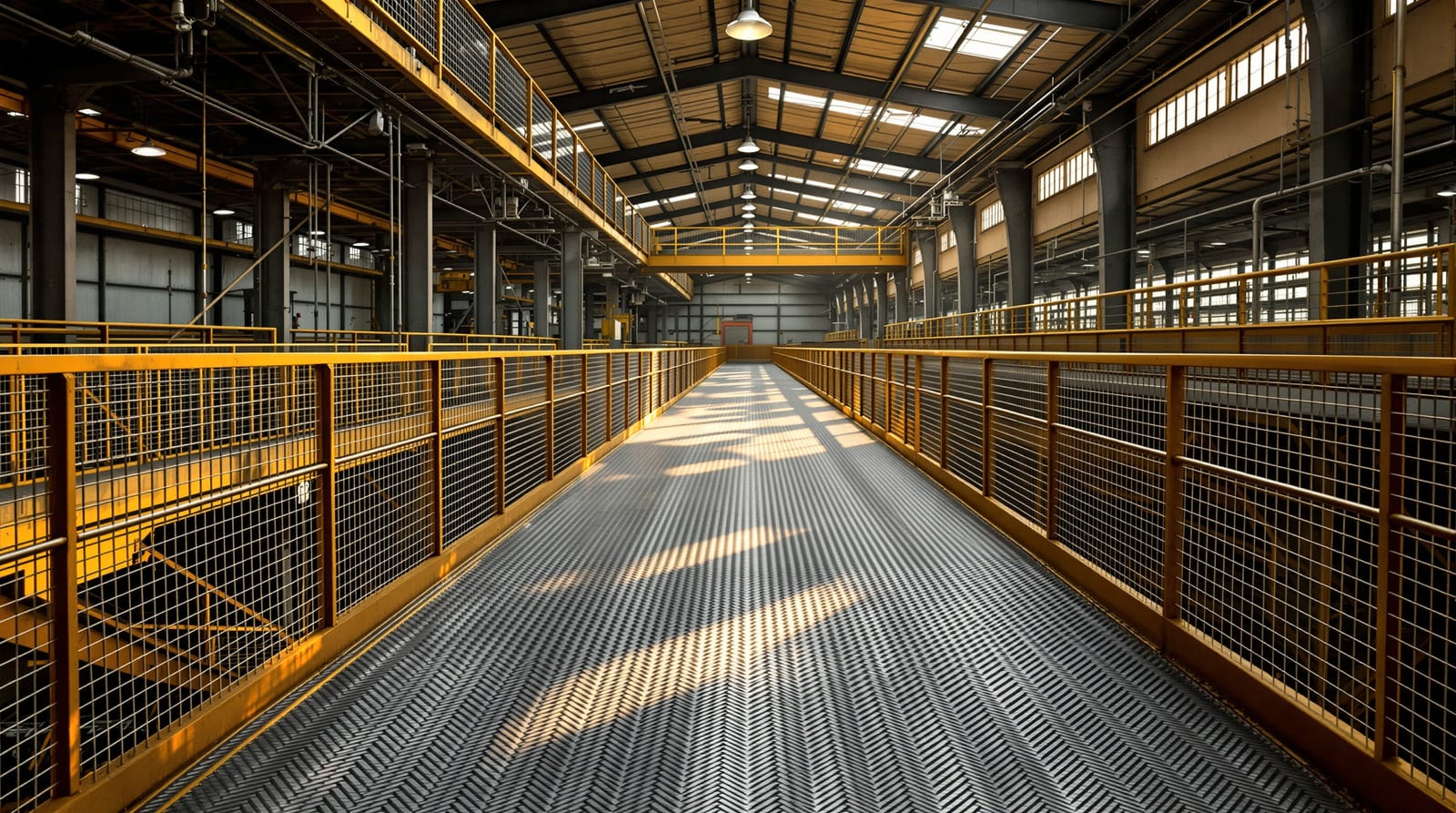
Metal Flooring in India: Chequered Plate, Gratings & Tread Plate Guide (2026)
Steel and aluminium chequered plate, open gratings, perforated and expanded-metal floors for mezzanines, walkways, lofts and heavy-duty wet areas — types, anti-skid patterns, load, corrosion and ₹/sq ft.
Metal flooring is the floor you walk on when the ground below has to breathe, drain, carry forklifts, or simply isn't there. It is the chequered steel plate of a factory mezzanine, the open galvanised grating of a plant-room walkway, the aluminium tread plate on a stair, and — increasingly — the deliberately raw, industrial-chic accent in a loft, café or studio. Unlike almost every other floor in this cluster, metal is structural and decorative at once: it spans, it carries load, and it shrugs off water, fire and abrasion that would destroy tile, wood or vinyl. This guide covers the real Indian market — types, anti-skid patterns, load and span, corrosion, costs and care.
Where metal flooring actually belongs
Metal floors are specialist floors. You choose them for one of a handful of reasons, and outside those reasons a tiled or screed floor is cheaper and quieter. The honest use-cases in India are:
- Mezzanines and structural floors — a steel platform inside a warehouse or shed where pouring a concrete slab is impossible or too heavy. Chequered plate or grating sits directly on the steel framing as the walking surface.
- Industrial walkways, gantries and platforms — access routes over machinery, tank tops, pipe racks and rooftop plant. Open gratings here let rain and washdown water fall straight through.
- Stair treads and landings — chequered or grating treads on industrial steel staircases; far more durable and slip-aware than tiled treads in a wet plant.
- Wet and drainage-heavy zones — wash bays, dairy and food floors, fish/poultry processing, areas hosed down constantly, where you want water to leave the walking surface instantly. Gratings excel here.
- Lofts and industrial-chic interiors — exposed steel-plate accent floors, riveted mezzanine landings, perforated screens-as-floors in cafés, studios, retail and converted-warehouse homes.
- Plant rooms, lift pits, trench covers and drainage gratings — small functional floors where removability and water passage matter.
If your floor is a normal dry interior, metal is overkill and acoustically punishing. For everything else here, look first at the specialty flooring guide to place metal against seamless, resilient, paving and technical options, and at industrial flooring when the answer is actually a heavy-duty concrete topping rather than a steel deck.
The four metal floor types
1. Chequered (chequer / tread) plate
Solid steel or aluminium plate rolled with a raised pattern — the classic teardrop, diamond or two-bar/five-bar relief — for anti-skid grip. This is the workhorse: a continuous, watertight, walkable surface that also spans short distances between supports.
- MS (mild steel) chequered plate — the default and cheapest. Supplied raw, then painted, hot-dip galvanised or epoxy-coated for corrosion. Common thicknesses 3, 4, 5, 6, 8, 10 and 12 mm (the quoted thickness is the base plate; the pattern adds ~1-2 mm on top).
- SS (stainless steel) chequered plate — 304 or 316 grade for permanently wet, hygienic or corrosive areas (food, pharma, coastal). Expensive but maintenance-free.
- Aluminium tread plate — light, naturally corrosion-resistant, bright finish. Favoured for interiors, ramps, vehicle bodies, transit and decorative loft floors. Softer and lower load than steel, so used over closer supports.
2. Open gratings
A grid of load-bearing flat bars (bearing bars) connected by cross bars or twisted square rods, leaving open gaps. The point is that everything passes through — water, light, small debris, air.
- MS / galvanised steel gratings — press-locked or welded; the standard for walkways, platforms, drain covers and trench covers. Almost always hot-dip galvanised (GI) for outdoor and wet use.
- Serrated gratings — bearing-bar tops are notched into teeth for extra grip in oily or wet plant areas.
- FRP gratings (a non-metal cousin worth knowing) — moulded fibreglass grating used where metal would corrode badly (effluent plants, chemical floors, coastal jetties); non-conductive and rust-proof but outside the scope of true metal flooring.
3. Perforated metal
Sheet punched with round, square or slotted holes. Lighter than solid plate, partially open (drains and ventilates), and visually refined — so it crosses over into industrial-chic interiors, mezzanine infill and screen-floors. Lower load than chequered plate of the same thickness because the holes remove material.
4. Expanded metal
A sheet slit and stretched into a diamond mesh — no waste, integral strength, strong anti-skid texture. Used for walkways, security/grip floors, treads and rugged industrial mezzanine decks. Flattened expanded metal gives a smoother top; standard (raised) expanded metal is grippier underfoot.
Type, use and cost table
Costs are indicative material-plus-fabrication ranges for 2026 and vary by city, steel price, thickness, grade and coating; supply-and-fix with steel framing, cutting, drilling and welding pushes the upper figures higher. Add 18% GST. Steel is a commodity, so always re-quote against the current MS/SS rate.
| Metal floor type | Best use | Anti-skid | Corrosion handling | Indicative ₹/sq ft |
|---|---|---|---|---|
| MS chequered plate (painted) | Dry mezzanines, lofts, interior platforms | Raised pattern | Paint / epoxy coat | 200-400 |
| MS chequered plate (hot-dip galvanised) | Outdoor/wet walkways, terraces, ramps | Raised pattern | GI coating | 300-550 |
| SS 304/316 chequered plate | Food, pharma, dairy, coastal wet floors | Raised pattern | Inherent (stainless) | 600-900+ |
| Aluminium tread plate | Interior lofts, ramps, transit, decorative | Raised pattern | Inherent (oxide layer) | 350-650 |
| GI steel grating (walkway) | Plant walkways, drains, platforms, trench covers | Bar edges / serrations | Hot-dip galvanised | 250-550 |
| Serrated grating | Oily/wet industrial platforms, stair treads | Serrated teeth | Hot-dip galvanised | 350-650 |
| Perforated metal panel | Mezzanine infill, screen-floors, ventilated decks | Edge / pattern | GI / powder-coat / SS | 250-550 |
| Expanded metal mesh | Rugged walkways, security floors, treads | Diamond mesh | GI / paint / SS | 200-450 |
For benchmarking against tile, stone and wood, use the flooring cost per square foot guide and the flooring cost calculator, remembering that metal almost always carries a separate supporting-steel cost that mainstream floors do not.
Anti-skid: the pattern is the safety system
Smooth metal that gets wet, oily or dusty is genuinely dangerous. The whole anti-skid value of metal flooring lives in its surface relief, and you specify it deliberately:
- Chequered / tread relief — teardrop, diamond, two-bar or five-bar patterns roll-formed into the plate. Five-bar gives directional grip on ramps and stairs.
- Serrated grating — notched bearing-bar tops bite through a film of water or oil; the default for plant rooms and wet platforms.
- Expanded-metal diamonds and perforation edges — every hole or strand edge is a grip point.
- Anti-slip coatings — aluminium-oxide or carborundum-loaded epoxy and self-adhesive grit nosing strips, applied to plate and to stair nosings for an extra grip layer.
India has no single mandatory metal-floor slip code, so engineers borrow the DIN 51130 R9-R13 ramp-test bands used across flooring: wet plant walkways and stair treads should target the R11-R13 end. Pair this with the cluster's wet-area thinking in anti-slip flooring for wet areas and the anti-slip rating selector. The recurring failure mode is specifying smooth plate to look sleek in a loft, then discovering it is a skating rink the first monsoon a wet shoe meets it.
Load, span and how a metal floor is built
A metal floor is an engineered assembly, not a finish you trowel on. Three layers matter:
1. The framing — steel joists, channels or angles (the secondary steel) at a designed spacing, themselves carried by primary beams or columns.
2. The deck — chequered plate, grating or mesh spanning between those joists.
3. Fixings — plate welded or bolted down; gratings clipped with proprietary saddle clips so panels stay seated yet remain liftable for access.
The two numbers a fabricator works to are uniformly distributed load (UDL, kg/sq m) — people, stock, light equipment spread out — and point/concentrated load — a forklift wheel, a pallet leg, a single heavy foot. The thicker the plate or the deeper the grating bearing bar, the further it spans for a given deflection, but cost rises with steel weight. The standard moves are: increase plate thickness, deepen the grating bar, or simply add more joists to shorten the span. A simplified section:
For framing dimensions and bolt patterns, a fabricator references general structural-steel practice (IS 800 for steel design, IS 808 for section dimensions). Get a structural engineer to size a mezzanine deck — do not eyeball plate thickness for anything people stand on above ground.
Corrosion: the decision that outlives the floor
Steel rusts, and a metal floor lives where water lives, so corrosion strategy is the most important specification after load. Match the protection to the environment:
- Dry interior (loft, dry mezzanine) — painted or epoxy-coated MS plate is fine; re-coat every few years.
- Outdoor, wet, washdown, terrace — hot-dip galvanising (GI) is the workhorse: a thick zinc coat that protects sacrificially even at scratches. The default for almost all gratings and outdoor plate.
- Permanently wet, hygienic, chemical, coastal — stainless steel (304 inland, 316 near the sea or with chlorides). Costs the most but never needs coating and meets food/pharma hygiene.
- Light, bright, non-rusting interior — aluminium, self-protected by its oxide layer.
Galvanising and SS also handle India's coastal salt air and monsoon far better than paint, which chalks and lifts. The reseal-and-recoat discipline that paint demands is the metal equivalent of the cluster's floor resealing guide — neglect it on painted steel and rust creep starts at every cut edge and bolt hole.
Pros and cons
| Strengths | Limitations |
|---|---|
| Exceptional strength and load capacity; spans where slabs can't go | Noisy underfoot — clangs, rings and amplifies footsteps |
| Drains and ventilates (gratings) — ideal for wet/washdown floors | Cold and hard; smooth plate is slippery when wet unless patterned |
| Fire-resistant and non-combustible | Steel rusts without GI/SS/coating; cut edges are weak points |
| Removable panels — access to services and pits below | Conducts heat — bakes on a sunlit terrace, chills in a cold store |
| Fully recyclable; scrap value at end of life | Higher installed cost once supporting steel is counted |
| Slim deck depth — saves headroom vs a concrete mezzanine slab | Acoustically and thermally needs underlay/coatings for human spaces |
| Strong industrial-chic aesthetic for lofts, cafés, studios | Specialist fabrication and welding; not a DIY floor |
The two practical caveats for interiors are noise and temperature. A bare steel mezzanine in a café is loud and cold; designers tame it with rubber or acoustic underlay, perforated infill panels, and area rugs. For warmth-and-quiet interiors, a resilient floor such as rubber flooring is often laid over the metal deck rather than walking on bare steel.
Care and maintenance
- Painted MS — keep dry where possible, inspect cut edges and bolt holes for rust, touch up and recoat on a schedule.
- Galvanised steel — largely maintenance-free; rinse off salt and grime, avoid acidic cleaners that attack zinc, repair any deep scratches with cold-galv paint.
- Stainless steel — wipe with mild detergent, avoid chloride bleach and steel wool (which can embed carbon steel and cause tea-staining); buff with the grain.
- Aluminium — non-abrasive cleaners only; avoid harsh alkalis.
- Gratings — periodically lift panels, clear debris and silt from gaps and check clip tightness; the whole point is drainage, so keep gaps open.
General washing and grime removal follow the same logic as the cluster's floor cleaning guide — just substitute zinc- and stainless-safe products for stone sealers.
How metal sits among the specialty floors
Within the specialty family, three neighbours overlap with metal and are worth distinguishing:
- For a structural feature floor that you see through, glass flooring uses toughened-laminated glass on a steel sub-frame — often the same fabricator, very different surface.
- For removable panels routing cables and air under an office or data centre, raised access flooring uses steel or cement-filled panels on pedestals — metal-based, but a dry, level, modular system rather than a load-spanning deck.
- For heavy-duty ground-bearing factory and warehouse floors, the answer is usually not a steel deck at all but a hardened concrete topping — see industrial flooring. Metal flooring earns its place specifically when you need to be above the ground, drain water through, or carry load on a slim, removable, recyclable deck.
Frequently asked questions
What thickness of chequered plate do I need for a mezzanine floor?
It depends entirely on the joist spacing and the load, so it must be engineered — but as a rough field guide, 5-6 mm MS chequered plate over joists at close centres suits light foot-traffic mezzanines and lofts, while 8-12 mm suits heavier loads or wider spans. Never decide thickness without a structural engineer for any floor people stand on above ground level.
Is metal flooring slippery in the monsoon or wash areas?
Smooth metal is, which is exactly why floor metal is never smooth. The raised chequered pattern, serrated grating teeth and expanded-metal diamonds are the anti-skid system, supplemented by carborundum coatings and grit nosing strips. Specify a strongly patterned or serrated surface for wet, oily or outdoor floors and aim for the higher (R11-R13) end of slip ratings.
Plate or grating — which should I choose?
Choose by water. If the floor must stay dry and continuous (a loft, a stock mezzanine, a clean platform), use solid chequered plate. If water, washdown, rain or debris must fall away instantly (plant-room walkways, wash bays, terrace gantries, drains), use open grating so nothing pools on the walking surface.
How do I stop a metal floor from rusting in India's humidity and coastal air?
Match protection to exposure. Hot-dip galvanising is the default for outdoor and wet steel and handles monsoon and washdown well; stainless steel (316 near the coast) is the maintenance-free choice for permanently wet, hygienic or salty environments; aluminium self-protects for bright interiors. Painted mild steel is only for dry interiors and needs periodic recoating, especially at cut edges and bolt holes.
Can metal flooring work in a home or café interior?
Yes, as deliberate industrial-chic — exposed chequered-plate mezzanine landings, perforated screen-floors, riveted treads. The two things to plan for are noise and temperature: bare steel rings underfoot and runs cold or hot, so designers add acoustic or rubber underlay, perforated infill, and rugs, or lay a resilient floor on top of the steel deck for everyday living spaces.
Export this guide
Related Guides — Deep-dive reading
Glass Flooring in India: Structural Toughened-Laminated Glass Floors, Walkways, Stair Treads, Cost and Engineering
Structural glass flooring uses multi-ply laminated toughened glass panels with an anti-slip ceramic-frit top to create see-through floors, walkways, stair treads and skylights-underfoot — the dramatic wow-factor floor for luxury homes, villas, retail and restaurants; here is how it is engineered, where it suits, the safety design, and what it costs at ₹1,500–4,000+ per sq ft.
Flooring & SurfacesIndustrial Flooring in India: Floor Hardeners, VDF, Epoxy & PU Systems for Factories, Warehouses & Parking — Method, Flatness & Cost
Industrial flooring is the family of heavy-duty floor systems built for factories, warehouses, godowns, workshops, parking and logistics — dry-shake floor hardeners, vacuum-dewatered concrete, granolithic, epoxy and PU toppings, and polished concrete, all rated for forklift traffic, point loads, abrasion, chemicals and dust control at roughly ₹80–400 per sq ft. Here is how to choose the right system by use, with the joints, curing, flatness and cost detail.
Flooring & SurfacesPU Flooring in India: Polyurethane Resin & PU-Cement Floors, Types, Thickness, Cost & vs Epoxy
Seamless polyurethane (PU) and PU-cement screed floors are the hygienic, thermal-shock-proof, flexible alternative to epoxy for food, dairy, brewery, pharma, cold storage and commercial-kitchen floors in India — here are the types, thickness, anti-slip and coving detail, install and cure, ₹150–500 per sq ft costs, and an honest PU-vs-epoxy comparison.
Flooring & SurfacesRelated Tools — Try Free
Specialty Flooring Selector
Find the right specialty floor for your use — gym, data centre, factory, hospital, heritage home, driveway and more.
Flooring ToolMonsoon-Readiness Checklist
Pre-rain home audit across 9 categories — terrace, drains, waterproofing, electrical, HVAC, pest, vehicles, documents.
Seasonal AuditFlooring Cost Calculator
Estimate the all-in cost of a floor — material, laying, wastage, skirting and GST — by area and material.
Flooring Calculator