
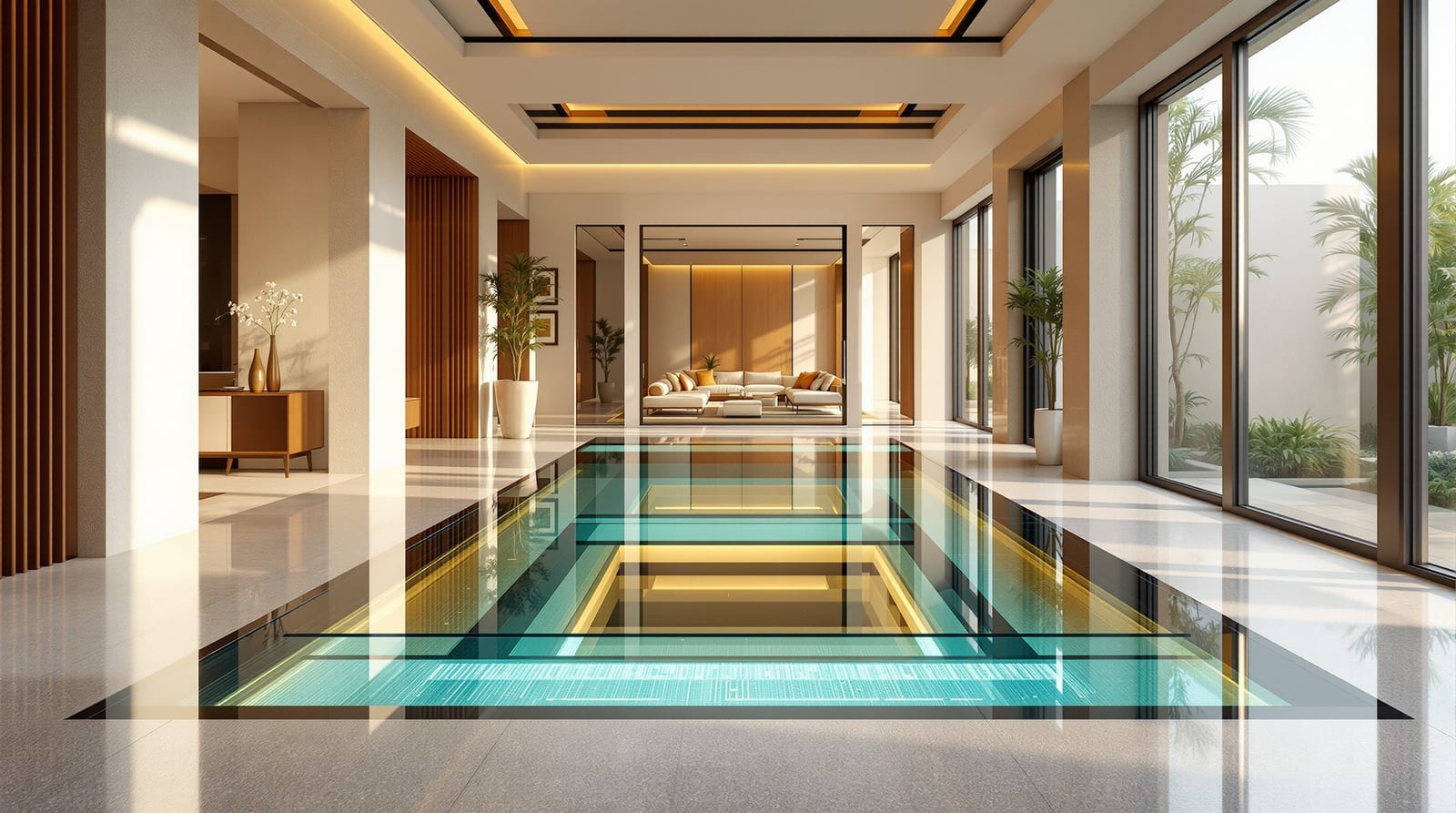
Glass Flooring in India: Structural Toughened-Laminated Glass Floors, Walkways, Stair Treads, Cost and Engineering
Structural glass flooring uses multi-ply laminated toughened glass panels with an anti-slip ceramic-frit top to create see-through floors, walkways, stair treads and skylights-underfoot — the dramatic wow-factor floor for luxury homes, villas, retail and restaurants; here is how it is engineered, where it suits, the safety design, and what it costs at ₹1,500–4,000+ per sq ft.
Few floors stop people in their tracks like a sheet of glass you can stand on. A structural glass floor turns a landing, a mezzanine edge or a stretch of corridor into a window underfoot — daylight spilling between storeys, a glimpse of the room below, a wine cellar or a water feature shimmering beneath your shoes. It is pure theatre, and in luxury Indian homes, villas, retail flagships, restaurants and showpiece offices it has become the signature "wow" move. But behind the drama sits serious engineering: this is not a pane of window glass, it is a multi-ply laminated toughened glass panel designed to carry people, furniture and crowds and to stay safe even when it breaks.
This guide explains how walk-on glass flooring is built up, how it is load-designed and made anti-slip, where it suits in an Indian project, the honest safety and care realities, and what it costs — typically ₹1,500–4,000+ per sq ft, firmly in premium territory.
What structural glass flooring is
A glass floor is a load-bearing assembly, not a finish you trowel on. The walking surface is a thick laminated panel made of two, three or more plies of fully toughened (tempered) glass bonded together with tough interlayers, supported on a steel, aluminium or stainless framing system. Each panel sits in or on a frame, and the frame carries the load down into the structure exactly the way a beam or joist would.
Three things separate floor glass from ordinary glazing. First, it is laminated — multiple sheets glued into one monolith — so that if one or even two plies crack, the remaining glass and the interlayer hold together and keep carrying load. Second, it is toughened, which makes each ply several times stronger than annealed glass and, crucially, makes it shatter into small blunt granules rather than long shards. Third, the top surface is treated for slip resistance, usually with a fired-on ceramic frit pattern of dots, lines or full texture, so the floor is not a skating rink — especially important in India's humid, monsoon-wet conditions.
Studio Matrx classes glass flooring among the technical and specialty floors. For the full map of alternative floors beyond mainstream tiles, stone and wood, start with the specialty flooring guide; glass sits alongside metal flooring and raised access flooring as an engineered, framed system rather than a poured or bonded one.
How a glass floor panel is built up
The panel is the heart of the system, and it is always a make-up of several glass plies plus interlayers, never a single sheet. A typical walk-on build-up reads from the bottom up as a structural laminate plus a sacrificial top, with an anti-slip surface fired into the uppermost face.
The lower plies are the structural glass — these are the plies sized to carry the design load. Above them sits a sacrificial (wearing) ply, a top sheet that takes the scuffs, point loads and abrasion of everyday traffic and can in principle be replaced without touching the structural plies. Between every pair of plies runs a structural interlayer — not the basic PVB used in car windscreens but a stiffer, stronger ionoplast interlayer (the SentryGlas family is the common reference) that keeps the laminate rigid and, after breakage, holds the fragments together so the floor retains residual strength. The very top face carries the anti-slip ceramic frit — ceramic ink dots or lines fired permanently into the glass during toughening, giving a durable, non-wearing grip pattern.
The diagram below shows a representative section through a laminated toughened glass floor panel and its frit top.
The number and thickness of plies are not chosen by eye — they fall out of the load calculation. A small feature insert may use two 10–12 mm plies; a large public walkway may stack three or four 15–19 mm plies into a panel 50–70 mm thick or more.
Engineering and load design
A floor is judged on three things: how much load it carries, how little it deflects, and what happens when something breaks. Glass is designed against all three.
Design loads. A residential floor is typically designed for around 2 kN per square metre of uniformly distributed load (heavier — 3–5 kN/m² — for assembly spaces like restaurants, retail and offices where crowds gather), plus a concentrated point load to represent a stiletto heel, a chair leg or a single person. The Indian loading reference is IS 875 (Part 2) for imposed loads on buildings; the structural engineer applies these to the glass exactly as to any floor.
Deflection. Glass is stiff but it does flex, and a floor that visibly bounces feels unsafe even if it is strong. Panels are sized so deflection under load stays within a strict limit (commonly the lesser of span/360 or a fixed few millimetres), which is what drives panels thick. Larger spans mean thicker laminates or more framing — there is no free lunch.
Breakage and residual strength — the safety logic. This is the heart of glass floor design and follows a simple rule: the floor must remain safe to stand on even after glass breaks. Because the panel is laminated from several toughened plies, the design assumes the top sacrificial ply may break (it is meant to, as a warning), yet the remaining structural plies and the interlayer still carry the design load — this is the post-breakage / residual-strength condition. Good practice designs so that even with the top ply and one structural ply broken, the panel does not fall through. The toughened glass breaks into harmless granules and the ionoplast interlayer holds the broken pieces in place, so the floor goes to a safe state rather than a hole.
Framing and support. The glass never bears directly on steel — it sits on setting blocks and gaskets so the hard, brittle glass is isolated from the hard steel and from point stresses at the edge. The supporting frame (steel, stainless or aluminium) is itself sized for the loads and deflection, and the perimeter detail must allow the glass to be replaced and must drain and shed water on any outdoor or wet application. For larger or public installations this is signed off by a structural glass specialist, and the work overlaps general glazing practice covered by IS 2553 (safety glass) and the toughened-glass standard IS 2835; the build-up logic mirrors how Studio Matrx treats other engineered, framed floors such as raised access flooring.
Types and uses of glass flooring
| Type | What it is | Typical use | Notes |
|---|---|---|---|
| Floor panels / inserts | Framed laminated panels set into a normal floor | Landings, corridors, feature strips in luxury homes and lobbies | Small inserts read as "windows in the floor" |
| Mezzanine / double-height inserts | Glass panel at a mezzanine or void edge | Villas, retail flagships, showrooms | Lets daylight and sightlines pass between storeys |
| Walkways / bridges | A run of glass spanning a void | Atriums, viewing decks, attractions, restaurants | Often the headline feature; needs the most engineering |
| Glass stair treads | Laminated glass treads in a staircase | Statement stairs in homes, retail, offices | Frit grip essential; each tread is a small structural beam |
| Skylight-underfoot / rooflight | Glass floor doubling as the rooflight to the space below | Terraces over double-height rooms, courtyards | Must be weather-sealed and drained as a roof too |
| Pool / water-feature glass | Glass over or beside water | Infinity-edge views, cellar-over-water drama | Slip and weather design critical |
In Indian practice the most common asks are a stair-landing insert or a mezzanine-edge panel in a high-end villa, glass treads on a sculptural staircase, and the double-height "look down" panel that lets a dramatic ground-floor space — a courtyard, a car display, a cellar, a water body — be seen from above. In hospitality and retail, glass walkways and inserts pull footfall and feature in the brand story.
Anti-slip and India's wet, humid reality
A see-through floor is useless if it is treacherous, and glass is naturally smooth. The standard solution is a ceramic-frit pattern — dots, squares, lines or a full texture of ceramic ink fired permanently into the top face during toughening. Because it is fired in, it never wears off the way an applied coating would, and it can be tuned for the grip class you need. Slip resistance is specified to ratings such as the German DIN 51130 R-scale (R9 for dry interior areas up to R11–R13 for wet and outdoor zones); a dense frit also helps mask smudges and gives the eye something to read so the edge of the panel is obvious.
This matters more in India than in cooler climates. Monsoon damp, high humidity, wet footwear at entries and condensation on a cool glass surface all raise the slip risk, so any glass floor near an entrance, terrace, pool or wet zone should carry a higher anti-slip frit class — the same logic Studio Matrx applies in the anti-slip flooring for wet areas guide. Outdoor and skylight panels additionally need UV-stable interlayers and proper weather sealing and drainage, since they double as roofing.
Cost in India: ₹ per sq ft
Glass flooring is a premium, engineered product, and the headline rate reflects custom fabrication, heavy laminates, structural framing and specialist installation. Indicative all-in ranges below are material plus framing and fixing; they vary widely by panel size, span, ply count, frit and site, add 18% GST, and always need a project-specific quote and structural design.
| Application | Indicative ₹/sq ft | Notes |
|---|---|---|
| Small floor insert / feature panel | ₹1,500–2,500 | Modest span, two to three plies |
| Glass stair treads | ₹2,000–3,500 | Per-tread fabrication, frit grip, fixings |
| Mezzanine / double-height insert | ₹2,000–3,500 | Larger panel, heavier laminate |
| Walkway / bridge over a void | ₹3,000–4,000+ | Longest spans, highest loads, most engineering |
| Skylight-underfoot / outdoor panel | ₹3,000–4,000+ | Weather-sealed, drained, UV-stable interlayer |
| Premium / very large / curved panels | ₹4,000+ | Custom one-offs, bespoke framing |
Add to the panel rate the structural framing, the structural design and sign-off fee, and any edge lighting or feature detailing. For perspective, this puts glass at the very top of the flooring market — many multiples of marble flooring at the slab level and far above resilient or vinyl options like luxury vinyl tile. Sanity-check overall flooring budgets with the Studio Matrx flooring cost calculator, but treat glass as a bespoke line item to be quoted by a specialist.
Care, cleaning and maintenance
Glass shows everything, and that is its maintenance story in one line. Fingerprints, footprints, dust, smudges and water spots are all visible, so a glass floor needs more frequent wiping than a stone or tile floor to stay looking its best — daily in a busy retail or restaurant setting. Clean it like any architectural glass: a soft microfibre cloth or squeegee with a mild glass cleaner or just water, avoiding abrasive pads and gritty dirt that could scratch the surface. The fired ceramic frit helps disguise marks between cleans and gives the surface bite, which is one more reason a denser frit pays off in high-traffic areas.
Structurally, glass floors are very low maintenance — there is nothing to reseal, no grout to fail, no coating to peel. The watch-items are different: keep grit off the surface, never drag heavy sharp objects across it, inspect the perimeter seals and gaskets (especially on outdoor or skylight panels that double as roofing and must keep draining), and if the sacrificial top ply ever chips or cracks, have it assessed and replaced by the fabricator — the panel is designed to keep working in that state, but the warning ply should be restored.
Pros and cons
Pros
- Unmatched drama — a true see-through floor is a one-of-a-kind feature that no tile, stone or wood can imitate; it is the headline of the room.
- Brings light down — glass inserts and skylights-underfoot push daylight from upper floors into the spaces below, making double-height and basement areas brighter.
- Opens sightlines — mezzanine and void inserts connect storeys visually, making homes and retail feel larger and more theatrical.
- Hygienic and seamless surface — non-porous glass does not absorb stains, spills or odours and wipes clean.
- Engineered to a safe failure state — a correctly designed laminated panel does not drop you through; the toughened glass crumbles to granules and the interlayer holds it.
Cons
- Very expensive — at ₹1,500–4,000+ per sq ft plus framing and design, it is among the costliest floors you can specify, and only for accent areas, not whole rooms.
- Shows every mark — smudges, footprints and dust are constantly visible and demand frequent cleaning.
- Specialist-only — design, fabrication and installation need a structural glass specialist; this is not a job for a general tiling crew, and a poor design is dangerous.
- Slip risk if under-specified — without an adequate frit class, glass is slippery, especially when wet in India's humid and monsoon conditions.
- Hard and cold underfoot, and vertigo — like all glass it is hard with no give, and the see-through effect makes some people uneasy to walk on.
- Replacement is a project — a damaged panel must be re-fabricated and swapped by the specialist, not patched on site.
Where glass flooring suits in India
Glass flooring earns its cost as a feature, not a field. It is at its best as a stair landing or corridor insert in a luxury home or villa, a mezzanine or double-height "look-down" panel that connects storeys, a statement staircase with glass treads, a walkway or viewing bridge in a retail flagship, restaurant, hotel atrium or showroom, and a skylight-underfoot that lights a space below. It pairs naturally with water features, wine cellars, courtyards and car displays meant to be admired from above.
It is the wrong choice for whole rooms, for budget projects, for high-impact utility or wet-cleaning areas where simpler floors win, and for anyone unwilling to clean often or uneasy walking on glass. In those cases a polished stone, marble, metal feature floor, or — for a different kind of engineered drama — metal flooring or a raised access floor in a tech space may serve far better.
Cross-links and where this fits
This guide sits in the Studio Matrx flooring cluster. For the full map of alternative, technical and specialty floors, start with the specialty flooring guide. To compare other engineered and framed floor systems, see metal flooring and raised access flooring. For luxury context and pairings, see marble flooring and the resilient alternative luxury vinyl tile. To budget the wider job, use the flooring cost calculator.
Frequently asked questions
Is glass flooring safe to walk on?
Yes, when correctly engineered. A walk-on floor is a multi-ply laminated panel of fully toughened glass bonded with stiff ionoplast interlayers, sized by a structural engineer for the design load and deflection. It is designed so that even if the top sacrificial ply breaks — and even one structural ply below it — the remaining glass and interlayer keep carrying load and hold the fragments together, so the floor goes to a safe state rather than a hole. Toughened glass also breaks into blunt granules, not shards. The danger lies only in under-engineered or non-specialist work.
How much does glass flooring cost in India?
Indicatively ₹1,500–4,000+ per sq ft, plus 18% GST, plus structural framing and design fees. Small feature inserts sit at the lower end, glass stair treads and mezzanine panels in the middle, and large walkways, bridges and weather-sealed skylight-underfoot panels at the top. It is a bespoke, custom-fabricated product, so always get a project-specific quote from a structural glass specialist rather than relying on a square-foot rate.
Is glass flooring slippery?
Plain glass is, which is why floor glass is never plain. The top surface carries a fired-in ceramic-frit pattern of dots, lines or texture that gives durable, non-wearing grip, specified to a slip rating such as DIN 51130 R9 to R13 depending on the area. In India's humid and monsoon-wet conditions, any glass floor near entrances, terraces, pools or wet zones should use a higher anti-slip frit class.
Can glass flooring be used outdoors or as a skylight?
Yes — glass floors are often used as skylights-underfoot over double-height rooms and courtyards, and over pools and water features. Outdoor and skylight panels need extra design: a UV-stable interlayer so it does not yellow, full weather sealing and drainage because the panel also acts as a roof, and a higher anti-slip frit class for wet conditions. The perimeter detail and gaskets must be inspected periodically to keep draining and sealing properly.
What is the glass actually made of?
A walk-on panel is a laminated make-up of two, three or more plies of fully toughened (tempered) glass, each typically 10–19 mm thick, bonded with stiff structural ionoplast interlayers (the SentryGlas family is the common reference). The lower plies are sized to carry the load, the top ply is a sacrificial wearing layer that takes the traffic and can be replaced, and the top face is finished with the fired-in anti-slip ceramic frit. The exact build-up is set by the load calculation, not chosen by eye.
Export this guide
Related Guides — Deep-dive reading
Roof Access & Walkways
Someone will need to get onto your roof several times a year — to clear a drain, service the tank, wash the solar panels, check the waterproofing. Access designed into the house is far safer and cheaper than a ladder propped against a wall. This guide covers the ways up (mumty stairs, fixed ladders, hatches, loft ladders), the ways around (walkways and duckboards over fragile or waterproofed surfaces), and the guardrails and anchor points that make maintenance safe.
RoofingPorcelain, Ceramic & Sintered-Stone Facade Cladding in India: A Practical Guide
Thin large-format porcelain and sintered-stone slabs can clad a building with the look of marble, concrete or weathered steel at a fraction of stone's weight — but on a facade, the fixing system is a life-safety decision, not a finish choice.
Building FacadesFlooring Materials Explained: Every Type for Indian Homes (2026)
One scannable reference to every flooring material family — tiles, natural stone, wood, resilient and seamless — with look, durability, water resistance, ₹/sq ft cost band and where each suits Indian homes.
Flooring & SurfacesRelated Tools — Try Free
Cross-Ventilation Analyzer
Estimate airflow and air changes per hour (ACH) from room size, window areas, layout, and local wind — with NBC 2016 Part 8 compliance check.
Ventilation CalculatorWindow Cost Calculator
Estimate window price plus installation by type, frame material, size, glass and quantity.
Window CalculatorWindow Cleaning Cost Calculator
Estimate professional window cleaning cost per visit and per year by access and frequency.
Window Calculator