

MCB vs RCCB vs RCBO vs MCCB: Which Protection Does What
Four devices in your distribution board, four different jobs — an at-a-glance guide to what protects against overload and short circuit, what protects against electric shock, what does both, and where each belongs, so you can read your own board and know it's complete.
Open a modern distribution board and you'll see rows of similar-looking switches — but they aren't all the same, and confusing them is dangerous. An MCB, an RCCB, an RCBO and an MCCB each guard against a different danger. Knowing which does what lets you read your own board and confirm the two essential protections — against fire and against shock — are both present. This guide is a plain-language comparison of the four.
It is the protection-device comparison in the Electrical Knowledge Hub, distilling the MCB/MCCB, RCCB/RCBO and protection guides into one decision view.
The safety line. This guide helps you understand and verify your protection. Selecting, rating and installing these devices is a licensed electrician's job to IS 732 — but knowing what each does lets you confirm your board is complete and ask the right questions.
The two dangers, four devices
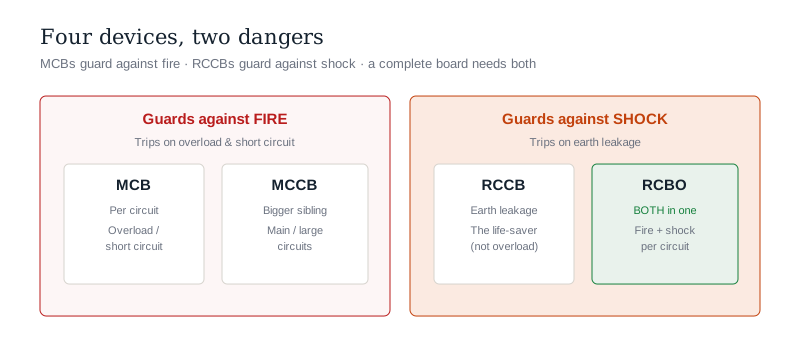
Remember the two dangers: fire (from overload/short circuit) and shock (from earth leakage). The four devices map to them:
| Device | Protects against | Trips on | Guards you from |
|---|---|---|---|
| MCB | Overload & short circuit | Too much current | Fire |
| MCCB | Overload & short circuit (higher capacity) | Too much current (big circuits) | Fire |
| RCCB | Earth leakage | Small leakage current | Shock |
| RCBO | Both — overload/short and leakage | Either | Fire + shock |
The essential insight: MCBs guard against fire; RCCBs guard against shock; a complete board needs both — and an RCBO combines them in one device.
MCB — the fire guard
The Miniature Circuit Breaker:
- Protects against overload and short circuit — too much current heating the cable.
- Trips when current exceeds its rating, before the wire overheats.
- Guards against fire, not shock — it won't detect earth leakage.
- One per circuit, rated to the cable and load (see choosing MCB rating).
MCCB — the MCB's bigger sibling
The Moulded Case Circuit Breaker:
- Same job as an MCB (overload/short circuit) but for higher currents — the main incomer or large circuits.
- Higher ratings and breaking capacity than an MCB.
- In homes, you'll typically meet it as a main switch for a larger supply, with MCBs on the individual circuits.
RCCB — the life-saver against shock
The Residual Current Circuit Breaker:
- Protects against earth leakage — the small current that flows when electricity escapes to earth (through a faulty appliance or a person).
- Trips in milliseconds on that leakage, cutting power before a shock becomes fatal.
- Guards against shock — but not overload/short circuit; it does not replace MCBs.
- The single most important life-safety device — every home should have one covering its circuits.
RCBO — both in one
The Residual Current Breaker with Overcurrent:
- Combines an MCB and an RCCB in one device — overload/short circuit and earth-leakage protection.
- Per-circuit shock protection — so a leakage fault trips only that circuit, not the whole home (an advantage over one RCCB covering many circuits).
- The premium, tidy choice — more device per circuit, but focused protection.
How a complete board uses them
A well-protected home combines them:
- A main switch / MCCB as the incomer.
- RCCB(s) covering the circuits for shock protection — or RCBOs per circuit for focused protection.
- MCBs on individual circuits for overload/short-circuit (fire) protection — unless RCBOs are used, which include this.
- The non-negotiable: both fire protection (MCB-type) and shock protection (RCCB-type) present — see the distribution board guide.
If your board has only MCBs and no RCCB/RCBO, it has no shock protection — the most important gap to fix.
The one-line answer
Four devices, two dangers: MCBs (and higher-capacity MCCBs) trip on overload and short circuit to guard against fire; RCCBs trip on earth leakage to guard against shock; and an RCBO does both in one device, giving per-circuit fire and shock protection. A complete board needs both kinds present — MCBs (or RCBOs) for every circuit and RCCB/RCBO shock protection covering them. The commonest and most dangerous gap is a board with MCBs but no RCCB or RCBO — meaning no protection against electric shock. A licensed electrician selects and rates these to IS 732; knowing what each does lets you confirm yours is complete.
Where to go next
- The devices in depth: MCB & MCCB Guide · RCCB & RCBO Guide.
- The whole protection picture: Electrical Protection Guide.
- Where they live: Distribution Board Guide.
- Pick a rating: MCB/RCCB Selector.
References
- IS/IEC 60898 (Parts), Miniature Circuit Breakers (MCBs), Bureau of Indian Standards.
- IS 12640 (Parts 1 & 2), Residual Current Operated Circuit Breakers (RCCBs/RCBOs), BIS.
- IS/IEC 60947-2, Low-Voltage Switchgear — Circuit Breakers (MCCBs); IS 732 : 2019, BIS: https://www.bis.gov.in/
Device selection and rating are safety-critical and must be done by a licensed electrician to IS 732. Verify any standard's status via the BIS catalogue before relying on it.
Export this guide
Related Guides — Deep-dive reading
RCCB, RCBO & ELCB: The Devices That Protect You From Shock
The single most important safety device in a home distribution board — the residual current device that detects electricity leaking to earth and cuts power in milliseconds. What RCCB, RCBO and ELCB mean, why 30 mA matters, the difference from an MCB, and why every home must have one.
Electrical & WiringMCB vs MCCB: What They Do & Which Your Home Needs
The two circuit breakers that protect wiring from overload and short circuit — the MCB in every home distribution board and the larger MCCB in bigger installations. What each does, the trip curves and ratings, when you need which, and why a bigger breaker is never the fix for tripping.
Electrical & WiringElectrical Safety for Security Systems in India (2026): Powering It Without Peril
A homeowner's guide to the power side of home and RWA security systems, CCTV, alarms, gates, access control and NVRs, done so it protects you instead of quietly becoming a shock or fire hazard. What makes a supply safe, what to insist on, and why the mains work belongs to a licensed electrician.
SecurityRelated Tools — Try Free
Electrical Safety & Load Audit
Home electrical audit — 10 categories, 65+ checkpoints across earthing, RCCB, MCB, wiring, switchboards, appliance circuits, DG/inverter backup.
Safety AuditMCB & RCCB Selector
Suggests an MCB current rating and trip curve for a home circuit, the minimum matching cable, and the RCCB sensitivity for shock protection.
ElectricalElectrical Load Calculator
Estimate a home's connected load and realistic maximum demand from its appliances, whether it needs single or three-phase supply, and a suggested main switch rating.
Electrical