
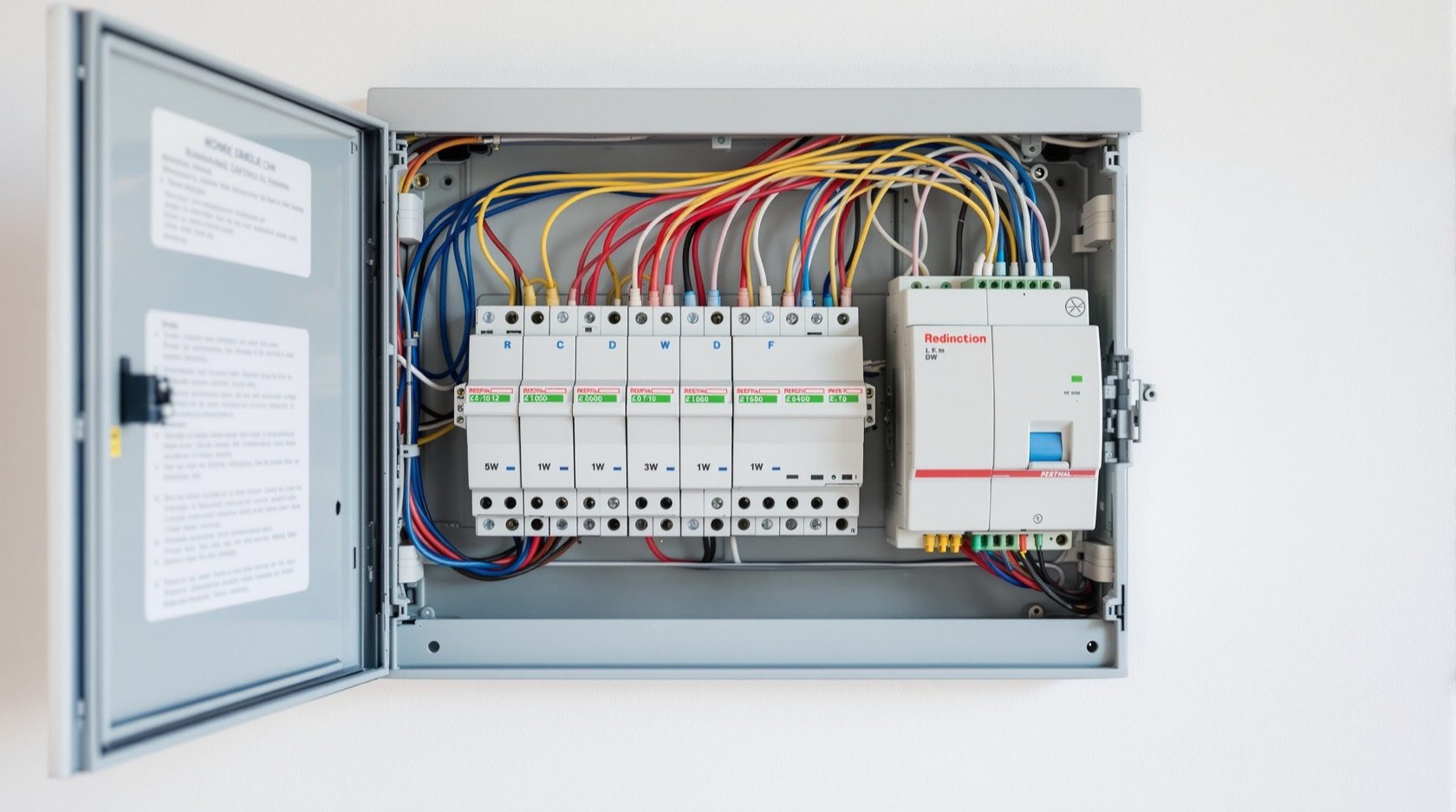
The Distribution Board Explained: Your Home's Electrical Command Centre
What is inside the DB (consumer unit) on your wall — the main switch, the RCCB that protects lives, the row of MCBs that protect cables, and the busbars that tie them together — how it is sized and laid out, and how to read yours.
If a home's electrical system has a heart, it is the distribution board — the panel on the wall, near the entrance or in a utility area, where the incoming supply is split into circuits and where the protective devices live. It is also the single most useful thing for a homeowner to understand, because reading it tells you how your home is protected, and because it is where you go the moment something trips. This guide opens the DB and explains every part.
It sits under the residential electrical systems pillar and connects to the MCB & MCCB guide and the RCCB, RCBO & ELCB guide for the devices inside it.
The safety line. You can safely reset a tripped MCB and read the circuit chart. Opening the board's cover, touching the busbars or terminals, or altering anything inside is a licensed electrician's job — the incoming side is live even when the main switch is off, unless the supply itself is isolated. Understand your DB; do not work inside it.
What a distribution board is
The distribution board (DB), also called the consumer unit or loosely "the fuse box", does three jobs:
1. Distributes the incoming supply to the home's separate circuits.
2. Protects each circuit with its own device, so a fault trips only that circuit.
3. Isolates — lets you cut power to the whole home, or to one circuit, for safety and repairs.
Everything about how well a home is protected is visible, to a trained eye, in its DB.
Inside the board, part by part
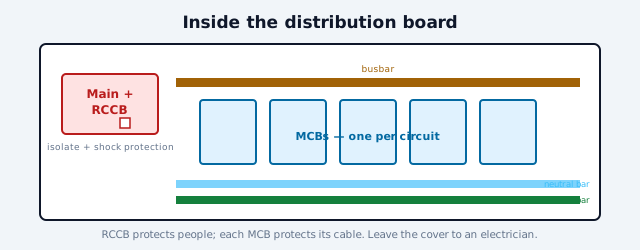
- Main switch / isolator — the incoming double-pole switch that cuts all power to the home. On many boards this is combined with, or sits beside, the RCCB.
- RCCB (residual current circuit breaker) — the life-saver. It compares the current going out on the live with the current returning on the neutral, and if even ~30 mA is leaking (for instance, through a person), it trips in milliseconds. This is what protects people from fatal shock. Covered in the RCCB, RCBO & ELCB guide.
- MCBs (miniature circuit breakers) — one per circuit, each rated to protect its cable from overload and short circuit. Lighting circuits get small ratings, socket and heavy-appliance circuits larger ones. Covered in the MCB & MCCB guide.
- Busbar — the conductor bar that distributes the incoming power across all the MCBs.
- Neutral bar and earth bar — where the neutral and earth conductors of every circuit terminate.
- Circuit chart — the label on the inside of the door telling you which breaker feeds what. A DB without one is only half-finished.
How a DB is sized and laid out
A DB is specified by the number of ways (breaker positions) it needs, plus spare capacity:
- One MCB per circuit — lighting, general sockets by area, and a dedicated way for each heavy appliance (geyser, each AC, kitchen, pump, EV charger).
- The RCCB (or RCBOs) sized to cover the circuits it protects.
- 20–30% spare ways for the future — solar, an EV charger, an extra room. A DB packed full on day one has nowhere to grow. (See the planning guide.)
Good layout also means the DB is accessible and dry (never buried in a cupboard or where moisture reaches it), mounted at a sensible height, and clearly labelled. Larger homes may have a main DB plus sub-boards on each floor to keep cable runs short.
Reading your own board
You can safely learn a lot from your DB without opening it:
- Is there an RCCB? Look for a device with a test button (marked T) and usually a higher current rating than the MCBs. No RCCB means no shock protection — a serious gap (see the renovation guide).
- Test the RCCB periodically: press its test button — it should trip instantly. If it does not, it is not protecting you; call an electrician.
- Is there a circuit chart? If not, ask your electrician to label which breaker feeds what — invaluable in an emergency.
- When a breaker trips, switch off the appliances on that circuit, reset the breaker once, and if it trips again, stop and call an electrician — repeated tripping is a fault, not a nuisance.
The one-line answer
The distribution board is your home's electrical command centre: a main switch to isolate everything, an RCCB that trips on earth leakage to protect people, a row of MCBs that each protect one circuit's cable from overload and short circuit, and busbars tying it together — all sized to your circuits with spare ways for the future. Learn to read yours (does it have an RCCB? a circuit chart? does the test button work?), reset a trip once, and leave everything inside the cover to a licensed electrician.
Where to go next
- The overload protection: MCB & MCCB Guide.
- The shock protection: RCCB, RCBO & ELCB Guide.
- Choosing ratings: Choosing the Right MCB Rating.
- The whole system: Residential Electrical Systems.
References
- IS/IEC 60898-1 : 2015, Circuit-Breakers for Overcurrent Protection for Household and Similar Installations (MCBs), Bureau of Indian Standards.
- IS 12640 (Parts 1 & 2), Residual Current Operated Circuit-Breakers for Household and Similar Uses (RCCBs / RCBOs), BIS.
- IS 732 : 2019, Code of Practice for Electrical Wiring Installations, BIS.
- National Electrical Code of India, SP 30 : 2023, BIS: https://www.bis.gov.in/
Board contents and layout are indicative for typical Indian homes. Never work inside a distribution board — the incoming side can remain live. All DB work must be done by a licensed electrician. Verify any standard's status via the BIS catalogue before relying on it.
Export this guide
Related Guides — Deep-dive reading
RCCB, RCBO & ELCB: The Devices That Protect You From Shock
The single most important safety device in a home distribution board — the residual current device that detects electricity leaking to earth and cuts power in milliseconds. What RCCB, RCBO and ELCB mean, why 30 mA matters, the difference from an MCB, and why every home must have one.
Electrical & WiringResidential Electrical Systems: The Complete Guide for Indian Homes
How the electricity in an Indian home actually works — from the utility supply and meter through the distribution board, circuits, wiring, earthing and protection, to lighting, safety, energy efficiency, smart controls, solar and backup — written so a homeowner can understand, plan and judge it, and know exactly where a licensed electrician must take over.
Electrical & WiringElectrical Safety for Security Systems in India (2026): Powering It Without Peril
A homeowner's guide to the power side of home and RWA security systems, CCTV, alarms, gates, access control and NVRs, done so it protects you instead of quietly becoming a shock or fire hazard. What makes a supply safe, what to insist on, and why the mains work belongs to a licensed electrician.
SecurityRelated Tools — Try Free
Electrical Safety & Load Audit
Home electrical audit — 10 categories, 65+ checkpoints across earthing, RCCB, MCB, wiring, switchboards, appliance circuits, DG/inverter backup.
Safety AuditElectrical Load Calculator
Estimate a home's connected load and realistic maximum demand from its appliances, whether it needs single or three-phase supply, and a suggested main switch rating.
ElectricalRoom Lighting Calculator
Estimate the target lux, total lumens and number of LED fixtures a room needs, from its type and size — a general-illumination planning guide.
Lighting