
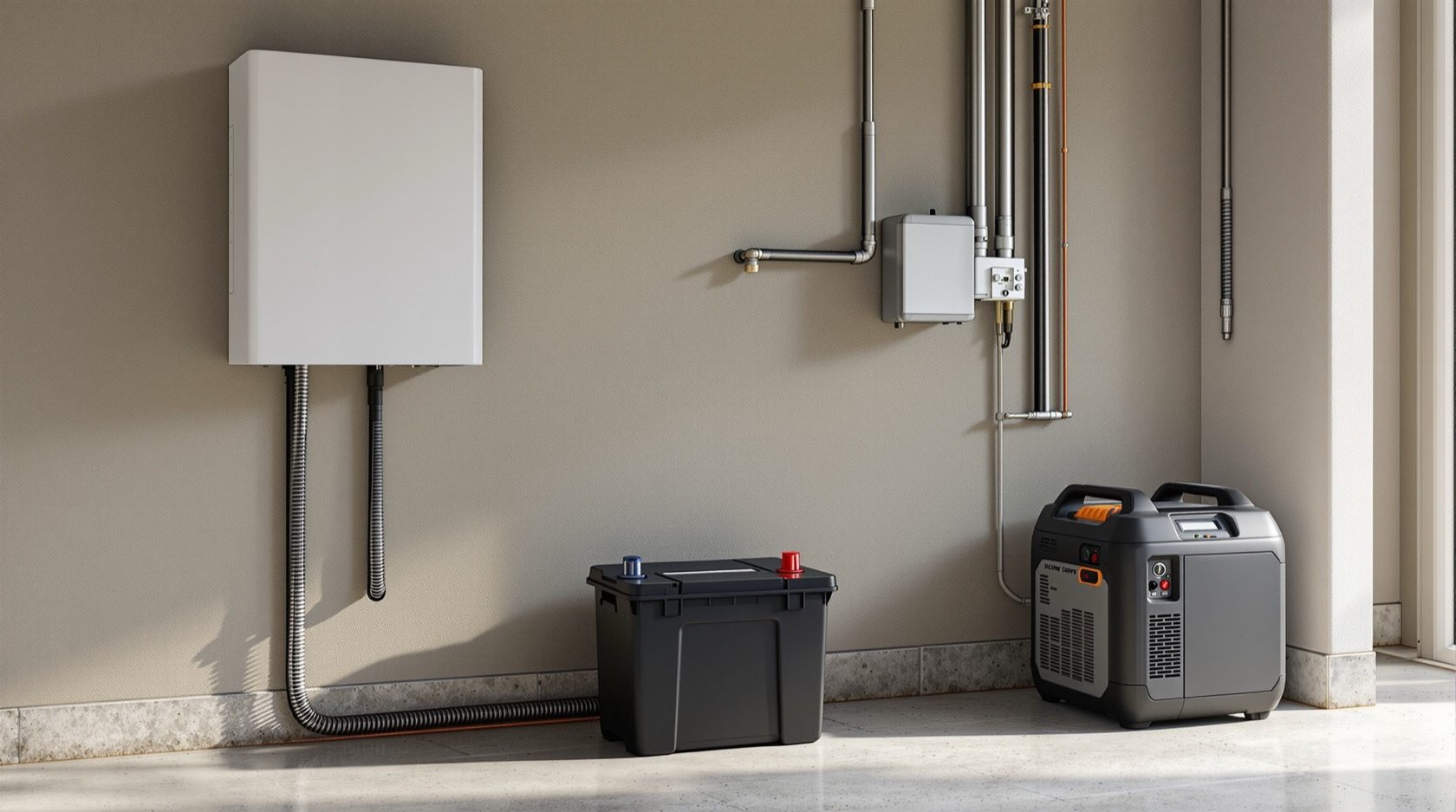
Inverter vs Generator vs UPS: Which Backup Power Is Right for You?
Three ways to keep the power on, for three different jobs — an honest side-by-side of the home inverter, the generator and the UPS: what each does well, what it costs to run, how long it lasts, and a simple decision framework for choosing the right one (or the right combination) for your home.
When the power goes, three technologies can keep it on — an inverter, a generator or a UPS — and they're often confused for one another. In truth they solve three different problems: instant seamless backup for electronics, long-run high-power backup for outages, and battery backup for the whole home's essentials. Choosing well (or combining them sensibly) is about matching the tool to the job. This guide is an honest, India-grounded side-by-side of the three, with a simple framework to pick the right one.
It is the backup-power comparison in the Electrical Knowledge Hub, pulling together the inverter, generator and UPS guides.
The safety line. This guide helps you choose. Installing any backup system — wiring an inverter to the home circuits, a generator's connection and exhaust, a UPS on a circuit — is a licensed electrician's work. Generators also carry fuel and carbon-monoxide hazards; never run one indoors.
At a glance
| Home inverter | Generator | UPS | |
|---|---|---|---|
| Power source | Battery (charged from mains) | Fuel (petrol/diesel/gas) | Battery |
| Switchover | Fast (near-seamless) | Delay (start-up) | Instant (no gap) |
| Runtime | Hours (battery-limited) | Long (as long as fuel) | Minutes (bridge only) |
| Best for | Home essentials in outages | Long/whole-home high loads | Computers, network — no-gap |
| Running cost | Electricity to recharge | Fuel (ongoing) | Electricity to recharge |
| Noise/emissions | Silent, clean | Noisy, emissions, fuel | Silent, clean |
They aren't rivals so much as different tools — and many homes use more than one.
The home inverter — everyday backup
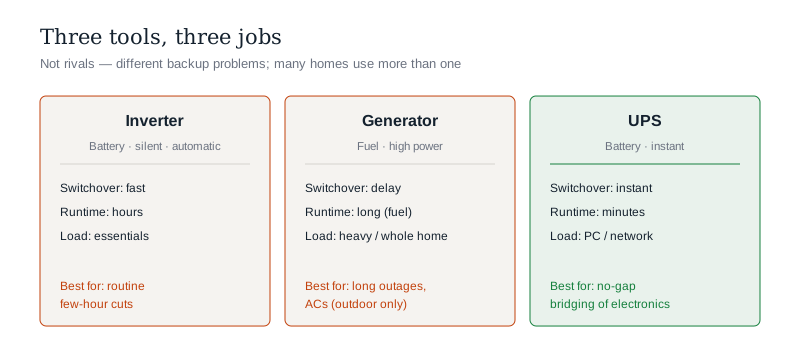
The inverter (inverter + battery) is the default Indian home backup:
- What it does — stores mains power in a battery and runs your chosen essential circuits (lights, fans, TV, Wi-Fi) during a cut, switching over fast.
- Strengths — silent, clean, low running cost, automatic, no fuel; ideal for the common few-hour outage.
- Limits — runtime is battery-limited (hours, not days), and it won't comfortably run very heavy loads like ACs unless sized large.
- Best for — keeping a home's everyday essentials running through routine cuts.
The generator — long, heavy backup
The generator makes its own power from fuel:
- What it does — burns fuel to generate electricity for as long as you have fuel.
- Strengths — long runtime and high power — can run heavy loads (even ACs) and whole homes through long outages, limited only by fuel.
- Limits — noise, emissions, fuel cost and handling, a start-up delay, maintenance, and it must run outdoors/ventilated (carbon-monoxide risk).
- Best for — long outages, high loads, or areas with frequent long cuts — villas, essential heavy loads, backup for a whole home.
The UPS — instant, brief bridge
The UPS is about seamlessness, not duration:
- What it does — provides instant, gap-free power from a battery the moment the mains fails, for a short time.
- Strengths — zero switchover gap — protects computers, network gear and sensitive electronics from even a momentary cut; conditions the power too.
- Limits — minutes of runtime (it's a bridge, not a backup) — enough to ride out a blip or shut down cleanly.
- Best for — computers, home office, network, and sensitive electronics that mustn't lose power for even an instant.
How to choose — the framework
Match the tool to the problem:
- Routine few-hour cuts, everyday essentials → a home inverter (the default for most Indian homes).
- Long outages or heavy loads (ACs, whole home) → a generator (often alongside an inverter).
- Zero-gap protection for a PC/network/office → a UPS (small, focused, added to the above).
- The common combination → inverter for the home + a UPS on the computer/router (see the home office guide); add a generator where cuts are long or loads are heavy.
The honest answer for most homes: an inverter is the backbone, a UPS guards the electronics that can't blink, and a generator joins in only where outages are long or loads are large. Size any of them with the inverter/battery calculator and the load calculator.
The one-line answer
Inverter, generator and UPS solve three different backup problems, so match the tool to the job: a home inverter (battery, silent, automatic) is the default for keeping everyday essentials running through routine few-hour cuts; a generator (fuel, high power, long runtime — but noisy, emitting and outdoor-only) is for long outages or heavy loads like ACs and whole homes; and a UPS (instant, gap-free, but only minutes) protects computers and network gear that can't lose power for even an instant. Most homes are best served by an inverter as the backbone plus a UPS on the electronics, adding a generator only where cuts are long or loads are large — all installed by a licensed electrician.
Where to go next
- The options in depth: Home Backup Power Guide.
- Each one: Inverter & Battery Guide · Generator Guide · UPS Guide.
- Size it: Inverter & Battery Calculator.
- The battery choice: Lithium vs Lead-Acid Battery Guide.
References
- IS 732 : 2019, Code of Practice for Electrical Wiring Installations, Bureau of Indian Standards.
- IS 16242 (Parts) / IS/IEC 62040, Uninterruptible Power Systems (UPS), BIS.
- Central Electricity Authority (Measures relating to Safety and Electric Supply) Regulations, 2010 (as amended) — generator connection: https://cea.nic.in/
Ratings, runtimes and costs vary by product and usage; all backup systems must be installed by a licensed electrician, and generators run outdoors with proper ventilation. Verify any standard's status via the BIS catalogue before relying on it.
Export this guide
Related Guides — Deep-dive reading
Electrical Safety for Security Systems in India (2026): Powering It Without Peril
A homeowner's guide to the power side of home and RWA security systems, CCTV, alarms, gates, access control and NVRs, done so it protects you instead of quietly becoming a shock or fire hazard. What makes a supply safe, what to insist on, and why the mains work belongs to a licensed electrician.
SecurityHome Backup Power: Inverter, Generator or UPS?
How to keep the lights on when the grid goes down — the three backup options compared (inverter-battery, generator, UPS), how to decide which your home needs, the idea of 'essential loads' that makes backup affordable, and why a proper changeover switch is non-negotiable.
Electrical & WiringHome Generators: Portable, Standby, Sizing & When You Need One
When a battery isn't enough — how a generator produces power for heavy loads and long outages, the difference between a portable set and a fixed standby DG, how they are sized, the fuel, noise and emission realities, and whether a home actually needs one.
Electrical & WiringRelated Tools — Try Free
Electrical Safety & Load Audit
Home electrical audit — 10 categories, 65+ checkpoints across earthing, RCCB, MCB, wiring, switchboards, appliance circuits, DG/inverter backup.
Safety AuditInverter & Battery Calculator
Size a home inverter (VA) and battery (Ah) for the load you want to back up and the hours of backup you need.
Backup PowerSecurity Backup Power Calculator
Size a UPS/inverter and battery to keep CCTV, NVR, router and alarm running through a power cut — load, Ah, VA and cost.
Backup Power