
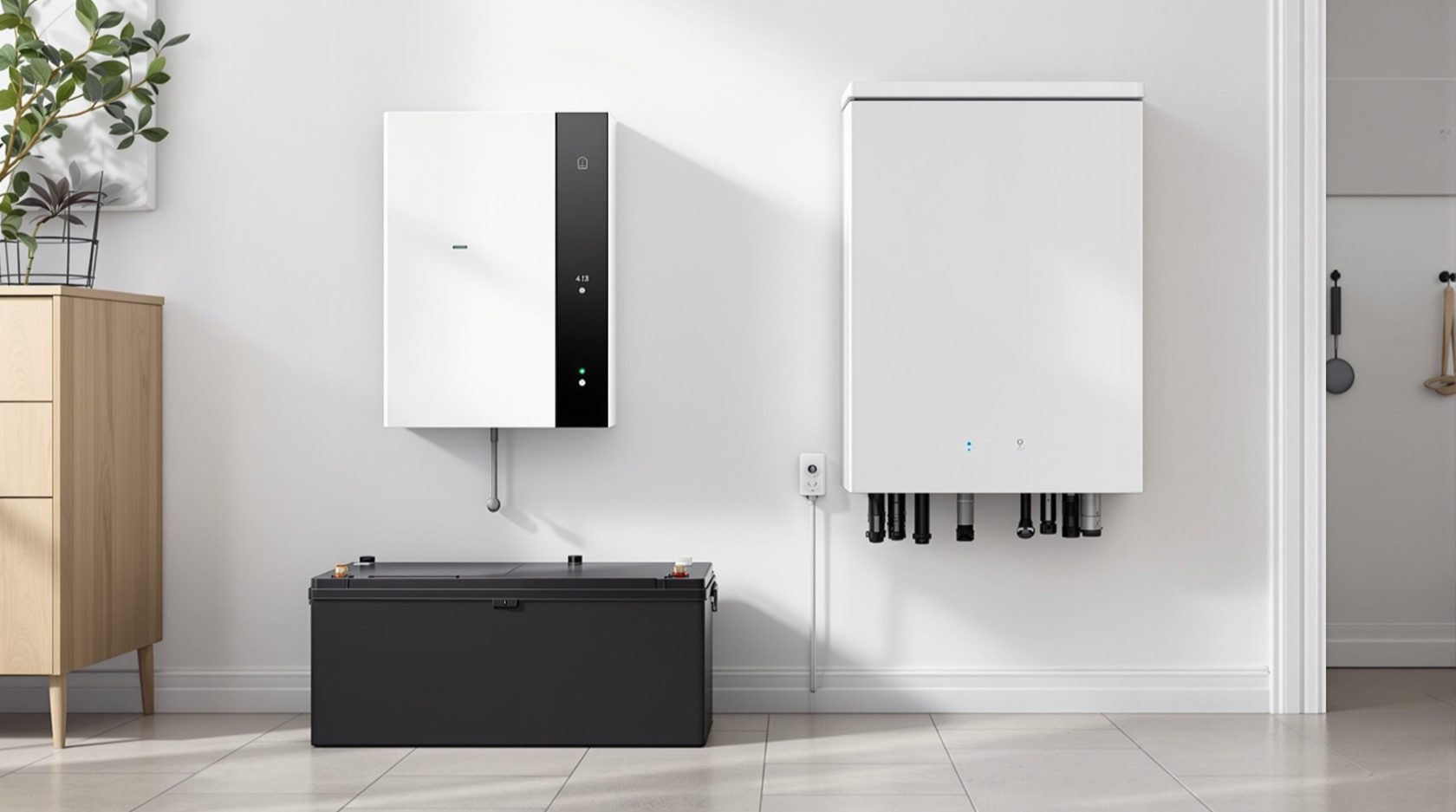
Lithium vs Lead-Acid: Choosing a Home Battery for Inverter & Solar
The battery is where most of a backup system's cost and lifespan live — an honest comparison of lithium and lead-acid for home inverters and solar storage: upfront cost versus lifespan, usable capacity, maintenance, space and safety, and which genuinely works out cheaper over time.
In any inverter or solar storage system, the battery is where most of the cost, most of the lifespan, and most of the disappointment lives. Two families dominate Indian homes: the long-familiar lead-acid (tubular) battery, and the newer lithium (typically LiFePO₄) battery. They differ sharply on upfront price, lifespan, usable capacity, maintenance and space — and the "cheaper" one on the shelf often isn't the cheaper one over ten years. This guide is an honest comparison to help you choose.
It is the battery comparison in the Electrical Knowledge Hub, deepening the inverter battery types guide.
The safety line. This guide helps you choose a battery type. Installation, wiring and safe siting are a licensed electrician's work. Lithium home batteries should conform to the relevant safety standard (IS 16046) and be quality products from reputable makers.
At a glance
| Lead-acid (tubular) | Lithium (LiFePO₄) | |
|---|---|---|
| Upfront cost | Lower | Higher |
| Lifespan | Shorter (fewer cycles) | Longer (many more cycles) |
| Usable capacity | Partial (shallow discharge) | Most of rated capacity |
| Efficiency | Lower | Higher |
| Maintenance | Some (water top-up on many) | Virtually none |
| Size/weight | Bulky, heavy | Compact, light |
| Cost over 10 years | Often higher (replacements) | Often lower |
The headline: lead-acid is cheaper to buy; lithium is often cheaper to own.
Lead-acid (tubular) — the familiar default
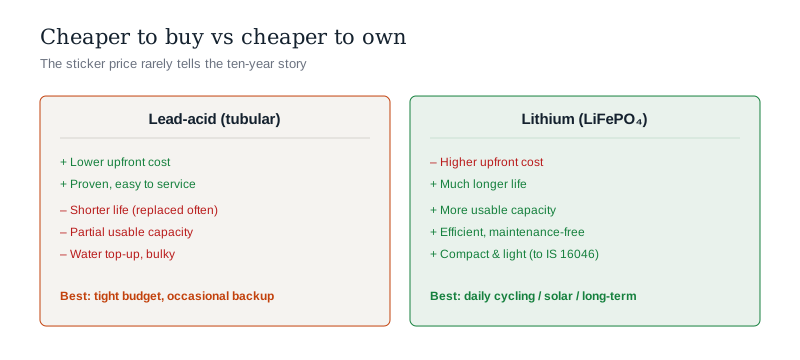
The traditional tubular lead-acid battery:
- Lower upfront cost — the reason it's still the default.
- Proven and widely available everywhere, with easy service.
- Shorter lifespan — fewer charge cycles, so replaced more often over the years.
- Partial usable capacity — you shouldn't deeply discharge it, so you use only part of its rated capacity.
- Maintenance — many types need periodic distilled-water top-up and ventilation.
- Bulky and heavy, and best sited in a ventilated spot.
Lithium (LiFePO₄) — the long-term choice
The newer lithium (usually lithium iron phosphate, LiFePO₄) battery:
- Higher upfront cost — the main barrier.
- Much longer lifespan — many more charge cycles, so far fewer replacements.
- More usable capacity — can be discharged deeper, so more of the rated capacity is actually available.
- Higher efficiency — less energy lost charging/discharging (useful with solar).
- Virtually maintenance-free, compact and light.
- Built-in battery management for safety; choose products to IS 16046 from reputable makers.
The real comparison: cost over time
The honest way to compare isn't the sticker price — it's the cost over the system's life:
- Lead-acid wins on day-one cost but is replaced more often and delivers less usable capacity per rupee.
- Lithium costs more upfront but its long life and deeper usable capacity often make it cheaper per usable kWh over 8–10 years, especially with daily cycling (as in solar).
- Where you cycle daily (solar self-consumption), lithium's advantage is largest; where backup is occasional, lead-acid's low upfront cost stays attractive.
- Run the numbers for your usage rather than trusting either headline.
How to choose
- Tight upfront budget, occasional backup → lead-acid remains sensible.
- Daily cycling, solar storage, or valuing low-maintenance long life → lithium usually wins over time.
- Limited space / weight → lithium (compact).
- Prefer proven, easily-serviced, widely-available → lead-acid.
- Whichever you pick — buy quality (a cheap battery of either type disappoints), size it with the inverter/battery calculator, and have it installed and sited safely by a licensed electrician.
The one-line answer
For a home inverter or solar store, lead-acid (tubular) is cheaper to buy but lithium (LiFePO₄) is often cheaper to own: lead-acid wins on upfront cost and easy availability but has a shorter life, needs some maintenance, is bulky, and gives only partial usable capacity; lithium costs more upfront but lasts far longer, is maintenance-free and compact, and delivers more usable capacity and efficiency — so over 8–10 years, especially with daily cycling like solar, it often works out cheaper per usable kWh. Choose lead-acid for a tight budget and occasional backup; choose lithium for daily cycling, solar, tight space or long-term value — and buy a quality product (to IS 16046 for lithium) installed by a licensed electrician.
Where to go next
- The battery types in depth: Inverter & Battery Types Guide.
- The system it powers: Inverter & Battery Guide.
- Storing solar: Solar Battery Storage Guide.
- Size it: Inverter & Battery Calculator.
References
- IS 16046 : Part 2 : 2018 (IEC 62133-2), Safety Requirements for Portable Sealed Secondary Lithium Cells and Batteries, Bureau of Indian Standards.
- IS 15549 : 2006, Stationary Valve Regulated Lead Acid (VRLA) Batteries; IS 13369, Batteries for inverter/UPS applications, BIS.
- IS 732 : 2019, Code of Practice for Electrical Wiring Installations, BIS: https://www.bis.gov.in/
Battery costs, lifespans and usable capacity vary by product, quality and usage; figures are indicative. Lithium batteries should meet IS 16046 and be installed by a licensed electrician. Verify any standard's status via the BIS catalogue before relying on it.
Export this guide
Related Guides — Deep-dive reading
Inverter Battery Types: Tubular, Flat-Plate, VRLA & Lithium Compared
The battery is where most of the money and most of the trouble in a backup system lives — so choose it well. Flooded tubular and flat-plate lead-acid, sealed VRLA, and lithium compared on life, maintenance, cost, safety and where each fits an Indian home.
Electrical & WiringCustom vs Ready-Made Doors: Buyer's Guide India 2026
Factory ready-made, made-to-order from a brand, or carpenter-built on site — costs, lead times, fit and warranty compared for Indian homes.
Home Doors & EntrancesResidential Electrical Systems: The Complete Guide for Indian Homes
How the electricity in an Indian home actually works — from the utility supply and meter through the distribution board, circuits, wiring, earthing and protection, to lighting, safety, energy efficiency, smart controls, solar and backup — written so a homeowner can understand, plan and judge it, and know exactly where a licensed electrician must take over.
Electrical & WiringRelated Tools — Try Free
Inverter & Battery Calculator
Size a home inverter (VA) and battery (Ah) for the load you want to back up and the hours of backup you need.
Backup PowerElectrical Safety & Load Audit
Home electrical audit — 10 categories, 65+ checkpoints across earthing, RCCB, MCB, wiring, switchboards, appliance circuits, DG/inverter backup.
Safety AuditAccess-Control Battery-Backup Calculator
Size the standby battery so an access system keeps running through a power cut, with an egress life-safety note.
Battery Backup