
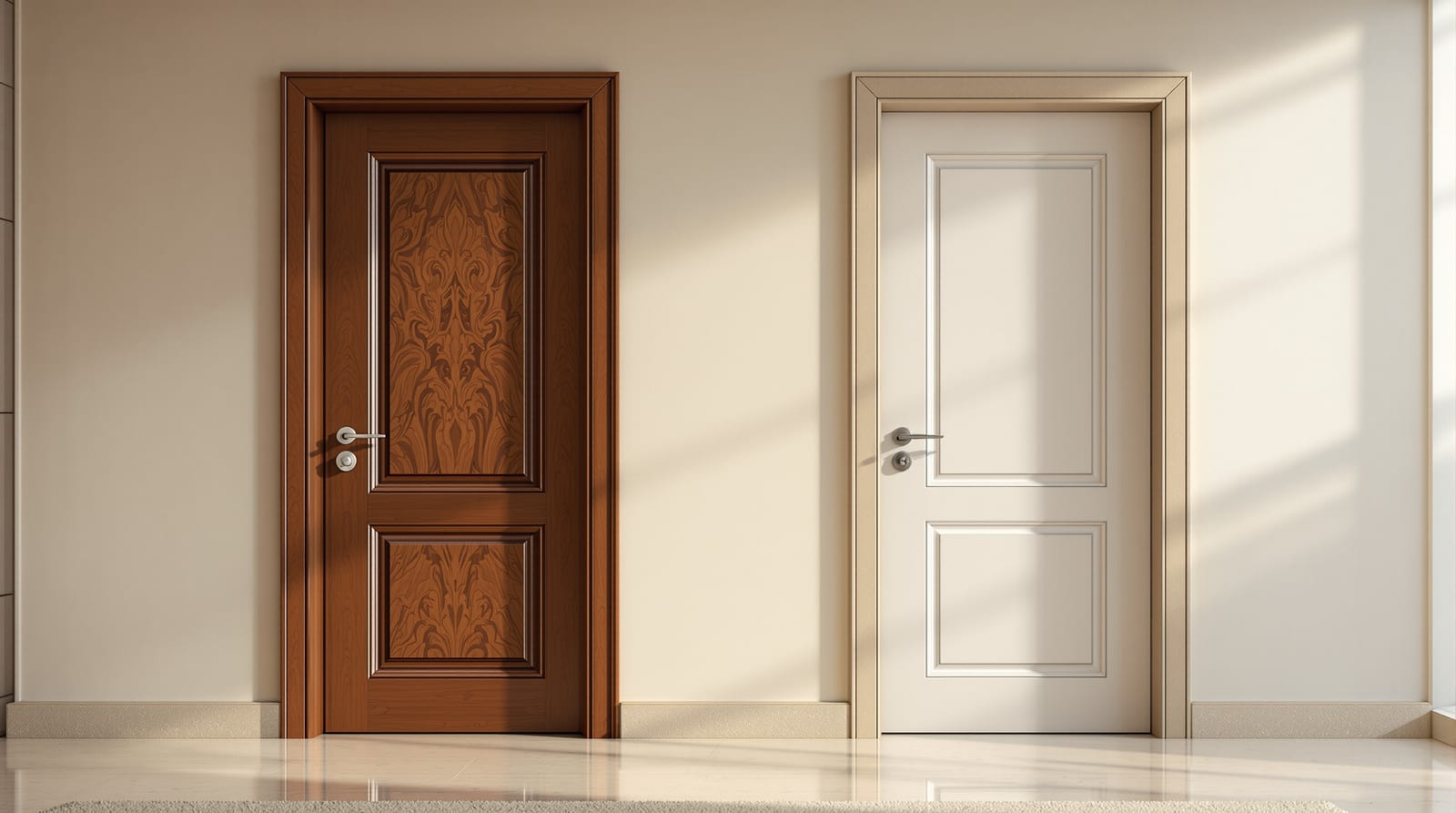
Premium vs Budget Door Brands: Worth It? India 2026
Where a premium door brand actually pays off in core quality, warranty and service — and where budget or unbranded is genuinely fine.
Walk into any plywood market and you will be offered the "same" 7×3 ft flush door at ₹2,000, ₹3,800 and ₹6,500 — and the salesman will swear all three are solid-core BWR. The premium vs budget door brands question is really a question about what you cannot see: the core packing, the glue, the moisture resistance, and whether anyone will honour a warranty when the door swells in your second monsoon. This guide unpacks what extra money buys, where it is wasted, and how to split a whole-home order so you spend on the few doors that matter and save on the rest. For the underlying numbers, keep the master 2026 door cost guide open alongside this.
Premium vs budget door brands: the three tiers
India's door market sorts roughly into three tiers. The labels matter less than what each tier actually controls.
| Tier | Typical names | What you're really paying for | Flush door supply (₹, before GST) |
|---|---|---|---|
| Premium / national | CenturyPly (Century Doors), Greenpanel, Greenply, Merino, Action Tesa, Duroply | Audited core, consistent glue line, factory QC, traceable warranty, dealer network | 5,000–7,000+ |
| Mid / regional brand | Alstone, Kitply, Sarda Ply, Bright Doors, strong local mills | Decent core, named warranty, patchier QC and finish | 3,500–5,000 |
| Budget / unbranded | Local "factory" doors, no-name flush | Looks identical on day one; core and glue are a lottery | 1,800–3,200 |
For uPVC the gap is even starker: established names like Fenesta (DCM Shriram), Weatherseal (Asian Paints), Aparna Venster and LG Hausys sit clearly above unbranded fabricators on profile quality, hardware and installation discipline. There the brand is buying you the system, not just the leaf — see best uPVC door brands India.
What you actually get for paying more
Ignore the showroom and look at five things that separate tiers.
Core quality and what's inside the leaf
A flush door is judged by its core. A premium solid-core BWR door uses properly seasoned, tightly packed timber battens with boiling-water-resistant phenolic glue; a budget door may use loose, green, or hollow-ish packing with cheaper urea-formaldehyde glue that lets go in humidity. You only discover the difference when the door warps, sags on its hinges, or the laminate bubbles. Premium brands run the door through factory pressing and QC; an unbranded mill does not. If you want the material logic first, read best flush door brands India and the broader door materials comparison India.
Quality control and consistency
The single biggest premium-brand advantage is consistency. Order ten branded doors and they arrive the same thickness, same finish, same squareness. Order ten unbranded doors and you may get two that are 2–3 mm off, which the carpenter then "adjusts" — costing you fit, gaps and time on site.
Warranty that is actually honoured
Budget doors often carry no real warranty, or a verbal one that evaporates. Premium brands publish warranties and, crucially, have a dealer and service chain to honour them. A warranty is only worth the company standing behind it — covered in detail in our door warranty guide India.
| Warranty norm (indicative, varies by brand) | Premium / national | Mid brand | Budget / unbranded |
|---|---|---|---|
| Stated warranty | Typically 7–15+ years (some flush doors longer) | Often 3–7 years | Usually none / verbal |
| Covers core delamination | Broadly yes | Sometimes | Rarely |
| Service chain to claim | Dealer + company | Dealer-dependent | None |
| Proof needed | GST invoice, batch/warranty card | Invoice | — |
Treat the numbers above as norms, not promises — always read the actual warranty card and keep the GST invoice.
Finish longevity
A premium laminate or membrane door holds its surface for years; a cheap finish chips at the edges, fades, or peels at the lock cut-out within a couple of seasons. On a frequently touched door this is the difference you notice daily.
After-sales service
When something goes wrong, a branded dealer is a phone call; an unbranded "factory" is often untraceable. This matters most for uPVC and hardware, less for a back-bedroom flush door. See door after-sales service India.
Where budget or unbranded is genuinely fine
Paying premium prices on every door is the most common over-spend we see. Low-use internal doors — a guest bedroom, a store, a dry utility room — do light duty in a controlled, dry environment. A sound mid-brand or even a decent unbranded solid-core door (bought after physically checking weight, squareness and edge) will serve for years. The risk in a budget door is mostly about moisture and heavy use, and a dry low-traffic room has neither.
The rule of thumb: spend where the door faces water, weather, security or constant use; save where it does not.
When to splurge, when to save
- Splurge — main door. It is your security, your first impression, and the one door you cannot easily swap later. A premium hardwood, teak or designer leaf with a branded multi-point lock is money well spent. See main door cost India.
- Splurge — wet areas. Bathrooms and balconies destroy budget wooden doors. A branded WPC or uPVC door here saves you a costly replacement in three years — compare options in WPC doors India.
- Splurge — hardware on used doors. A ₹300 lock on a daily-use door fails fast; a Godrej, Yale or Dorset lockset is cheap insurance. See door hardware guide India.
- Save — low-use internal doors. Mid-brand solid-core flush doors are the sweet spot. You get a real warranty and consistency without premium markup.
- Save — anything hidden or rarely opened. Behind-furniture, store and dry-utility doors do not justify premium spend.
Cost-versus-value: a 3BHK split
Here is how a typical 3BHK (≈12 doors) looks if you blanket-buy premium versus split intelligently. All figures are supply-only, before 18% GST, at the national average.
| Approach | Main door | 2 wet-area doors | 9 internal doors | Indicative total (supply, +18% GST) |
|---|---|---|---|---|
| All premium | Premium teak/designer ₹35,000 | Premium WPC ₹6,500 each | Premium flush ₹6,000 each | ~₹1,02,000 |
| Smart split | Premium teak/designer ₹35,000 | Premium WPC ₹6,500 each | Mid-brand flush ₹4,000 each | ~₹84,000 |
| All budget | Unbranded panel ₹15,000 | Unbranded "WPC" ₹4,000 each | Unbranded flush ₹2,500 each | ~₹45,500 |
The smart split costs roughly the same on the doors that matter while trimming the rest — and crucially keeps a real warranty on the main and wet-area doors. Going all-budget saves the most upfront but loads risk onto exactly the doors most likely to fail. Add roughly ₹1,000–₹2,500 per door for installation and frame on top, and remember city pricing shifts the whole table — Mumbai runs ~20% above and Lucknow ~8% below national average. Work your own city using door cost by city and the door cost by city calculator.
To model your exact door mix and brand tiers, the door budget planner and door brand comparison tool let you compare tier by tier before you walk into a showroom.
How to buy smart in any tier
- Always get a GST invoice (doors attract 18% GST). No invoice means no warranty and no recourse.
- Don't buy on the label alone — physically check the door: lift it (a real solid-core door is heavy), check it is square, tap for hollow spots, and inspect edge banding and the lock cut-out.
- Match the door to its environment: BWR/BWP grade or WPC/uPVC for anything near water.
- Get the warranty in writing and keep the batch/warranty card with the invoice.
- Compare a written quotation across two or three dealers before committing — see door quotation guide India.
Frequently asked questions
Are premium door brands actually worth the extra money?
For the main door, wet-area doors and daily-use hardware — yes, clearly. You are paying for core quality, consistency, a warranty that is honoured, and a service chain. For low-use dry internal doors, a mid-brand door usually delivers most of the benefit for less, and the premium is hard to justify.
Is an unbranded door always bad?
No. A well-made local solid-core door can be perfectly fine for a dry, low-traffic room — if you inspect it physically (weight, squareness, edges) and accept there is no warranty. The danger is buying unbranded for a bathroom, balcony or main door, where failure is likely and replacement is expensive.
How can I tell a real solid-core door from a hollow one?
Lift it — a genuine solid-core BWR door is noticeably heavy. Tap across the face: hollow or loosely packed cores sound drum-like in patches. Check the cross-section at the lock cut-out if you can. Premium brands also stamp grade and batch details you can verify.
Should I match the brand across the whole house?
You don't have to. A common, sensible approach is a premium main door, branded WPC/uPVC for wet and external areas, and consistent mid-brand flush doors for bedrooms. Keeping internal doors one brand does help them look and fit uniformly.
Does a longer warranty mean a better door?
It usually correlates, but the warranty is only as good as the company honouring it. A 15-year warranty from an untraceable seller is worthless; a 7-year warranty from a national brand with dealers is real. Judge the company and the service chain, not just the number — read the door warranty guide India.
Where does the brand premium matter least?
On doors that are dry, low-traffic and out of sight — store rooms, dry utility, behind-furniture doors. Here, spending up to premium tier rarely pays back. Put that saved budget into your main door, wet areas and locks instead.
Export this guide
Related Guides — Deep-dive reading
Best Door Brands in India: Complete Buyer's Guide 2026
A balanced guide to India's leading flush, WPC and uPVC door brands — who makes what, warranty norms, dealer reach and how to pick for your budget.
Home Doors & EntrancesGuest Room Door in India: Privacy, Quiet and Smart Picks Without Overspending (2026)
How to choose a guest bedroom door for an Indian home - privacy and acoustics so visitors feel comfortable, but budget-sensible for a room used only now and then: solid-core flush for quiet, panel or laminate for looks, the right privacy lock, simple soundproofing, and a finish that matches the rest of your doors - with picks ranked and indicative rupee costs.
Home Doors & EntrancesDoor Cost in Hyderabad: Prices, Markets, GST Guide 2026
What doors really cost in Hyderabad in 2026 — city index 1.05, worked examples with 18% GST, and the markets where people actually buy.
Home Doors & EntrancesRelated Tools — Try Free
Door Cost Calculator
Estimate the all-in cost of a door — leaf, frame, hardware, fitting and GST — by type, material and size.
Door CalculatorDoor Material Comparison Tool
Compare 2–4 door materials on cost, durability, maintenance, security and moisture resistance.
Comparison ToolMaterial Comparison Sheet
India's interior material cheatsheet — plywood, finishes, hardware, countertops, paints, waterproofing.
Reference Guide