
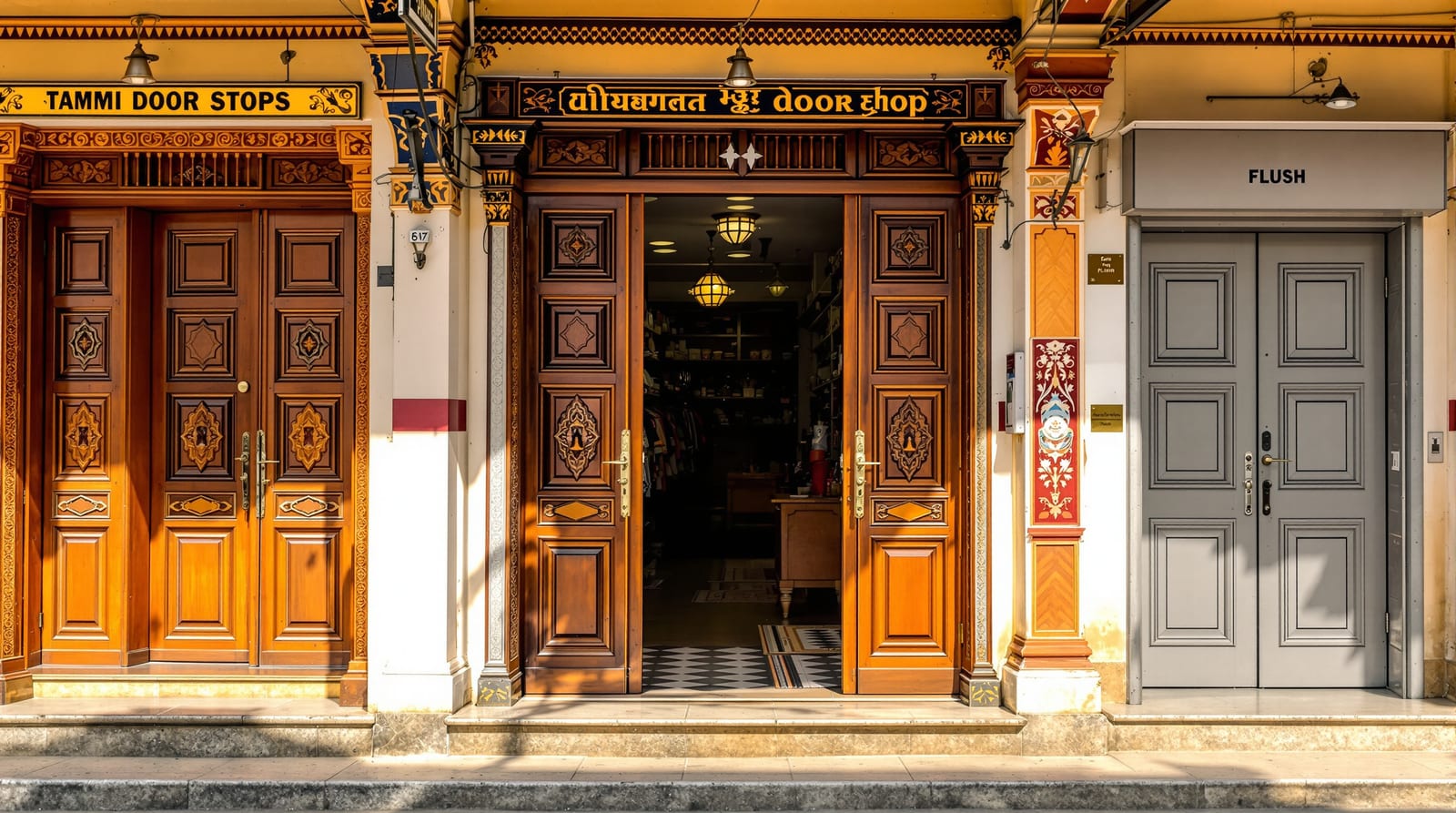
Door Cost in Chennai (2026): Prices, Markets & Buying Guide
What doors really cost in Chennai in 2026 — city index 1.08, worked examples with 18% GST, real markets and coastal-climate advice.
Figuring out the door cost in Chennai in 2026 means starting from the national average and then adjusting for the city. Chennai sits at a cost index of 1.08 — about 8% above the pan-India benchmark — because of higher labour rates, showroom real-estate costs, and the premium the city's hot, humid coastal climate puts on moisture-resistant timber and engineered doors. This guide gives you supply-only and installed price ranges, worked examples with 18% GST, the real markets where Chennai families actually buy, and honest advice on which materials survive the monsoon. For the all-India picture first, see the master 2026 door cost guide and the city overview in door cost by city.
How the Chennai index works
Every price below is a pan-India supply-only average for one standard 7×3 ft (2.1×0.9 m) leaf, then multiplied by Chennai's 1.08 index. Supply-only means the door leaf alone — frame, hardware, fitting and GST are extra. A finished, hung door always costs noticeably more than the leaf sticker price, so read the installed column carefully.
| Door type | India avg supply (₹) | Chennai supply ≈ ×1.08 (₹) |
|---|---|---|
| Hollow-core flush (commercial) | 1,800–3,000 | 1,950–3,250 |
| Solid-core flush (BWR) | 3,000–5,500 | 3,250–5,950 |
| Laminate / membrane flush | 4,000–7,000 | 4,300–7,550 |
| WPC door | 4,500–7,500 | 4,850–8,100 |
| PVC door (bathroom) | 1,800–4,000 | 1,950–4,300 |
| uPVC door | 8,000–16,000 | 8,650–17,300 |
| Sal / hardwood panel | 9,000–16,000 | 9,700–17,300 |
| Teak panel / carved | 22,000–45,000+ | 23,750–48,600+ |
| Designer main door | 30,000–80,000+ | 32,400–86,400+ |
These are indicative ranges, not quotes. Actual numbers swing with timber grade, thickness, finish and your negotiating room. Always ask whether a price is supply-only or installed.
A worked example, with 18% GST
Say you want a solid-core BWR flush door for a bedroom. The national average is around ₹4,000; in Chennai it runs roughly ₹4,320 supply-only. Now build up the full installed cost:
| Line item | Chennai estimate (₹) |
|---|---|
| Solid-core flush leaf (supply) | 4,320 |
| Sal frame (per door) | 2,160–3,780 |
| Basic hardware set | 1,300–2,700 |
| Fitting / installation | 1,080–2,700 |
| Subtotal (before GST) | 8,860–13,500 |
| GST on doors @ 18% | 1,595–2,430 |
| Total installed, GST-inclusive | ₹10,455–₹15,930 |
So a single "₹4,000" flush door realistically becomes ₹10,000–₹16,000 hung and taxed in Chennai. A whole 3BHK with 10–14 doors lands in the ₹1.4L–₹4L+ band depending on how many are teak versus flush. Use the door cost by city calculator to model your exact door count, or the door GST calculator to split tax cleanly on a quotation.
Where to buy doors in Chennai
Chennai has well-established timber and door hubs. These are real, long-standing markets where families and contractors source doors — visit a few before you commit, and compare the same spec across at least three sellers.
- Pulianthope and Saidapet timber yards — historic clusters for sal, teak and hardwood sections; good for custom-made panel and carved main doors through local carpenters.
- NSC Bose Road / Sowcarpet (George Town) — hardware, locks and fittings wholesale; useful for Godrej, Yale, Dorset and Europa locksets at keener prices.
- Mount Road (Anna Salai) and OMR showrooms — branded flush, WPC, laminate and uPVC doors from CenturyPly/Century Doors, Greenpanel, Greenply, Action Tesa and uPVC names like Fenesta and Aparna Venster.
- Padi, Ambattur and Poonamallee High Road — building-material belts on the city's industrial fringe, often cheaper for bulk flush and frame orders.
- Madhavaram and Red Hills timber depots — north-Chennai yards strong on frame timber and seasoned hardwood.
For the broader decision of showroom versus internet, see door showroom vs online in India and the practical steps in where to buy doors in India.
What drives the price in Chennai
The 1.08 index is not random. A few local forces push Chennai a little above the national line:
- Labour and carpentry rates in the metro are higher than in tier-2 Tamil Nadu towns; skilled teak carving labour especially commands a premium.
- Showroom and real-estate costs along OMR and Anna Salai feed into branded-door pricing.
- Coastal climate raises the bar on material quality — buyers correctly avoid the cheapest hollow-core flush, lifting the average spend.
- Timber availability is decent thanks to old George Town and Madhavaram trades, which keeps teak and sal more competitive here than in, say, landlocked northern cities — a partial offset that keeps Chennai below Bengaluru (1.15) and Mumbai (1.20).
Compare neighbouring Tamil Nadu pricing in door cost in Coimbatore, and the wider region in the south India door buying guide.
Coastal climate: choose materials that survive Chennai
Chennai is hot, salty and humid, with a sharp north-east monsoon (October–December). That climate is hard on doors, and it shapes what locals buy.
| Material | Coastal verdict in Chennai |
|---|---|
| Cheap hollow-core flush | Avoid for any external or wet area — swells, delaminates and warps in monsoon humidity |
| Solid-core BWR flush | Acceptable indoors with good edge-banding and a sealed bottom; keep away from bathrooms |
| WPC | Excellent for bathrooms, balconies and utility — waterproof, termite-proof, no swelling |
| uPVC | Strong for external and rear doors near the coast; salt- and weather-resistant |
| Teak | The gold standard for main doors — dense, oily, stable in humidity, ages beautifully |
| Sal hardwood | Good value frame timber; durable when seasoned and treated |
Two Chennai-specific habits make sense: a carved teak main door is a deep tradition in Tamil homes — it signals welcome, suits Vastu thinking (see Vastu for the main door), and genuinely outlasts cheaper options in this climate. And for bathrooms, balconies and back doors, WPC or uPVC is the practical pick because monsoon swelling will wreck a low-cost flush door within a couple of seasons. Read WPC door price in India and teak door cost in India for material deep-dives, and coastal-region door buying for the full salt-air checklist.
Smart ways to control your Chennai door budget
- Mix tiers deliberately. Splurge on one teak main door; use BWR flush internally and WPC in wet zones. This is where most of a sensible ₹1.5L–₹2.5L 3BHK budget goes.
- Always confirm supply-only vs installed, and get GST shown as a separate 18% line. A verbal "₹5,000" often hides frame, fitting and tax.
- Buy frames and hardware separately from George Town wholesale rather than bundling at a single showroom markup.
- Get three written quotations for the identical spec — see the door quotation guide — and use the spread to negotiate.
- Time bulk orders before monsoon, when carpenters have capacity and timber is drier.
Frequently asked questions
How much does a main door cost in Chennai in 2026?
A branded flush or laminate main door runs roughly ₹6,000–₹12,000 supply-only, while a solid teak panel or carved main door starts around ₹24,000 and easily crosses ₹48,000+ for ornate work — all before frame, hardware, fitting and 18% GST. Most Chennai families budget ₹35,000–₹70,000 all-in for a statement teak main door.
Why are doors more expensive in Chennai than the national average?
Chennai's cost index is 1.08, so doors sit about 8% above the pan-India average. The drivers are higher metro labour and carpentry rates, showroom real-estate costs, and a climate that pushes buyers toward better materials. It is still cheaper than Bengaluru or Mumbai partly because local timber trades keep teak and sal competitive.
Which door material is best for Chennai's climate?
For main doors, teak — dense, oily and stable in humidity. For bathrooms, balconies and external rear doors near the coast, WPC or uPVC, which are waterproof and salt-resistant. Avoid cheap hollow-core flush doors anywhere they may meet moisture, as monsoon humidity makes them swell and delaminate.
Is GST included in Chennai door quotes?
Often not. Doors attract 18% GST (wooden and flush under HSN 4418; uPVC and PVC under HSN 3925). Always ask the dealer to show the tax as a separate line so you can compare like with like. The door GST guide explains the HSN codes in detail.
Where do people in Chennai actually buy doors?
Timber and carved doors come from Pulianthope, Saidapet and Madhavaram yards; branded flush, WPC and uPVC doors from showrooms on Anna Salai (Mount Road) and OMR; and hardware from the George Town / NSC Bose Road wholesale market. Padi and Ambattur belts are popular for bulk and budget buying.
How much should I budget for all doors in a 3BHK in Chennai?
A 3BHK typically has 10–14 doors. With a mix of one teak main door, BWR flush bedrooms and WPC bathrooms, expect roughly ₹1.4L–₹2.5L installed and GST-inclusive for a sensible spec, rising to ₹3.5L–₹4L+ if most doors are premium teak or designer pieces.
Export this guide
Related Guides — Deep-dive reading
Door Cost in Hyderabad: Prices, Markets, GST Guide 2026
What doors really cost in Hyderabad in 2026 — city index 1.05, worked examples with 18% GST, and the markets where people actually buy.
Home Doors & EntrancesSouth India Door Buying Guide: Prices & Brands India 2026
Where South Indians buy doors, what teak, WPC and uPVC cost across Bengaluru, Chennai, Hyderabad and Kochi, and how to spec for heat and monsoon.
Home Doors & EntrancesDoor Cost in Chandigarh (2026): Tricity Buyer Price Guide
What doors really cost across Chandigarh, Mohali and Panchkula in 2026 — worked examples with 18% GST and the local markets where people actually buy.
Home Doors & EntrancesRelated Tools — Try Free
Door Cost Calculator
Estimate the all-in cost of a door — leaf, frame, hardware, fitting and GST — by type, material and size.
Door CalculatorDoor Material Comparison Tool
Compare 2–4 door materials on cost, durability, maintenance, security and moisture resistance.
Comparison ToolFalse Ceiling Cost Estimator
Live ₹/sqft across 8 ceiling types — POP, gypsum, designer, metal, PVC, wooden — with cove and spot lighting for 20 Indian cities.
Cost Calculator