
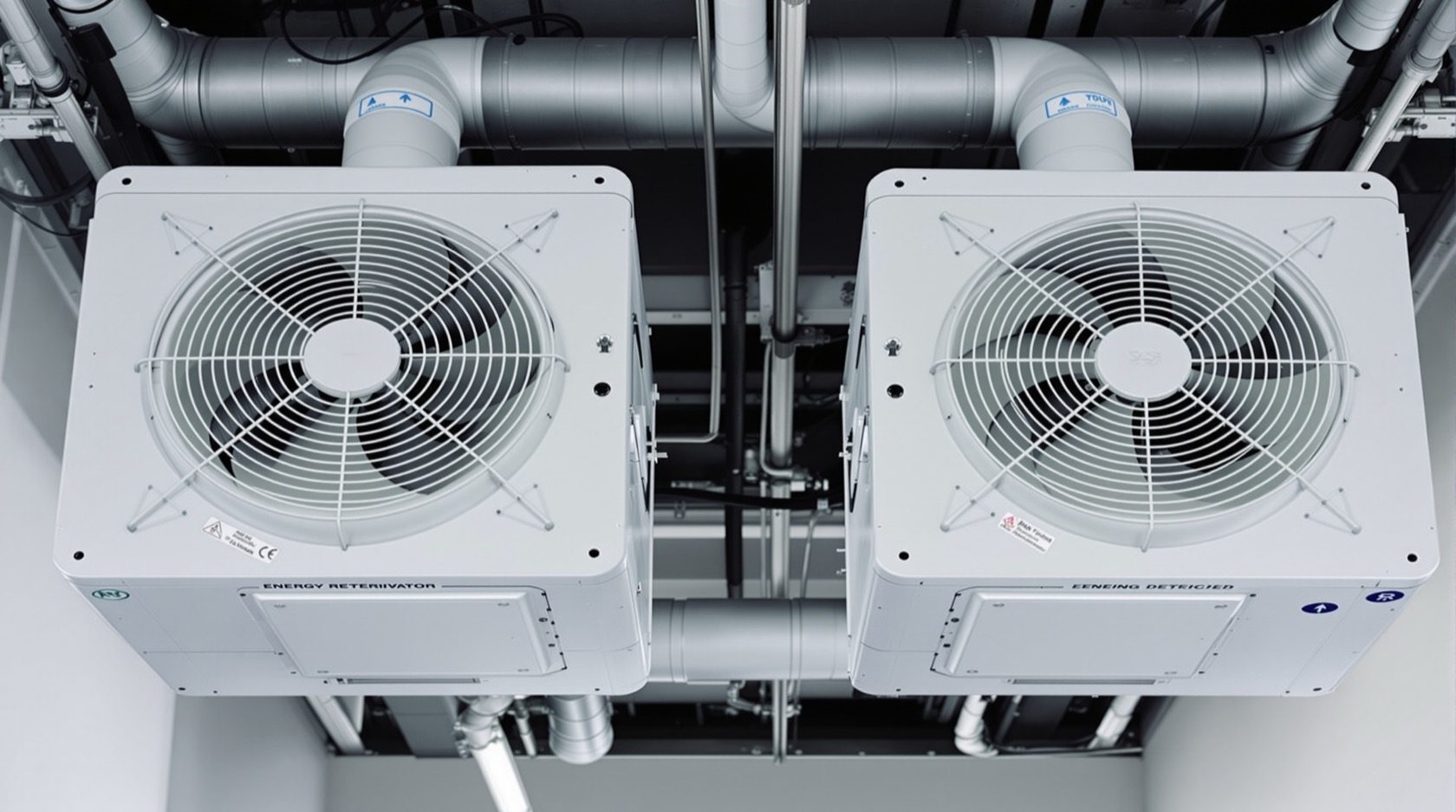
HRV vs ERV: Which Recovery Ventilator Suits India?
One letter, one big difference — how a heat recovery ventilator and an energy recovery ventilator differ in what they recover (heat only vs heat and moisture), and why that makes the ERV the usual choice for India's hot, humid climate.
When you specify a recovery ventilator to bring fresh air into a sealed, air-conditioned building efficiently, you meet two options separated by a single letter: HRV and ERV. They look and work almost identically — both swap energy between outgoing stale air and incoming fresh air — but differ in what they recover, and that one difference decides which suits your climate. For most of India, the answer leans clearly one way. This guide settles the HRV-vs-ERV comparison.
It builds on the HRV & ERV Guide, part of the HVAC Knowledge Hub.
The safety line & scope. Both are engineered ducted systems — design, sizing and installation are qualified HVAC work. This guide helps you understand and specify the right one.
The one difference that matters
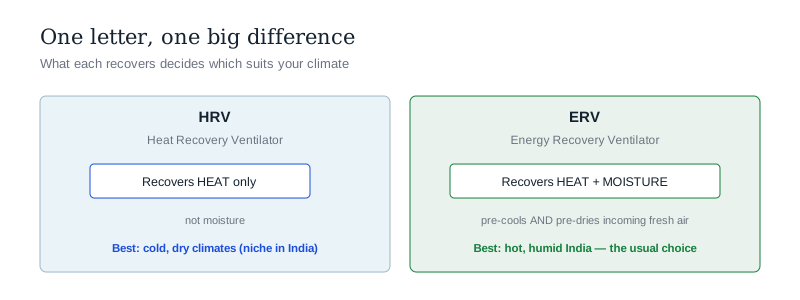
Both pass outgoing and incoming air through a heat exchanger that swaps energy without mixing the streams (see the HRV/ERV guide). The difference:
- HRV (Heat Recovery Ventilator) — recovers heat (temperature) only. It transfers heat between the streams, but not moisture.
- ERV (Energy Recovery Ventilator) — recovers heat and moisture (humidity). Its exchanger transfers some water vapour too, so it manages the humidity of the incoming air as well as its temperature.
That's the whole distinction: HRV = temperature only; ERV = temperature + humidity.
At a glance
| HRV | ERV | |
|---|---|---|
| Recovers | Heat only | Heat + moisture |
| Manages incoming humidity | No | Yes |
| Best climate | Cold & dry | Hot & humid (and mixed) |
| In cooling | Pre-cools fresh air | Pre-cools and pre-dries fresh air |
| India suitability | Niche (hill stations, dry) | Usual choice |
Why ERV usually wins in India
The climate makes the case:
- India is largely hot and often humid — so managing the moisture of incoming fresh air matters, not just its temperature.
- In cooling, an ERV pre-dries as well as pre-cools the incoming fresh air, reducing the dehumidification load on the AC — a real efficiency and comfort gain in humid conditions.
- It stops sticky outdoor humidity flooding in with the fresh air, which a plain HRV would let through.
- So for coastal, monsoon and most Indian conditions, the ERV is the usual, better choice.
When an HRV makes sense
The narrower case for HRV:
- Cold, dry climates — hill stations and the far north in winter, where you want to keep warmth in without transferring moisture, and humidity control isn't the concern.
- Where indoor humidity must be actively expelled rather than partly retained (specific process needs).
- For most Indian buildings, though, these are niche — the ERV's moisture management is what the climate calls for.
The one-line answer
HRV and ERV are nearly identical recovery ventilators — both swap energy between outgoing stale air and incoming fresh air through a heat exchanger — separated by one difference: what they recover. An HRV recovers heat (temperature) only, while an ERV recovers heat and moisture (humidity). That makes the ERV the usual, better choice for India's hot, humid climate, because in cooling it pre-dries as well as pre-cools the incoming fresh air, cutting the AC's dehumidification load and stopping sticky outdoor humidity flooding in — a real comfort and efficiency gain on the coasts, in the monsoon and across most Indian conditions. An HRV suits cold, dry climates (hill stations, far-north winters) where you want to keep warmth without transferring moisture — a niche case in India. So: think ERV by default here, HRV for cold-dry exceptions.
Where to go next
- Both in depth: HRV & ERV Guide.
- The ventilation picture: Home & Building Ventilation Guide.
- The humidity it manages: Humidity Control Guide.
- The air quality it protects: Indoor Air Quality Guide.
References
- ASHRAE Standard 62.1 (ventilation & IAQ) and energy-recovery guidance; ISHRAE ventilation & IAQ guidance.
- Bureau of Energy Efficiency (BEE) — ECBC / Eco Niwas Samhita (energy recovery): https://beeindia.gov.in/
- National Building Code of India, SP 7 (Part 8 — Building Services, mechanical ventilation; verify current edition), BIS.
Recovery ventilators are engineered systems; the right choice depends on climate and is sized and installed by qualified HVAC professionals. Verify any standard's current status via the BIS catalogue before relying on it.
Export this guide
Related Guides — Deep-dive reading
Bathroom Ventilation India: The Complete Guide to Moisture, Mould, NBC 2016 Air Changes & Windowless Solutions
Why bathroom ventilation matters more than any fitting in an Indian home — how moisture, mould and odour build up, natural versus mechanical options, what NBC 2016 actually requires, how to size a fan by air changes and CFM, and how to ventilate a windowless bathroom that stays dry through the monsoon.
BathroomsHome Heating in India: Where It Matters and What Actually Works
India is cooling-dominant, but heating matters more than it seems — hill stations, North-Indian winters and, above all, hot water in every home. A grounded overview of the options (heat pumps, water heaters, radiant, room heaters, solar) and how to choose without wasting energy.
HVAC & CoolingDesigning a Naturally Energy-Efficient Indian Home
Comfort first, gadgets last — passive design, orientation, insulation, ventilation and the climate wisdom that cuts Indian energy bills
SustainabilityRelated Tools — Try Free
Cooling Cost Comparison Calculator
What a ceiling fan, an air cooler and an AC each cost to run per year, side by side — weigh running cost against comfort.
HVACCross-Ventilation Analyzer
Estimate airflow and air changes per hour (ACH) from room size, window areas, layout, and local wind — with NBC 2016 Part 8 compliance check.
Ventilation CalculatorDoor Laminate Finish Selector
Answer a few questions and get a recommended door laminate finish family — woodgrain, solid, textured, gloss or matte.
Design Selector