
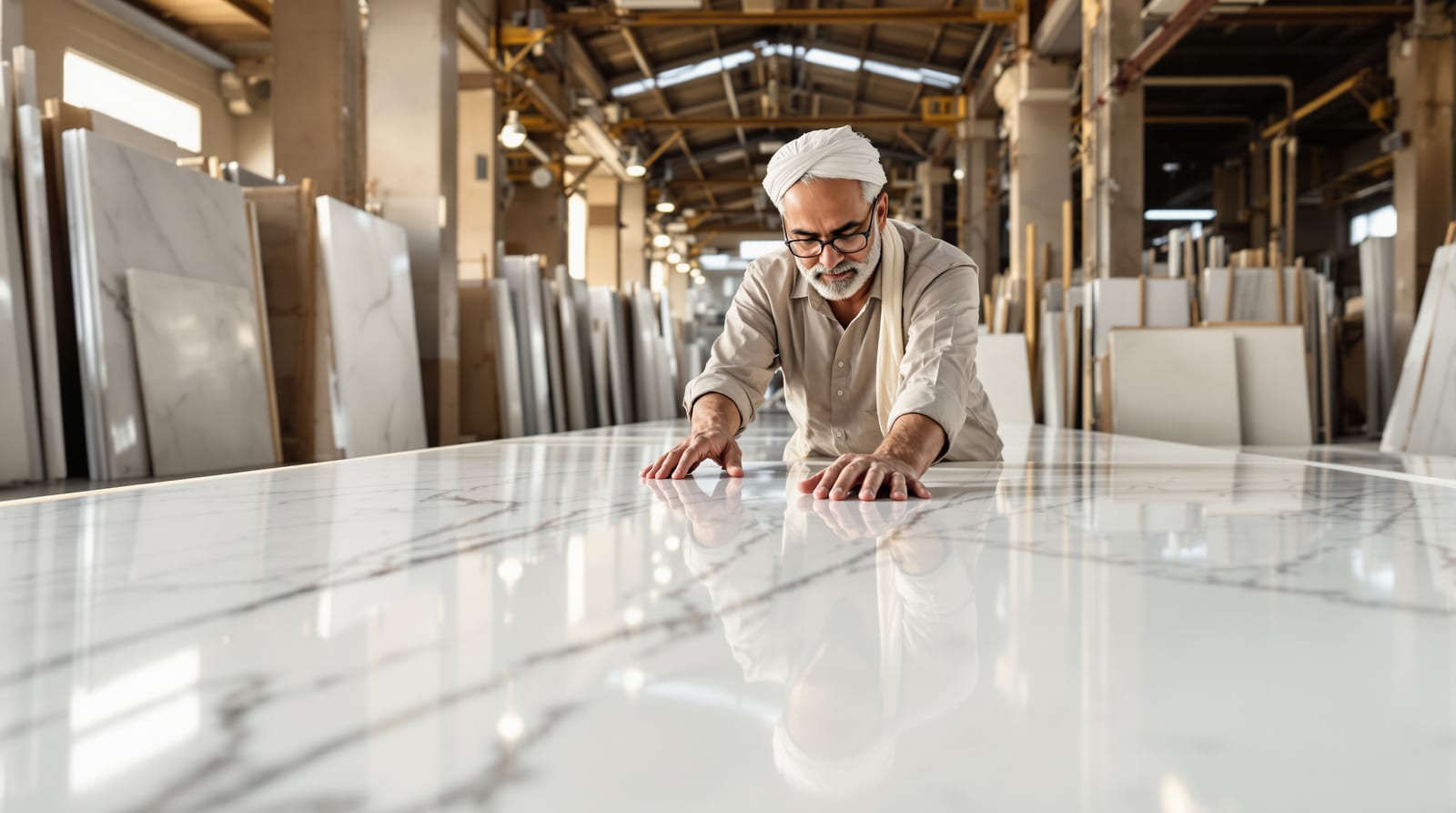
How to Buy Marble in India Without Getting Cheated (2026 Buyer's Guide)
Inspect full slabs in daylight, spot resin fills and the 'Italian marble' relabelling scam, read grades and thickness, and price a job all-in — from Makrana and Kishangarh to your floor.
Marble is one of the few building materials where the difference between a beautiful floor and an expensive regret is decided in a single afternoon at the yard. The slab you approve is the slab you live with for decades, and the trade knows that most homeowners cannot read a slab. This guide shows you exactly how to buy marble in India without getting cheated — what to inspect in daylight, how to catch resin fills and the "Italian marble" relabelling scam, how grades and thickness work, and how to price the whole job before you pay a rupee.
Why marble buying goes wrong
Marble is sold as full slabs, not boxed tiles, so there is no ISI box mark, no fixed MRP, and no two slabs are identical. Pricing is per square foot but negotiable, quality is judged by eye, and the same stone can carry three different names and three different prices in the same market. Add resin treatments that hide cracks, "imported" labels stuck on Indian stone, and quotes that quietly leave out cutting and transport, and it becomes very easy to overpay for inferior stone.
The defence is simple but non-negotiable: see the actual slabs, in daylight, before money changes hands — never buy marble from a phone photo or a sample chip alone. Our broader marble flooring guide covers where marble suits your home; this guide is purely about the transaction.
Inspect the full slab in daylight — the core skill
Yard lighting is deliberately warm and dim, which flatters stone and hides flaws. Insist that slabs be stood up and tilted toward natural light, or photographed by you under daylight, then walk through every point below. A reputable dealer in Kishangarh or Makrana will expect this.
Veining and pattern. Decide whether you want consistent linear veining (calmer, easier to book-match) or dramatic random veining. Crucially, ask to see ALL the slabs from the same block or lot together — colour and vein density drift across a quarry, and you do not want one yellow slab in a grey floor. For a continuous floor, buy from one block where possible.
Cracks vs veins. A vein is a colour band that sits flush with the surface. A crack is a physical fracture you can often feel with a fingernail or see as a fine line that interrupts the polish. Run your hand across; tilt the slab so light rakes across the surface — cracks throw a shadow line that veins do not. A dull thud on tapping (versus a clear ring) signals a hidden crack.
Resin fills and patches. Most commercial marble today is resin-treated: the back is meshed and surface pits are filled with clear or tinted epoxy. Light filling is normal and acceptable. Heavy filling that bridges cracks is a defect being hidden. Spot it by looking for glossy patches that reflect differently from the stone, slight colour mismatches, or areas that feel softer. Under daylight at a low angle, resin reads as a faint film. Ask directly: "Is this slab resin-treated, and where are the fills?" — and watch the answer.
Colour consistency and patches. Reject slabs with obvious putty patches (a different-coloured plug filling a hole), bleeding rust spots, or large dull "dead" zones where the polish will not hold. Lay candidate slabs side by side and step back ten feet.
Polish and surface. The polish should be even and mirror-like on a polished finish, with no orange-peel haze or swirl marks. Pooled water should bead and the reflection stay sharp.
SVG: where to look on a slab
Inspection checklist table
Carry this to the yard.
| Check | What to do | Pass | Reject / negotiate |
|---|---|---|---|
| Daylight view | Tilt slab toward sun or daylight | Even colour, sharp reflection | Only shown under warm yellow lamps |
| Whole lot | See all slabs from the block together | Consistent shade & veining | One-off slab, big shade drift |
| Cracks | Rake light, fingernail, tap test | Clear ring, no shadow lines | Dull thud, fine fracture lines |
| Resin/fills | Look for glossy film at low angle | Minor backing resin only | Heavy fills bridging cracks |
| Putty patches | Scan for plugged holes | None in visible field | Coloured plugs, rust bleed |
| Polish | Bead water, check reflection | Mirror-even | Haze, swirl, dead matte zones |
| Thickness | Measure edge with tape/vernier | 18–20 mm slab, 16–18 mm tile | Under-thickness, uneven edge |
| Squareness | Check edges & corners | Straight, square | Bowed, chipped edges |
| Backing | Inspect rear | Sound, lightly meshed | Thick mesh hiding many cracks |
Thickness — measure it yourself
Thin slabs save the seller money and crack under load. Standard floor marble slabs run 18–20 mm thick; marble cut into tiles is typically 16–18 mm. Measure the slab edge yourself with a tape or vernier; do not trust a quoted number. Thinner stock (10–12 mm) exists for cladding and counters but is risky for floors with point loads. Under-thickness is a legitimate reason to renegotiate price.
Indian vs imported — and the "Italian marble" scam
India produces world-class marble: Makrana (Nagaur, Rajasthan — the Taj Mahal stone, dense and ageing beautifully), Rajnagar/Morwad/Udaipur whites and the famous Udaipur greens, Banswara, and Ambaji. Imported marble — true Italian (Statuario, Carrara, Botticino), Spanish, Greek, Turkish, Egyptian — commands a large premium for whiteness and fine grain.
The most common cheat is relabelling: cheaper imported or Indian stone sold as "Italian marble" at Italian prices. "Italian marble" is not a grade — it is an origin claim, and origin is exactly what gets faked. Protect yourself:
- Ask for the country of origin in writing on the quote and invoice.
- Genuine imports arrive in blocks/slabs with quarry/exporter markings, a bill of entry and customs documentation — ask to see them for high-value Italian stone.
- Compare the offered price against the realistic market band for that named stone. A "Statuario" at half the going rate is not Statuario.
- Remember dealers use loose trade names ("Italian Statuario", "Italian White") for Indian or third-country stone. The name on the wall is marketing, not proof.
Our dedicated guides on Italian marble flooring and Indian marble flooring compare the genuine articles, and the Rajasthan marble guide maps the home varieties in detail.
Natural vs reconstituted / engineered marble
A trap for the unwary: "marble" tiles that are not solid natural stone.
- Natural marble — quarried slabs, each unique, the subject of this guide.
- Reconstituted / engineered marble (also "agglomerate" or "composite marble") — crushed marble chips bound in resin/cement and cast into slabs. Very uniform, cheaper, often glossier, but softer, less heat-tolerant, and can yellow or scratch with age. Legitimate, but it must be sold as engineered marble, not passed off as natural.
- Marble-look vitrified tiles are a different product entirely — see our marble vs vitrified comparison.
Tell-tales of engineered slabs: an unnaturally repeating pattern, perfectly even colour, resin smell, and identical "veining" across many slabs. Ask the seller to state natural or engineered on the bill.
Grades and where they come from
Marble has no single national letter-grade like a school exam; the trade ranks slabs by stone variety, source block, defect level and finish. In practice you will hear: premium (clean, first-quality, low fills), standard/commercial (some fills, minor variation), and economy/second (heavy fills, patches — fine for low-traffic or back areas, not the living room). Refer to broad standards under the natural stone standards guide (IS 1130 covers marble blocks, slabs and tiles), and apply the same slab-inspection discipline regardless of the grade label.
Sourcing: Makrana and Kishangarh
Buying near the source cuts cost and breakage. Kishangarh (Ajmer, Rajasthan) is Asia's largest marble market — thousands of yards selling Indian and imported stone, full slabs, processing and cut-to-size, with the keenest prices and the widest choice. Makrana is the place for the legendary dense white. Udaipur/Rajnagar covers whites and greens; see Udaipur green marble and Indian marble types by region.
If you are far from Rajasthan, you will buy through a city dealer who stocks from these markets — fine, but the inspection rules and the origin question matter even more, because you cannot easily walk the quarry yourself.
Cut-to-size, wastage and who lays it
You can buy raw slabs and have your contractor cut on site, or order cut-to-size pieces from the yard. Slab buying is cheaper per square foot but generates off-cuts and breakage; budget 10–15% wastage (more for rooms with many angles or borders). Cut-to-size reduces site mess but costs more and ties you to exact measurements — measure twice. Always agree who bears the cost of breakage during cutting and who supplies the wastage allowance.
Marble laying is skilled work — full mortar bed, careful levelling, then grinding and polishing on site to a mirror finish (see marble polishing and care). Use an experienced marble mason, not a general tile-layer; a poor polish ruins good stone. Confirm whether the price is supply-only or supply-and-lay, and check the laying labour against your city in our marble flooring cost guide.
Price, GST and the all-in number
Quotes per square foot are only the start. Build the ALL-IN cost before you commit, and get it in writing with the stone variety, origin and thickness named.
GST is where buyers get surprised: marble blocks are taxed at 12%, but marble slabs and tiles at 18%, and works-contract/labour at 18%. Always take a GST invoice — it is your proof of genuineness, your input credit if applicable, and your basis for any warranty claim. For transport, the seller must raise an e-way bill; insist on it for inter-state movement.
Cost-stack: what an all-in quote includes
| Line item | Typical basis | Notes |
|---|---|---|
| Marble (slab) | ₹/sq ft, varies hugely by variety | Indian commercial to premium imported is a wide band |
| GST on stone | 12% block / 18% slab-tile | Take a GST invoice always |
| Cutting / cut-to-size | ₹/sq ft or per piece | Plus 10–15% wastage on slab buys |
| Transport + loading | per trip + per slab handling | Big factor far from Rajasthan |
| Laying (works contract) | ₹/sq ft, 18% GST | Skilled marble mason |
| Grinding + polishing | ₹/sq ft on site | Decides the final look |
| Skirting, grouting, sealing | ₹/sq ft | Often left out of headline quotes |
Estimate your job with the marble flooring cost calculator, and apply the general flooring quality inspection discipline to delivery — count slabs, check for transit cracks before unloading, and note breakage on the challan.
Scam-watch table
| Scam / trap | How it works | How to defeat it |
|---|---|---|
| "Italian marble" relabel | Indian/third-country stone sold as Italian | Demand origin in writing + bill of entry; check price band |
| Resin hiding cracks | Heavy epoxy fills bridge fractures | Daylight low-angle inspection + tap test |
| Bait slab | Pristine sample, inferior bulk on delivery | Mark/photograph approved slabs; match on delivery |
| Under-thickness | 14–16 mm sold as 18–20 mm | Measure every slab edge yourself |
| Engineered as natural | Composite marble passed off as quarried | Look for repeat pattern; "natural" stated on bill |
| Wastage hidden | Quote on net area, no spare | Agree wastage % and who pays for breakage upfront |
| GST-free "discount" | No invoice, no recourse | Always take a GST invoice |
| Quote padding | Cutting/transport/polish added later | Get one written ALL-IN ₹/sq ft |
Frequently asked questions
How can I tell if marble has been relabelled as Italian?
You cannot tell from the surface alone — "Italian" is an origin, not a look. Get the country of origin written on the quote and invoice, ask to see customs/bill-of-entry documents for high-value imports, and sanity-check the price against the realistic market band for that named stone. A suspiciously cheap "Statuario" is the giveaway.
Is resin-filled marble bad?
Not by itself. Almost all commercial marble has some backing resin and minor surface fills, which is normal. The problem is heavy filling used to hide cracks. Inspect under raking daylight, do the tap test for a clear ring, and reject slabs where fills bridge fractures.
What thickness should marble flooring be?
Floor slabs are normally 18–20 mm and marble tiles 16–18 mm. Measure the edge yourself rather than trusting the quoted figure; under-thickness stock is weaker underfoot and a fair reason to renegotiate.
Is it cheaper to buy marble directly from Kishangarh or Makrana?
Usually yes — Kishangarh is Asia's largest marble market with the keenest prices, widest choice and on-site processing. But factor in transport and breakage to your city, and apply the same daylight inspection and written-origin discipline whether you buy at source or through a local dealer.
What is the GST on marble in India?
Marble blocks are taxed at 12%, while marble slabs and tiles are at 18%, and laying/works-contract at 18%. Always take a GST invoice for genuineness, warranty and any input credit, and ensure an e-way bill accompanies inter-state transport.
Export this guide
Related Guides — Deep-dive reading
Flooring Buying Mistakes in India: 12 Costly Purchase Errors and How to Avoid Them (2026)
From ordering the exact area with no spare and losing the dye-lot, to mixing calibre, buying seconds for living rooms, skipping the ISI mark, paying full advance and ignoring transport and loading charges, here are the purchase mistakes that quietly inflate a floor's true cost.
Flooring & SurfacesHow to Buy Floor Tiles in India: The Complete Buyer's Playbook for Size, Spec, Grade, Quote & Delivery (2026)
From deciding size, finish, PEI and water-absorption group for each room to reading the box spec and ISI mark, matching calibre and lot, spotting seconds, and getting an honest all-in quote.
Flooring & SurfacesSpotting Fake Tiles in India: How to Catch Seconds, Fake ISI Marks, Misrepresented Stone and Under-Spec Tiles Before You Buy (2026)
The trader's tricks and the buyer's counter-tests: seconds sold as first quality, fake or absent ISI marks, branded-look unbranded tiles, mislabelled water-absorption and PEI, resin-filled marble, dyed granite and relabelled imported stone.
Flooring & SurfacesRelated Tools — Try Free
Marble Flooring Cost Calculator
Estimate installed marble-floor cost — material, laying, grinding and polishing, sealing, wastage and GST.
Flooring CalculatorFlooring Cost Calculator
Estimate the all-in cost of a floor — material, laying, wastage, skirting and GST — by area and material.
Flooring CalculatorAI Measurement Tool
Measure your room using voice, photos, or video sweep — no tape measure needed.
DesignAI