
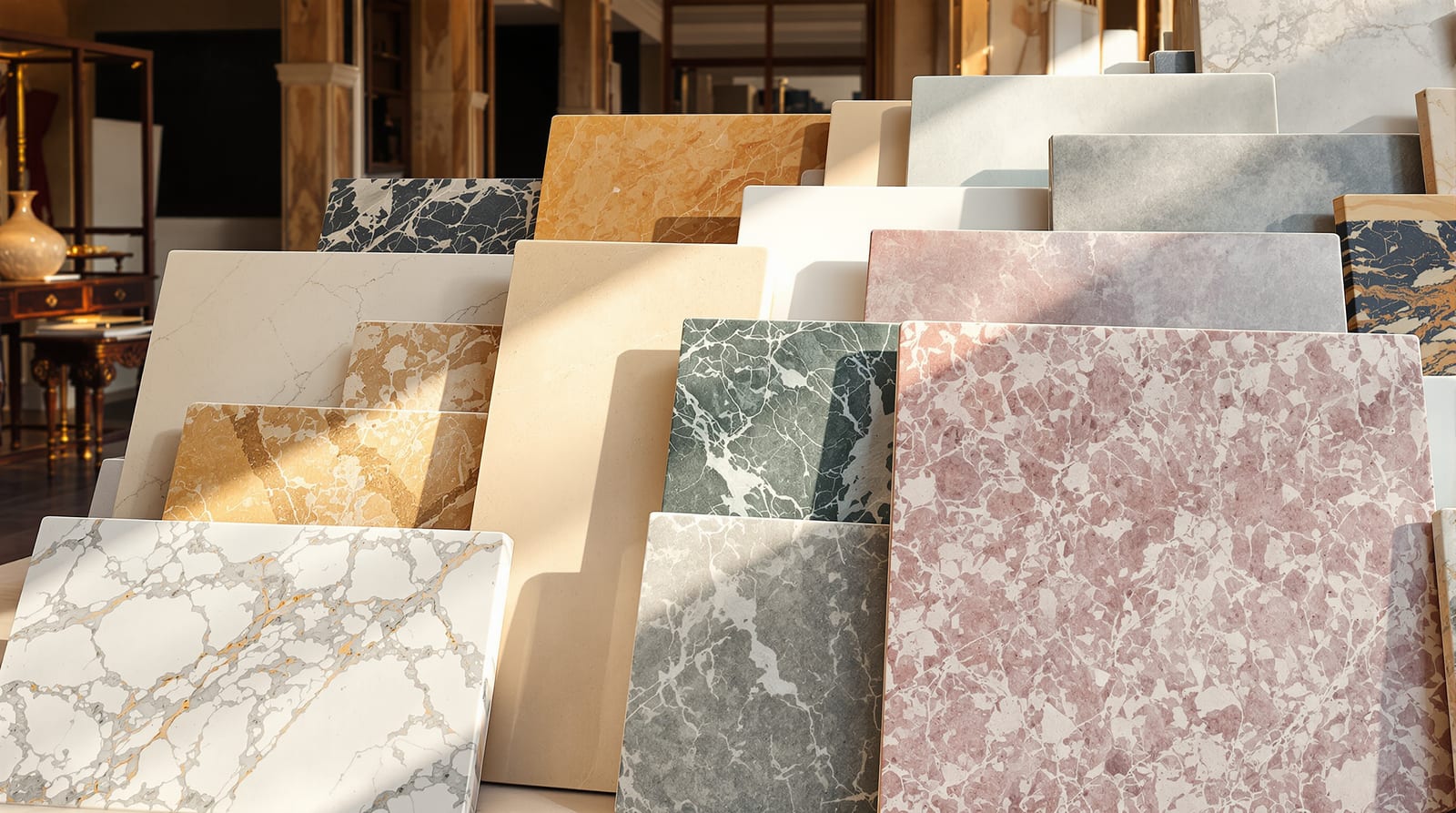
Indian Marble Types by Region: A State-Wise Map of India's Marble (2026)
The state-wise catalogue of Indian marble — Rajasthan, Gujarat, Andhra/Telangana, Madhya Pradesh and Maharashtra — with each region's signature varieties, colour, character, hardness, price per square foot and best use, so you can match a look to its source.
Indian marble is not one material — it is a dozen distinct stones, each carrying the geology and reputation of the place it was quarried. A white Makrana slab from Nagaur behaves nothing like a green serpentine from Udaipur or a cream-veined beige from Katni, even though every dealer files them under "Indian marble." Once you learn to read the country as a map of sources, the buying decision flips: instead of chasing a vague look in a showroom, you match the look you want to the state that produces it best, then buy as close to that source as your budget and transport allow. This guide is that map — region by region, variety by variety, with colour, character, hardness, real price bands and the rooms each stone actually suits.
How to read India as a marble map
Geology decided which states make which marble, and the trade grew around it. The Aravalli belt running through Rajasthan into Gujarat is India's calcite-marble engine — almost every famous white and beige comes from here, plus the green serpentine marbles near Udaipur. Madhya Pradesh adds its own calcite belt around Katni and Jabalpur, known for warm beiges. Andhra Pradesh and Telangana contribute coloured and "fancy" marbles from the Deccan. Maharashtra's contribution is smaller and more about traditional surfaces than branded slab marble.
Two practical truths follow from this. First, proximity to source is the single biggest lever on delivered price — marble is heavy, and transport across the country can add a meaningful amount per square foot, which is why marble is cheapest near Rajasthan and dearest in far cities like Kolkata. Second, Kishangarh in Rajasthan has become Asia's largest marble market, so even stone quarried elsewhere (and most imported Italian and Turkish marble) is processed and traded there. You can therefore buy almost any Indian variety in one mandi — but you pay for the slab to come to you. The deep-dive on the Rajasthan marble heartland covers that market town by town; this guide widens the lens to the whole country.
The diagram below places the main marble regions on an abstract map so you can see, at a glance, where each look comes from.
A quick note on hardness: marble is a soft stone overall, roughly 3 to 4 on the Mohs scale (calcite is 3). The greens and some "fancy" marbles run a little harder because of serpentine or dolomite content, but no natural marble is as scratch- and acid-resistant as granite. Treat every variety below as a beautiful interior stone that needs sealing and acid-free care, not a maintenance-free floor — the Indian marble flooring overview and marble polishing and care explain that upkeep.
The state-wise master table
This is the reference catalogue. Prices are indicative installed/slab ranges for 2026 and vary widely by quality, slab size, finish and your distance from the source; treat them as a starting point for negotiation, not a fixed rate.
| Region | Signature marbles | Colour / look | Approx. price (₹/sq ft) | Best use |
|---|---|---|---|---|
| Rajasthan (Nagaur) | Makrana — Doodh Sagar, Albeta, Kumari | Bright milky white, fine even grain, ages and yellows gracefully | 80–300+ | Temples, premium floors, statues, lobbies |
| Rajasthan (Ajmer) | Kishangarh — traded varieties + processing hub | Whole spectrum (market, not a single stone) | Varies by variety | Buy/process almost any Indian or imported marble |
| Rajasthan (Rajsamand) | Morwad, Rajnagar white | Soft white to off-white, light grey veining, economical | 45–120 | Budget-to-mid white floors, large areas |
| Rajasthan (Udaipur) | Udaipur green, Forest/Verde green | Deep green serpentine with white veining, slightly harder | 60–150 | Feature walls, accents, bands, low-traffic floors |
| Rajasthan (Banswara) | Banswara white / Banswara marble | White to greyish-white with grey veins | 50–110 | Mid-range floors, cladding |
| Gujarat (Sabarkantha) | Ambaji / Himmatnagar green, Ambaji white | Green serpentine and creamy white, durable | 50–130 | Accents, floors, cladding |
| Madhya Pradesh (Katni, Jabalpur) | Katni beige, Indian beige | Warm beige to cream with darker veining | 55–140 | Warm-toned living and bedroom floors |
| Andhra / Telangana | Coloured / "fancy" Indian marbles | Pinks, browns, greys, variegated patterns | 50–160 | Decorative floors, feature areas |
| Maharashtra | Local marble + traditional surfaces (Shahabad/IPS context) | Limited slab marble; more about cast/traditional floors | Varies | Traditional and budget surfaces |
The rest of the guide unpacks each region so you understand the character behind the numbers.
Rajasthan — the white-and-green heartland
Rajasthan is India's marble country, and it produces the two looks most buyers come for: pure white and deep green.
Makrana (Nagaur district) is the most famous Indian marble in the world — the stone of the Taj Mahal. It is a dense, fine-grained calcite white that takes a deep polish and, crucially, holds up over decades rather than crumbling or going dull. Within Makrana the trade distinguishes sub-varieties: Doodh Sagar (milky white with faint grey waves), Albeta (whiter, cleaner) and Kumari among them. It commands a premium and is the default for temples, statues and prestige floors. If you want a genuinely lasting white marble floor, this is the benchmark — and the reason "Makrana" is so often counterfeited, so origin matters.
Morwad and Rajnagar (around Rajsamand) are the workhorse whites — softer, slightly more open in grain, and far cheaper than Makrana. They cover huge floor areas affordably and are what most builders mean by "Indian white marble." Banswara marble, from the south of the state, is a white-to-greyish stone with characteristic grey veining, sitting in the mid range.
Udaipur green is Rajasthan's signature coloured marble — a serpentine green, ranging from forest to brighter verde, shot through with white veins. It is a little harder than the white calcites and visually dramatic, which is why it works best as feature walls, skirting bands, stair risers and accents rather than acres of floor. The dedicated Udaipur green marble guide goes deeper on its grades and quirks. For the markets, mandis and shipping logistics behind all of these, the Rajasthan marble guide is the companion to read next.
Gujarat — Ambaji green and Himmatnagar beige
Gujarat sits at the western end of the same Aravalli belt, so its marbles are cousins of Rajasthan's. The best known is Ambaji (and the nearby Himmatnagar belt in Sabarkantha district): a green serpentine marble similar in family to Udaipur green, plus a creamy Ambaji white. Gujarat green tends to be durable and is widely used for cladding, accents and low-to-medium-traffic floors. Because Gujarat is also India's ceramic-tile capital around Morbi, buyers here often weigh marble against high-end vitrified — a comparison the Indian marble flooring overview frames honestly. Practically, Ambaji and Himmatnagar marble is cheapest in Gujarat and the nearby western markets and gets dearer the further east you ship it.
Madhya Pradesh — Katni beige, India's warm cream
Move into central India and the palette warms. The Katni–Jabalpur belt in Madhya Pradesh produces Katni beige (often sold simply as "Indian beige"), a warm beige-to-cream marble with darker, flowing veins. It is the go-to Indian alternative to imported beige Italian marbles like Botticino and Crema Marfil, at a fraction of the price. Katni reads warm and inviting underfoot, which makes it popular for living-room and bedroom floors in homes that find pure white too cold or clinical. Quality varies a lot by lot — better Katni is uniform and well-veined, poorer material is patchy — so daylight slab inspection matters even more here.
Andhra Pradesh, Telangana and the south
The Deccan south is far better known for granite than marble — Ongole's Black Galaxy and the famous Absolute Black come from here, covered in the South India granite guide. But Andhra Pradesh and Telangana also yield a range of coloured or "fancy" Indian marbles: pinks, browns, greys and variegated patterned stones used for decorative floors and feature areas rather than plain fields of white. These travel less far as branded marbles than the Rajasthan whites, so they are most cost-effective bought within the south. If you are floor-shopping in the south, weighing local granite against shipped-in Rajasthan marble is the real decision, and the delivered (transport-loaded) price usually tips it toward granite.
Maharashtra and the traditional belt
Maharashtra produces relatively little branded slab marble compared with Rajasthan or MP. Its flooring identity leans instead on traditional surfaces — Shahabad stone (a limestone, not marble), terrazzo and Indian Patent Stone (IPS) cast floors, and the red-oxide tradition shared with the south. For a marble floor in Maharashtra you will mostly buy stone shipped from Rajasthan or Gujarat through Mumbai's dealers, so transport and the city's high labour rates dominate the budget more than the choice of variety.
Choosing a region for the look you want
Work backwards from the look and the room, then pick the source:
| You want… | Go to | Variety to ask for | Watch out for |
|---|---|---|---|
| A lasting, premium pure white | Rajasthan (Nagaur) | Makrana (Doodh Sagar, Albeta) | Counterfeits — verify Makrana origin |
| An affordable white for large floors | Rajasthan (Rajsamand) | Morwad / Rajnagar white | Softer, more porous — seal well |
| Deep green feature surfaces | Rajasthan / Gujarat | Udaipur green / Ambaji green | Best as accents, not whole busy floors |
| A warm beige / cream floor | Madhya Pradesh | Katni beige / Indian beige | Lot-to-lot patchiness — inspect slabs |
| Decorative coloured marble | Andhra / Telangana | "Fancy" Indian marbles | Limited reach — buy in the south |
| Imported white/beige looks | Kishangarh mandi | Italian/Turkish (relabelled often) | Verify true origin — see below |
Two cross-cutting cautions. First, "Italian marble" is the most relabelled term in the trade — much of what is sold as Italian is actually Indian or Turkish stone dressed up at a premium, so confirm origin paperwork; the slab-by-slab routine in how to buy marble in India walks you through it. Second, before you fall in love with marble at all, it is worth comparing its upkeep and cost against engineered surfaces — the Italian marble vs quartz comparison is the honest version of that conversation. Once you have settled on a region and variety, price the installed job with the marble flooring cost calculator and sanity-check it against the marble flooring overview.
Frequently asked questions
Which is the best Indian marble?
For a lasting pure-white floor, Makrana from Nagaur in Rajasthan is the benchmark — it is dense, fine-grained, the marble of the Taj Mahal, and it ages well rather than dulling. "Best" depends on the look, though: Katni beige is best for warm cream tones, Udaipur or Ambaji green for dramatic accents, and Morwad or Rajnagar for affordable white over large areas. Match the variety to the room and your budget.
Why is marble cheaper in some cities than others?
Marble is heavy, so delivered price tracks distance from the quarry. It is cheapest in and around Rajasthan (Jaipur, Udaipur, Kishangarh) and Gujarat, where it is produced, and dearest in far cities like Kolkata where transport, loading and handling stack onto the slab price. Buying closest to the source — or accepting that transport is a real line item in your quote — is the practical takeaway.
What is the difference between Makrana, Morwad and Katni marble?
Makrana (Nagaur, Rajasthan) is a premium dense white that ages gracefully. Morwad/Rajnagar (Rajsamand, Rajasthan) are softer, cheaper whites for large budget floors. Katni (Madhya Pradesh) is a warm beige-to-cream stone with darker veining, used where buyers want warmth instead of stark white. All three are calcite marbles around 3–4 on the Mohs scale and need sealing and acid-free care.
Is Indian marble harder or softer than Italian marble?
Both are calcite marbles in the same hardness range, roughly 3 to 4 on the Mohs scale, so neither is dramatically harder. The difference is mostly look, consistency and price: imported Italian beiges and whites are prized for uniformity and command a premium, while comparable Indian stones like Makrana white and Katni beige cost far less. Because "Italian" is frequently relabelled, verify origin before paying an import premium.
How do I avoid fake Makrana or relabelled Italian marble?
Insist on origin documentation, buy from established dealers, and inspect full slabs in daylight for veining, fills and resin patches. Genuine Makrana has a characteristic dense, fine white grain; relabelled "Italian" stone often cannot produce import papers. For any large or premium purchase, the slab-by-slab inspection routine in the how-to-buy-marble guide is your real protection, since natural stone carries no mandatory ISI mark.
Export this guide
Related Guides — Deep-dive reading
Flooring Cost Comparison Across Indian Cities 2026: Installed ₹/Sq Ft by Material
A single cross-city reference comparing installed flooring rates across Mumbai, Delhi-NCR, Bangalore, Hyderabad, Chennai, Pune, Kolkata, Ahmedabad and Jaipur — vitrified, granite, marble, wood/laminate and vinyl, plus laying labour — and why each city differs.
Flooring & SurfacesMarble Flooring in India: Indian vs Italian, Types, Cost & Care (2026)
Marble is India's aspirational natural-stone floor — cool underfoot, luxuriously veined and re-polishable. Here is the homeowner's honest guide to Makrana and the popular Indian types, Indian vs Italian marble, ₹/sq ft costs, the staining and etching downsides, where to use it and how it is laid and polished.
Flooring & SurfacesRajasthan Marble Guide: Makrana, Kishangarh & India's Marble Heartland (2026)
A buyer's guide to Rajasthan's marbles and markets — Makrana, Kishangarh, Rajnagar, Udaipur and Banswara — with varieties, looks, real prices per square foot, where to buy and how to ship to your city.
Flooring & SurfacesRelated Tools — Try Free
Flooring Cost Calculator
Estimate the all-in cost of a floor — material, laying, wastage, skirting and GST — by area and material.
Flooring CalculatorMarble Flooring Cost Calculator
Estimate installed marble-floor cost — material, laying, grinding and polishing, sealing, wastage and GST.
Flooring CalculatorGranite Flooring Cost Calculator
Estimate installed granite-floor cost — material, cutting, laying, polishing, sealing, wastage and GST.
Flooring Calculator