
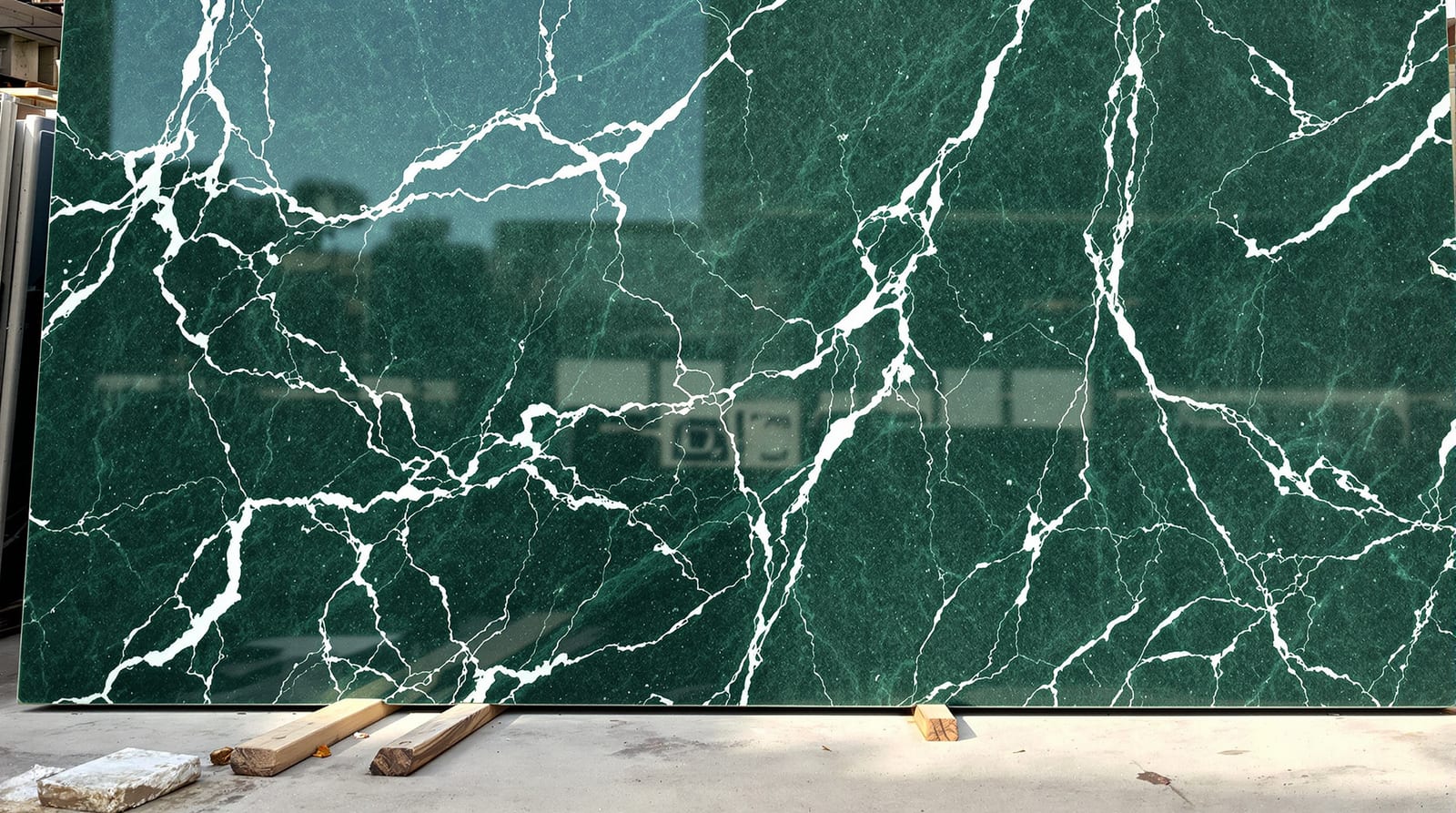
Green Marble Guide: Udaipur & Rajasthan's Deep-Green Stone (2026)
What Indian green marble really is, its grades and looks, real prices per square foot, where it suits a home, and how to seal and care for it.
Few Indian stones look as instantly luxurious as green marble — that rich, forest-green slab shot through with white and grey veins, quarried from the hills around Udaipur, Rajsamand and Kesariyaji in southern Rajasthan. It is one of India's great export stones, and you have probably seen it underfoot in a temple, a hotel lobby or a grand staircase. But "green marble" is a bit of a misnomer, and that single fact decides where you should — and should not — use it at home. This guide walks through what it really is, the grades and looks you will be quoted, honest prices per square foot, the best uses, and the sealing and care caveats nobody mentions at the showroom.
What green marble really is
Most so-called Indian green marble is not a true calcite marble at all. It is serpentine (technically serpentinite / verde antique) — a rock rich in serpentine minerals that takes a high polish like marble and so is sold under the marble name in the trade. This matters for three practical reasons:
- It is harder than ordinary white marble. Serpentine sits around 3–4 on the Mohs scale (some grades feel harder underfoot than soft Makrana white), so it resists scratching and foot wear a little better than soft calcite marbles.
- It is less acid-sensitive than calcite marble. A lemon or vinegar spill that would etch a dull mark on Makrana white usually does far less to green serpentine, because the chemistry is different. It is not acid-proof — just more forgiving.
- But it can react badly to water over time. This is the catch. Many green serpentine stones contain minerals that are sensitive to prolonged moisture; water can cause warping, curling at slab edges, cracking or dulling if the stone is wet-laid in a thick cement mortar bed or used in constantly damp areas. Reputable fabricators lay green marble with epoxy or thin-set adhesive rather than a wet cement bed, and keep it out of showers and wet kitchens.
So treat green marble as a beautiful, fairly tough decorative stone with one weakness — standing water — and you will use it correctly. For a broader primer on marble as a material, see our marble flooring guide, and for how Indian marble varies by source, our Indian marble flooring guide.
Where it comes from
The green-marble belt is concentrated in southern Rajasthan: the districts around Udaipur, Rajsamand (Rajnagar) and Kesariyaji (Rikhabdeo), with related material from Kesariyaji, Devimata and the wider Aravalli hills. Slabs and blocks are processed in and around Udaipur and traded heavily through Kishangarh, Asia's largest marble market, before being trucked across India or shipped for export. Because the source is in Rajasthan, green marble is cheapest in Udaipur, Rajsamand and Kishangarh and dearest in far metros once transport is added — the same logic that governs all Rajasthan stone, covered in our Rajasthan marble guide and Indian marble types by region.
Grades, looks and prices
Green marble is sold by appearance, and the names vary by dealer, but these are the broad grades you will be quoted. Prices below are indicative material rates per square foot (slab/tile, before laying and GST), 2026 — they vary widely by lot, slab size, thickness and how heavily veined and even-coloured the lot is. Add roughly ₹20–60/sq ft for laying depending on city, plus 18% GST on slabs/tiles.
| Grade / trade name | Look | Indicative ₹/sq ft (material) | Best suited to |
|---|---|---|---|
| Verde / plain green | Even deep green, light to moderate white veining | ₹70–130 | Accent floors, skirting, large even fields |
| Rainforest green | Dense green with dramatic flowing, branch-like veins | ₹120–250 | Feature walls, tabletops, staircase risers |
| Spider green | Green with a fine cracked-web "spider" pattern of white lines | ₹110–220 | Temple floors, statement areas, cladding |
| Forest / dark green | Very dark, near-black green, sparse veining | ₹100–200 | Borders, inlay, contrast bands |
| Premium export / book-matched | Hand-selected even colour, matchable veins | ₹200–400+ | Lobbies, luxury homes, export orders |
| Reconstituted "green marble" | Engineered chips in resin, very uniform | ₹60–120 | Budget cladding (not natural stone) |
Two cautions on price. First, very cheap "green marble" can be reconstituted (stone chips bonded in resin) or a green-dyed stone — natural serpentine has irregular, three-dimensional veining, not a printed-looking surface. Second, thickness drives both price and durability: insist on 16–18 mm for tiles and 18–20 mm for slabs; thin Chinese-import green tiles are cheaper but chip and curl more readily. For how prices stack up against other marbles, see our marble flooring cost guide (linked from the marble flooring page).
Reading the veining
The veining is the whole point of green marble, so it helps to know what you are looking at before you commit a lot. The white-and-grey lines are mineral veins running through the green serpentine body; a good slab has crisp, well-distributed veins with no resin-filled cracks masquerading as veins.
Where green marble suits — and where it does not
Green marble earns its place as an accent and feature stone, not usually as the wall-to-wall floor for a whole modern home. Its strengths are colour, polish and a sense of occasion; its weakness is moisture.
| Use | Verdict | Why |
|---|---|---|
| Temple / pooja room floor | Excellent | Dry, revered space; green reads as auspicious and rich |
| Feature / accent flooring band or rug | Excellent | A green inlay or border against white marble or beige tile |
| Staircase treads, risers, landings | Very good | Hard-wearing, dramatic; keep dry |
| Feature wall / cladding | Excellent | No foot traffic, shows veining beautifully |
| Tabletops, vanity tops (dry), reception desks | Good | Striking; seal and avoid standing water |
| Living / dining floor (full area) | Use with care | Fine if dry-laid and sealed; budget more than tiles |
| Bathroom / shower floor | Avoid | Constant water risks warping, dulling, cracking |
| Open kitchen wet zone, terrace, balcony | Avoid | Water and weather; choose a vitrified tile or granite instead |
For wet and outdoor areas, lean on more tolerant materials covered elsewhere on Studio Matrx rather than forcing green marble where it will struggle. It is a stone for the dry, celebrated parts of a home — which is exactly why it ends up in temples, lobbies and export containers. Green marble is one of India's strongest stone exports, valued abroad precisely for that deep colour at a price European green marbles cannot match.
Care, sealing and the water caveat
Green marble is low-maintenance for a natural stone, with three rules that flow directly from what it is:
1. Seal it, and reseal periodically. A penetrating (impregnating) stone sealer reduces staining and slows moisture uptake. Reseal accent floors every 1–3 years depending on traffic; our floor resealing guide covers how to test whether the seal has worn (the water-bead test) and how to reapply.
2. Keep it dry. Wipe spills promptly, never let water stand on it, and avoid wet-mopping with sloshing water — a damp microfibre mop is enough. Do not use it where water pools.
3. Use stone-safe cleaning. Avoid acids (vinegar, lemon, harsh bathroom cleaners) and abrasive scrubs; use a pH-neutral stone cleaner. Re-polishing (diamond pads / crystallisation) restores shine on worn floors much as it does for white marble.
Because the body is harder and less calcite-rich than white marble, green serpentine generally holds its polish better and shows fewer etch marks from minor acidic spills — but it is the moisture, not the acid, that ends most green-marble floors prematurely. Get the laying right (adhesive or thin-set, not a soaking wet bed) and keep it dry, and a green marble accent floor will outlast the fashion that put it there.
Buying tips
- Inspect full slabs in daylight, not just a sample tile. Look for resin-filled cracks, dull patches, colour mismatch between slabs, and "fills" used to disguise flaws. Natural serpentine has organic, varied veining.
- Buy one lot plus 5–10% spare. Green varies a lot block to block; a later top-up will not match. Reserve offcuts for repairs.
- Confirm thickness (16–18 mm tiles, 18–20 mm slabs) and ask whether it is natural serpentine or reconstituted — they are not the same product.
- Ask how it will be laid. A good fabricator will say adhesive/epoxy or thin-set, and will keep it out of wet areas. If a contractor wants to wet-lay green marble in a thick cement bed in a bathroom, walk away.
- Compare all-in ₹/sq ft — material + adhesive + laying + polishing + skirting + GST + transport — not just the slab rate. Green slabs are heavy; transport from the Udaipur/Kishangarh belt to a far metro can add a real per-square-foot premium.
- Get a GST invoice (slabs/tiles attract 18% GST; blocks 12%). The invoice protects you on genuineness and any input credit. For inter-state transport, the dealer should raise an e-way bill.
- Verify origin. "Italian" or premium green names are sometimes used loosely; Indian Udaipur/Rajsamand green is excellent stone in its own right and far better value — buy it as what it is. See how to buy marble in India for the full slab-inspection and quotation checklist.
Frequently asked questions
Is green marble actually marble?
Mostly no — most Indian green "marble" is serpentine (verde antique), a different rock that takes a marble-like polish and is sold under the marble name. It is harder and less acid-sensitive than true white marble, but more sensitive to standing water.
Is green marble good for flooring?
Yes, for dry accent and feature areas — temple floors, borders, staircases, feature bands and cladding. It is hard-wearing and striking. Avoid it in bathrooms, showers, wet kitchen zones and outdoors, where prolonged moisture can warp, dull or crack it.
How much does green marble cost per square foot in India?
Indicatively ₹70–130/sq ft for plain verde, ₹110–250 for rainforest or spider green, and ₹200–400+ for premium export grade (material only, before laying and 18% GST). Prices are lowest near Udaipur, Rajsamand and Kishangarh and rise with transport to far cities. Rates are indicative and vary by city and vendor.
Does green marble need sealing?
Yes. Use a penetrating stone sealer and reseal every 1–3 years on accent floors. Sealing slows staining and moisture uptake, which matters more for green serpentine than for white marble because of its water sensitivity.
Why does green marble crack or curl sometimes?
Almost always because it was wet-laid in a thick cement mortar bed or used in a constantly damp area. The minerals react to prolonged moisture, causing warping, edge-curling or hairline cracks. Laying it with adhesive or thin-set and keeping it dry prevents this.
Export this guide
Related Guides — Deep-dive reading
How to Buy Marble in India Without Getting Cheated (2026 Buyer's Guide)
Inspect full slabs in daylight, spot resin fills and the 'Italian marble' relabelling scam, read grades and thickness, and price a job all-in — from Makrana and Kishangarh to your floor.
Flooring & SurfacesMarble Flooring in India: Indian vs Italian, Types, Cost & Care (2026)
Marble is India's aspirational natural-stone floor — cool underfoot, luxuriously veined and re-polishable. Here is the homeowner's honest guide to Makrana and the popular Indian types, Indian vs Italian marble, ₹/sq ft costs, the staining and etching downsides, where to use it and how it is laid and polished.
Flooring & SurfacesComplete Home Flooring Guide for Indian Homes (2026)
The authoritative overview of every flooring family — tiles, stone, wood, vinyl and seamless — with India ₹/sq ft costs, room-by-room logic and laying basics.
Flooring & SurfacesRelated Tools — Try Free
Flooring Cost Calculator
Estimate the all-in cost of a floor — material, laying, wastage, skirting and GST — by area and material.
Flooring CalculatorMarble Flooring Cost Calculator
Estimate installed marble-floor cost — material, laying, grinding and polishing, sealing, wastage and GST.
Flooring CalculatorApartment Furniture Size Chart
Standard furniture dimensions for Indian apartments — sofas, beds, tables, dining, storage.
Reference Chart