
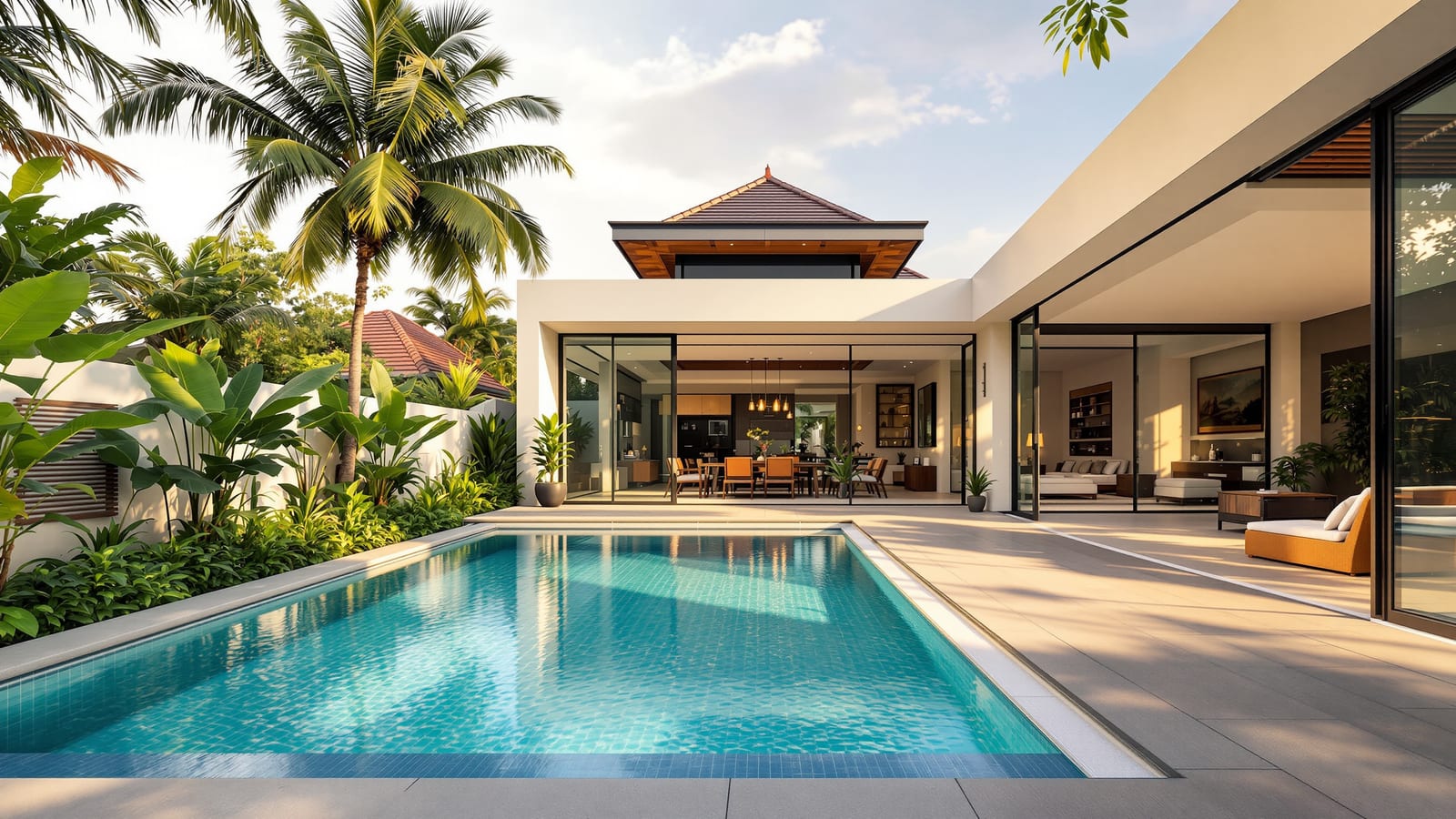
The Complete Home Swimming Pool Guide for India
Everything an Indian homeowner needs to plan, build, run and enjoy a home pool — types, sizes, cost, approvals, safety, Vastu, design and maintenance, in one place.
A swimming pool at home is one of those dreams that feels almost cinematic in the Indian heat: stepping out at 6 am for a few quiet laps, the kids splashing through a long summer holiday, friends drifting in for a Sunday brunch by the water. For a long time, a private pool was the preserve of farmhouses and luxury villas. Today, with smarter construction methods, compact designs and a maturing pool-building industry across our metros and tier-2 cities, a home pool is a realistic ambition for a much wider set of families, whether you have a sprawling plot in the suburbs or a tight terrace in the city.
But a pool is also a serious piece of engineering and a long-term commitment. It is a waterproofed concrete or fibreglass structure that has to survive monsoons, soil movement and decades of use; it needs filtration, plumbing and electricity running every day; and it carries genuine safety and water-use responsibilities. This pillar guide walks you through the whole journey, honestly: whether you should build one at all, how a pool actually works, the types and sizes that suit Indian homes, what it broadly costs, the approvals and rules to respect, the build sequence, and what life with a pool is really like once the construction crew leaves. Wherever money comes up, treat every figure as an indicative 2026 range that shifts with your city, builder, plot size, soil and finish, and always gather two or three written quotes before you commit.
Should you build a pool?
Before the romance, a few honest questions. A pool rewards families who will actually use it and who plan for its upkeep. It punishes those who treat it as a one-time purchase.
Space. A usable swimming pool needs more than the water rectangle. You need deck space to walk and lounge around it, a plant room for the filtration and pumps (even a compact one), and a setback from your boundary wall and from the house foundation. As a rough mental model, a modest 4 x 8 metre pool with decking and equipment can comfortably occupy a 60-80 square metre zone of your plot. If your usable open area is tight, that does not rule you out, but it points you toward compact and plunge-pool formats rather than a full lap pool.
Budget honesty. The build cost is only the first cheque. The pool then draws power, water, chemicals and either your time or a service contract every single month, for as long as you own it. If the monthly running cost would make you flinch, it is better to know that now than after the tiles are laid.
Use. Be honest about how often the pool will be swum in versus admired. A family with young children, daily swimmers or a genuine entertaining habit will get years of value. A pool built purely for resale appeal or a few weekends a year may disappoint relative to its cost.
Upkeep appetite. Pools are not fit-and-forget. Water chemistry, skimming, filter cleaning and seasonal care are non-negotiable. You can do this yourself or hire it out, but somebody has to do it every week. If neither you nor a service contract will reliably handle it, a pool will turn green and sad faster than you expect.
If you have read those four points and still want a pool, wonderful. Let us understand what you are actually building.
The anatomy of a pool
A pool looks like a simple box of water, but it is a small water-treatment system in disguise. Knowing the parts helps you read quotes, ask sharp questions and spot corners being cut.
- Shell. The structural body that holds the water, whether cast in reinforced concrete, moulded in fibreglass or lined in vinyl. This is the part that must never leak or crack, so waterproofing and structural detailing matter most here.
- Coping. The capping edge around the top of the pool where it meets the deck. It protects the shell edge, gives a comfortable handhold and sets much of the visual style.
- Waterline tile. The band of tile at the water surface where scum, oils and sunscreen collect. Being tiled here makes this grimy zone easy to scrub.
- Skimmer or overflow. The mechanism that draws surface water (and floating leaves and dust) into the filtration. A skimmer pool has discreet skimmer boxes set into the wall; an overflow or "infinity edge" pool lets water spill over an edge into a channel and a balance tank. Overflow systems look stunning but cost and complicate more.
- Returns or inlets. The jets that push clean, filtered water back into the pool, positioned to circulate the whole body of water so no dead corners go stagnant.
- Main drain. The outlet at the deepest point that helps circulation and allows the pool to be emptied. Modern practice uses anti-entrapment, dual-drain or domed covers so a swimmer can never be pinned by suction.
- Balance tank. A separate water reservoir that overflow pools need to absorb the surge when swimmers enter and to feed the pumps steadily.
- Plant room. The heart of the system: the pump, the filter (usually sand or cartridge), and the dosing or chemical-handling kit, plus valves and pipework. It can be a small underground chamber or a neat above-ground cabin, but it must be accessible for service.
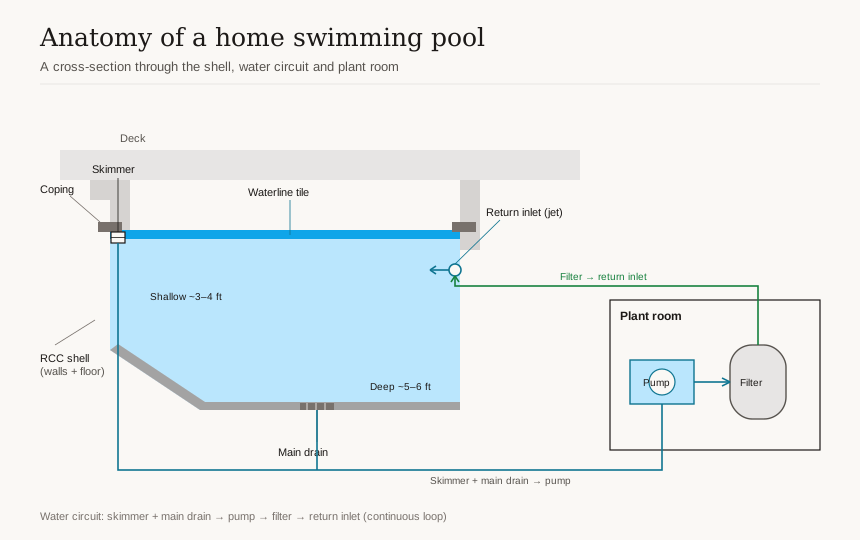
When you read a contractor's proposal, check that each of these is specified, not glossed over. A vague quote that does not mention filtration capacity, return positions or drain covers is hiding decisions you will pay for later.
Choosing a pool type
There is no single best pool, only the right trade-off for your plot, budget and patience. Here is the short version; for a deeper comparison see our guide to types of swimming pools.
| Type | Best for | Trade-offs |
|---|---|---|
| Concrete / RCC | Any shape or size, fully custom, long life | Longest build time; needs excellent waterproofing and skilled labour |
| Fibreglass | Faster install, smooth finish, lower upkeep | Limited to factory shapes and sizes; transport and crane access needed |
| Vinyl-liner | Lower upfront cost, soft finish | Liner needs periodic replacement; less common and serviced in India |
| Above-ground | Lowest cost, no excavation, semi-portable | Shorter life, more utilitarian look, less integrated with the home |
For most Indian custom homes that want a permanent, design-led pool, concrete/RCC remains the default because it adapts to any shape and any plot quirk. Fibreglass is winning fans where speed and lower maintenance matter and a standard shape fits. Above-ground pools are an excellent low-commitment way to test whether your family will actually use a pool before you dig.
How big, how deep
Size is where dreams meet plot reality. A few practical anchors:
- Depth. A typical home pool has a shallow zone of about 3 to 4 feet, comfortable for children, lounging and most adults, and a deeper zone of about 5 to 6 feet for proper swimming. You do not need a diving-pool depth for home use; deeper water only adds water volume, heating load and cost. A uniform 4 to 4.5 feet "sport depth" is increasingly popular because it suits the whole family and is cheaper to run.
- Length. For genuine lap swimming, longer is better, but even a 7 to 8 metre pool gives a satisfying swim with a turn. Many families happily settle for a relaxation pool rather than a lap pool.
- Small plots. Do not assume a tight plot rules you out. Plunge pools, compact lap pools and even spill-over courtyard pools can fit surprisingly small footprints, and a smaller pool costs less to build, fill, heat and maintain. See small swimming pools for homes for layouts that work in real Indian plots.
A quick way to sanity-check volume, chemical dosing and heating before you talk to anyone is our Pool Volume Calculator; it turns your length, width and depth into litres so the rest of the numbers make sense.
What it costs
Here is the honest truth: there is no single price for a home pool, and anyone who quotes you one without seeing your plot is guessing. Cost depends on size, depth, type (RCC versus fibreglass), finish (plain plaster versus imported mosaic), filtration grade, whether you want an overflow edge, heating, lighting, automation, and crucially your soil and site access.
As an indicative 2026 picture only, a basic compact home pool can start in the low single-digit lakhs, a well-built mid-range family pool typically lands in a higher band, and a large, design-led pool with overflow edges, premium finishes, heating and automation can run into many lakhs or more. These ranges vary widely by city, builder, size, soil and finish, so do not anchor on them. The right move is always to gather two or three written, itemised quotes and compare like for like.
To build your own ballpark before you call contractors, run our Pool Cost Calculator, and for the full breakdown of what drives the number up or down, read swimming pool cost in India. Pay special attention to the line items that are easy to under-quote: waterproofing, filtration sizing, the plant room, decking and the first year of chemicals.
Approvals, water and safety in India
This is the part homeowners most often skip and most often regret. Rules differ across states and municipalities, so treat the following as a map of what to check locally, not a national rulebook, and confirm everything with your local authority or a licensed professional.
Building-plan sanction. A swimming pool is a built structure and an excavation, so in many cities it must appear in your sanctioned building plan or require a separate permission from the municipal corporation or local planning authority. Whether and how this applies varies city to city; check before you dig, not after.
Water and groundwater. Filling and topping up a pool uses a lot of water. If you intend to use borewell or groundwater, extraction may require a No Objection Certificate from the Central Ground Water Authority (CGWA) or your State Ground Water Authority, and the abstraction structure may need a flow meter. This is an evolving area, so verify the current requirement for your district.
Discharge. You cannot simply drain pool water full of chlorine and chemicals into a storm drain or a neighbour's land. The Water (Prevention and Control of Pollution) Act, 1974 prohibits discharging untreated polluting matter into water bodies and drains. Plan for de-chlorination and responsible disposal or reuse of backwash and drain-down water.
Pool-specific codes. India has no single mandatory national private-pool code. Tamil Nadu is notable as the only state with a dedicated swimming-pool regulation. Elsewhere, requirements live inside general building bye-laws.
Safety standards. BIS published IS 16508:2017 covering swimming-pool safety, but a BIS standard is largely voluntary unless a local bye-law or authority specifically adopts and mandates it. So treat the following as essential best practice regardless of whether your municipality requires it:
- Fencing or a barrier with a self-closing, self-latching gate to keep unsupervised children away from the water.
- Clear depth markers at the shallow and deep ends.
- Anti-entrapment drain covers and dual-drain or split-suction designs so no swimmer can be held by suction.
- Constant adult supervision of children, which no equipment ever replaces.
- A handrail, ladder or steps, slip-resistant deck surfaces, and basic rescue and first-aid kit on hand.
The clean way to think about it: statutory requirements (plan sanction, water NOC, discharge rules) are non-negotiable and local; safety best practices are your responsibility to adopt fully even where no law forces you. A good local architect or contractor will know your city's specifics, and you can find a designer or contractor who has built pools in your area.
The build journey, step by step
A home pool is built in a fairly fixed sequence, and rushing any stage shows up later as a leak or a crack. Here is the path from idea to first swim.
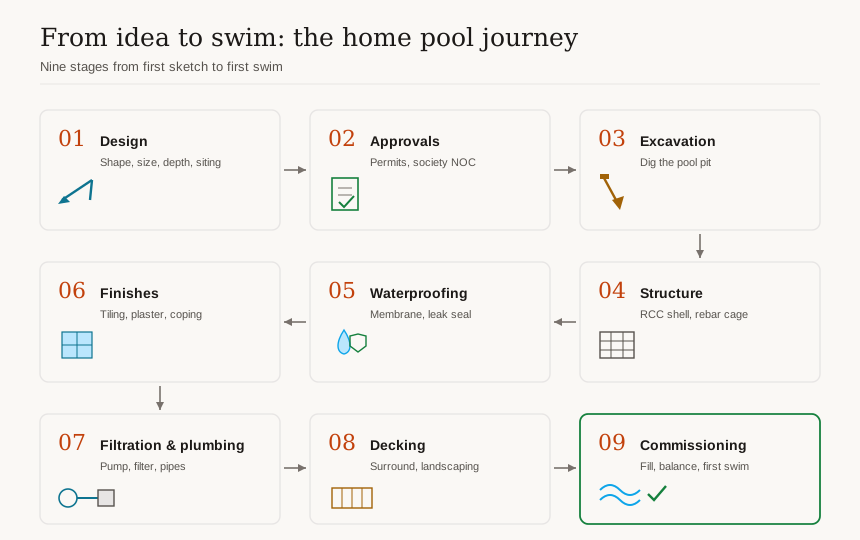
1. Design. Fix the type, size, depth, edge style, position on the plot and the look. This is where you align the pool with your home, your Vastu preferences and your landscaping.
2. Approvals. Secure the building-plan sanction, any water NOC and the discharge plan before excavation begins.
3. Excavation. Dig the pit to the designed shape, allowing for the shell thickness, services and over-dig for working room. Soil type heavily affects this stage.
4. Structure. For RCC, lay the reinforcement and cast the shell; for fibreglass, set the moulded shell and backfill carefully. Get the levels and bracing right.
5. Waterproofing. Arguably the single most important step. A quality membrane or coating system, properly lapped and tested, is what keeps water in and groundwater out for decades. Never let this be value-engineered down.
6. Finishes. Apply the internal finish (plaster, tile or mosaic), the coping, the waterline tile and the deck-edge details.
7. Filtration and plumbing. Install the pump, filter, returns, skimmers or overflow, main drain, balance tank and the plant-room kit, and pressure-test all pipework before it is buried.
8. Decking. Lay the surround, choosing slip-resistant, cool-underfoot materials suited to Indian sun.
9. Commissioning. Fill the pool, balance the water chemistry, run the system, check for leaks, train you on operation and hand over.
Ask your contractor for this sequence in writing with stage-wise payments tied to completed, inspected stages rather than dates. It protects both sides.
Living with a pool: maintenance and running cost
The build ends; the relationship begins. A pool stays clear, safe and inviting only with regular care: skimming the surface, brushing walls, emptying skimmer baskets, cleaning or backwashing the filter, and above all keeping the water chemistry balanced (chlorine or alternative sanitiser, pH, alkalinity) so the water is safe and the surfaces are protected.
You broadly have two routes. Doing it yourself with a test kit, chemicals and a little weekly discipline typically costs in the region of an indicative ₹2,000 to ₹3,000 per month in consumables for a modest pool, plus your time and the electricity to run the pump. A professional annual maintenance contract (AMC) hands the whole job to a service team and indicatively runs around ₹3,000 to ₹10,000 per month depending on pool size, visit frequency and what the contract covers. Both ranges vary with your pool's size, your local water quality, electricity tariff and how heavily the pool is used, so treat them as starting points, not promises.
To pressure-test your own monthly number before signing anything, use our Pool Maintenance Cost Calculator, and for the full care routine, season by season, read our pool maintenance guide. Budgeting realistically for upkeep is the single best predictor of whether you will love your pool five years in or resent it.
Vastu, design and landscaping
A pool is also a design centrepiece, and getting the placement, look and surroundings right turns a utility into the soul of the home.
- Vastu. Many Indian families want the pool positioned and oriented in harmony with Vastu principles, which carry views on direction, shape and placement relative to the house. Our guide to Vastu for swimming pools explains the common guidance so you can decide how much to weigh it.
- Design. From the water colour and tile to the edge style, lighting and the relationship with the house, design choices shape the entire mood. Browse pool design ideas for inspiration, and if the dramatic vanishing-edge look tempts you, read our dedicated infinity pools guide before committing to that extra cost and complexity.
- Landscaping. The planting, paving, shade, screening and poolside zones are what make a pool feel like a destination rather than a tank. Our pool landscaping guide covers plants that suit poolsides, materials that stay cool and safe underfoot, and how to frame the view.
Where to start
If your head is full of possibilities, here is the calm next step. First, get a feel for the numbers without committing to anyone: estimate your pool's water volume with the Pool Volume Calculator, build a rough budget with the Pool Cost Calculator, and check the ongoing reality with the Pool Maintenance Cost Calculator. These give you a defensible ballpark before any salesperson does.
Next, visualise it. Use DesignAI to picture how a pool, deck and landscaping could sit in your actual space, so you are reacting to images rather than abstractions. Then, when you are ready to turn the dream into a real project with proper approvals, waterproofing and safety, find a designer or contractor experienced with pools in your city, share your three quotes and let them guide the local specifics.
A home pool is a big, joyful commitment. Build it with open eyes, honest budgets and respect for the rules and the upkeep, and it will repay you with years of cool mornings and happy evenings by the water.
Export this guide
Related Guides — Deep-dive reading
The Homeowner's Guide to Compound Walls and Gates in India (2026)
A plain-language, start-to-finish walkthrough of building a boundary wall and gate in India — plan and permit first, then material and height, foundation and structure, building and supervision, the gate, finishes, lighting and greenery, budget and long-term upkeep — with a stage-by-stage roadmap, a full planning checklist and answers to the questions every homeowner asks.
Compound WallsSwimming Pool Maintenance: The Complete Home Guide
Filtration, sanitising, water chemistry and a simple weekly routine — how to keep a home pool clean, safe and clear, what it costs, and when to call a professional.
Swimming PoolsRoof Access & Walkways
Someone will need to get onto your roof several times a year — to clear a drain, service the tank, wash the solar panels, check the waterproofing. Access designed into the house is far safer and cheaper than a ladder propped against a wall. This guide covers the ways up (mumty stairs, fixed ladders, hatches, loft ladders), the ways around (walkways and duckboards over fragile or waterproofed surfaces), and the guardrails and anchor points that make maintenance safe.
RoofingRelated Tools — Try Free
Swimming Pool Cost Calculator
Estimate a home pool's build cost by type, size and finish, with an indicative range and a build breakdown.
Pool CalculatorMonsoon-Readiness Checklist
Pre-rain home audit across 9 categories — terrace, drains, waterproofing, electrical, HVAC, pest, vehicles, documents.
Seasonal AuditPool Maintenance Cost Calculator
Monthly and yearly running cost of a home pool — chemicals, electricity, water and service, DIY vs AMC.
Pool Calculator