
Infinity Pools: How They Work and What They Cost
The vanishing-edge effect explained — the weir wall, catch basin, balance tank and second pump — why infinity pools cost more, where they work, and whether one is right for you.
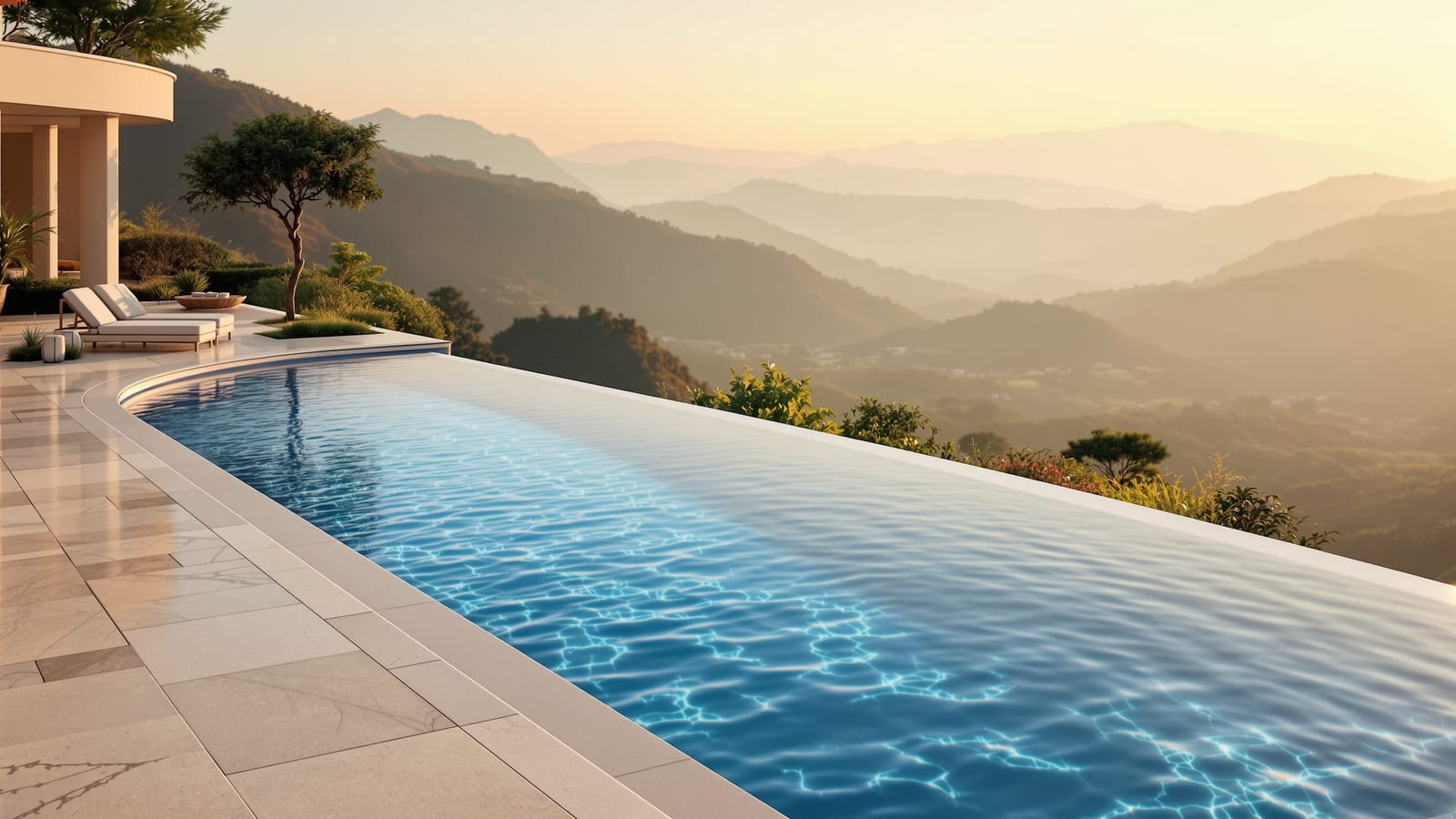
There is a particular kind of photograph that sells a home before anyone reads a single word about it: a swimming pool that seems to end in mid-air, its water dissolving into a valley, a coastline, or a city skyline beyond. That illusion of water without a boundary is the infinity pool. For Indian homeowners building on a hillside in Lonavala, a villa plot in Goa, a farmhouse outside Bengaluru, or even a rooftop in Mumbai, the vanishing edge has become the single most requested "wow" feature in luxury home design.
But behind the drama is a surprisingly precise piece of engineering, and a meaningful jump in cost over an ordinary pool. This guide explains exactly how an infinity pool works, why it costs what it costs, where it makes sense, and where it does not. If you are still deciding whether to build a pool at all, start with the complete home pool guide and the overview of types of swimming pools, then come back here once you know the vanishing edge is what you want.
What an infinity pool actually is
You will hear several names for the same thing, and it helps to know they all mean one feature. An infinity pool, a negative-edge pool, a vanishing-edge pool, and a zero-edge pool all describe a pool where the water appears to flow over one or more sides and disappear, rather than being held in by a visible coping or wall.
The trick is an optical one. On at least one side, the usual raised edge is replaced by a wall, called the weir, whose top sits very slightly below the water's surface. Water continuously runs over that lip and falls out of sight, so from a viewing position the surface of the pool seems to merge with whatever lies beyond it. Nothing is actually lost. The pool is a closed loop, and the water that spills over is caught, collected, and pumped straight back in.
The important word in all of this is precision. The whole effect lives or dies on a few inches of water and the flatness of a single edge.
How it works, step by step
Start with the weir wall. Unlike every other side of the pool, the infinity edge is built deliberately low, set roughly one to two inches below the pool's maximum water level. Because the water sits higher than the lip, the top sheet of water, only an inch or two deep, slides over the weir and falls. This is why the wall must be level along its entire length to a fraction of an inch. If one end is even slightly higher than the other, water sheets over the low part and the high part stays dry, and the seamless mirror effect breaks. Achieving and holding that tolerance is the hardest part of the whole build.
Below the falling water is the catch basin, sometimes called the trough. This is a second, narrower channel running along the outside base of the weir wall, built to catch every drop that comes over the edge. It has to be a properly reinforced structure of its own, sized to hold the falling water even when the pool is busy and people are pushing waves over the edge.
From the catch basin, water flows by gravity into a surge tank, also called a balance tank. This is a holding reservoir, usually buried nearby, typically sized at around five to fifteen percent of the pool's total volume. Its job is to absorb the swings. When swimmers enter the pool, water level rises and more spills over; when they leave, the level drops. The balance tank takes up that slack so the pool never runs dry at the weir and never overflows the catch basin.
Then comes the part that defines an infinity pool mechanically: a dedicated second pump. A normal pool has one filtration pump. An infinity pool needs an additional pump whose only task is to draw water out of the balance tank, send it through filtration, and return it to the main pool body, keeping the level high enough that water keeps spilling over the weir. The two pumps together form a continuous, closed circuit. No water is wasted by the effect itself; it simply travels in a loop from pool, over the edge, into the basin, down to the tank, and back up through the pump.
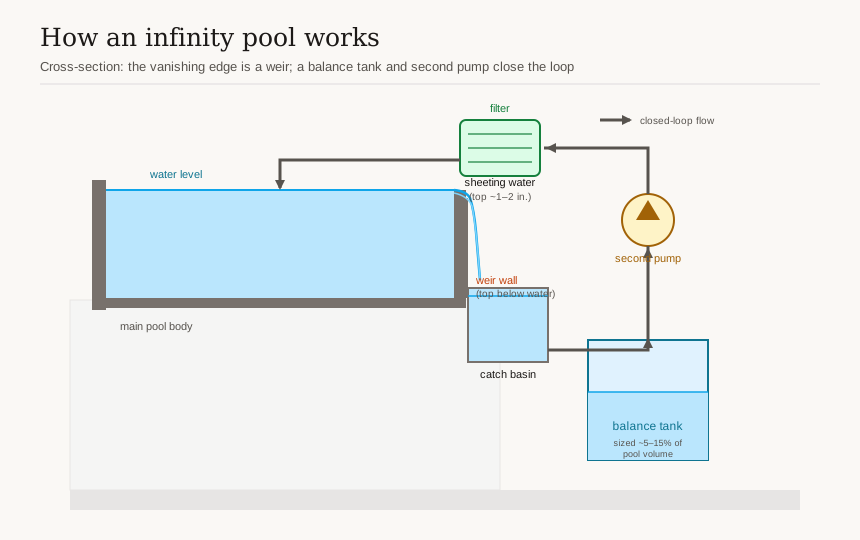
Once you understand this loop, the cost and the running characteristics of an infinity pool stop being mysterious. Every extra rupee, and every extra litre of evaporation, traces back to one of these four elements.
Why it costs more than a regular pool
An infinity pool is more expensive than a standard pool of the same size, and it is worth being clear-eyed about why, because the reasons are structural rather than decorative.
First, there is the extra reinforced catch basin. You are effectively building a second concrete channel, with its own waterproofing and steel, alongside the main shell. Second, the precision-levelled weir takes far more skilled labour and care than a normal coping; getting and keeping that edge dead level is slow, exacting work, and mistakes are very visible. Third, the second pump and its associated balance tank, pipework, and electrical work add equipment cost up front. And fourth, the running cost is higher for the life of the pool: the overflow pump runs long hours to keep water flowing over the edge, and the larger exposed and falling water surface increases evaporation, so you top up more often and spend more on power.
Putting a single rupee figure on the premium is where honesty matters. A reliable, India-specific number for exactly how much more an infinity edge adds is not something we can point to with confidence, so treat any precise claim with caution. What is safe to say is that the vanishing edge adds a meaningful premium over a standard pool of the same dimensions. To get a grounded sense of the base pool cost before that premium, use the Pool Cost Calculator, and read the wider breakdown of swimming pool cost in India. When you brief a builder, ask them to quote the standard pool and the infinity upgrade as separate line items so you can see the premium for your own site.
Where an infinity pool works, and where it doesn't
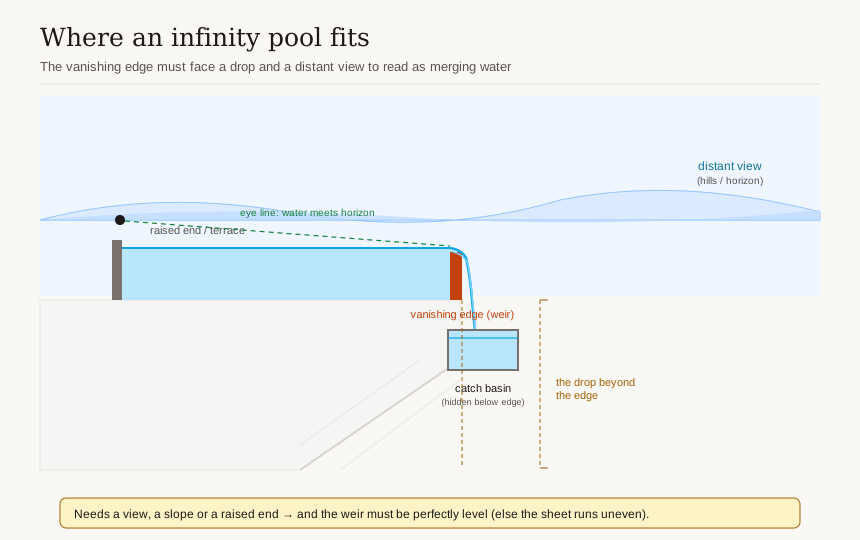
An infinity pool is not a feature you can bolt onto any plot and expect to look good. The effect needs something to vanish into.
The ideal condition is a view, a slope, or a raised end. The whole illusion works because the water's edge reads against a backdrop, a valley, the sea, a garden dropping away, a skyline, rather than against a wall or a fence two metres beyond it. A natural slope is a gift here, because the land falls away exactly where you want the water to disappear, and it gives the falling water and the catch basin somewhere to sit. On a flat plot you can still build one by raising that end of the pool on a plinth so the edge stands proud against the sky or distant trees, but you are then paying to manufacture the elevation that a sloped site gives you for free.
There is also a practical, water-management reason the slope helps: the design works best when water flows away from the structure, not back toward the house or terrace it sits on. You want the falling water and any splash directed outward and downward, into a basin that drains cleanly.
One more constraint is the construction method. Because the weir and catch basin are custom shapes built to fine tolerances, an infinity pool effectively requires a concrete or RCC shell. Cast concrete lets the builder form any shape, depth, and edge profile the design demands. Prefabricated and panel pools cannot give you the bespoke vanishing edge, so if an infinity pool is the goal, you are committing to a fully custom built shell from the start. Indian builders do offer infinity pools, so this is achievable here; it simply needs the right contractor and the right site.
Where it does not work: a flat plot hemmed in by boundary walls with no view and no room to raise the edge will give you all the cost and none of the magic. In that situation a beautifully detailed conventional pool is the better spend. Browse pool design ideas for alternatives that suit enclosed urban plots.
Single vs multi-edge, and partial or perimeter overflow
Not every infinity pool spills on only one side, and the choices here change both the look and the budget.
A single-edge infinity pool, with one vanishing side facing the view, is the most common and the most economical version of the idea, and for most homes it is also the most sensible, because you usually have only one good view to play to.
A multi-edge pool spills over two or even three sides. This reads as more dramatic and is suited to a pool that sits at the corner of a hill with views in more than one direction. Each additional spilling edge multiplies the cost, because every one of them needs its own precisely levelled weir and its own catch basin.
A close cousin is the perimeter overflow or wet-edge pool, where water spills over a thin slot on all sides at deck level, leaving the pool surface flush with the surrounding floor like a mirror. This is the most expensive and the most demanding to build of all, and it is a different aesthetic, a calm reflecting plane rather than a dramatic disappearing edge, but it relies on the same balance-tank-and-second-pump principle described above.
Running it: water, pumps and maintenance
It is worth setting expectations honestly: an infinity pool is more work and more cost to run than a standard pool of the same size, not less.
The overflow pump runs for long hours to keep the sheet of water moving over the weir, which means higher electricity use than a single-pump pool. The larger exposed surface, plus the continuously falling water, increases evaporation, so you top up the pool more often, which matters in hot, dry parts of India and in any place where water is precious. The catch basin and balance tank are extra components to keep clean and leak-free, and the weir itself needs to stay clean and undisturbed so the sheet of water stays even. Settlement over time, if the structure moves even slightly, can throw the level off and spoil the effect, which is one more reason the original construction quality matters so much.
None of this is a reason to avoid an infinity pool. It simply means your running budget and your maintenance routine should be planned for a more demanding pool. The general principles still apply, so read the pool maintenance guide and add the extra pump and basin to your service checklist.
Is an infinity pool right for you
Here is the honest summary. An infinity pool is the right choice when you have a genuine view or a slope to play to, the budget to absorb a meaningful premium over a standard pool both to build and to run, and a builder with a real track record in vanishing-edge work. On those plots, nothing else comes close for sheer impact, and the home's value and presence lift with it.
It is the wrong choice when the plot is flat and enclosed with nothing to vanish into, when the budget is tight enough that the premium would come out of build quality elsewhere, or when low running cost and minimal maintenance are priorities. In those cases a well-detailed conventional pool, a Pool Cost Calculator estimate, and good landscaping will serve you far better than an infinity edge that has nothing to disappear into.
Explore the idea
If you want to see how a vanishing edge could sit on your specific plot, the view it would frame, the elevation it would need, the deck and landscape around it, describe your site to Studio Matrx DesignAI and let it visualise the options before you commit a rupee to construction. Then, when you are ready to build, find an architect or pool builder with real infinity-pool experience, and ask them to quote the standard shell and the infinity upgrade as separate lines so you can see exactly what the magic costs on your land.
Export this guide
Related Guides — Deep-dive reading
The Complete Guide to Planning Your Home Before You Spend a Rupee
Why the cheapest, most powerful work happens on paper — a planning playbook for Indian homeowners before any money moves
Home PlanningBathroom Planning for New Homes in India: Get It Right Before You Build
The bathroom decisions you cannot undo once the slab is cast — location and stacking, sunken vs non-sunken slabs, waterproofing, and the plumbing, electrical and ventilation you must coordinate with the civil work, stage by stage.
BathroomsThe Best Trees for Indian Homes
A research-grade guide to choosing and placing trees around an Indian home — the real cooling and clean-air numbers, the right species for shade, flowers, fragrance and fruit, and the placement science that keeps roots out of your walls and drains.
LandscapeRelated Tools — Try Free
Swimming Pool Cost Calculator
Estimate a home pool's build cost by type, size and finish, with an indicative range and a build breakdown.
Pool CalculatorRainwater Tank Sizer
How big should your rainwater tank be? Computes annual harvest, recommended tank capacity in litres, water-bill savings, and payback — for 10 Indian cities.
RWH CalculatorMonsoon-Readiness Checklist
Pre-rain home audit across 9 categories — terrace, drains, waterproofing, electrical, HVAC, pest, vehicles, documents.
Seasonal Audit