
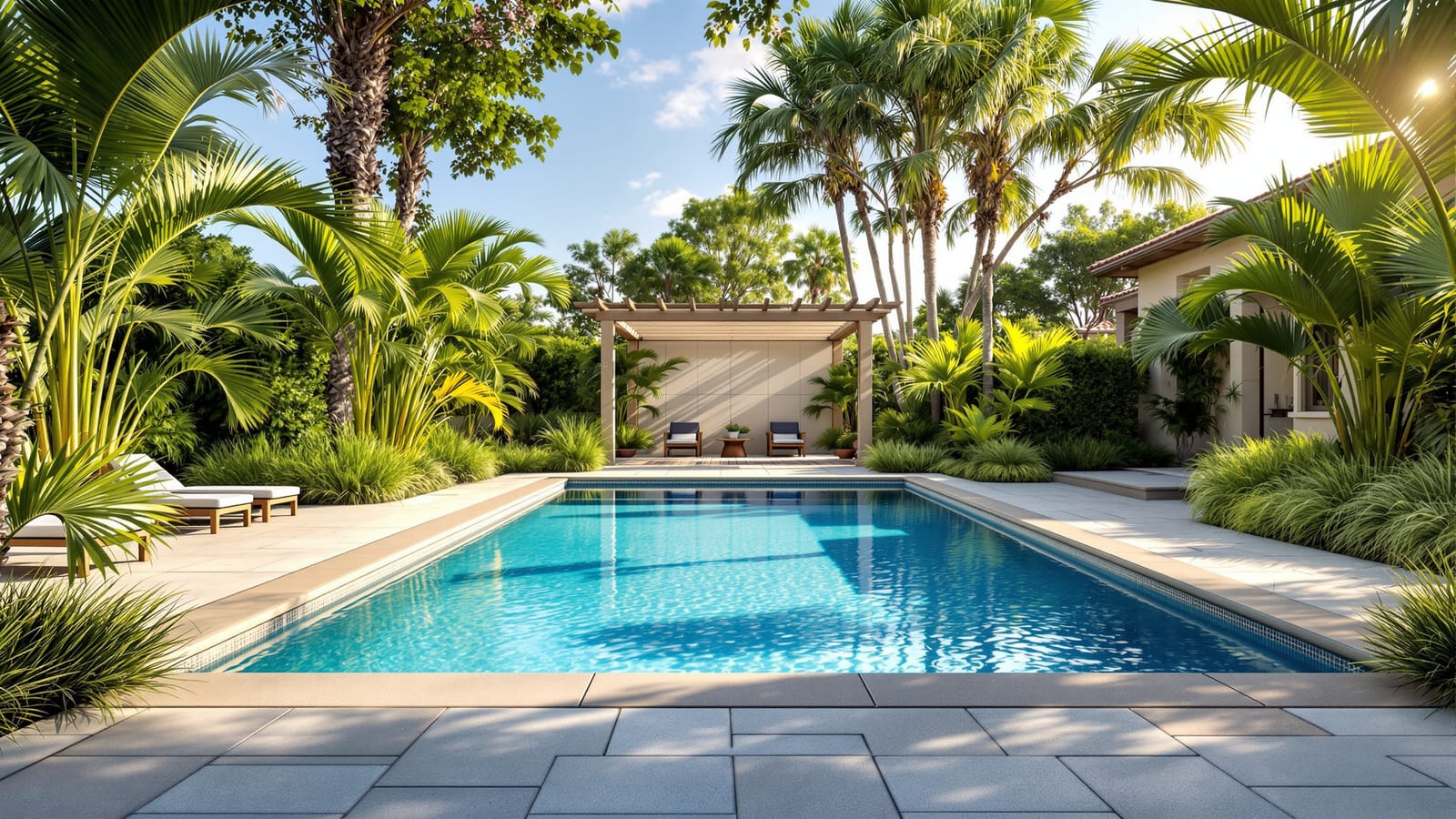
Pool Landscaping: Decking, Planting and Poolside Design
Slip-safe decking and coping, the right poolside plants (and the ones to avoid), privacy screening and shade — how to design a beautiful, safe, low-maintenance poolside in India.
A swimming pool is only as good as the few feet of ground that surround it. The water gets all the attention, but it is the decking underfoot, the planting at the edge and the screening beyond that decide whether your pool feels like a resort or a maintenance headache. In Indian conditions, with hard summer sun, monsoon leaf-fall and chlorinated splash, the landscaping choices you make around the shell matter as much as the pool itself. This guide walks you through decking and coping, poolside planting, privacy screening, shade and lighting, all with safety leading the way.
If you have not yet built or finalised the pool, read the complete home pool guide first for the engineering and budgeting picture, and browse pool design ideas for inspiration. For keeping the water itself clear, see pool maintenance. This guide is about everything around the water.
The poolside as an outdoor room
Think of the area around the pool as a room without walls. It has a floor (the decking), soft furnishings (planting), walls (screening and boundary), a ceiling (pergolas, shade sails, the open sky) and lighting. When you plan it as a room rather than as leftover space, the whole thing comes together. A good poolside has a clear circulation path all the way around, at least one generous flat zone for loungers or a dining set, a shaded corner for the hottest part of the day, and planting that frames the water without dropping debris into it.
The mistakes people make are almost always about treating the surround as an afterthought: a narrow strip of slippery tile, a tree planted too close because it looked nice in the nursery, no shade anywhere. Get the bones right and the poolside becomes the most-used part of the garden.
Decking and coping: safety first
Before anything else, understand this: the single most important property of any wet poolside surface is slip resistance. Wet feet on a smooth surface are how poolside accidents happen, and around a pool you are guaranteed wet feet. This is not a place to compromise on looks.
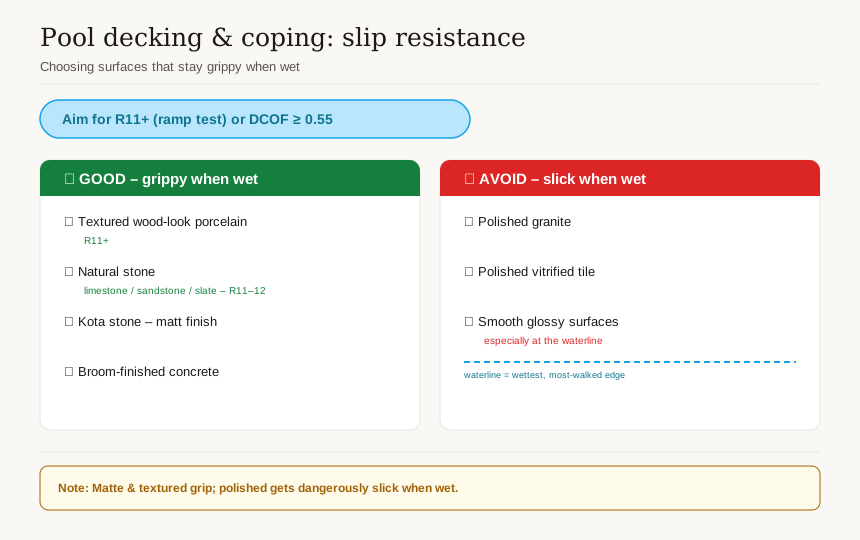
The measurable target is clear. Aim for a surface rated R11 or higher on the European ramp test, or DCOF 0.55 or higher on the American test. Matte, textured, tumbled and cleft finishes grip far better than polished ones. The rule that follows from this is blunt: avoid polished granite and polished vitrified tile at the waterline and on the deck. They look beautiful in a showroom and turn into an ice rink the moment they are wet. The coping, the edge piece that caps the pool shell where you grip when climbing out, is the most critical zone of all and must be a textured, rounded, comfortable-to-grip finish.
Two more comfort factors matter in the Indian climate. First, heat: dark, dense surfaces store the afternoon sun and can scorch bare feet by 3 pm. Lighter colours and naturally cooler stones like travertine stay walkable. Second, drainage: the deck should slope very gently away from the pool, around 1 to 2 percent, so splash and rain run off into a drain channel rather than back into the pool or pooling where people walk.
Decking materials compared
Here is how the realistic options stack up for an Indian home pool, balancing grip, heat, durability and budget.
Porcelain, specifically textured wood-look or stone-look porcelain, is the modern favourite. Dense and non-porous, it resists chlorine, stains and frost, and good outdoor-grade porcelain is often rated R11 or higher straight off the shelf. It gives you the warm look of timber decking with none of the rot. Insist on the anti-slip outdoor grade, not the polished indoor tile of the same range.
Natural stone is the classic choice and ages beautifully. Limestone, sandstone, granite and slate in a natural, flamed or honed finish typically sit around R11 to R12. Travertine deserves a special mention because it stays noticeably cooler underfoot than most stones, which is a real advantage in Indian summers. Choose a flamed or brushed finish, never polished, and seal porous stones to resist staining from chlorine and pool chemicals.
Indian Kota stone is an excellent, economical option that many homeowners overlook. In its natural matt finish it has good grip and handles weather and chemicals well. The trap is the polished or mirror Kota that is popular for flooring, which is slippery when wet. For a pool deck, always specify the matt or leather finish.
Concrete is the most flexible and budget-friendly base. A broom-finished concrete deck has good grip built in by the dragging of a broom across the wet surface, and stamped concrete can mimic stone or timber at lower cost. The key is the surface texture and a quality sealer. Plain trowel-smooth concrete is too slippery and must be avoided.
Wood and composite decking give the most resort-like feel. Real hardwood looks gorgeous but needs regular oiling and is vulnerable to chlorine and constant wetting, so it is higher maintenance in our climate. Composite (wood-plastic) decking solves the rot and splinter problem and needs far less upkeep, though cheaper boards can get hot in full sun, so check the colour and grain texture for grip.
Planting around a pool: the rules
Planting is where most poolside regret comes from, because the wrong plant in the wrong place causes problems for years. Three forces are at work and every choice has to respect all three.
The first is litter. Anything that drops leaves, flowers, fruit, berries or seed pods will drop them into the water, clog the skimmer, stain the deck and double your cleaning time. Low-litter, evergreen plants are your friends.
The second is roots. Pool shells and the plumbing buried around them are vulnerable to aggressive, water-seeking roots that can crack the structure or lift the deck. This is the single biggest reason to keep large and invasive-rooted plants well away from the shell.
The third is chemicals. Splash from a chlorinated or salt-water pool lands on nearby foliage and soil. Plants right at the edge need to be tolerant of that salt and chlorine, or they will scorch and die.
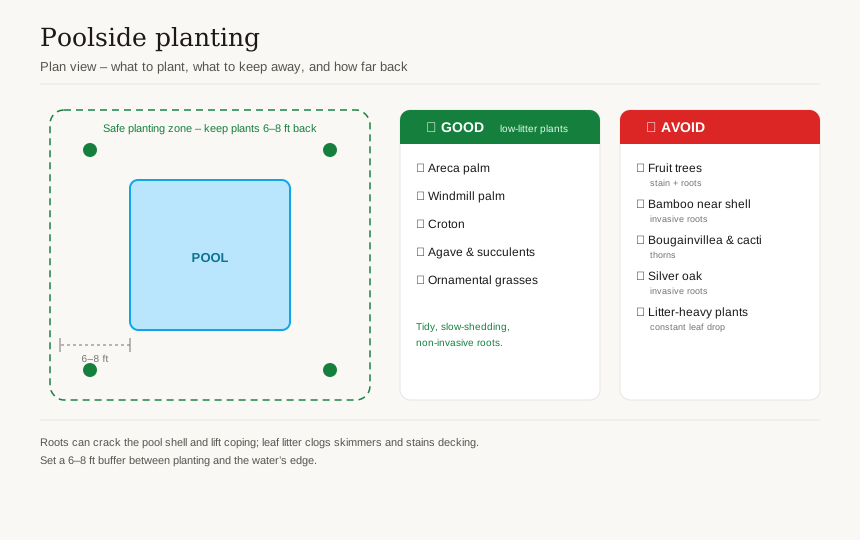
From these three forces comes the golden rule: plant at least 6 to 8 feet back from the pool edge. Inside that zone, use only ground cover, potted plants and movable containers. Save your shrubs, screening and trees for beyond that line, and even there, mind their root habit.
Plants to avoid, and good poolside plants
Some plants are simply wrong for a poolside and worth naming so you can refuse them at the nursery. Avoid all fruit trees near the pool: they stain the deck with dropped fruit and most have invasive roots. Keep bamboo away from the shell entirely; its wandering, running roots are notorious for damaging pool structures and plumbing, so use it only as a boundary screen in raised planters, never ringing the pool. Avoid thorny plants such as cacti and bougainvillea near where people walk barefoot and swim. Silver oak, despite being a common fast-growing tree, has invasive roots and should be kept well clear. And steer clear of any litter-heavy flowering tree that carpets the deck.
The good news is the list of well-behaved poolside plants is long and handsome. Palms are the natural poolside plant: areca, windmill and sago palms are low-litter, structurally tidy and tolerant of salt and chlorine splash, giving you that resort silhouette. Bird of paradise gives dramatic foliage and flowers, though site it back from the water because it can be a little messy. Croton brings reliable colour and copes well with our climate. Succulents and agave are tough, sculptural and need almost no water or fuss. Ornamental grasses sway nicely and shed very little. Together these let you build a lush, layered poolside that stays clean.
Privacy and screening
Most home pools need a green wall to block the neighbours and the street, and India offers plenty of fast-growing options. The trick is to get height and density quickly without inviting root or litter trouble close to the shell.
Clumping bamboo gives the fastest, most elegant screen, but remember the rule: keep it in raised planters and away from the pool shell, never as a ring around the water. Columnar Ashoka is the classic tall, narrow Indian privacy tree, perfect along a boundary where you want height without spread. Ficus nitida makes a dense, clippable formal hedge. Murraya, also called Kamini, is fragrant, evergreen and hedges beautifully. Duranta gives a fast, flowering screen, and Thuja gives a soft conifer wall. For a more tropical look, rows of areca palm screen well, and a traditional hibiscus or mehendi hedge is dense, cheap and fast.
Whichever you choose, plant the screen along the boundary, beyond the 6 to 8 foot zone, and check its mature root behaviour against the position of your pool plumbing.
Shade, lighting and poolside structures
A pool with no shade goes unused for half the day in the Indian summer. Plan at least one shaded zone. A pergola over the deck, draped with a non-littering creeper or fitted with a retractable shade, gives dappled cover for loungers. A cabana or small covered structure at one end becomes a changing room, a bar and a rainy-season retreat. Shade sails are a lighter, cheaper option that can be angled against the western sun.
Lighting transforms the poolside after dark and adds safety. Use warm, low-level path lights to mark the deck edge and steps, underwater LED lights in the pool for drama and visibility, and a few uplights into the palms and screening to give the green wall depth at night. Keep all fittings rated for wet, outdoor use and route the wiring through proper conduit, away from splash.
Putting it together
Walk the space as a whole before you commit. Picture the circulation: can you walk all the way around the pool on a non-slip surface without squeezing past a planter? Locate the flat lounging zone where the afternoon shade falls, not in the full glare. Set your screening on the boundary for privacy, your low-litter palms and grasses in the mid-ground, and only pots and ground cover inside the 6 to 8 foot splash zone. Confirm every walking surface is matte and rated R11 or DCOF 0.55 or higher, with the coping the grippiest of all. Check that the deck drains away from the water. Do these few things and the poolside becomes a genuine outdoor room that is safe, low-maintenance and beautiful in every season.
Design your poolside
You do not have to imagine all this in your head. Use DesignAI to visualise decking materials, planting layouts and screening for your own pool before you spend a rupee, and when you are ready to build it for real, find a landscape designer who can detail the levels, drainage and planting plan properly. A poolside designed with safety and the Indian climate in mind will reward you for decades.
Export this guide
Related Guides — Deep-dive reading
Anti Slip Flooring for Bathroom and Wet Areas in India: R-Ratings, Finishes and Genuinely Safe Tile Choices
How to choose genuinely safe flooring for bathrooms, kitchens, balconies, pools, entrances and elderly- or child-friendly homes — the R-rating system, finishes that grip wet feet, anti-skid natural stone, slope to drains and the tiles to avoid.
Flooring & SurfacesThe Best Trees for Indian Homes
A research-grade guide to choosing and placing trees around an Indian home — the real cooling and clean-air numbers, the right species for shade, flowers, fragrance and fruit, and the placement science that keeps roots out of your walls and drains.
LandscapePatio Flooring in India: Best Decks & Outdoor-Seating Floors for Weather, Grip & Looks
How to floor a patio, deck or outdoor lounge in India so it shrugs off UV and monsoon, grips wet feet, stays barefoot-friendly and still looks like a place you want to entertain.
Flooring & SurfacesRelated Tools — Try Free
False Ceiling Cost Estimator
Live ₹/sqft across 8 ceiling types — POP, gypsum, designer, metal, PVC, wooden — with cove and spot lighting for 20 Indian cities.
Cost CalculatorGarden Planning Toolkit
Get a tailored garden plan — planting layers, Indian species, features and a checklist — from your climate, space, sun and goals.
PlannerPool Water Calculator
Chlorine, shock and salt doses plus top-up water for your pool — an indicative balancing guide.
Pool Calculator