
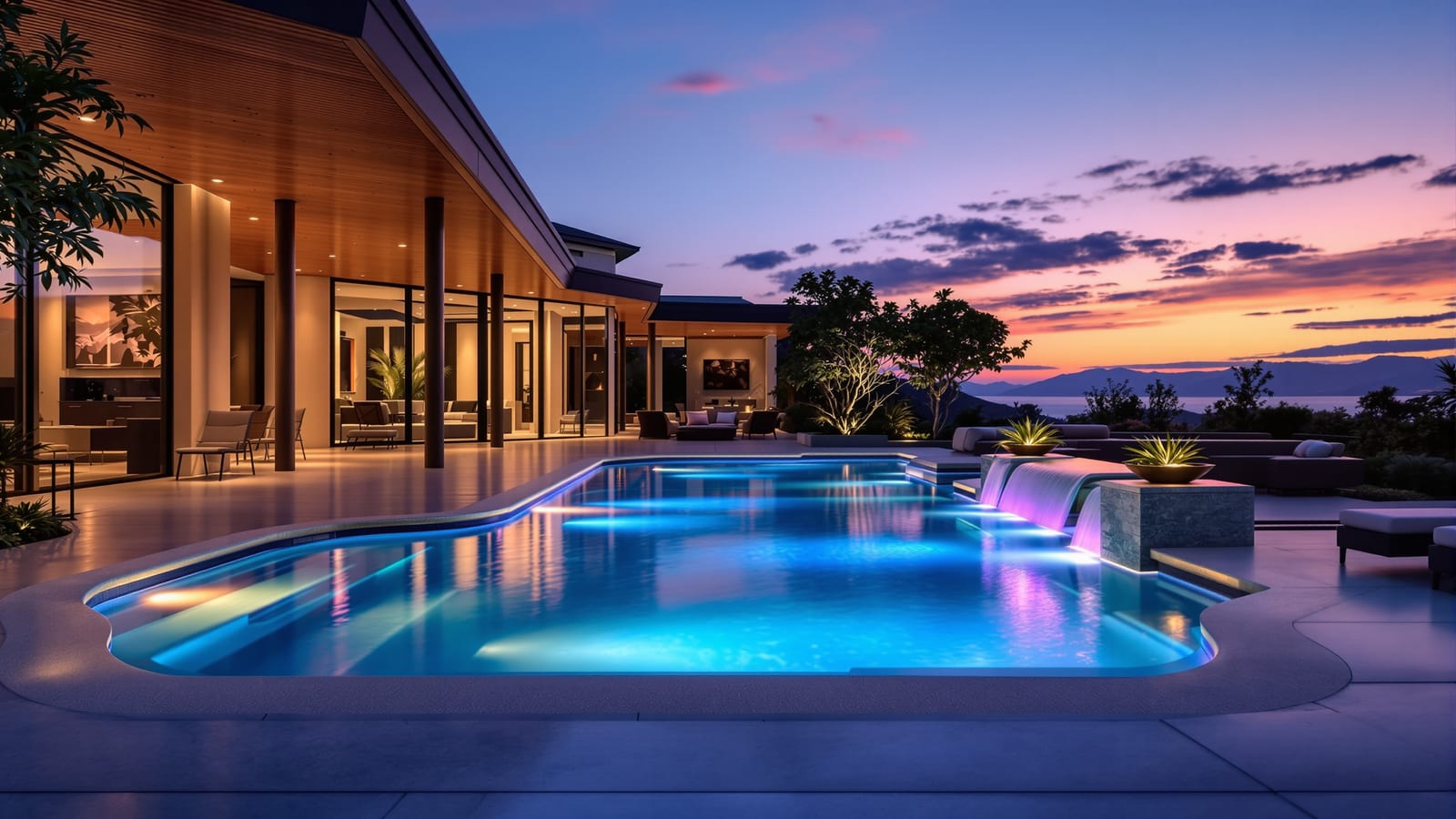
Swimming Pool Design Ideas for Indian Homes
From plunge and courtyard pools to infinity edges, stepwell forms, water features and LED lighting — design ideas and the moves that make a home pool beautiful.
There is a particular kind of stillness that only water brings to a home. In the heat of an Indian afternoon, a pool is not just a place to swim. It is a square of cool light in the courtyard, a mirror that doubles the sky, a sound that softens the city outside your gate. Designing one well is less about size and budget than about feeling, about the way the water will sit inside your daily life. This guide is here to spark ideas and keep you honest about what makes those ideas work. For the full picture, including engineering, safety and running costs, pair it with the complete home pool guide at the complete home pool guide.
A beautiful pool begins as a decision about character. Do you want a sheet of glassy water that vanishes into the horizon, a sunken courtyard pool that feels like the heart of the house, or a compact plunge you can slip into before dinner. Every choice that follows, from the typology to the tile colour, flows from that first picture in your mind.
Start with how you'll use it
Before you fall in love with an image, be honest about how the pool will earn its place. Most Indian families want one of four things, and often a blend of them.
If you mainly want to cool off, you do not need length. You need shade, easy steps, a shallow lounging ledge and water that stays comfortable through the hottest months. If you want to exercise, length and a consistent depth matter more than looks, and even a short pool can be fitted with a swim jet to give you an endless current to push against. If you want to entertain, think of the pool as the centre of a room, with deck space, seating and lighting that make evenings linger. And if you simply want to look at water, to have it reflect your facade and calm your courtyard, then the surface, the edge detail and the stillness become the whole point.
Most homes want a little of each. Naming your priority first, though, stops you from building a lap pool you never swim in or a party deck with nowhere comfortable to sit.
Pool styles and typologies
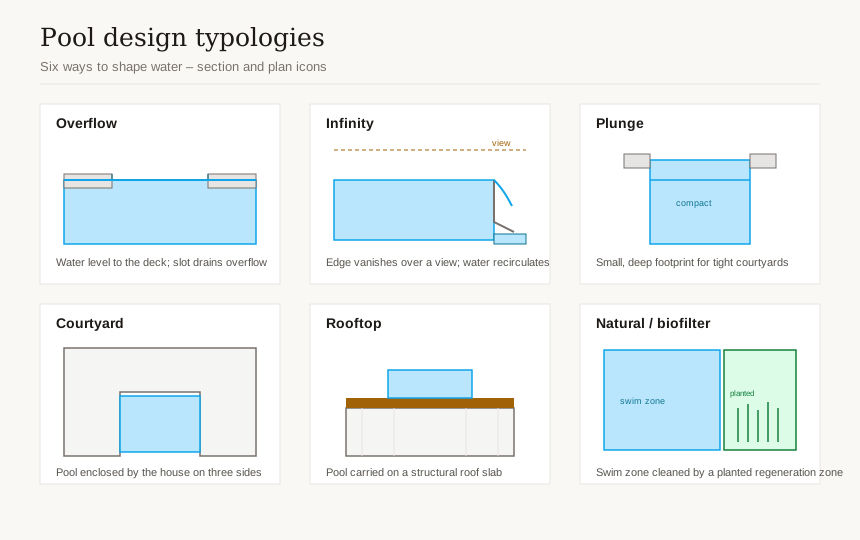
The structure underneath the surface shapes everything you see. A handful of typologies cover almost every home pool in India, and knowing them helps you speak clearly to your designer. For a deeper walk-through, see types of swimming pools.
An overflow or deck-level pool fills right to the brim, so the water sits flush with the surrounding deck and spills over the edges into a slim channel. The effect is luminous and seamless, a perfect plane of water with no visible lip. Because the water that spills over has to go somewhere, these pools rely on a balance or surge tank that catches the overflow and feeds it back through filtration.
An infinity pool takes that idea and runs one edge off into a view, so the water appears to drop away into the valley, the sea or the skyline beyond. It is the most cinematic of all pool types, and it depends on the same balance tank to capture the water that pours over the vanishing edge. If a view is the gift your site offers, an infinity edge is how you frame it. Our dedicated infinity pools guide explains the engineering behind that magic.
A plunge pool is small and deep, built for soaking, cooling and quiet rather than laps. It suits compact plots and rooftops beautifully, and because it holds far less water and structure, it tends to cost roughly half of what a standard family pool does. Do not mistake small for modest, though, as a well-finished plunge can be the most jewel-like water in the house. See small swimming pools for more.
A courtyard pool sits at the core of the home, wrapped by rooms and verandahs that look onto it. This is one of the oldest and most satisfying Indian arrangements, turning the pool into a shared, sheltered heart that every part of the house can borrow light and breeze from.
A rooftop or elevated pool lifts the water to the terrace, reclaiming space that a tight plot cannot spare at ground level and rewarding you with privacy and a long view. These need careful structural planning, but they turn an unused roof into the best room in the house.
A natural or biofilter pool swaps chemicals for biology. Alongside the swim zone sits a regeneration zone, a planted area of roughly equal size where aquatic plants and beneficial bacteria clean the water naturally. The swim area runs to about two metres deep, the water stays soft and chemical-free, and the whole thing reads as a living pond you can swim in. It asks for space and patience, but it is gentle on skin, on the eyes and on the surrounding garden.
Indian design language
A pool does not have to look like it was lifted from a resort brochure. Some of the most moving designs draw on India's own long romance with water. The stepwell, or vav, gives us a vocabulary of descending stone steps, deep shade and water reached by a sequence of levels, and even a hint of that, a generous flight of broad steps leading into the shallow end, brings a sense of ritual and arrival.
The courtyard tradition reminds us that water belongs at the centre of family life, cooled by the house around it and threaded with breeze. Terracotta, in lamps, planters, edging or a warm-toned deck, adds an earthy softness that flatters Indian light and the colours of our gardens. Kota stone, that quiet blue-green limestone, makes a handsome, grounded surround that ages with grace and sits naturally beside our architecture.
Jaali screens are perhaps the most useful idea of all. A perforated wall or carved screen gives you privacy from neighbours, dapples the harsh sun into patterns on the water, and lets the evening breeze move through. Used well, these elements make a pool feel rooted in place rather than imported, of this house, in this climate, in this country.
Water features and movement
Still water is beautiful, but moving water is alive. A few well-chosen features add sound, sparkle and a sense of luxury without overwhelming a modest pool.
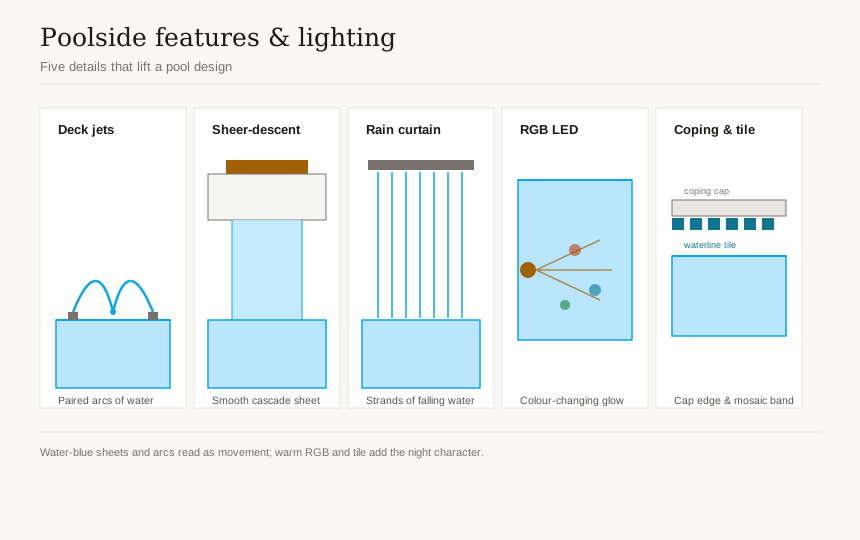
Deck jets are slim nozzles set into the surround that arc thin ribbons of water across the surface, usually fitted in pairs and often lit from within so the streams glow after dark. They are playful by day and theatrical by night. Cascades and sheet falls send water spilling from a raised wall or spout, and because they are driven by the same filtration system that already circulates your pool, they earn their keep by keeping the water moving and aerated. Adding LED light to a cascade turns a working feature into the centrepiece of an evening.
A rain curtain is the most dramatic of all, a wall of fine water falling in a sheet, typically somewhere between four and eight feet wide, that you can sit behind or walk past. It brings sound, coolness and a touch of theatre to a courtyard. The trick with all of these is restraint. One memorable feature, beautifully placed, says far more than three competing ones. Where these features meet the garden, decks and planting, our pool landscaping guide picks up the story.
Lighting a pool
Lighting is where a pool transforms after sunset, and it is often the difference between a pool you use only by day and one that becomes the soul of the evening.
LED is the dominant modern choice, and for good reason. It is efficient, long-lived, and available in rich colour, from a single warm glow to full RGB that you can shift through an app to match a mood or a celebration. A pool lit a deep cobalt for a dinner party and a soft amber for a quiet night becomes two different spaces in the same water.
Fibre-optic lighting works differently and elegantly. The light is generated by a single source kept well away from the water, then carried along fibres to glow at the pool edge or underfoot, which means no electrical fittings sit in the pool itself. It is wonderful for delicate, starry effects, like points of light threaded along a step edge or coping line.
Think in layers rather than floodlight. A wash of colour in the water, a few warm points along the deck, an uplit tree or jaali screen, and a glowing cascade together build depth and intimacy. Harsh, even light flattens a pool. Gentle, layered light gives it romance.
Finishes and colour
The colour of the water is not the colour of the water. It is the colour of the surface beneath it, read through depth and sky. This is one of the most powerful and most underused design levers you have.
A pale, sandy or off-white interior gives bright, tropical, almost turquoise water that feels resort-like and inviting. Mid-blue tiles read as a classic, crisp swimming-pool blue. Grey, charcoal or dark pebble finishes turn the water deep, reflective and mirror-like, beautiful for a contemporary house and for catching the sky, though they read warmer underfoot in full sun. Green and earthy tones lean towards a natural-pond character that suits courtyard and garden settings and natural pools especially.
Mosaic and tile let you add pattern, a deep border, a sunburst on the floor or a gradient that deepens towards the deep end. Pebble and aggregate finishes give a softer, more textured, organic look. Whichever you choose, the coping and waterline materials deserve care, because they are what hands and feet actually touch. These should be matte or textured for grip, never polished, since shallow shelves and steps stay safe only when they resist slipping wet. The full material detail, including non-slip decking and edge stones, lives in the pool landscaping guide.
Integrating the pool with the house and garden
A pool should never feel parachuted into the plot. The best ones are stitched into the house so that indoor and outdoor blur. Align the pool with a key sightline, the view from the living room, the axis of the verandah, the line of the entrance, so that water greets you as you arrive and as you sit.
Let materials carry across the threshold. When the deck stone continues the floor of the adjoining room, the boundary dissolves and the pool reads as another room rather than a separate object. Frame it with planting that gives privacy and softness, and place the deck and seating where the evening shade falls, not where you will be chased indoors by the afternoon sun. Sketch a shallow shelf or broad steps on the side that faces the house, where children play and adults sit with their feet in the water and watch.
Small-space design moves
A tight plot is not a closed door. A plunge pool or a slim lap pool can transform a narrow side yard or a courtyard. Going deeper rather than longer keeps the footprint small while still giving a proper soak. A swim jet turns even a short pool into a place to exercise. Mirrors, pale finishes and a clean edge make compact water feel larger and brighter, and a single rain curtain or a pair of deck jets adds all the drama a small pool needs. Lifting the pool to the rooftop sidesteps the ground-floor squeeze entirely. Our small swimming pools guide is full of these moves.
Bring your idea to life
The hardest part of a pool is seeing it before it exists, picturing your courtyard with water in it, this tile rather than that, lit blue or lit amber. That is exactly where Studio Matrx can help. Describe your home and your dream, and DesignAI will visualise pool styles, finishes and lighting against your own space so you can compare ideas before a single tile is ordered. When you are ready to build, find a designer to turn the picture in your head into a pool that holds the cool, the light and the calm your home deserves.
Export this guide
Related Guides — Deep-dive reading
Designing for Views and Privacy
The site-level craft of capturing the good view while screening the neighbour's window three metres away — tuned for dense Indian plots.
Site PlanningPool Landscaping: Decking, Planting and Poolside Design
Slip-safe decking and coping, the right poolside plants (and the ones to avoid), privacy screening and shade — how to design a beautiful, safe, low-maintenance poolside in India.
Swimming PoolsThe Ultimate Guide to Roofing Systems
The one guide that makes roofing make sense — the five jobs every roof does, the three roof shapes (flat, sloping, terrace), the material families, the layers that keep water out and heat off, and how to choose the right system for an Indian home. Plain language, India-grounded.
RoofingRelated Tools — Try Free
Rainwater Tank Sizer
How big should your rainwater tank be? Computes annual harvest, recommended tank capacity in litres, water-bill savings, and payback — for 10 Indian cities.
RWH CalculatorPool Tile Calculator
Floor, wall and waterline area and the total number of tiles for your pool, with a wastage allowance.
Pool CalculatorJaali Generator
Design a parametric jaali / perforated screen, see its open-area (daylight vs privacy), and download a print-ready SVG for CNC/laser fabrication.
Parametric Tool