
Small Swimming Pools for Homes: Plunge, Lap and Compact Pools
How to fit a pool into a small plot, courtyard or terrace — plunge and lap pools, sizes and depths, the rooftop structural reality, and making a small pool feel big.
A swimming pool no longer means a sprawling bungalow with a half-acre garden. Across Indian cities, homeowners are fitting water into the spaces they actually have: a 12-foot courtyard between rooms, a side setback that was only ever used for the AC outdoor unit, or a terrace that catches the evening breeze. Small pools, the plunge pools, lap pools and compact "spools" that have taken over Instagram, are not a compromise. For most urban homes they are the only sensible way to own water at all, and they often deliver more relief per rupee than a full-sized pool ever could.
This guide is written for the Indian homeowner working with a tight plot. It covers what small pools are, how small you can realistically go, where they fit, and the one situation that genuinely demands caution: putting a pool on a terrace or roof. If you want the full picture first, start with the complete home pool guide and the breakdown of types of swimming pools.
Why small pools make sense
The case for going small rests on three honest advantages: cost, plot and maintenance.
On cost, a smaller pool means less excavation, less concrete or a smaller shell, less water, a smaller pump and filter, and a smaller heater or chiller if you ever add one. Because shallow plunge pools hold a fraction of the water of a deep family pool, the running costs, the part most people forget, also drop. You are filtering, treating and circulating far less water every single day.
On plot, this is the real reason small pools have exploded in popularity. A typical 30x40 or 30x50 site in a Bengaluru, Pune or Hyderabad layout simply has no room for a 40-foot pool once you account for setbacks, parking and the house itself. A plunge pool tucked into a courtyard or a side margin uses space that would otherwise sit dead.
On maintenance, less water is less chemistry to balance, less surface to skim, and a faster turnover for the filter. A compact pool is something a homeowner can realistically maintain without a daily pool boy.
The honest trade-off: a small pool is for cooling off, sitting, and relaxing. It is not for swimming laps unless you specifically build a lap pool, which we cover below.
Small pool types: plunge, lap, courtyard, spool
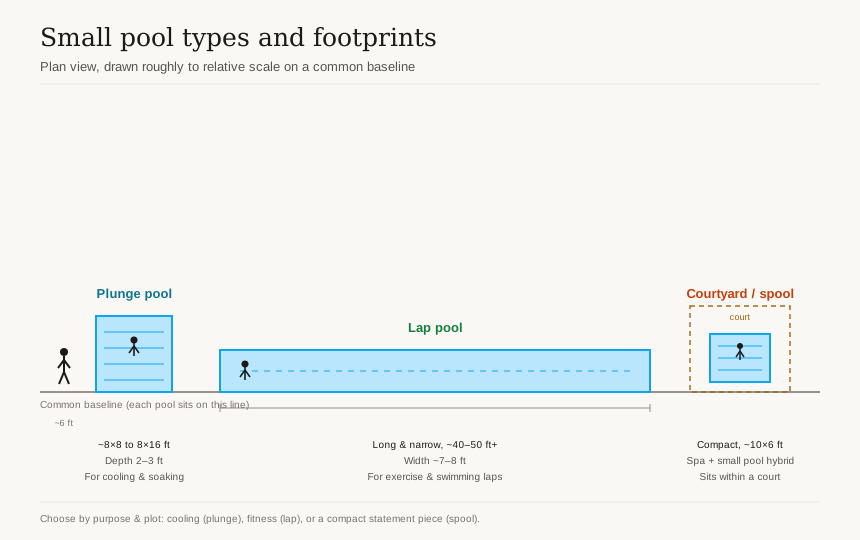
A plunge pool is the workhorse of compact design. Footprints commonly run from about 8x8 ft up to roughly 8x16 ft, with a shallow depth of around 2 to 3 ft. That depth is enough to sit, wade, cool down and let children splash, but not enough to swim in. A plunge pool is about relief from the heat, not exercise, and once you accept that, it becomes the most space-efficient water feature you can build.
A lap pool is the opposite philosophy. It is long and narrow, often 50 ft or longer but only 6 to 8 ft wide, designed so an adult can swim continuous lengths for exercise. A lap pool needs length, so it suits a long side margin or a slim strip running down one edge of a plot. If your goal is fitness rather than lounging, a lap pool is the small-footprint answer, but be clear that "small" here means narrow, not short.
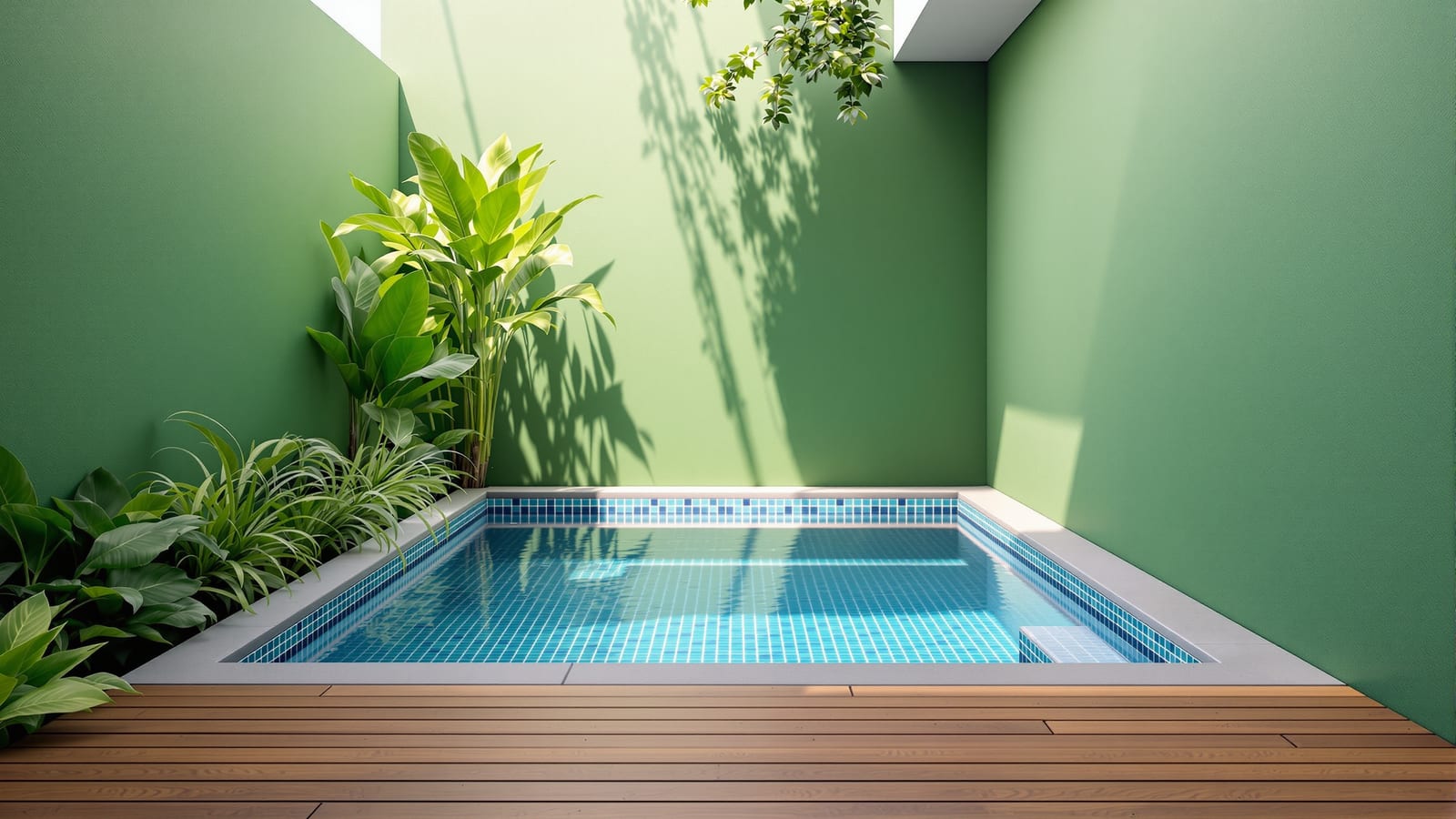
A courtyard pool is less a type than a placement. It is usually a plunge-sized pool set inside an internal courtyard so the water becomes the visual and thermal heart of the home, cooling the air that moves through surrounding rooms. Indian vernacular architecture has used central water for centuries, and a courtyard pool is a modern continuation of that logic.
A "spool" is the hybrid that has become a buzzword: a small pool crossed with a spa. It is roughly plunge-sized but often includes jets and seating, so it works as a cold plunge in summer and a warm soak in winter. For families who want a bit of both, a spool packs a lot into a tiny footprint.
How small can you go
The practical floor depends on what you want from the water.
For a plunge pool, many homeowners are happy with something around 8x8 ft, and a 12x6 ft plunge is a popular compact rectangle that fits a narrow courtyard while still giving two adults room to sit and stretch out. Depth of 2.5 to 3 ft is usually plenty; going deeper adds water, weight, cost and a safety concern around children without buying you any real benefit in a pool you are not diving into.
For a lap pool, the constraint flips to length. To genuinely swim, you want as close to 50 ft as your plot allows; below about 40 ft you start touching the wall on every stroke, which works for tethered "swim against a current" setups but not for natural lengths. Width can stay tight at 6 to 8 ft.
A useful early step is to put real numbers to your idea. Sketch a rectangle that fits your site, then use the Pool Volume Calculator to see how much water it holds. Volume drives almost everything downstream: fill cost, treatment, pump sizing and, critically for elevated pools, weight.
Where it fits: courtyard, side-setback, terrace
A courtyard is the most rewarding home for a small pool. The water is sheltered, private and visible from the living spaces around it, and it cools the courtyard air. If you are designing a new home, reserving the central court for a plunge pool is one of the highest-impact moves you can make.
A side setback is the unsung hero of Indian plots. That narrow strip between the house wall and the boundary, often three to five feet wide, is exactly the proportion a lap pool or a slim plunge wants. You are converting otherwise wasted regulatory space into something usable.
A terrace or roof is the most ambitious option and the one that demands the most respect. A rooftop plunge pool with the city or sky around it is a genuinely beautiful idea, and it is achievable, but only with proper structural engineering. That is the subject of the next section, and it is not optional reading.
Rooftop and terrace pools: the structural reality
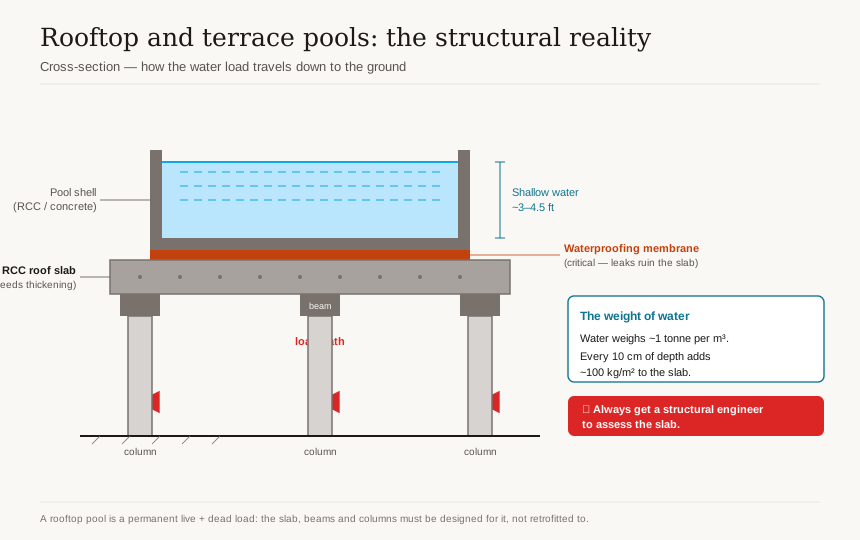
Here is the fact that governs everything about elevated pools: water is heavy. Water weighs about one tonne per cubic metre. In practical terms, every 10 cm of water depth adds roughly 100 kg over every single square metre of pool floor. The water does not care that the pool is "small."
Work through a realistic example. A modest rooftop plunge of about 3 m by 2 m, filled to 1 m deep, holds 6 cubic metres of water, which is about 6 tonnes, before you add the weight of the pool shell, the surrounding deck, the people in it and the equipment. Six tonnes is a serious load to land on a slab that was very likely designed only to carry a terrace, a water tank and foot traffic.
This is why rooftop pools are kept deliberately shallow, typically around 3 to 4.5 ft. Less depth means less water, which means less weight, which means a load the structure has a fighting chance of carrying.
But "shallower" is not the same as "safe by default." A terrace pool needs a professional structural assessment. An engineer has to confirm that the existing slab, beams, columns and foundations can carry the new load, or design reinforcement so they can. The load has to be carried down through columns and walls to the foundation, not simply dumped on a slab that was never intended for it. This is not a place for a contractor's confident guess or a "we have done many of these" reassurance. Before you commit to any elevated pool, find a structural engineer or contractor and get the slab assessed in writing. If the answer is that the structure cannot take it without expensive reinforcement, that is the system working, not bad news.
Waterproofing a small or elevated pool
For any pool, but especially an elevated one, waterproofing is the critical failure mode. A pool that leaks is not just losing water; on a terrace it is sending water into the slab, the rooms below, the steel reinforcement and the walls. Leakage is the single most common and most damaging thing that goes wrong with rooftop pools, and it is almost always a waterproofing failure rather than a structural collapse.
The defences are layered, and good projects use more than one. A well-built reinforced concrete shell is the first line. Many elevated pools add a second waterproof slab beneath the pool so that if the primary surface ever weeps, there is a captive layer that catches it rather than the living-room ceiling. Membrane systems, applied liquid or sheet membranes bonded to the shell, form a continuous waterproof skin. For weight-sensitive terraces, a lighter reinforced-PVC liner can replace some of the heavy concrete mass while still holding water reliably; it both reduces dead load and acts as the waterproof layer in one.
The principle to hold onto: never treat waterproofing as a finishing-stage afterthought to be squeezed on budget. On a rooftop pool it is the difference between a feature and a slow disaster, and it is far cheaper to over-specify it now than to chase a leak through a finished slab later.
What small pools cost
Treat all of these as indicative 2026 ranges, because the real number swings with your city, your soil, your finishes and your site access. For a compact pool of roughly 10x10 ft, a vinyl-lined pool runs about ₹1.5 to 2.5 lakh, a fibreglass shell about ₹2 to 3.5 lakh, and a poured concrete pool about ₹3 to 5 lakh. A smaller 12x6 ft plunge pool holds less water and less shell, so it typically lands at or below these figures.
The construction method shapes both cost and what is possible. Fibreglass and prefab shells suit small spaces and fast installs, because the shell arrives largely made and drops in, which is a real advantage on a cramped urban site with awkward access. Concrete costs more and takes longer but lets you build any custom shape, which matters when you are fitting a pool into an irregular courtyard or an odd side margin.
Elevated pools carry an extra cost line that ground pools do not: the structural assessment, any slab reinforcement, and the heavier waterproofing specification. Budget for it honestly rather than discovering it mid-project.
For a figure tuned to your own dimensions and finish, run the numbers through the Pool Cost Calculator, and read swimming pool cost in India for the fuller cost picture including running and maintenance costs.
Making a small pool feel bigger
A small pool wins or loses on design, and a few moves make a compact rectangle of water feel generous.
Push the water to the edge. An infinity or slot edge on at least one side removes the visual boundary and makes the pool read as larger than its footprint. Keep the coping and surround in a single continuous material so the eye is not chopped up by borders. Use a dark interior finish, which makes the water look deeper and more reflective and turns it into a mirror for the sky and surrounding planting.
Light it well. A small pool that glows at night becomes the centrepiece of the whole home, which is when most of us actually use it. Surround it with greenery, since a wall of plants on one side gives a tiny pool a sense of depth and privacy that hard walls cannot. And integrate seating into the pool itself, a submerged ledge or bench, so the small footprint does double duty as both pool and lounge.
For visual references and finishes that suit compact pools, browse pool design ideas before you finalise anything with your contractor.
Plan yours
A small pool is the most realistic way for most Indian homeowners to bring water home, whether it is a plunge in the courtyard, a lap pool down the side margin, or a shallow plunge on the terrace. The path is the same for all of them: settle on the size and depth you actually need, price it honestly as an indicative range, and, if it is going up on a roof or terrace, get a structural engineer to sign off on the slab before anything else.
Start by sizing your idea with the Pool Volume Calculator, put a budget to it with the Pool Cost Calculator, and when you are ready to build, especially anything elevated, find a structural engineer or contractor you trust.
Export this guide
Related Guides — Deep-dive reading
Soaking Tub India: Deep Japanese-Style Ofuro Baths, Geyser Sizing, Load & Real Costs (2026)
Why a deep soaking tub gives a full-immersion soak from a small footprint — ofuro ergonomics, the extra-deep water line, how much hot water and geyser capacity you actually need, heat-retention materials, the structural load of a filled tub, and honest rupee ranges for an Indian home.
BathroomsThe Homeowner's Guide to Compound Walls and Gates in India (2026)
A plain-language, start-to-finish walkthrough of building a boundary wall and gate in India — plan and permit first, then material and height, foundation and structure, building and supervision, the gate, finishes, lighting and greenery, budget and long-term upkeep — with a stage-by-stage roadmap, a full planning checklist and answers to the questions every homeowner asks.
Compound WallsCompound Wall Cost in India: Materials, Labour and What Drives the Price (2026)
An honest, indicative cost-literacy guide to what a boundary wall really costs in India — why the price swings so much (material first, then height, foundation, finish, gate and site), the full cost stack most people forget, how the wall is measured, and where to trim without cutting the wrong corner. Relative bands, not quotes — get local numbers.
Compound WallsRelated Tools — Try Free
Rainwater Tank Sizer
How big should your rainwater tank be? Computes annual harvest, recommended tank capacity in litres, water-bill savings, and payback — for 10 Indian cities.
RWH CalculatorSwimming Pool Cost Calculator
Estimate a home pool's build cost by type, size and finish, with an indicative range and a build breakdown.
Pool CalculatorFalse Ceiling Cost Estimator
Live ₹/sqft across 8 ceiling types — POP, gypsum, designer, metal, PVC, wooden — with cove and spot lighting for 20 Indian cities.
Cost Calculator